
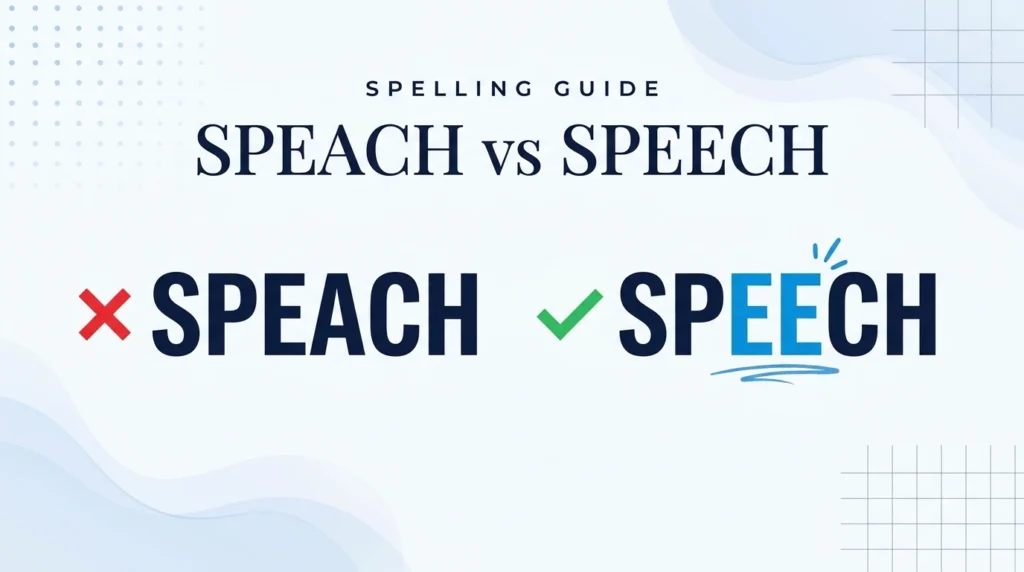

The correct spelling is speech, not speach. Speech is a standard English noun that means spoken communication, the ability to speak, or a formal talk given to an audience. Speach is a misspelling, not an accepted alternative in standard modern English. Whether you are writing a school assignment, preparing a presentation, sending a business email, or discussing speech therapy, always use speech.
What Is the Difference Between Speach and Speech?
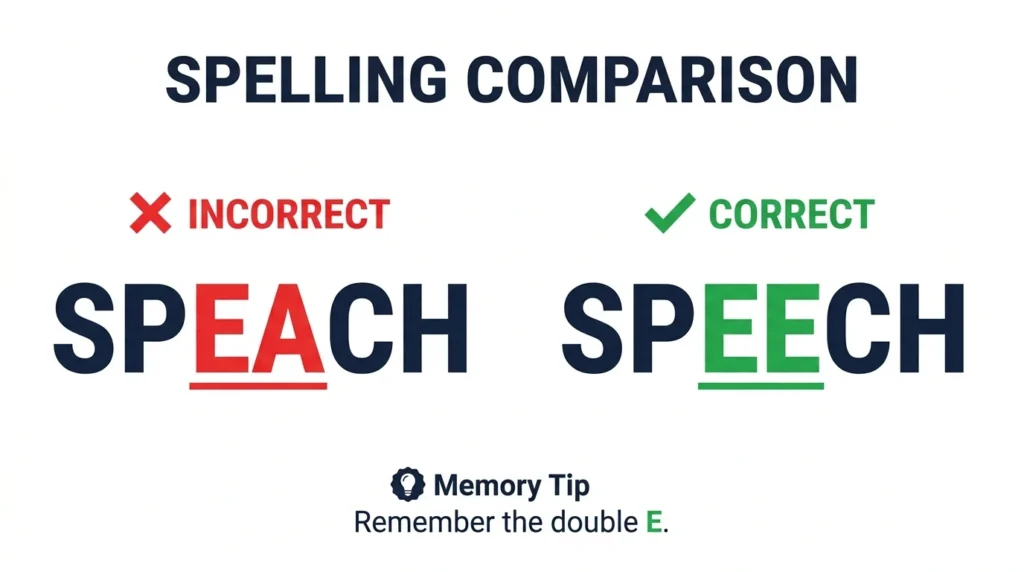
The difference between speach and speech is spelling. Only speech is correct in standard English.
| Word | Correct spelling? | Meaning |
|---|---|---|
| Speech | Yes | Spoken communication, the ability to speak, or a formal talk |
| Speach | No | A common misspelling of speech |
For example:
- Correct: The student prepared a speech about climate change.
- Incorrect: The student prepared a speach about climate change.
Both sentences are intended to communicate the same idea, but only the first uses standard spelling.
You do not need to choose between these forms based on meaning, tone, or context. When you mean spoken communication or a formal talk, the correct spelling is always speech.
What Does Speech Mean?
Speech has several related meanings. Understanding them helps you use the word naturally in different situations.
Speech as spoken communication
Speech can refer to the act or ability of communicating through spoken words.
Examples:
- Speech is an important part of human communication.
- The child is developing speech and language skills.
- The noise made it difficult to understand her speech.
- Clear speech helps people communicate their ideas.
In these examples, speech refers to speaking or the way spoken words are produced and understood.
Speech as a formal talk
Speech can also mean a prepared talk delivered to an audience. These talks are common at schools, workplaces, public events, and official ceremonies.
Examples:
- The principal gave a speech at the graduation ceremony.
- Her speech encouraged the students to work harder.
- The manager delivered a speech about the company’s future.
- I need to write a speech for tomorrow’s event.
In this sense, the word often appears with verbs such as give, deliver, prepare, write, and make.
Speech as a person’s manner of speaking
Speech can describe how someone speaks, including their clarity, style, or distinctive way of expressing words.
Examples:
- His speech was clear and easy to understand.
- The actor changed his speech to match the character.
- The therapist assessed the patient’s speech.
- Her speech became slower when she felt nervous.
The meaning depends on the sentence, but the spelling remains unchanged in every case.
Why Does the Correct Spelling Matter?
A single spelling mistake may not prevent someone from understanding your message, but it can affect how polished your writing appears.
Consider where the word speech commonly appears:
- School assignments: A misspelling in an essay or presentation can cost marks.
- Professional emails: Correct spelling helps maintain a professional impression.
- Public speaking: A presentation title such as My Graduation Speech should use the standard form.
- Academic writing: Terms such as speech development and freedom of speech require the correct spelling.
- Online publishing: Correct spelling helps readers find and understand your content.
Imagine sending a client a document titled Annual Meeting Speach. The reader will probably understand what you mean, but the mistake may make the document look less carefully prepared.
Correcting it to Annual Meeting Speech takes only a moment.
The goal is not to make every sentence complicated or overly formal. It is to express your ideas clearly while avoiding preventable errors.
The Core Rule: Always Write Speech
The spelling rule
Write speech, with ee in the middle.
- Correct: speech
- Incorrect: speach
- Correct plural: speeches
- Related verb: speak
There is no standard British-versus-American spelling difference for this word. The same spelling applies in everyday writing, formal documents, academic work, and professional communication.
When you are unsure, remember this simple sequence:
- Identify the word you want to use.
- Check that the middle contains ee, not ea.
- Read the entire sentence to confirm that speech fits the meaning.
This small habit can help you avoid the error before submitting or publishing your writing.
How to Use Speech Correctly
The easiest way to learn a word is to see it in natural sentences and familiar expressions.
Use speech when talking about public speaking
Use speech when someone prepares or delivers a talk to an audience.
Examples:
- She gave a speech at her sister’s wedding.
- The candidate delivered a speech during the campaign.
- We are preparing speeches for the school competition.
- His opening speech impressed the audience.
Notice that the word does not change when the speaker, audience, or occasion changes.
Use speech when discussing communication
Use speech when referring to spoken language or the ability to speak.
Examples:
- The teacher encouraged the children to practise their speech.
- The doctor asked about the patient’s speech.
- The device converts text into speech.
- The course focuses on speech and communication skills.
In medical and educational contexts, speech is also used in established terms such as speech therapy and speech development.
Use speech in common English expressions
Several familiar expressions contain the word speech.
| Expression | Meaning | Example |
|---|---|---|
| Freedom of speech | The right to express opinions through speech | Freedom of speech is an important public issue. |
| Figure of speech | An expression used in a nonliteral or distinctive way | “Time is money” is a figure of speech. |
| Parts of speech | Categories of words based on their grammatical roles | The class studied the parts of speech. |
| Speech therapy | Support for speech and communication difficulties | He attends speech therapy every week. |
| Direct speech | The exact words spoken by someone | The teacher explained direct speech. |
| Public speech | Speaking before an audience | She is learning public speech techniques. |
The correct spelling is speech in every expression.
Understand speech and speeches
Speech is a singular noun when referring to one talk or to speaking in general. When referring to multiple formal talks, its usual plural is speeches.
Examples:
- The speech was inspiring.
- The students prepared three speeches.
- Public speech requires practice.
- Each speaker delivered a different speech.
Do not write speachs or speaches. The standard plural is speeches.
Correct Examples of Speech in Everyday Writing
These examples show how to use speech across different situations.
Conversation
- “Did you finish writing your speech for tomorrow?”
- “Her speech was so clear that everyone understood her message.”
- “Please send me the final version of your speech before Friday.”
- “I have attached the speech for your review.”
School and college
- “Our English teacher asked us to prepare a speech about environmental protection.”
- “The winning speech received a standing ovation.”
Workplace
- “The director will deliver a speech at the annual meeting.”
- “Please check the speech for spelling errors before the event.”
Social media
- “I was proud to deliver my first speech in front of such a large audience.”
- “A powerful speech can inspire people to take action.”
Academic writing
- “The researcher examined how speech develops during childhood.”
- “The essay discusses the relationship between speech and language.”
Public events
- “The guest speaker gave a memorable speech at the ceremony.”
- “Her farewell speech brought tears to many people’s eyes.”
Every example uses the same spelling: speech. None requires the form speach.
Incorrect vs. Correct: Common Spelling Mistakes
The following table shows common mistakes and explains how to correct them.
| ❌ Incorrect | ✅ Correct | Why |
|---|---|---|
| She gave a speach. | She gave a speech. | Speech is the standard spelling. |
| Write your speach carefully. | Write your speech carefully. | The noun requires ee in the middle. |
| I prepared a speach for school. | I prepared a speech for school. | The incorrect form is not a standard alternative. |
| His speach was inspiring. | His speech was inspiring. | The word retains the same spelling in this context. |
| The manager delivered a speach. | The manager delivered a speech. | Formal talks are called speeches or a speech, depending on number. |
| We listened to three speaches. | We listened to three speeches. | The correct plural is speeches. |
| She needs speach therapy. | She needs speech therapy. | The established expression uses speech. |
| Freedom of speach matters. | Freedom of speech matters. | This common expression uses the standard spelling. |
| Identify the parts of speach. | Identify the parts of speech. | The grammatical term is parts of speech. |
| That is a figure of speach. | That is a figure of speech. | The established expression uses speech. |
| The speach was uploaded online. | The speech was uploaded online. | The spelling does not change in digital contexts. |
| He is preparing his graduation speach. | He is preparing his graduation speech. | The noun is spelled speech regardless of the occasion. |
The lesson is straightforward: changing ea to ee corrects the spelling, but remember to use speeches when the plural form is needed.
Why Do People Confuse Speach and Speech?
The mistake is understandable. English spelling contains patterns that overlap, and the letters people expect to hear are not always the letters they need to write.
1. Pronunciation can be misleading
Speech is pronounced /spiːtʃ/. The symbol /iː/ represents the long “ee” vowel sound.
Because English uses different letter combinations to represent similar sounds, a learner might choose ea instead of ee.
Compare:
- Speech
- Teach
- Reach
- Beach
- Team
The letters ea represent the same long vowel sound in several of these words, so the incorrect spelling may look plausible. However, similar pronunciation does not mean two words must follow the same spelling pattern.
2. English spelling is not perfectly predictable
English spelling reflects different historical influences and patterns. You cannot reliably determine the spelling of every word simply by listening to it.
For example, the long “ee” sound appears in see, team, piece, and speech. Each word uses a different spelling pattern.
That is why learning familiar word forms matters.
3. The related word speak may cause confusion
Speak and speech are closely related in meaning, but they serve different grammatical roles.
- Speak: a verb meaning to say words or communicate orally.
- Speech: a noun referring to spoken communication or a formal talk.
- Speaker: a person who speaks or delivers a talk.
- Speaking: the act of communicating orally.
A writer may assume that related words should follow the same spelling pattern. English word families do not always work that way.
4. Autocorrect cannot replace proofreading
Spellcheckers can catch many spelling errors, but their suggestions depend on the software, settings, and context.
A tool may flag speach, yet you should not rely on automatic correction alone. A quick review of the final document is still worthwhile, especially before submitting an assignment or sending an important email.
5. Translation can influence spelling
English learners sometimes transfer spelling expectations from another language into English. If the spelling conventions of a learner’s first language differ from English, choosing letters based on sound may seem reasonable.
The solution is to learn common English word forms through reading, practice, and repeated exposure rather than assuming that pronunciation determines spelling.
Common Mistakes Checklist
Use this checklist whenever you write the word.
- Writing speach instead of speech. The two forms look similar, but only speech is standard English. Remember the double e.
- Writing speaches as the plural. The correct plural is speeches. Learn the singular and plural together.
- Assuming British English uses speach. It does not. Both British and American English use speech.
- Confusing speech with speak. Use speak for the action of communicating orally and speech for the noun.
- Trusting pronunciation alone. Several spellings can represent similar sounds. Check the written form when uncertain.
- Overlooking mistakes in headings. Titles such as My First Speech deserve the same proofreading as the main text.
- Assuming autocorrect catches everything. Review important writing manually instead of relying entirely on software.
A simple final check is to search your document for speach before publishing it. If you intended the ordinary English word, replace the misspelling with speech or speeches, depending on the sentence.
Speech in Real English
Understanding a correct spelling is only the first step. You should also know whether a word is grammatically correct, natural in everyday English, or technically possible but unsuitable for the intended meaning.
Grammatically correct
Speech is a grammatically correct noun in sentences such as “She delivered a speech” and “Speech is essential to human communication.” Both sentences follow standard English grammar. The first refers to a particular talk; the second refers to spoken communication in general. The spelling remains speech regardless of whether the sentence is conversational, academic, or professional.
Grammatically possible but unnatural
A sentence can be grammatically possible yet sound unusual because of its word choice or context. For example, “I performed a speech” may be understandable, but “I gave a speech” or “I delivered a speech” is generally more natural when describing a formal talk. This is a question of collocation, meaning which words commonly occur together, rather than a difference between speech and speach.
Natural, everyday English
English speakers commonly say “give a speech,” “write a speech,” “prepare a speech,” and “deliver a speech.” For example, “I’ve got to write a speech for Monday” sounds natural in everyday conversation. In contrast, speach is not a natural alternative spelling. If you mean the ordinary English noun, use speech in both casual messages and formal documents.
American vs. British English
There is no spelling difference between American and British English for this word. Both varieties use speech and speeches.
| Feature | American English | British English |
|---|---|---|
| Singular | speech | speech |
| Plural | speeches | speeches |
| Formal talk | give a speech | give a speech |
| Communication support | speech therapy | speech therapy |
| Common expression | freedom of speech | freedom of speech |
Some words have recognized regional spelling differences, such as color/colour and center/centre. Speech is not one of them.
Whether you are writing for a US university, a UK employer, an international audience, or an English examination, use speech.
Formal vs. Informal Usage
The word speech is appropriate in both formal and informal English. What changes is the surrounding language and the situation in which you use it.
| Context | Example | Why it fits |
|---|---|---|
| Casual conversation | “I need to write a speech for tomorrow.” | Direct and conversational |
| School assignment | “The students prepared a speech on climate change.” | Clear and appropriate for education |
| Business meeting | “The CEO delivered a speech outlining the company’s plans.” | Professional and precise |
| Academic writing | “The study examines speech development in children.” | Suitable for research and analysis |
| Official ceremony | “The president delivered the opening speech.” | Appropriate for a formal event |
There is no informal spelling such as speach. Casual writing may use contractions or shorter sentences, but it does not change the standard spelling of the word.
Speech vs. Similar and Confusing Words
The following comparison helps you distinguish speech from related terms that appear in writing about communication.
| Word | Part of speech | Meaning | Example |
|---|---|---|---|
| Speech | Noun | Spoken communication or a formal talk | Her speech was inspiring. |
| Speak | Verb | To communicate orally | Please speak clearly. |
| Speaker | Noun | Someone who speaks or presents | The speaker answered questions. |
| Speaking | Noun or verb form | The act of communicating orally | Public speaking requires practice. |
| Spoken | Past participle or adjective | Expressed in spoken words | English is widely spoken. |
| Language | Noun | A system used to communicate | Language connects people. |
| Conversation | Noun | An exchange of ideas through communication | We had a long conversation. |
The main distinction is grammatical: speak describes an action, while speech names communication or a particular talk. Learning the role of each word can help you choose the correct one when building a sentence.
An Easy Memory Trick for Speech
Remember this sentence:
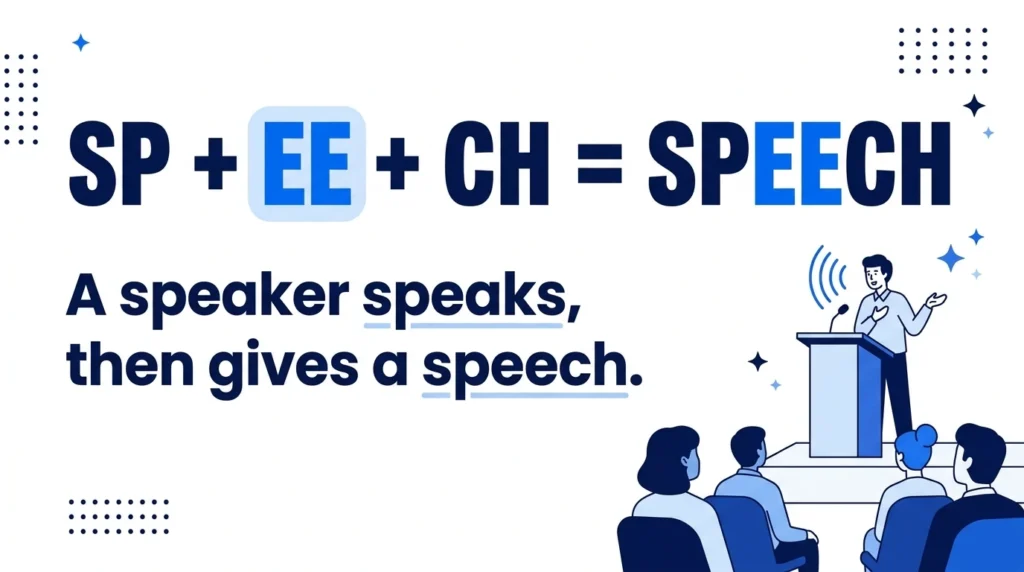
“A speaker speaks, then gives a speech.”
The phrase connects three related words and reinforces the spelling of speech.
You can also divide the word visually:
SP + EE + CH = SPEECH
Focus on the two e letters in the middle. Do not substitute ea, even though that combination produces the same vowel sound in many other English words.
Try writing the word three times while saying the memory sentence aloud:
- Speech
- Speech
- Speech
Then use it in a sentence of your own, such as “I will prepare a speech for the meeting.”
A word becomes easier to spell when you repeatedly see, write, and use its correct form.
Read More: Honor vs Honour: The Spelling Difference Explained.
Speech in Real-Life Situations
At a job interview
A candidate says, “I prepared a speech about my professional achievements.”
The spelling is correct, but depending on the interview format, a short presentation about my professional achievements might describe the task more precisely. The best word depends on what the candidate is expected to deliver.
In a school examination
A question asks students to write a speech about protecting the environment.
A student writes the heading A Speech on Environmental Protection. This is correct. Writing A Speach on Environmental Protection would introduce an avoidable spelling error.
In a business email
A manager writes, “Please review the speech before the annual meeting.”
The sentence is clear and professional. The reader understands which document needs reviewing, and the word speech is spelled correctly.
In a text message
Someone texts, “I have to finish my speech tonight!”
This is natural informal English. The exclamation mark makes the message more expressive, but the spelling remains the same as in formal writing.
At a public event
A host announces, “Please welcome our guest speaker for the opening speech.”
Both speaker and speech are correctly used. The first identifies the person; the second identifies the talk.
Expert Tips for Remembering the Correct Spelling
These practical habits can make spelling errors less frequent.
- Learn complete phrases. Remember give a speech, write a speech, and speech therapy rather than memorizing the word in isolation.
- Notice the spelling in books and articles. Reading correct examples reinforces the standard form.
- Learn related words together. Connect speak, speaker, speaking, and speech while remembering that each has its own spelling.
- Proofread headings separately. Titles are often overlooked because writers focus on the main text.
- Use spellcheck as a backup. Treat automatic correction as assistance, not a substitute for reviewing your writing.
- Keep a personal error list. If you repeatedly type speach, add speech to a short list of words to practise.
- Check the plural too. Remember the pair speech → speeches so that correcting the singular does not leave a plural error behind.
The most useful habit is to pause briefly whenever a familiar word looks uncertain. Checking it once is faster than allowing the same mistake to appear throughout a document.
Read More: Eying vs Eyeing: Which Spelling Is Correct?
Frequently Asked Questions
1. Is it speach or speech?
Speech is correct. Speach is a misspelling in standard English. Use speech when referring to spoken communication, the ability to speak, or a formal talk delivered to an audience.
2. Is speach ever an acceptable spelling?
Not as the standard spelling of the ordinary English word. You may encounter speach in usernames, brand names, or other special contexts, but these do not make it an accepted alternative spelling of speech.
3. What is the plural of speech?
The plural is speeches. For example: “The students prepared their speeches for the competition.” Do not write speachs or speaches.
4. How do you pronounce speech?
Speech is pronounced /spiːtʃ/, with a long “ee” vowel sound. It rhymes with words such as teach and beach. The pronunciation does not change the standard spelling.
5. Is speech a noun or a verb?
Speech is primarily a noun. It refers to spoken communication or a formal talk. The related verb is speak, as in “Please speak clearly.”
6. Why is speech spelled with ee instead of ea?
English spelling does not follow a single predictable rule for every vowel sound. Although ea represents the long “ee” sound in words such as teach and reach, the established spelling of this word is speech.
7. Is speech spelled the same way in the UK and the US?
Yes. British and American English both use speech. The plural is speeches in both varieties, so no regional spelling adjustment is necessary.
8. Which is correct: a speech or speech?
Both can be correct, depending on the meaning. Use a speech for one particular talk, as in “She delivered a speech.” Use speech without an article when referring to speaking generally, as in “Speech is an important form of communication.”
9. Is speech therapy the correct expression?
Yes. Speech therapy is the standard expression for professional support addressing speech and related communication difficulties. Speach therapy is a misspelling.
10. How can I stop making this spelling mistake?
Remember the pattern SP + EE + CH. Practise the word in phrases such as give a speech and write a speech. If the mistake persists, use spellcheck and review your writing before submitting or publishing it.
Mini Quiz: Test Your Knowledge of Speech vs. Speach
Complete these 10 questions to check whether you can identify the correct spelling and use the word naturally.
| No. | Question | Answer and explanation |
|---|---|---|
| 1 | Choose the correct spelling: (A) Speach (B) Speech | Answer: B — Speech. It is the standard English spelling. |
| 2 | She gave a short _____ at the ceremony. | Answer: speech. The sentence refers to a formal talk. |
| 3 | Correct this sentence: “I wrote a speach for my teacher.” | Answer: “I wrote a speech for my teacher.” Replace speach with speech. |
| 4 | What is the correct plural of speech? (A) Speachs (B) Speaches (C) Speeches | Answer: C — Speeches. The plural form ends in -ches. |
| 5 | True or false: British English uses speach, while American English uses speech. | Answer: False. Both varieties use speech. |
| 6 | Choose the correct expression: (A) Freedom of speach (B) Freedom of speech | Answer: B — Freedom of speech. This established expression uses the standard spelling. |
| 7 | Fill in the blank: Please _____ clearly during the presentation. | Answer: speak. Speak is the verb; speech is the noun. |
| 8 | Correct this sentence: “The students prepared two speaches.” | Answer: “The students prepared two speeches.” The plural is speeches. |
| 9 | Which sentence is more natural when describing a formal talk? (A) She gave a speech. (B) She performed a speech. | Answer: A — She gave a speech. Give a speech is a common, natural expression. |
| 10 | Fill in the blank: The child is receiving _____ therapy. | Answer: speech. The standard expression is speech therapy. |
Quick Summary
The correct spelling is speech, not speach. Speech is a noun that refers to spoken communication, the ability to speak, or a formal talk delivered to an audience. The word is used in expressions such as give a speech, freedom of speech, figure of speech, and speech therapy. Its correct plural is speeches, while the related verb is speak. Both American and British English use the same spelling, so there is no regional difference to remember. The easiest memory trick is SP + EE + CH = SPEECH. Whenever you are unsure, remember the double e, check your sentence, and proofread your writing before submitting or publishing it.