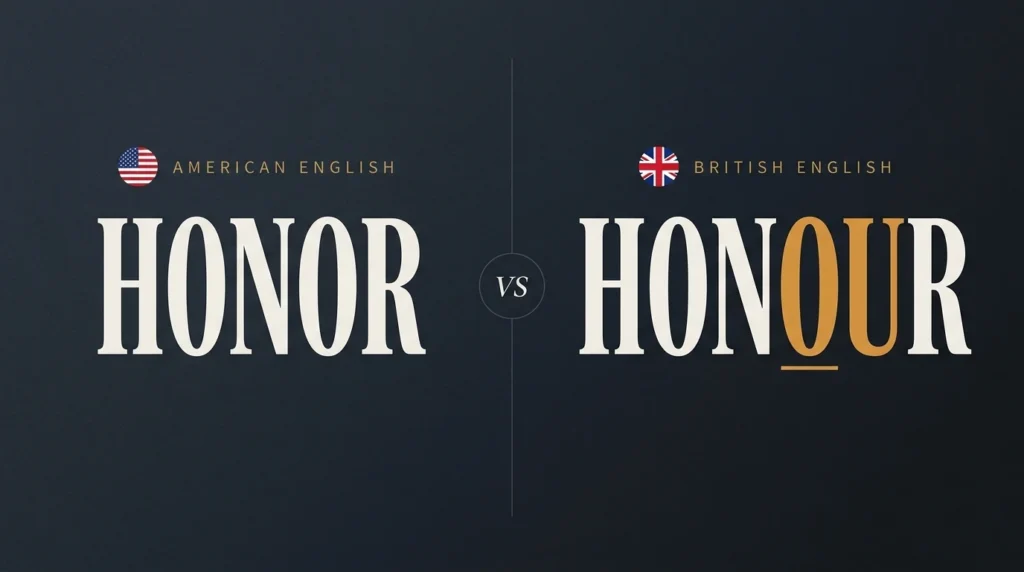

Honor and honour are both correct spellings of the same English word. The difference is regional: honor is the standard American English spelling, while honour is the standard British English spelling. Both mean to show respect, recognize someone’s achievements, or regard something as important. The correct choice depends on your audience and the English spelling system you are following. If you write for an American audience, use honor. If you follow British English, use honour.
What Is the Difference Between Honor and Honour?
The difference between honor and honour is spelling, not meaning or pronunciation.
Both words can function as nouns or verbs.
As a noun, the word refers to respect, honesty, a strong sense of moral duty, or a special recognition given to someone.
As a verb, it means to show respect, recognize an achievement, or fulfill a promise or commitment.
Here is the main distinction:
- Honor: American English spelling.
- Honour: British English spelling, also used in many other varieties of English, including Canadian and Australian English.
For example:
- American English: It was an honor to meet the president.
- British English: It was an honour to meet the president.
Both sentences are correct. The spelling changes, but the meaning stays the same.
Why Does the Difference Matter?
Choosing between honor and honour matters when you want your writing to follow a consistent English spelling standard.
The difference is especially important in professional, academic, and public-facing writing. Using both forms in the same document can make your work look inconsistent, even though neither spelling is inherently incorrect.
Consider these situations:
- Job applications: Follow the spelling conventions used by the employer or in the country where you are applying.
- Academic assignments: Use the English variety required by your institution or style guide.
- Business emails: Match the spelling convention used by your organization and intended audience.
- Websites and blogs: Choose a spelling standard that fits your target readers and apply it consistently.
- Formal speeches: Use the spelling convention appropriate to your audience in written scripts and supporting materials.
The key is not to memorize one spelling as correct and the other as wrong. Learn which variety of English you are using.
Read More: Eying vs Eyeing: Which Spelling Is Correct?
The Core Rule: Honor or Honour?
Use honor in American English and honour in British English. Both spellings are correct.
| English variety | Correct spelling | Example |
|---|---|---|
| American English | Honor | It is an honor to serve. |
| British English | Honour | It is an honour to serve. |
| Canadian English | Honour is generally standard | It was a great honour. |
| Australian English | Honour is standard | She received an honour. |
| International writing | Follow your chosen standard | Be consistent throughout. |
Canadian and Australian English generally follow the -our spelling in words such as honour, although official names, quotations, publications, and organization-specific styles may differ.
How to Use Honor and Honour
When to Use Honor
Use honor when writing in American English. It is appropriate for everyday communication, formal documents, education, business, and journalism.
Examples include:
- It is an honor to work with such a talented team.
- The university will honor its outstanding graduates.
- She received the Medal of Honor.
- We must honor the agreement we signed.
American English also uses the spelling in related words such as honorable, honorary, and honorably.
When to Use Honour
Use honour when writing in British English or another variety that follows the traditional -our spelling.
Examples include:
- It is an honour to welcome our guests.
- The school will honour the achievements of its students.
- He kept his word because he valued his honour.
- The ceremony was held in honour of the volunteers.
Related British spellings include honourable, honourary is not the standard form, and honourably. The correct standard spelling for the related word meaning “given as an honour” is honorary in American English and honorary in British English as well.
Honor and Honour as Nouns
A noun names a person, place, thing, quality, or idea. Both spellings can refer to respect, integrity, recognition, or a privilege.
Examples:
- Winning the scholarship was a great honor.
- Winning the scholarship was a great honour.
- He defended his honor during the investigation.
- She received the highest honour awarded by the institution.
The correct form depends on the spelling standard, not on whether the word is a noun.
Honor and Honour as Verbs
A verb describes an action or state. Both spellings can mean to respect someone, recognize an achievement, or fulfill an obligation.
Examples:
- We honor the people who helped us.
- We honour the people who helped us.
- The company honored its promise. (American English)
- The company honoured its promise. (British English)
The spelling distinction remains the same whether the word functions as a noun or a verb.
Correct Examples of Honor and Honour
The following examples show how the words appear in different settings.
| Context | American English | British English |
|---|---|---|
| Everyday conversation | It is an honor to meet you. | It is an honour to meet you. |
| Business email | We would be honored to work with you. | We would be honoured to work with you. |
| Education | She graduated with honors. | She graduated with honours. |
| Workplace | The company will honor the agreement. | The company will honour the agreement. |
| Social media | It is an honor to share this achievement. | It is an honour to share this achievement. |
| Academic writing | The award is an honor for the department. | The award is an honour for the department. |
| Public ceremony | We honor our community leaders. | We honour our community leaders. |
| Personal values | He acted with honor. | He acted with honour. |
| News reporting | The city will honor the volunteers. | The city will honour the volunteers. |
| Formal invitation | It would be an honor to attend. | It would be an honour to attend. |
| Military recognition | She received a Medal of Honor. | The organization awarded him a military honour. |
| Keeping a promise | We will honor our commitment. | We will honour our commitment. |
These examples illustrate the usual spelling conventions. Official award names, institutional titles, and quoted material should retain their established spelling.
Incorrect vs. Correct: Common Honor and Honour Mistakes
Neither spelling is universally wrong. In this table, “incorrect” means inconsistent with the English variety specified in the example.
| ❌ Incorrect for the stated variety | ✅ Correct | Why |
|---|---|---|
| American: It is an honour to meet you. | American: It is an honor to meet you. | American English generally uses honor. |
| British: It is an honor to meet you. | British: It is an honour to meet you. | British English generally uses honour. |
| American: We will honour the agreement. | American: We will honor the agreement. | The American verb spelling omits the u. |
| British: We will honor the agreement. | British: We will honour the agreement. | The British spelling retains the u. |
| American: She graduated with honours. | American: She graduated with honors. | American English uses honors in this expression. |
| British: He acted with honor. | British: He acted with honour. | The British form retains the u. |
| American: The honored guest arrived. | American: The honored guest arrived. | This is already correct; the American spelling is honored. |
| British: The honored guest arrived. | British: The honoured guest arrived. | This is already correct; the British spelling is honoured. |
| American: It was an honor and a privilege. | American: It was an honor and a privilege. | This is already correct in American English. |
| British: It was an honour and a privilege. | British: It was an honour and a privilege. | This is already correct in British English. |
The last four rows deliberately include correct sentences. They demonstrate that spelling checks should assess the actual English variety and the word’s form rather than assume that every sentence containing honor or honour is wrong.
Why Do People Confuse Honor and Honour?
The Words Sound the Same
In standard usage, honor and honour are pronounced the same way. The additional letter u does not create a different spoken word, so pronunciation alone cannot help writers choose the spelling.
American and British Spellings Look Similar
Many English words follow the same pattern:
- Color / colour
- Favor / favour
- Labor / labour
- Neighbor / neighbour
- Behavior / behaviour
Once writers learn one pattern, they may apply it to a document intended for readers who follow another.
Spellcheckers Follow Different Settings
A spellchecker configured for American English may flag honour, while a British English checker may flag honor. That does not necessarily mean the flagged word is misspelled in every variety of English.
Check your language settings before accepting every suggested correction.
Read More: Labelling vs Labeling: Which Spelling Is Correct?
People Mix English Varieties
A writer may use honour in one paragraph and color in the next. This often happens when material comes from several sources, when a writer switches keyboards or software settings, or when editing is shared across teams.
The solution is to choose a spelling standard before editing the complete document.
Translation Can Add Confusion
Learners may translate the meaning of a word correctly but remain unsure about regional spelling. Because the two forms mean the same thing, translating the word does not tell you which spelling convention to follow.
When writing in English, identify your target audience first.
Common Mistakes Checklist
Use this checklist to avoid the most frequent errors.
- Treating one spelling as universally correct. Both are standard. Choose according to the English variety you are following.
- Switching spellings within one document. Mixing conventions can make professional writing appear poorly edited. Use one standard consistently.
- Changing official names. Do not alter the spelling of a medal, institution, title, or organization just to match your general style.
- Changing quoted material unnecessarily. Preserve the original spelling in direct quotations unless your editorial policy specifically permits changes.
- Assuming the noun and verb have different regional rules. Both honor and honour can be nouns or verbs. The regional spelling distinction applies to both.
- Forgetting related forms. American English uses honorable and honored; British English generally uses honourable and honoured.
- Trusting spellcheck without checking its language setting. A valid British spelling can be flagged by an American English checker, and vice versa.
- Using the spelling of a source without considering your audience. A British article may use honour, while your American publication requires honor. Follow your publication’s style.
Honor vs Honour in Real English
Grammatically Correct
Both honor and honour are grammatically correct spellings. Each can be used as a noun or verb, and both can appear in standard expressions such as in honor of, in honour of, honor a promise, and honour a promise. The choice depends on the regional spelling standard. Neither form is inherently more formal, more respectful, or more grammatically sophisticated than the other.
Grammatically Possible but Inconsistent
A sentence may be grammatically correct but look inconsistent within a document. For example, an American report that says “We honor our neighbors and support local colour festivals” mixes common American and British spelling conventions. The words may each be valid, but the inconsistency can distract readers. A careful editor would normally standardize the spelling unless the difference appears in a proper name or quotation.
Natural, Everyday English
American speakers and writers naturally use honor, while British, Australian, and many Canadian writers naturally use honour. The same applies to related forms such as honored/honoured and honors/honours. Neither spelling sounds more natural when spoken because the two forms are normally pronounced alike. For natural written English, the best choice is the spelling expected by your readers and the publication they are reading.
American vs. British English
The distinction between honor and honour is a genuine difference between American and British spelling conventions.
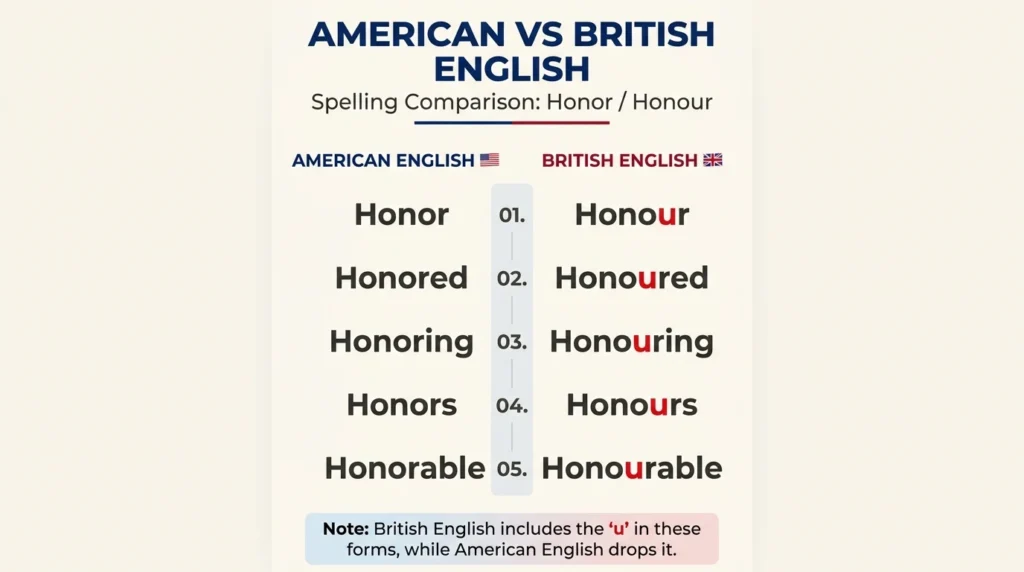
| Word form | American English | British English |
|---|---|---|
| Main word | Honor | Honour |
| Past tense | Honored | Honoured |
| Present participle | Honoring | Honouring |
| Related adjective | Honorable | Honourable |
| Recognition or distinction | Honors | Honours |
| Common expression | In honor of | In honour of |
American English often omits the u in this group of words, while British English retains it. However, related forms do not all follow the same pattern. For example, honorary is the standard spelling in both American and British English.
What About Canadian and Australian English?
Canadian and Australian English generally use honour, following the -our spelling pattern. Canadian usage can vary in some contexts because it combines British-derived and American-influenced conventions. Australian English generally follows British spelling conventions in this case.
For formal writing, follow the relevant organization’s style guide rather than assuming that every word follows one universal regional rule.
Formal vs. Informal Usage
There is no meaningful formal-versus-informal distinction between honor and honour. Both are suitable for casual conversation, emails, academic work, business documents, and formal speeches.
The spelling choice is regional rather than a matter of politeness or prestige.
For example:
- Casual American English: It was an honor to meet you.
- Formal American English: It is an honor to receive this award.
- Casual British English: It was an honour to meet you.
- Formal British English: It is an honour to receive this award.
The tone comes from the sentence and context, not from the presence or absence of the letter u.
Read More: Instalments vs Installments: Which Spelling Is Correct?
Honor vs Honour: Comparison Table
| Feature | Honor | Honour |
|---|---|---|
| Main spelling variety | American English | British English |
| Meaning | Respect, integrity, recognition, or fulfilling an obligation | The same |
| Noun | Yes | Yes |
| Verb | Yes | Yes |
| Pronunciation | Usually /ˈɑːnər/ in American English | Usually /ˈɒnə/ or /ˈɒnər/ depending on accent |
| Past tense | Honored | Honoured |
| Present participle | Honoring | Honouring |
| Related adjective | Honorable | Honourable |
| Suitable for formal writing | Yes | Yes |
| Universally wrong? | No | No |
Pronunciation varies across accents, and the phonetic forms above are broad guides rather than exact representations of every speaker.
Memory Trick: How to Remember Honor vs Honour
Use this simple mnemonic:
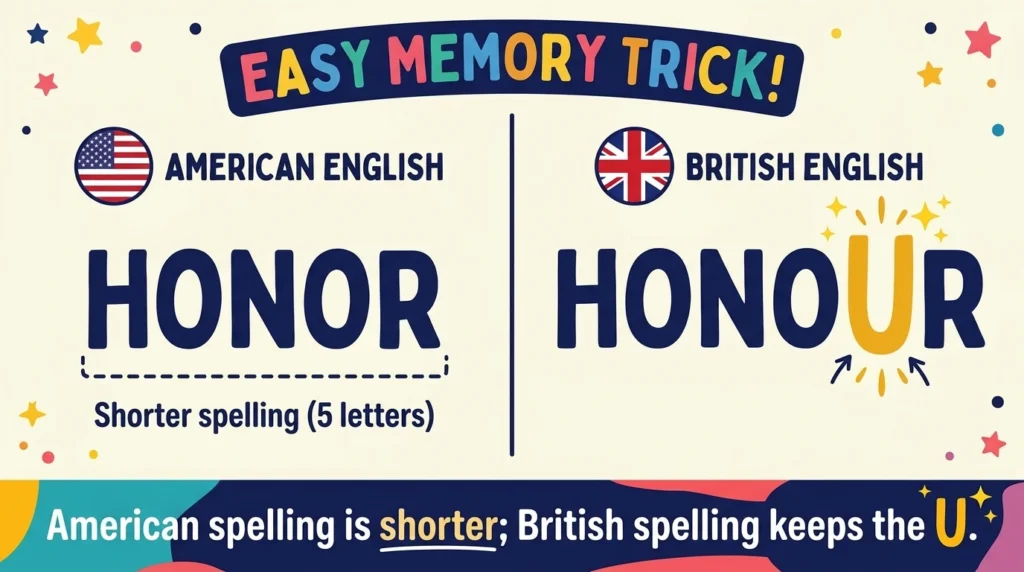
American spelling is shorter; British spelling keeps the “u.”
Think of these pairs:
- American: honor, color, favor.
- British: honour, colour, favour.
If you are writing for an American audience, choose the shorter forms. If you are writing for a British audience, remember the u.
One important exception to the pattern is honorary, which uses the same spelling in both varieties.
Honor vs Honour in Real-Life Situations
Situation 1: A Job Interview in the United States
You are thanking an American employer after an interview.
Natural choice: “It would be an honor to join your team.”
The spelling matches American English.
Situation 2: A University Email in the United Kingdom
You are accepting an invitation to speak at a British university.
Natural choice: “It would be an honour to speak at your university.”
The spelling follows British English conventions.
Situation 3: A Business Operating Internationally
Your company serves customers in both the United States and the United Kingdom.
Best approach: Maintain separate localized versions where appropriate, or follow one documented house style across all materials. The priority is consistency within each publication.
Situation 4: An Academic Examination
Your teacher has instructed you to use British English.
Correct choice: “The ceremony was held in honour of the students.”
Follow the required spelling convention rather than switching between varieties.
Situation 5: Writing About an Official Award
You are writing about an award with an established official name.
Best approach: Preserve the award’s official spelling. Do not automatically change a proper name to match the rest of your writing.
Read More: Sneek vs Sneak: Which Spelling Is Correct?
Expert Tips for Using Honor and Honour
- Set your language preference first. Select American or British English in your word processor before drafting or editing.
- Check related words together. Search for honor, honour, honored, honoured, honoring, and honouring when checking a long document.
- Follow the publication’s style guide. An employer, university, newspaper, or client may have a preferred spelling standard.
- Do not edit proper names blindly. Official titles, award names, and organization names may retain a spelling that differs from your general style.
- Use consistency as your final test. If your document follows American English, use American spellings throughout. If it follows British English, use British spellings throughout, except where a name or quotation requires otherwise.
- Remember that meaning does not change. Adding the u does not make the word more formal, more respectful, or more British in meaning. It changes the spelling convention only.
Quick Summary
Honor and honour are two correct spellings of the same English word. Honor is the standard American English form, while honour is the standard British English form and is also used in Australian and generally Canadian English. Both can function as nouns or verbs and refer to respect, integrity, recognition, or fulfilling a commitment. The pronunciation and meaning are essentially the same, so the difference is primarily regional spelling. Use honor when following American English and honour when following British English. Keep related forms consistent, such as honored/honoured and honoring/honouring. For official names and direct quotations, preserve the established spelling. The most important rule is to choose the appropriate English variety and use it consistently throughout your writing.
Frequently Asked Questions
Is honor or honour correct?
Both are correct. Honor is standard in American English, while honour is standard in British English. Choose the spelling that matches your audience or required style guide.
Is honour British English or American English?
Honour is the standard British English spelling. It is also commonly used in Australian and Canadian English. American English generally uses honor.
Is honor more correct than honour?
No. Neither spelling is universally more correct. Each belongs to a different regional spelling convention, and both are accepted English forms.
Do honor and honour have the same pronunciation?
Yes, they are normally pronounced alike within a given accent. The additional letter u changes the spelling, not the usual pronunciation.
What is the plural of honor or honour?
The American plural is honors, and the British plural is honours. For example, an American student may graduate with honors, while a British student may graduate with honours.
Is it honored or honoured?
Both are correct. American English uses honored, while British English uses honoured. The difference follows the same regional spelling rule as honor and honour.
Is it honoring or honouring?
Use honoring in American English and honouring in British English. Both forms describe the act of showing respect, recognizing someone, or fulfilling an obligation.
Is honorary spelled with or without a u?
Honorary is the standard spelling in both American and British English. Unlike honor/honour, this word does not change its spelling between these varieties.
Should I use honor or honour on my website?
Choose the spelling that suits your target readers. If your website primarily serves Americans, use American English. If it targets British or Australian readers, British-style spelling is generally appropriate. Consistency across your pages is more important than choosing one form for every audience.
Can I use honor and honour in the same document?
You can, especially when reproducing official names or direct quotations. However, ordinary prose should generally follow one spelling convention. Mixing regional forms without a reason can make your writing look inconsistent.
Does honour mean more respect than honor?
No. The words have the same meaning. The letter u does not make one form more respectful, formal, or meaningful than the other.
Mini Quiz: Honor vs Honour
Test your understanding with these 10 questions.
| No. | Question | Answer | Explanation |
|---|---|---|---|
| 1 | Choose the standard American spelling: (A) Honour (B) Honor | B — Honor | American English generally omits the u in this word. |
| 2 | Fill in the blank using British English: “It was a great ___ to meet her.” | Honour | British English retains the u. |
| 3 | Correct the sentence for American English: “We will honour our commitment.” | We will honor our commitment. | The American spelling is honor. |
| 4 | Which is standard British English? (A) Honored (B) Honoured | B — Honoured | British English generally retains the u in this form. |
| 5 | Fill in the blank using American English: “She graduated with ___.” | Honors | American English generally uses honors. |
| 6 | True or false: Honour is always incorrect in English. | False | It is the standard spelling in British English and several other varieties. |
| 7 | Correct the sentence for British English: “The ceremony was held in honor of the volunteers.” | The ceremony was held in honour of the volunteers. | The British spelling is honour. |
| 8 | Which spelling is standard in both American and British English? (A) Honourary (B) Honorary | B — Honorary | Honorary is the standard form in both varieties. |
| 9 | Fill in the blank using American English: “The organization is ___ its founders.” | Honoring | American English uses honoring. |
| 10 | True or false: Honor and honour have different meanings. | False | They have the same meaning; the difference is regional spelling. |