

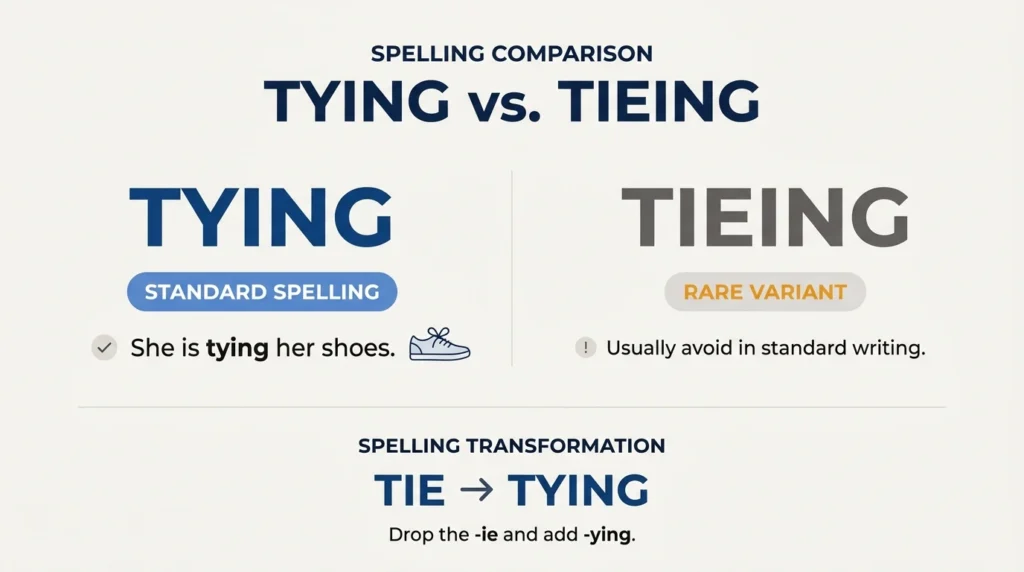
The correct spelling in standard modern English is tying, not tieing. Tying is the -ing form of the verb tie, meaning to fasten something with a knot, connect things, or make two scores equal. The spelling changes because verbs ending in -ie generally change -ie to -y before adding -ing. Therefore, write tying your shoes, tying a knot, and tying the score.
What Is the Difference Between Tieing and Tying?
The main difference is standard spelling. Tying is the normal, widely accepted spelling used in contemporary English. Tieing is a rare alternative spelling recorded in some sources, but it is not the form you should normally choose in everyday, academic, or professional writing.
Consider these examples:
- Correct: She is tying her shoelaces.
- Incorrect in standard usage: She is tieing her shoelaces.
- Correct: He is tying a ribbon around the gift.
- Incorrect in standard usage: He is tieing a ribbon around the gift.
Both spellings may appear in written material, but that does not make them equally suitable. If you want to write clearly and follow standard modern usage, choose tying.
Why Is Tying the Correct Spelling?
The answer comes from an English spelling pattern involving verbs that end in -ie.
When you add -ing to many verbs, you simply keep the original spelling and add the ending. For example:
- work → working
- read → reading
- play → playing
- jump → jumping
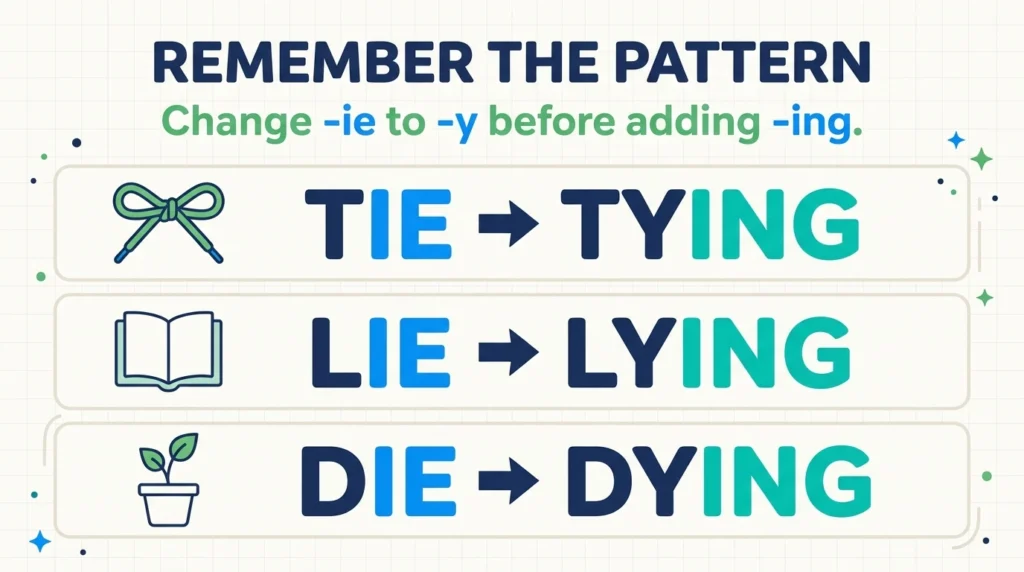
However, verbs ending in -ie generally change that ending to -y before -ing is added.
The pattern looks like this:
Final -ie + -ing → final -y + -ing
Examples include:
| Base verb | Correct -ing form |
|---|---|
| Tie | Tying |
| Lie | Lying |
| Die | Dying |
| Vie | Vying |
| Untie | Untying |
The rule explains why tying is the standard spelling rather than tieing. It is a spelling change, not a change in the verb’s basic meaning.
How to Use Tying Correctly
Tying has several grammatical uses. It can describe an action happening now, an activity in general, or a connection between people, things, ideas, or events.
1. Tying as an action in progress
Tying is the present participle of tie. A present participle is the form of a verb ending in -ing, often used with a form of be to describe an ongoing action.
Examples:
- She is tying her hair before exercising.
- Dad is tying the package with string.
- The children are tying balloons to their chairs.
- I was tying my shoes when the phone rang.
The action may be happening now or may have been in progress at a point in the past.
2. Tying as the name of an activity
Tying can also function as a gerund. A gerund is a verb form ending in -ing that functions like a noun.
Examples:
- Tying knots takes practice.
- Tying a tie can be difficult for beginners.
- She enjoys tying ribbons around handmade gifts.
- Learning rope tying requires patience.
In these sentences, tying identifies an activity rather than simply describing what someone is doing at that moment.
3. Tying in a figurative sense
The verb tie does not always refer to knots or physical objects. It can also mean connecting ideas, linking conditions, or creating a relationship between things.
Examples:
- The report is tying the sales decline to rising costs.
- The manager is tying bonuses to team performance.
- The speaker is tying the final point to the opening argument.
- The investigation is tying the evidence to the suspect.
The spelling remains tying, regardless of whether the connection is physical or figurative.
4. Tying in sports and competition
Tying can describe making a score equal to an opponent’s score.
Examples:
- The striker scored in the final minute, tying the game.
- The team is tying the series at two wins apiece.
- Her final answer was worth one point, tying the competition.
Again, the correct spelling is tying, not tieing.
Correct Examples of Tying in Everyday English
Here are 12 original examples showing how tying works in different situations.
- Everyday conversation: “Wait a second; I’m tying my shoes.”
- Family life: Dad is tying the birthday balloons to the chairs.
- Email: I am tying up the final details before sending the proposal.
- School: The student is tying the two pieces of cardboard together with string.
- Workplace: Our team is tying the quarterly bonus to measurable results.
- Social media: Spent the afternoon tying tiny ribbons around handmade gifts!
- Academic writing: The researcher is tying the observed changes to environmental factors.
- Sports: The midfielder scored a late goal, tying the match at one-all.
- Fashion: She is tying a silk scarf around her handbag.
- Gardening: We are tying the tomato plants to their supporting stakes.
- Travel: The sailor checked the rope before tying the boat to the dock.
- Creative writing: She stood by the window, tying her hair back as the rain began.
Each sentence uses tying, whether the action involves a physical knot or a figurative connection.
Read More: Neighbour vs Neighbor: Which Spelling Is Correct?
Incorrect vs. Correct: 10 Common Examples
The following table shows mistakes to avoid and explains the spelling choice.
| ❌ Incorrect | ✅ Correct | Why |
|---|---|---|
| She is tieing her shoes. | She is tying her shoes. | Tying is the standard spelling. |
| He is tieing a knot. | He is tying a knot. | The final -ie changes to -y. |
| I am tieing the ribbon. | I am tying the ribbon. | Use the conventional -ing form. |
| They are tieing the packages. | They are tying the packages. | The spelling stays the same for plural objects. |
| She enjoys tieing bows. | She enjoys tying bows. | The gerund also uses tying. |
| He was tieing his tie. | He was tying his tie. | The past progressive uses was tying. |
| The player is tieing the score. | The player is tying the score. | The standard spelling applies to sports, too. |
| We are tieing the cables together. | We are tying the cables together. | Figurative or physical connections use the same form. |
| Tieing the knot takes practice. | Tying the knot takes practice. | The gerund uses the standard form. |
| She is tieing her hair back. | She is tying her hair back. | Hair-related actions follow the same pattern. |
Important nuance: Tieing is recorded as a variant in Merriam-Webster, so it is not accurate to claim that no dictionary recognizes it. Nevertheless, tying is the best choice for standard contemporary writing.
Merriam-Webster
+1
Why Do People Confuse Tieing and Tying?
There are several reasons this spelling mistake occurs.
1. Adding -ing seems like the obvious solution
Many English verbs form their -ing forms by simply adding the suffix:
- talk → talking
- help → helping
- read → reading
- cook → cooking
Following this familiar pattern, a learner may assume that tie becomes tieing. The assumption makes sense, but it misses the spelling pattern for verbs ending in -ie.
2. The original word remains easy to recognize
The word tie is short and familiar. Keeping its original letters may look like the most logical way to preserve its identity.
However, English spelling sometimes changes the base word when a suffix is added. In this case, the ie changes to y.
3. Pronunciation does not reveal every spelling rule
The pronunciation of tying can make the alternative spelling seem plausible. However, spelling cannot always be worked out by listening to a word.
Learning the written pattern is more reliable than guessing from its sound.
4. Spellcheckers are not always decisive
Some writing tools may flag tieing, while others may accept it because it is recorded as a variant. A spellchecker can identify many mistakes, but it does not always tell you which form is most appropriate for standard writing.
5. Translation can encourage literal spelling
English learners may apply a familiar rule from another language or assume that the written form should preserve every letter of the original verb. That approach can create difficulties when English uses a specific spelling change.
The solution is simple: learn the word family rather than relying on a direct translation.
Common Mistakes Checklist
Use this checklist when editing your work.
- Writing tieing automatically: Remember that tying is the standard form. Check the spelling before submitting important writing.
- Assuming every verb simply takes -ing: Some verbs change their spelling. Learn common patterns such as tie → tying and lie → lying.
- Thinking the meaning changes: Tying and tieing do not normally represent different meanings. The distinction is primarily spelling and conventional usage.
- Calling tieing impossible in every context: Some dictionaries record it as a variant. The more precise advice is to prefer tying in standard modern writing.
- Confusing tying with tied: Use tying for an ongoing action or an activity; use tied for the past tense or past participle.
- Assuming British and American English use different forms: Tying is the normal spelling in both varieties.
- Trusting autocorrect without checking context: Review your sentence and choose the standard form that communicates your meaning clearly.
Tying in Real English
Grammatically correct
Tying is the conventional present participle and gerund of tie. It appears naturally in sentences such as “She is tying her shoes” and “Tying knots takes patience.” The spelling works across literal and figurative meanings, from fastening a package to connecting two ideas. It is suitable for ordinary conversation, formal correspondence, school assignments, and professional documents.
Grammatically possible but unusual
Tieing is an unusual variant that is recorded by Merriam-Webster. Its existence means it is too absolute to say that the spelling has never been accepted or documented. However, most writers have little practical reason to choose it. In contemporary writing, it may look like an error to readers who expect the conventional spelling tying.
Natural, everyday English
English speakers routinely write phrases such as “tying my shoes,” “tying a knot,” “tying a ribbon,” and “tying the game.” The form also appears in expressions such as “tying the knot,” meaning getting married, and “tying up loose ends,” meaning finishing unresolved tasks. These are familiar constructions, and tying is the spelling to use in each one.
American vs. British English
There is no meaningful American-versus-British spelling distinction to learn for this word.
| Feature | American English | British English |
|---|---|---|
| Standard spelling | Tying | Tying |
| Base verb | Tie | Tie |
| Past tense | Tied | Tied |
| Common phrase | Tying the knot | Tying the knot |
| Recommended form | Tying | Tying |
Whether you are writing for a US or UK audience, choose tying. Do not assume that tieing is a British alternative simply because some dictionaries record it as a variant.
Dictionary.com
+1
Formal vs. Informal Usage
The recommendation is the same in both settings: use tying.
- Formal writing: Use tying in research papers, business reports, applications, professional emails, and published articles.
- Informal writing: Use tying in text messages, social media captions, personal notes, and everyday conversation.
- Historical quotations: If an original document uses tieing, preserve the original spelling when faithful transcription is required. Do not silently change a quotation if the original wording must remain exact.
The spelling does not change according to how formal the sentence is. The difference is simply that edited writing calls for particular care and consistency.
Tying vs. Tieing: Comparison Table
| Feature | Tying | Tieing |
|---|---|---|
| Base verb | Tie | Tie |
| Meaning | Fastening, connecting, or equalizing | Same intended meaning |
| Standard modern spelling | Yes | Not the preferred form |
| Dictionary status | Standard form | Recorded variant in some dictionaries |
| Common in everyday writing | Yes | Uncommon |
| Suitable for schoolwork | Yes | Avoid |
| Suitable for professional writing | Yes | Avoid |
| Spelling pattern | -ie changes to -y | Retains -ie |
| Example | She is tying her shoes. | She is tieing her shoes. |
| Best choice when unsure | Yes | No |
The key takeaway is that these spellings are not normally used to express different meanings. Tying is the conventional choice, while tieing is a less common recorded variant.
Memory Trick: Tie Loses the I and Keeps the Y Sound
Remember this simple word pattern:
Tie → Tying
Now compare it with two familiar verbs:
- Tie → Tying
- Lie → Lying
- Die → Dying
Think of the three words as a small spelling family. When these verbs take -ing, their final -ie changes to -y.
A quick way to test yourself is to ask: “Would I write lieing or dieing for the ordinary -ing forms of these verbs?”
No. You would write lying and dying. Apply the same pattern to tie.
One rule, three useful examples: tie, lie, die.
Real-Life Situations: Tying in Context
Situation 1: Getting ready for an interview
You are preparing for a job interview and adjusting your clothes.
Correct: “I’m tying my tie before I leave.”
Why: Tying describes an action currently in progress.
Situation 2: Sending a professional email
You have completed a report and need to connect its recommendations to business results.
Correct: “The report is tying our recommendations to the company’s long-term goals.”
Why: Tying can describe a figurative connection between ideas.
Situation 3: Answering an English exam question
Your teacher asks you to choose the correct spelling.
Correct: “Tying is the standard spelling of the -ing form of tie.”
Why: This follows the conventional spelling pattern for verbs ending in -ie.
Situation 4: Writing a text message
You are running late because you are still getting ready.
Correct: “Give me a minute. I’m tying my shoes!”
Why: Informal messages use the same spelling as formal documents.
Situation 5: Reporting a sports result
A team scores in the final moments of a match.
Correct: “The late goal is tying the game at 2–2.”
Why: The verb tie can mean to make the score equal.
Expert Tips: How to Avoid Similar Spelling Errors
1. Learn the complete word family
Memorizing tying alone can help, but recognizing its relationship to tie makes the spelling easier to remember.
Keep these forms together:
| Grammatical form | Example |
|---|---|
| Base verb | I tie my shoes. |
| Third-person singular | She ties her shoes. |
| Past tense | She tied her shoes. |
| Present participle | She is tying her shoes. |
| Gerund | Tying shoes takes practice. |
2. Do not confuse spelling changes with tense changes
Tying and tied are not interchangeable.
- “She is tying the ribbon.” The action is in progress.
- “She tied the ribbon.” The action happened in the past.
- “She has tied the ribbon.” The present perfect tense describes a completed action with relevance to the present.
Choosing the correct form involves both spelling and grammar.
3. Remember that similar-looking words can follow different patterns
English has many suffix rules, but not all words behave alike.
Compare:
- tie → tying
- see → seeing
- agree → agreeing
- dye → dyeing
Notice that dye becomes dyeing, not dying, when referring to changing a colour. The latter is the -ing form of die.
This is an important distinction: dyeing and dying are both correct words with different meanings. The -ie to -y pattern should not be applied blindly to every word that looks similar.
Read More: Speach vs Speech: Which Spelling Is Correct?
4. Check the sentence, not just the individual word
When editing, read the whole sentence. Ask whether you need an ongoing action, a past action, or the name of an activity.
For example:
- “He is tying the rope.” — Ongoing action.
- “He tied the rope.” — Past action.
- “Tying the rope securely matters.” — Activity functioning as the subject.
This small check improves both spelling and grammar.
Quick Summary
Tying is the standard spelling of the -ing form of the verb tie. It describes fastening something, connecting ideas, or making a score equal. English generally changes the final -ie to -y before adding -ing, as in tie → tying, lie → lying, and die → dying. Although tieing is recorded as a variant by some dictionaries, it is uncommon and should normally be avoided in standard modern writing. The same recommendation applies to American and British English, formal documents, school assignments, emails, and social media. Remember the simple pattern, check the verb form you need, and choose tying whenever you want the conventional spelling.
Frequently Asked Questions
Is tieing ever acceptable in English?
Tieing is recorded as a variant in Merriam-Webster. However, tying is the conventional form and is the better choice for most contemporary writing.
How do you spell tying correctly?
Spell it T-Y-I-N-G. The word begins with t, followed by y, then i, n, and g.
Is tying the same as binding?
The meanings overlap, but they are not always interchangeable. Tying usually suggests fastening or connecting something, while binding can also mean restricting, securing, or holding things together in a broader sense.
What does tying the knot mean?
Tying the knot is an idiom meaning getting married. For example: “They are tying the knot in December.”
What does tying up loose ends mean?
It means completing unfinished tasks or resolving remaining details. For example: “I am tying up loose ends before the client meeting.”
Is tying a gerund or a participle?
It can be either, depending on its role in the sentence. In “She is tying her shoes,” it is a present participle. In “Tying shoes takes practice,” it is a gerund functioning as the subject.
Can I use tying in academic writing?
Yes. Tying is appropriate in academic writing when it accurately expresses the intended meaning, such as connecting evidence to a conclusion or describing a physical action.
Why does dyeing keep the e while tying does not?
Because dye and tie follow different spelling patterns. Dyeing refers to colouring something, while tying is the -ing form of tie. Keeping the e in dyeing also helps distinguish it from dying, the form of die.
Does tying have more than one meaning?
Yes. It can refer to fastening objects, connecting ideas, making scores equal, or forming certain relationships. The meaning depends on the context.
What is the easiest way to remember the difference?
Remember the pattern tie → tying. Compare it with lie → lying and die → dying. For standard contemporary writing, choose tying.
Mini Quiz: Test Your Knowledge
Choose the correct answer or correct the sentence in each question. Answers and explanations are included so you can learn from every response.
| No. | Question | Answer | Explanation |
|---|---|---|---|
| 1 | She is ___ her shoelaces. (tying / tieing) | Tying | Tying is the standard spelling. |
| 2 | What is the -ing form of tie? | Tying | The final -ie changes to -y. |
| 3 | Correct this sentence: “He is tieing the package.” | He is tying the package. | Use the conventional form tying. |
| 4 | Which is correct for an ongoing action? (She tied her shoes / She is tying her shoes) | She is tying her shoes. | The present progressive describes an action in progress. |
| 5 | Fill in the blank: ___ knots takes practice. | Tying | The gerund tying functions as the subject. |
| 6 | True or false: British English normally uses tieing instead of tying. | False | Tying is standard in both British and American English. |
| 7 | Choose the correct spelling: (lying / lieing) | Lying | The same -ie to -y pattern applies. |
| 8 | Correct this sentence: “The late goal was tieing the game.” | The late goal was tying the game. | Tying is the standard form used for equalizing a score. |
| 9 | What is the past tense of tie? (Tied / Tying) | Tied | Tied is the simple past form. |
| 10 | Which statement is most accurate? (Tieing is never recorded / Tying is standard and tieing is a recorded variant) | Tying is standard and tieing is a recorded variant. | This reflects the distinction between standard usage and dictionary-recorded variants. |