
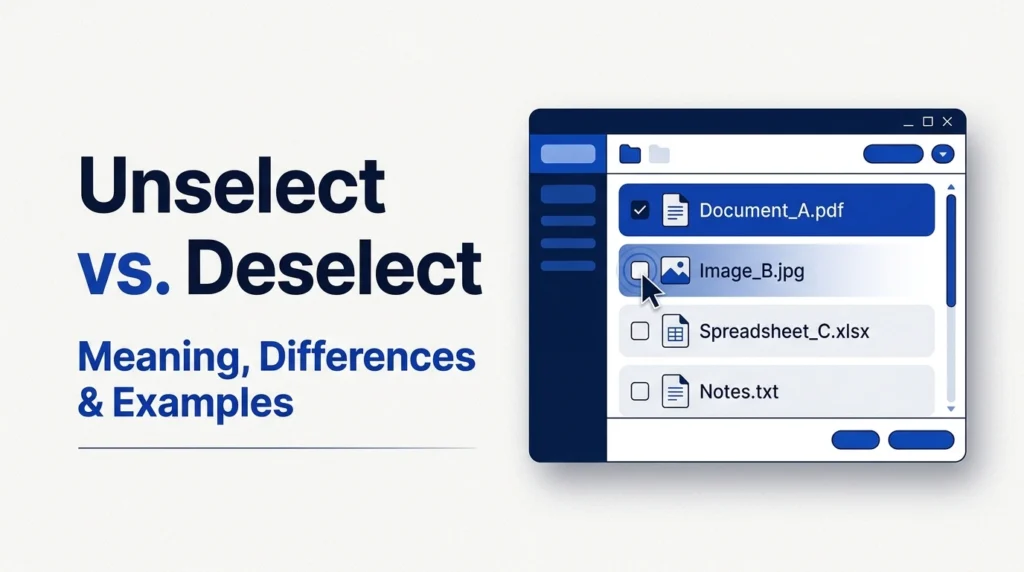

The main difference between unselect and deselect is how they are used in context. Both can mean removing a selection, especially in software, forms, menus, and digital interfaces. Deselect is generally the more established and widely preferred term in interface instructions, while unselect is also used, particularly in computing. If you are writing professional instructions or designing a user interface, deselect is usually the safer choice.
What Is the Difference Between Unselect and Deselect?
Both words describe reversing a selection, but they differ in common usage and how naturally they fit particular contexts.
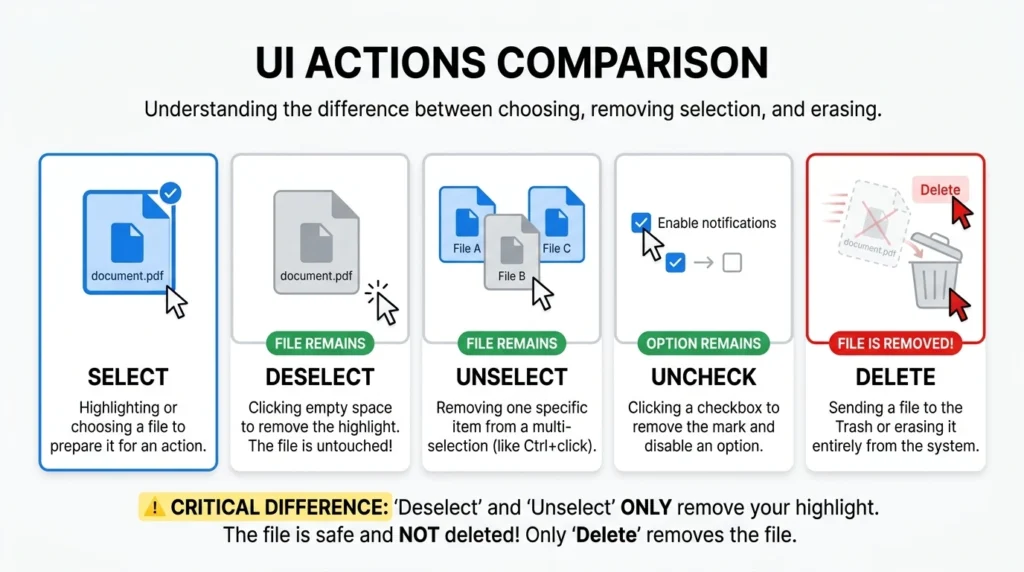
- Deselect means to remove something from a group of selected items or cancel an existing selection.
- Unselect also means to remove a selection, but it is less conventional in many interface instructions.
- Select means to choose an item in the first place.
For example, if you check a box on an online form and then click it again to remove the check mark, you can describe the second action as deselecting the box.
You may also encounter unselect in software documentation, settings, and technical discussions. It is not automatically incorrect; the best choice depends on the sentence, the application, and the terminology used by the software.
What Does Deselect Mean?
Deselect is a verb meaning to remove an item from a selection or reverse the act of selecting it.
The word commonly appears in digital environments where users choose checkboxes, menu items, files, options, or objects. It can also describe removing an item from a group chosen for a particular task.
Examples:
- Deselect the options you no longer need.
- I accidentally selected the wrong file, so I deselected it.
- Please deselect the checkbox before submitting the form.
- You can deselect individual photos before downloading the album.
In these examples, the item was selected first. The action of deselecting reverses that choice without necessarily deleting the item itself.
That distinction matters: deselecting an item does not usually mean deleting it. It simply removes the item from the current selection.
What Does Unselect Mean?
Unselect is a verb that means to remove something from a selection or undo a previous selection.
It is especially understandable in computing because the prefix un- often expresses reversal, removal, or the opposite of an action. For example, unlock reverses lock, and untie reverses tie.
Examples:
- Unselect the files you do not want to upload.
- I need to unselect one option before continuing.
- The program lets users unselect individual items.
- She unselected the wrong category and chose another one.
These sentences are understandable, and the verb is used in real technical contexts. However, some software products, style guides, and professional writers prefer deselect.
When consistency matters, follow the terminology used by the software or organization. If there is no established terminology, deselect is usually the better default.
The Core Rule: When Should You Use Each Word?
Use deselect when you want the most conventional wording for removing an existing selection. Use unselect when it matches the terminology of a particular application or established technical context.
Remember these practical rules:
- Use select when choosing an item.
- Use deselect when removing an item from the current selection.
- Use unselect when it is the established term in the software or context you are describing.
- Do not use either word to mean delete unless the action actually deletes something.
- Keep terminology consistent throughout your instructions, interface, or documentation.
For example, a software manual might say, “Select the files you want to export, then deselect any files you want to exclude.” This wording clearly distinguishes the two actions.
For software interfaces, deselect is usually a good choice because it is established technical terminology. However, the most important principle is consistency. If a product already uses Unselect All, documentation should normally preserve that exact label rather than rename it.
Should I use “unselect” in academic writing?
You can use unselect when describing a software function, but deselect is generally the safer choice in academic writing. It is more firmly established in standard dictionaries for this meaning and is familiar in technical contexts.
For example:
- Preferred: Participants were instructed to deselect all options that did not apply.
- Also understandable: Participants were instructed to unselect all options that did not apply.
The first version is the better default for a carefully edited research paper.
How to Use Unselect and Deselect Correctly
The following examples show how the words work in different settings.
Correct Examples
- Everyday conversation: “I selected the wrong movie, so I deselected it.”
- Email: “Please deselect the optional services before approving the quote.”
- School: “Deselect the incorrect answers before submitting your online test.”
- Workplace: “Deselect any projects that are outside your department.”
- Social media: “I deselected the photos I did not want to include in the post.”
- Academic writing: “Participants could deselect any response that they no longer wished to include.”
- Software documentation: “To remove a file from the group, select it and then click Deselect.”
- Online shopping: “Deselect the express-delivery option if you prefer standard shipping.”
- Photo editing: “Click the image again to deselect it.”
- Technical conversation: “You can unselect individual files before uploading the folder.”
- Customer support: “If the wrong category is highlighted, deselect it and choose the correct one.”
- Application settings: “Unselect this option if you do not want to receive notifications.”
All these examples communicate the intended action. Where professional consistency is important, prefer deselect unless the software uses a different established label.
Incorrect vs. Correct Examples
The following table focuses on genuine errors in meaning, clarity, or terminology. It does not treat every occurrence of unselect as grammatically incorrect.
| Incorrect or less suitable | Correct or clearer | Why |
|---|---|---|
| Deselect the file to erase it permanently. | Delete the file to erase it permanently. | Deselecting normally changes the selection state; it does not delete the file. |
| Please deselect your password. | Please clear the password field. | A text field’s contents are cleared, not deselected. |
| Deselect the checkbox to remove it from the website. | Uncheck the checkbox to turn off the option. | Unchecking changes the checkbox state; removing the checkbox itself is a different action. |
| Deselect the text to remove its words from the document. | Delete the text to remove its words from the document. | Deselecting text does not normally remove it. |
| I will deselect the file from the folder. | I will remove the file from the folder. | If the file itself must leave the folder, remove is clearer. |
| Deselect the form by clicking Submit. | Deselect the chosen options before clicking Submit. | The second version identifies what is actually being deselected. |
| Unselect the item, then permanently erase it. | Deselect the item, then delete it. | The two verbs describe separate actions. |
| I deselected the notification, so it stopped arriving. | I turned off notifications, so they stopped arriving. | Removing an item from a selection does not necessarily change notification settings. |
| Unselect the text box to erase its contents. | Clear the text box to erase its contents. | A field’s contents can be cleared independently of focus or selection. |
| Deselect all files, then upload the selected files. | Select the files to upload, then deselect any you want to exclude. | The original instruction creates a confusing sequence unless the user makes another selection. |
| I unselected the account from the system. | I removed the account from the system. | Unselect does not normally mean deleting or disabling an account. |
| Deselect the option to save your changes. | Select the option to save your changes. | If selecting the option enables saving, deselecting it would reverse that action. |
The key lesson is that word choice depends on the action being performed. Deselect and unselect are alternatives when reversing a selection, but they cannot replace delete, clear, remove, or uncheck in every situation.
Why People Confuse Unselect and Deselect
1. Both words contain “select”
The shared word makes their meanings easy to confuse. Both verbs are built around select, which means to choose something. Their prefixes suggest reversing or removing that choice.
Because the two forms can describe the same action, writers may assume that they are interchangeable in every context. They are not: the intended action and established terminology still matter.
2. The prefixes “un-” and “de-” both suggest reversal
English uses un- in words such as unlock, untie, and undo. It also uses de- in verbs such as deactivate and declassify.
However, prefixes do not work as perfectly interchangeable mathematical operators. A word’s meaning and conventional use depend on how English speakers have adopted it.
That is why the existence of undo does not automatically make unselect the preferred form in every technical document.
3. Software makes both forms understandable
Digital interfaces frequently require users to reverse an action. A selected file, checkbox, image, or menu item can return to an unselected state.
This context makes unselect easy to understand, even for readers who normally expect deselect. It also explains why the alternative appears in some software instructions.
4. Spellcheck does not settle every usage question
A spelling checker might accept both words, flag one, or behave differently depending on its dictionary and language settings.
Even if both pass a spellcheck, that does not establish that both are equally conventional in a particular context. Spellcheckers primarily help identify possible errors; they do not reliably decide every question of style, meaning, or naturalness.
5. Translation can encourage literal word formation
English learners sometimes translate a familiar expression from their first language and construct a verb using a logical prefix.
That approach can produce understandable English, but not every logical construction becomes the preferred word in actual usage. When learning technical vocabulary, it helps to remember established word combinations rather than rely on prefixes alone.
Read More: Tieing vs Tying: Which Spelling Is Correct?
Common Mistakes Checklist
Use this checklist when editing a sentence that contains unselect or deselect.
- Assuming unselect is never a word. It is used in computing. Prefer deselect for general professional writing, but do not automatically label unselect incorrect.
- Assuming both words are equally conventional everywhere. They overlap in meaning, but deselect is the safer default in standard technical prose.
- Confusing deselect with delete. Deselecting removes an item from the current selection; deleting removes the item itself.
- Using deselect when you mean uncheck. If the user needs to remove a check mark, uncheck the box may be more direct.
- Using deselect when you mean clear. Clearing a text field removes its contents; deselecting usually changes which item is selected.
- Ignoring interface labels. If a product explicitly calls a control Unselect All, preserve that wording when referring to the control.
- Changing terminology halfway through a document. Choose one term and use it consistently unless you are quoting different interface labels.
- Treating an unusual word as a grammar error without checking its meaning. A term may be less common without being grammatically impossible.
Unselect vs. Deselect in Real English
Grammatically Correct
“Please deselect the files you do not want to upload” is grammatically correct. The verb takes a direct object, the files, and describes removing those files from the current selection. “Please unselect the files you do not want to upload” is also grammatically possible and understandable. The difference is not basic sentence grammar; it is the degree to which each word matches conventional usage in the particular technical context.
Grammatically Possible but Less Conventional
“I unselected the unnecessary options” is understandable English, particularly in a software-related conversation. However, in polished technical documentation, many editors would choose “I deselected the unnecessary options.” The alternative is not necessarily a grammatical error. It simply has less uniform acceptance as the conventional term, so it may be a less predictable choice for a broad professional audience.
Read More: Neighbour vs Neighbor: Which Spelling Is Correct?
Natural, Everyday English
“I unchecked the box” is often the most direct expression when the action involves removing a check mark. “I deselected the file” is natural when the action concerns choosing files in a file manager. “I unselected the file” may also be understood, especially by people who use software that adopts this wording. The most natural expression depends on what the user actually did, not just which prefix seems logical.
American vs. British English
There is no major American-versus-British distinction that requires choosing unselect in one variety and deselect in the other for ordinary computing instructions.
Both forms can be encountered in English-language technical contexts. The safer general recommendation is to use deselect in both American and British English when you need a conventional verb meaning “remove from a selection.”
One separate point is worth knowing: deselect also has a specialized political meaning in British English, where a political party may withdraw its endorsement of a candidate. That meaning does not change its usual computing meaning.
Formal vs. Informal Usage
| Context | Recommended wording | Reason |
|---|---|---|
| Academic papers | Deselect | Conventional and precise |
| Professional emails | Deselect | Clear to a broad audience |
| Software manuals | Deselect, unless the product uses another label | Maintains standard terminology |
| User-interface buttons | Match the existing interface | Consistency matters more than personal preference |
| Casual technical conversation | Deselect or unselect | Both may be understood |
| Instructions about checkboxes | Uncheck | Names the specific action |
| Instructions about removing files | Delete or remove | Identifies the actual operation |
For formal writing, choose the most conventional term. For interface design, choose the term that accurately describes the action and matches the language users already see.
Comparison Table: Unselect vs. Deselect and Similar Terms
| Word or phrase | Meaning | Best use |
|---|---|---|
| Select | Choose an item | Selecting files, options, or text |
| Deselect | Remove an item from a selection | Software instructions and technical writing |
| Unselect | Reverse a selection | Computing contexts where the term is established |
| Unselected | Not currently selected | Describing an item’s state |
| Deselected | No longer selected after a selection was reversed | Describing the result of an action |
| Uncheck | Remove a check mark | Checkboxes and tick-box controls |
| Clear | Remove entered content or reset a value | Text fields, search boxes, and filters |
| Delete | Remove content or an item | Files, text, records, and messages |
| Remove | Take something away from a place or group | General instructions |
| Cancel | Stop an operation or withdraw an action | Dialogues, processes, and pending tasks |
The terms are related, but they are not interchangeable. Choose the verb that describes the actual action rather than relying on a general idea of reversal.
Memory Trick
Remember this simple pair:
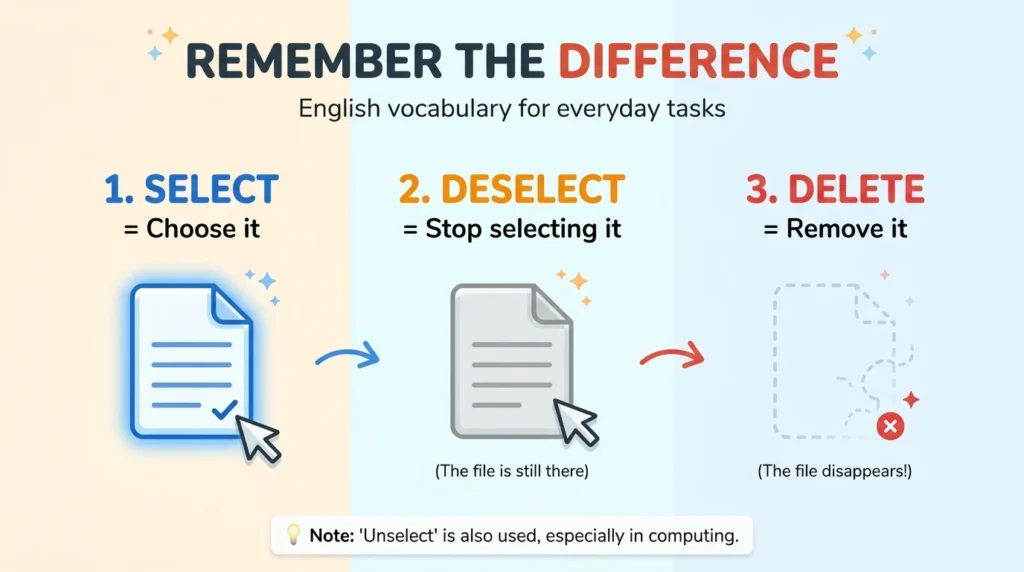
Select → Deselect → Delete only if you want it gone.
- Select means choose it.
- Deselect means stop including it in the current selection.
- Delete means remove it from its location or system.
The key is to remember that deselecting changes a selection, not necessarily the item itself.
For unselect, think of it as an alternative expression you may encounter in software, rather than the first word to reach for in formal writing.
Real-Life Situations
Situation 1: During a Job Interview
An interviewer asks you to complete an online assessment with multiple-choice options.
Instruction: “Select your answer, and deselect it if you change your mind.”
This is clear because the candidate is changing a selected answer rather than deleting anything.
Situation 2: In a Team Meeting
Your manager asks you to choose the projects your team will handle.
Instruction: “Select the projects you can support and deselect the ones outside your team’s responsibilities.”
The verbs make it clear that the project list remains intact while the selection changes.
Situation 3: In a Professional Email
You are explaining how to update a service order.
Email sentence: “Please deselect the optional maintenance package before submitting the revised order.”
This is a conventional choice for professional instructions.
Situation 4: In a Text Message
A friend is helping you select photos for a shared album.
Message: “I selected the wrong photo. Can I unselect it?”
This sounds understandable in casual technical conversation. If you are writing a formal guide to the same process, deselect is the safer default.
Situation 5: In an Exam
A student is taking an online test and changes an answer.
Instruction: “Deselect your previous choice before selecting another answer if the test interface does not automatically replace it.”
This describes the action without implying that the previous answer has been erased from the test system.
Expert Tips
1. Think about the user’s goal, not just the word
When writing instructions, identify whether the user needs to change a selection, remove a check mark, erase text, or delete an item. These actions may look similar on screen, but their consequences differ.
2. Use shorter language when it is clearer
“Uncheck the box” may be easier to understand than “Deselect the checkbox” if the interface uses checkboxes and the action simply removes the check mark.
However, deselect is still appropriate when the user is choosing or unchoosing items in a broader selection.
3. Match the product’s vocabulary
If a software product uses Deselect All, retain that exact label. Consistent wording helps readers connect instructions to the controls on their screens.
4. Distinguish an action from a state
Deselect and unselect describe an action. Unselected usually describes the state of an item that is not selected.
For example:
- Action: “Deselect the image.”
- State: “The image is unselected.”
The distinction helps avoid awkward constructions.
5. Do not overcorrect understandable English
If someone writes unselect in a technical discussion, consider whether it creates a genuine problem before changing it. Editing should improve clarity and consistency, not label every less conventional expression as an error.
Read More: Speach vs Speech: Which Spelling Is Correct?
Quick Summary
Unselect and deselect can both mean removing an item from a selection, particularly in software and digital interfaces. However, deselect is the more firmly established choice in standard technical writing and is generally the better option for professional instructions, academic work, and user-interface documentation. Unselect is an attested alternative, especially in computing, so it should not automatically be treated as incorrect. Choose the term that matches the actual action and any established product terminology. Remember that deselecting an item does not normally delete it. Use uncheck for removing a check mark, clear for removing entered content, and delete when the item itself must be removed.
Frequently Asked Questions
Is “unselect” grammatically incorrect?
No. Unselect is used as a verb, especially in computing. It is less firmly established than deselect in standard dictionary treatment, but that does not make every use grammatically incorrect.
Which word is better for a website button?
Use Deselect or Deselect All when that accurately describes the action. If the website already uses a different label consistently, preserve the established terminology.
Is “unselected” the same as “deselected”?
Not always. Unselected describes an item that is not selected. Deselected often suggests that an item was selected and then removed from the selection. In some contexts, the two descriptions can refer to the same final state.
Can I say “deselect all”?
Yes. Deselect All is a conventional interface command that removes all items from the current selection. It does not normally delete those items.
Can I use “unselect” in a technical manual?
Yes, especially if the software itself uses that term. If you are creating a new manual without established terminology, deselect is generally the safer choice.
Does “deselect” mean cancel?
Sometimes the ideas overlap, but they are not identical. Deselecting removes an item from a selection. Cancelling usually stops an operation, closes a process, or withdraws an action.
Is “unselectable” a word?
Yes, unselectable can mean that something cannot be selected. However, in user-interface writing, disabled, not available for selection, or cannot be selected may be clearer, depending on the situation.
Is “deselected” a correct word?
Yes. Deselected is the standard past-tense and past-participle form of deselect. For example: “The file was deselected before the upload began.”
Should I say “deselect the checkbox” or “uncheck the box”?
Both can be understood, but uncheck the box is often more direct when the action specifically removes a check mark. Use deselect when describing a broader selection process or following the interface’s terminology.
What is the opposite of deselect?
The usual opposite is select. For example, you select a file to include it in a group and deselect it to remove it from that group.
Mini Quiz: Unselect vs. Deselect
Test your understanding with these 10 questions.
Test your knowledge
0 of 10 answered
1. Which word is generally preferred in professional software documentation?UnselectDeselectDelete
2. You want to remove a file permanently. Which verb is most accurate?DeselectUnselectDelete
3. Complete the sentence: Please ___ the options you do not want included.deselectdeletedselection
4. Is unselect always grammatically incorrect?YesNoOnly in American English
5. Which is usually clearest when removing a check mark?Delete the boxUncheck the boxDeselect the text
6. Correct this sentence: “Deselect the text field to erase the words inside it.”Deselect the words permanently.Clear the text field to erase its contents.Unselect the text field to erase its contents.
7. What does “deselected” usually describe?An item that was selected and then removed from the selectionAn item permanently deleted from storageA file that was uploaded
8. Fill in the blank: Select the photos you want to keep, then ___ the unwanted ones.deletedeselecterase
9. A product’s existing button says “Unselect All.” What should its manual normally call the button?Delete AllDeselect AllUnselect All
10. Choose the most accurate statement.Unselect and deselect always have different meanings.Deselecting always deletes an item.Unselect and deselect can describe the same action.