
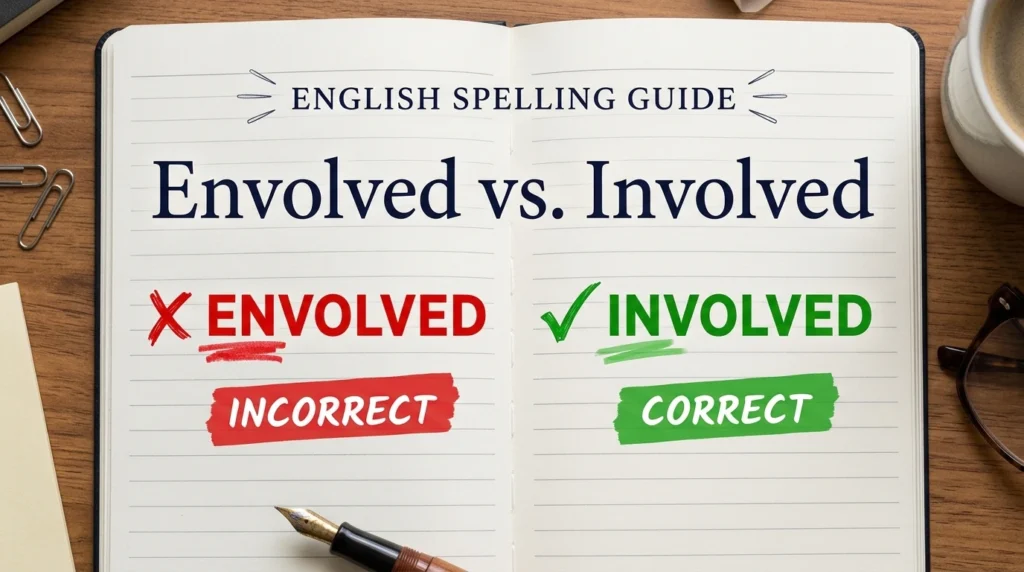

Involved is the correct spelling when you mean participating in, being connected to, or being part of something. Envolved is not the standard modern English spelling for these meanings. For example, write “She was involved in the project,” not “She was envolved in the project.” The confusion often comes from similar-looking words, pronunciation, and the common English spelling pattern en-. Remember that the correct verb is involve, and its past tense and past participle are both involved.
What Is the Difference Between Envolved and Involved?
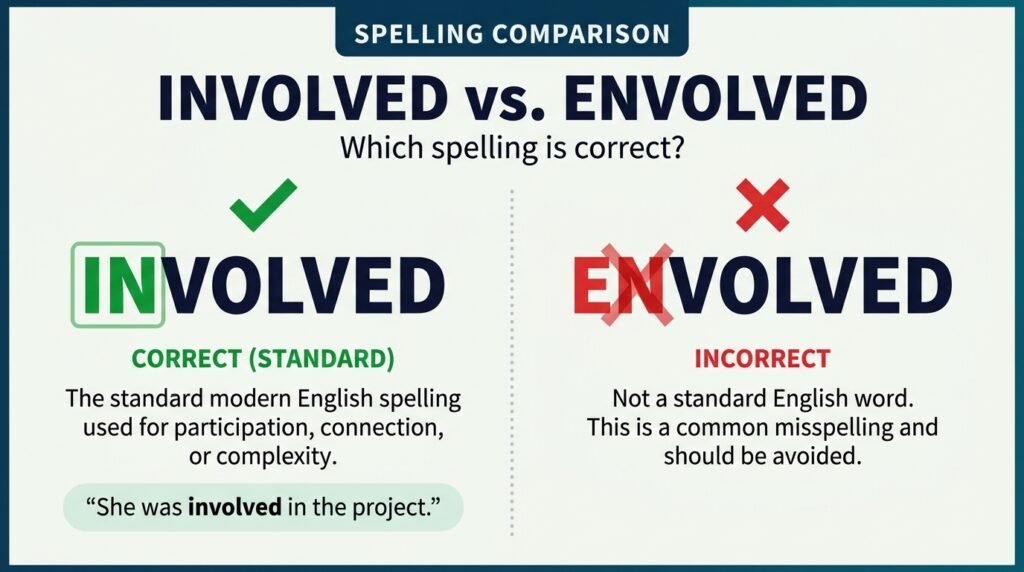
The difference is straightforward: involved is the standard word used in modern English, while envolved is generally an incorrect spelling when the intended meaning is participation, connection, or complexity.
The correct word belongs to the verb family involve, involves, involved, and involving. It can describe someone taking part in an activity, a person being connected to a situation, or a process being complicated.
Consider these examples:
- Correct: The students were involved in the science project.
- Incorrect: The students were envolved in the science project.
- Correct: The investigation was more involved than expected.
- Incorrect: The investigation was more envolved than expected.
In both situations, the spelling should be involved.
Although envolved can appear in historical or specialized contexts related to the rare verb envolve, it is not the standard modern form you should choose for ordinary English writing. If you are writing an email, school assignment, professional report, or everyday message, use involved.
Why Does the Correct Spelling Matter?
A single spelling mistake may not prevent someone from understanding your message, but it can make your writing look less polished. This matters when you want readers to focus on your ideas rather than errors.
Imagine writing a job application that says, “I was envolved in several successful projects.” The reader will probably understand what you mean, but the spelling error may weaken the professional impression you want to create.
The same issue can arise in academic assignments, business correspondence, reports, and public posts.
Using the correct spelling helps you:
- Communicate clearly and professionally.
- Avoid unnecessary spelling errors in important documents.
- Improve your confidence when writing in English.
- Make your work easier to proofread.
- Build a stronger understanding of related words, such as involvement and involving.
The goal is not to make every sentence complicated. It is to express your meaning accurately using the standard form.
The Core Rule: Always Use Involved for the Intended Meaning
The rule is simple: use involved, not envolved, when you mean included, connected, participating, or complicated.
The word involved comes from the verb involve. Its spelling remains the same whether it functions as a past-tense verb, a past participle, or an adjective.
For example:
- Present tense: I involve my colleagues in important decisions.
- Past tense: I involved my colleagues in the decision yesterday.
- Present participle: I am involving my colleagues in the planning.
- Noun: Their involvement improved the project.
Notice that the word family begins with in- in every form.
How to Use Involved Correctly
The word involved has several common meanings. Understanding them helps you choose it naturally instead of simply memorizing its spelling.
1. Involved Means Participating in Something
Use involved when someone takes part in an activity, project, event, or organization.
Examples:
- Maria was involved in organizing the school competition.
- Several volunteers were involved in the fundraising campaign.
- I want to become more involved in community activities.
- Our department was involved in the product launch.
A useful expression is involved in, which commonly introduces the activity or situation in which someone participates.
2. Involved Means Connected to a Situation
The word can also describe someone who has a connection to an event, decision, problem, or investigation.
Examples:
- The manager was involved in the final decision.
- Three departments were involved in the investigation.
- Everyone involved in the incident was interviewed.
- She was not involved in the disagreement.
This meaning does not always suggest that someone did something wrong. A person may simply have been connected to the situation.
3. Involved Means Complicated or Detailed
Involved can describe something complex, detailed, or difficult to understand because it has many parts.
Examples:
- The instructions were too involved for a beginner.
- We discussed an involved legal procedure.
- The assignment requires an involved analysis of the evidence.
- The repair process was more involved than we expected.
Here, involved describes the complexity of a thing rather than a person’s participation.
4. Involved Can Describe a Personal or Romantic Connection
The word may also describe a close personal relationship or a romantic connection.
Examples:
- They became romantically involved last year.
- I do not want to get involved in their personal disagreement.
- He became involved with a local charity after retiring.
The expression get involved can mean becoming part of a situation, while be romantically involved refers specifically to a romantic relationship.
5. Involved Can Be Used in Passive Sentences
A passive sentence places emphasis on the person or thing affected by an action rather than the person performing it.
For example:
- Two teachers were involved in the planning.
- The finance team was involved in the review.
- Several witnesses were involved in the investigation.
In these sentences, involved follows a form of be. The spelling does not change.
Correct Examples of Involved in Everyday English
Here are 12 original examples showing how to use involved in different situations.
| Situation | Correct example |
|---|---|
| Everyday conversation | I was involved in a family event yesterday. |
| Please let me know who was involved in preparing the report. | |
| School | Every student was involved in the classroom activity. |
| Workplace | Our team was involved in developing the new policy. |
| Job interview | I was involved in managing customer feedback. |
| Academic writing | Several factors were involved in the final outcome. |
| Social media | It feels good to be involved in a meaningful cause. |
| Community service | Local residents were involved in the cleanup campaign. |
| Personal relationship | I do not want to get involved in their argument. |
| Technical instructions | The installation process is more involved than it appears. |
| Research | Researchers involved in the study completed a survey. |
| Project management | We involved the design team before approving the proposal. |
All these examples use the correct spelling. The precise meaning depends on the sentence, but the spelling remains unchanged.
Incorrect vs. Correct: 12 Common Examples
The following table shows how to fix the spelling error in different contexts.
| ❌ Incorrect | ✅ Correct | Why |
|---|---|---|
| She was envolved in the project. | She was involved in the project. | The standard word begins with in-. |
| I am envolved in community service. | I am involved in community service. | The adjective uses the spelling involved. |
| They were envolved in the meeting. | They were involved in the meeting. | Participation is expressed with involved. |
| He got envolved in an argument. | He got involved in an argument. | The expression is get involved. |
| The teacher envolved all students. | The teacher involved all students. | The past-tense verb is involved. |
| We have envolved the entire team. | We have involved the entire team. | The past participle of involve is involved. |
| She is deeply envolved in research. | She is deeply involved in research. | The standard spelling remains unchanged. |
| The process was very envolved. | The process was very involved. | Involved can mean complicated. |
| Everyone envolved should attend. | Everyone involved should attend. | The correct participle is involved. |
| He was envolved with the organization. | He was involved with the organization. | Use involved with for a connection. |
| The people envolved were contacted. | The people involved were contacted. | Involved identifies the people concerned. |
| I want to be more envolved at school. | I want to be more involved at school. | The correct expression is be involved. |
Important: These examples correct the spelling only. In some contexts, you may need to adjust the surrounding sentence for meaning or grammar as well.
Why Do People Write Envolved Instead of Involved?
Several factors make this mistake understandable, especially for people learning English.
1. Similar Spelling Patterns
English contains many words that begin with en-, including encourage, enable, enclose, and enjoy. Writers may assume that envolved follows the same pattern.
However, English words do not all follow one predictable prefix rule. The spelling of an established word must be learned as part of that word.
2. Pronunciation and Weak Vowels
In everyday speech, unstressed vowel sounds can be difficult to distinguish. Some learners may hear the opening sound of involved incorrectly and write an e instead of an i.
Pronunciation varies across accents, and the spelling cannot always be reliably inferred from sound alone.
3. Confusion With Evolved
The words involved and evolved look similar, but they have different meanings.
- Involved: Participated in, connected to, or complicated.
- Evolved: Developed or changed gradually over time.
Compare:
- The company was involved in the research.
- The company’s strategy evolved over several years.
The first sentence describes participation. The second describes change and development.
4. Typing Errors and Autocorrect
Typing quickly can lead to accidental substitutions. A writer may also overlook a spelling error while rereading a familiar sentence.
Spell-checking tools can help, but they are not perfect. They may miss mistakes that resemble valid words, particularly when the spelling is close to another form or appears in an unusual context.
5. Translation Interference
People who speak other languages may apply spelling patterns from their first language when writing English. For example, Spanish uses the verb envolver, which can mean “to wrap” and, in certain contexts, relate to involving someone.
This similarity may influence a learner’s spelling choice, but English follows its own standard form: involve and involved.
Common Mistakes Checklist
Use this checklist to catch errors before publishing or submitting your writing.
- Writing envolved instead of involved: Replace the incorrect form when you mean participation, connection, or complexity.
- Writing envolve instead of involve: The standard English verb is involve.
- Changing the spelling in the past tense: The correct form is involved, not envolved.
- Using evolved when you mean involved: Check whether you mean participation or gradual development.
- Confusing involved with involvement: Involved can describe participation or serve as a verb form; involvement is a noun.
- Assuming every word beginning with en- follows the same pattern: Learn the standard spelling of each word instead of guessing from its first letters.
- Trusting autocorrect without reviewing the sentence: Read the whole sentence to confirm that the word expresses your intended meaning.
A final read-through is often enough to catch this error. If you are unsure, check the base verb first: if you mean involve, the correct form is involved.
Involved in Real English: Correct, Possible, and Natural
Grammatically Correct
“The volunteers were involved in the event” is grammatically correct and natural English. The word involved describes their participation, and the preposition in identifies the event they took part in. This construction works in conversation, formal writing, and academic contexts. You can use it when describing a project, campaign, investigation, meeting, or other activity without changing the spelling.
Grammatically Possible but Unnatural
A sentence such as “I was involved for the event” may communicate the general idea, but it is not the usual construction when you mean that you participated in an event. In standard English, “I was involved in the event” is the natural choice. The problem here is the preposition, not the spelling of involved. Choosing the right preposition helps your sentence sound clear and idiomatic.
Natural, Everyday English
“I’m involved in a few school activities” is a natural way to describe regular participation. In casual conversation, speakers may also say “I’m helping with a few school activities” when they want to emphasize their practical contribution. Both sentences can work, but they highlight slightly different things. Involved is useful when describing a connection or participation, while helping with puts more emphasis on the action being performed.
American vs. British English
There is no standard American–British spelling difference between involved and envolved.
Both American English and British English use involved when referring to participation, connection, or complexity.
| Meaning | American English | British English |
|---|---|---|
| Participating | She is involved in the project. | She is involved in the project. |
| Past tense | We involved the whole team. | We involved the whole team. |
| Complicated | The process is involved. | The process is involved. |
Other words can have different spellings in American and British English, such as color/colour and organize/organise. That difference does not apply here.
Formal vs. Informal Usage
The spelling involved is correct in both formal and informal English. What changes is how you use the word in context.
Formal Usage
In professional and academic writing, involved can describe participation, responsibility, or a connection to a process.
Examples:
- Several departments were involved in the evaluation.
- The researchers involved in the project followed the approved procedure.
- The procedure was more involved than initially anticipated.
These constructions suit reports, academic assignments, and business correspondence.
Informal Usage
In conversation and casual messages, involved is also common.
Examples:
- I got involved in a new hobby.
- Are you involved in the school event?
- I don’t want to get involved in their argument.
You can use these expressions with friends, colleagues, and family members.
The important distinction is not formality. It is choosing the right meaning and spelling the word correctly.
Read More: Tieing vs Tying: Which Spelling Is Correct?
Involved vs. Evolved vs. Involvement
These three words are related in appearance, but they serve different purposes.
| Feature | Involved | Evolved | Involvement |
|---|---|---|---|
| Part of speech | Verb form or adjective | Verb form | Noun |
| Main meaning | Participating, connected, or complicated | Developed or changed over time | The act or state of participating |
| Example | She was involved in the project. | The plan evolved gradually. | Her involvement was valuable. |
| Can describe participation? | Yes | Not ordinarily | Yes |
| Can describe gradual development? | No, not in the same sense | Yes | No |
| Correct spelling? | Yes | Yes | Yes |
Choose involved when describing participation or connection, evolved when describing development, and involvement when you need a noun.
For example:
- The teacher was involved in the activity.
- The teaching method evolved over time.
- The teacher’s involvement improved the activity.
This comparison is especially helpful if you are unsure whether envolved is intended to mean involved or evolved.
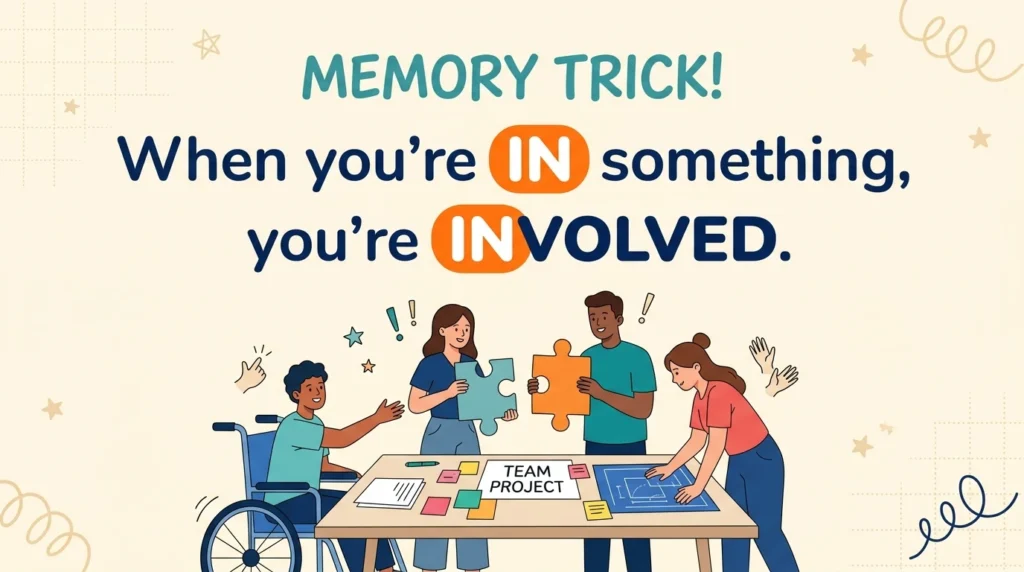
Memory Trick: Remember “IN”
The easiest way to remember the correct spelling is to connect involved with the word in.
When you are involved in something, you are in it or connected to it.
Remember this simple pattern:
IN + VOLVED = INVOLVED
Think of the phrase:
“I’m IN the project, so I’m INVOLVED.”
The trick is not a technical explanation of the word’s historical origin. It is a practical spelling reminder that helps you remember the first two letters.
You can also memorize the word family:
Involve → Involved → Involving → Involvement
Each form begins with in-.
Real-Life Situations: How to Use Involved
1. In a Job Interview
Question: What experience do you have in project management?
Answer: “I was involved in coordinating a team of six people and tracking project deadlines.”
Here, involved describes participation in a professional responsibility.
2. In a Workplace Email
Message: “Please share the names of everyone involved in the client presentation.”
The word identifies the people who participated in or contributed to the presentation.
3. In a School Assignment
Sentence: “Students involved in the research collected data through questionnaires.”
The word describes the students who participated in the research.
4. In a Text Message
Message: “I don’t want to get involved in their disagreement.”
This is a natural everyday expression indicating that the speaker does not want to become part of the dispute.
5. In a Formal Report
Sentence: “Several departments were involved in reviewing the proposed changes.”
The word clearly describes participation in a formal process.
In every situation, involved is the correct spelling. The surrounding words determine its precise meaning.
Read More: Neighbour vs Neighbor: Which Spelling Is Correct?
Expert Tips for Remembering the Correct Word
Learn the Base Verb First
When you encounter a confusing past-tense form, identify its base verb. Here, the base verb is involve. Adding -d gives involved.
This method also helps with other regular verbs, such as approve → approved and include → included.
Check the Meaning Before Choosing a Similar Word
If you are describing participation, consider involved. If you mean gradual change, consider evolved. Checking the meaning can prevent you from choosing a correctly spelled but unsuitable word.
Use Word Families
Learning related forms together makes spelling easier to remember:
- Involve: to include or engage someone.
- Involved: participating, connected, or complicated.
- Involving: including or engaging someone or something.
- Involvement: participation or connection.
Read the Entire Sentence Aloud
Reading aloud can help you notice awkward phrasing, although it may not reveal every spelling error. Combine this technique with visual proofreading or a spell-checking tool.
Do Not Rely on the First Letter Alone
English has many words beginning with in- and en-. Instead of assuming that a prefix determines the spelling, learn the established spelling of the complete word.
Frequently Asked Questions
Is envolved a correct English word?
Envolved is not the standard modern English spelling when you mean participating in, connected to, or complicated. Use involved in these situations. The form may occur in rare or historical contexts associated with envolve, but that does not make it an appropriate substitute in ordinary modern English.
What is the correct spelling of involved?
The correct spelling is involved, with in- at the beginning. It is spelled I-N-V-O-L-V-E-D. The word is the past tense and past participle of involve and can also function as an adjective.
What is the difference between involved and evolved?
Involved describes participation, connection, or complexity. Evolved describes development or gradual change. For example, “She was involved in the project” describes participation, while “The project evolved over time” describes change.
Is involved a verb or an adjective?
It can be either, depending on the sentence. In “They involved the whole team,” it is a past-tense verb. In “The team was involved in the project,” it functions as a past participle in a passive construction or as an adjective describing the team’s connection to the project.
What is the past tense of involve?
The past tense is involved. For example: “The manager involved the staff in the planning process.” The same form is also used as the past participle.
What is the noun form of involved?
The noun is involvement. For example: “Her involvement in the project helped the team.” The noun refers to participation, engagement, or connection.
Should I write involved in or involved with?
Both expressions are correct, but their uses differ. Involved in commonly introduces an activity, process, or situation: “He is involved in research.” Involved with often describes a connection to a person, organization, or activity: “She is involved with a local charity.” The best choice depends on the intended meaning.
Can involved mean complicated?
Yes. Involved can describe something complicated, detailed, or difficult to follow. For example, “The instructions were too involved for a beginner.” This meaning is different from the sense of participating in an activity, but the spelling is identical.
Is involved spelled differently in American and British English?
No. Both American and British English use involved. There is no standard regional spelling difference between these varieties for this word.
Why do people confuse envolved with involved?
The mistake can arise from similar-looking words, weak vowel sounds in speech, unfamiliarity with the word family, and the influence of other languages. Fast typing can also contribute. Learning involve → involved → involvement is a useful way to reinforce the correct spelling.
How can I check whether I have used involved correctly?
First, check whether you mean participation, connection, or complexity. Then confirm that the sentence uses the appropriate construction, such as involved in a project or involved with an organization. Finally, proofread the spelling. If you intended the ordinary modern English word, write involved, not envolved.
Mini Quiz: Test Your Understanding
Choose the correct answer for each question before checking the explanation.
| No. | Question | Answer | Explanation |
|---|---|---|---|
| 1 | She was ___ in the school project. (a) envolved (b) involved | (b) involved | Involved is the standard spelling. |
| 2 | Correct the sentence: “He got envolved in an argument.” | He got involved in an argument. | The correct expression is get involved. |
| 3 | Which word means to develop gradually? (a) involved (b) evolved | (b) evolved | Evolved describes development or change over time. |
| 4 | The past tense of involve is ___. | involved | The regular past-tense form ends in -ed. |
| 5 | Choose the correct sentence. (a) The process was envolved. (b) The process was involved. | (b) | Involved can describe something complicated. |
| 6 | Complete the sentence: Her ___ in the project was valuable. | involvement | Involvement is the noun form. |
| 7 | Correct the sentence: “Everyone envolved should attend.” | Everyone involved should attend. | Use involved to identify the people concerned. |
| 8 | Is involved spelled differently in British and American English? | No. | Both varieties use the same spelling. |
| 9 | Choose the correct sentence. (a) She was involved in the research. (b) She was evolved in the research. | (a) | Involved in describes participation; evolved does not express that meaning. |
| 10 | Complete the word family: involve, involved, involving, ___. | involvement | The noun form is involvement. |
Quick Summary
Involved is the correct standard modern English spelling when describing participation, connection, or complexity. Envolved is not the standard spelling for these meanings. The word involved is the past tense and past participle of involve, and it can also function as an adjective. Use expressions such as involved in a project, involved with an organization, and deeply involved in research according to your intended meaning. Do not confuse involved with evolved, which means developed or changed gradually. There is no American–British spelling difference for involved. To remember the correct form, think of IN: when you are involved in something, you are in it or connected to it.