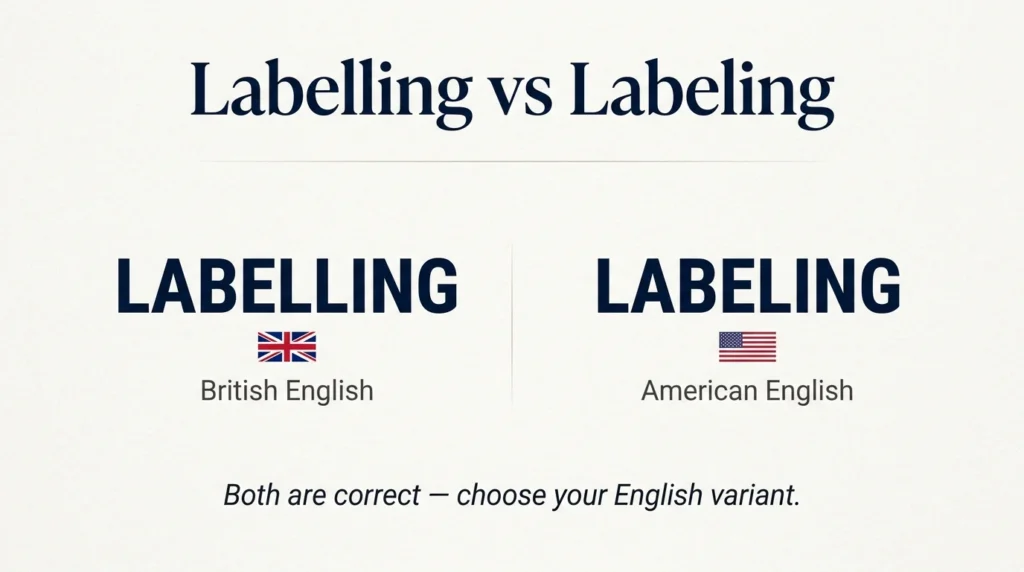

Both labelling and labeling are correct spellings of the same word. The difference is regional: labelling is the standard spelling in British English, while labeling is the standard spelling in American English. Both forms mean attaching a label to something or describing, identifying, or categorizing it. Choose the spelling that matches your audience, and use it consistently throughout your writing.
What Is the Difference Between Labelling and Labeling?
Labelling and labeling are two accepted spellings of the present participle and gerund of the verb label. Their meaning and pronunciation are the same. The only difference is how the final consonant is handled when adding -ing.
- Labelling: The preferred spelling in British English and many other varieties that follow British spelling conventions.
- Labeling: The preferred spelling in American English.
Both spellings are grammatically correct. Neither is inherently more professional, more accurate, or more intelligent than the other.
For example:
- British English: The staff are labelling the boxes.
- American English: The staff are labeling the boxes.
Both sentences communicate the same idea. The spelling changes to match the regional convention, not the meaning of the sentence.
Why the Difference Matters
Choosing between labelling and labeling may seem like a minor detail, but consistent spelling helps your writing look polished and appropriate for its audience.
Professional writing
Businesses often prepare product labels, packaging instructions, reports, and customer communications for different markets. A company targeting the UK may prefer labelling, while a company targeting the US will generally use labeling.
Academic writing
Universities, journals, and publishers may follow a specific style guide. Using the preferred spelling helps you meet their editorial requirements.
Websites and SEO content
If your website targets American readers, labeling is usually the more suitable choice. If your audience is primarily British, labelling is generally the better fit. This is a language and consistency choice, not a guarantee of higher search rankings.
Read More: Instalments vs Installments: Which Spelling Is Correct?
Product packaging and compliance
Terms involving product labelling can appear in manufacturing, food packaging, medicines, and safety documentation. In these contexts, spelling consistency matters, but you must also follow the applicable regulatory terminology and requirements.
The Core Rule
Use labelling for British English and labeling for American English. Both spellings are correct, and both have the same meaning.
The difference follows a common spelling pattern:
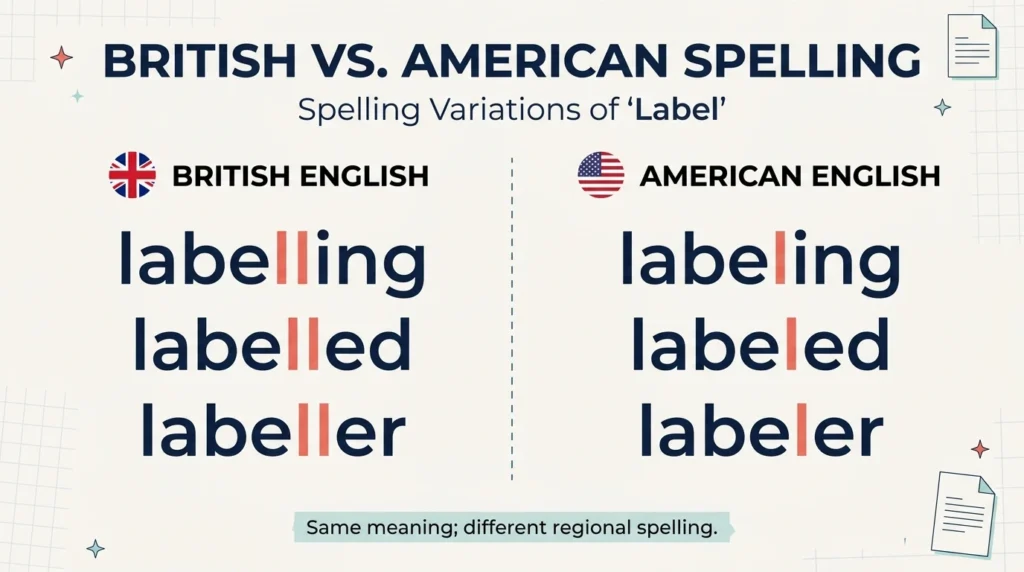
- British English often doubles the final l when adding a suffix to certain words.
- American English often keeps the single l in the same words.
Compare these examples:
| British English | American English |
|---|---|
| Labelling | Labeling |
| Travelled | Traveled |
| Traveller | Traveler |
| Cancelled | Canceled |
| Modelling | Modeling |
These are common regional patterns, although spelling conventions vary by word and style guide. Do not assume that every word ending in l follows exactly the same rule.
How to Use Labelling and Labeling
The correct choice depends mainly on the variety of English you are using.
When to use labelling
Use labelling when writing in British English or following a style guide that prefers British spelling.
Examples include:
- The factory is labelling every package before shipment.
- Correct labelling helps customers identify ingredients.
- The research team is labelling the collected samples.
- New labelling rules apply to certain products.
- She is responsible for labelling files in the archive.
The same spelling is common in writing that follows British conventions in countries such as the UK, Australia, and New Zealand, though local standards and individual style guides should take priority.
When to use labeling
Use labeling when writing in American English or following a style guide that specifies American spelling.
Examples include:
- The warehouse is labeling the boxes for delivery.
- Accurate labeling helps customers identify allergens.
- The laboratory is labeling each specimen.
- The company is updating its product labeling.
- He is labeling the folders before the meeting.
When both spellings are acceptable
Both spellings are acceptable when the audience does not require a particular regional convention. However, choosing one form and using it consistently is usually the clearest approach.
For example, if an article begins with labeling, avoid switching to labelling later unless you are quoting a source or discussing the spelling difference itself.
Correct Examples of Labelling and Labeling
The following examples show how both spellings work in everyday and professional contexts.
Everyday conversation
- British: I’m labelling the jars so everyone knows what’s inside.
- American: I’m labeling the jars so everyone knows what’s inside.
Emails and workplace communication
- British: Please finish labelling the folders before the client meeting.
- American: Please finish labeling the folders before the client meeting.
Education and academic research
- British: The students are labelling the parts of the diagram.
- American: The students are labeling the parts of the diagram.
- British: The researcher completed the labelling of the samples.
- American: The researcher completed the labeling of the samples.
Business and manufacturing
- British: The production team is labelling each carton with its batch number.
- American: The production team is labeling each carton with its batch number.
- British: Clear labelling can help customers compare products.
- American: Clear labeling can help customers compare products.
Social media and digital content
- British: We’re labelling the photos to make them easier to find.
- American: We’re labeling the photos to make them easier to find.
Formal reports
- British: The report examines the effects of food labelling on consumer choices.
- American: The report examines the effects of food labeling on consumer choices.
Each sentence uses the appropriate regional spelling. The grammar and meaning remain the same.
Labelling vs Labeling: Incorrect vs Correct
Because both spellings are valid, a sentence containing labelling is not automatically wrong in American English, nor is labeling automatically wrong in British English. The issue is usually regional consistency rather than basic grammar.
| ❌ Less suitable or inconsistent | ✅ Preferred version | Why |
|---|---|---|
| An American-style report uses labelling throughout without a reason. | An American-style report uses labeling consistently. | American conventions generally prefer the single l. |
| A British-style report uses labeling throughout despite requiring British spelling. | A British-style report uses labelling consistently. | British conventions generally prefer the double l. |
| The document uses labelling in one section and labeling in another. | Choose one spelling throughout the document. | Unexplained spelling changes can make editing look inconsistent. |
| The UK product guide says, “Check the labeling instructions,” when the publisher requires British spelling. | “Check the labelling instructions.” | The revision follows the specified regional convention. |
| The US product guide says, “Check the labelling instructions,” when the publisher requires American spelling. | “Check the labeling instructions.” | The revision follows the specified regional convention. |
| The British report says, “The team is labeling the packages,” despite a strict British house style. | “The team is labelling the packages.” | The change matches the required spelling standard. |
| The American report says, “The team is labelling the packages,” despite a strict American house style. | “The team is labeling the packages.” | The change matches the required spelling standard. |
| A writer changes every instance of labeling to labelling without considering the audience. | Match the spelling to the intended English variant. | A global replacement may introduce inconsistencies with the style guide. |
| A writer assumes labelling and labeling have different meanings. | Treat them as spelling variants with the same meaning. | The difference is regional, not semantic. |
| A writer claims that labeling is always a spelling mistake. | Recognize labeling as standard American spelling. | The single-l form is fully accepted in American English. |
| A writer claims that labelling is always incorrect. | Recognize labelling as standard British spelling. | The double-l form is fully accepted in British English. |
| A writer changes a direct quotation to match the surrounding spelling style without indicating the edit. | Preserve the original spelling in a quotation unless the quotation is being explicitly edited under the applicable rules. | Direct quotations should accurately represent the source. |
Important: The examples above are errors of consistency or mismatches with a specified style, not proof that one spelling is universally incorrect.
Why People Confuse Labelling and Labeling
Both spellings look reasonable
The word label ends in a consonant preceded by a vowel. When adding -ing, writers may expect the final consonant to double. That expectation fits British spelling conventions for this word, while standard American spelling keeps one l.
Regional spelling rules differ
English has several accepted spelling systems. Words such as colour/color, travelling/traveling, and labelling/labeling show how a word can have more than one standard form.
People overgeneralize spelling rules
A learner may remember that British English often doubles a final l and assume that every English variety must do the same. Another learner may have learned the American form first and consider the British form a typo.
Neither assumption is reliable. Regional conventions should guide the choice.
Spellcheck may use the wrong dictionary
A spellchecker set to American English may flag labelling, while a British English spellchecker may prefer labelling over labeling. The software is usually applying a selected language setting, not deciding that the alternative spelling is invalid everywhere.
Translation can create uncertainty
Learners whose first language does not use the same spelling conventions may look for one universally correct form. English does not always work that way. In this case, the key question is not simply “Which spelling is right?” but “Which spelling fits my audience?”
Common Mistakes Checklist
Before publishing, check these frequent problems.
- Mixing both spellings: Writers may switch forms without noticing. Search the document for both labelling and labeling, then standardize the text where appropriate.
- Calling one form universally wrong: Both are accepted spellings. Avoid correcting someone unless you know the required regional standard.
- Ignoring the audience: A UK-facing document may need British spelling, while a US-facing document may need American spelling. Set the convention before drafting.
- Trusting spellcheck without checking its settings: A dictionary set to the wrong English variant may flag an acceptable spelling. Confirm the language settings first.
- Applying the same rule to every word: Many words follow similar patterns, but English spelling is not perfectly uniform. Check individual words when uncertain.
- Changing quoted material unnecessarily: If a source uses one spelling, preserve it in direct quotations unless your editorial policy allows and clearly identifies changes.
- Confusing spelling with meaning: Labelling and labeling do not describe different actions. Both refer to the same general activity.
Labelling vs Labeling in Real English
Grammatically correct
Both labelling and labeling are grammatically correct. They function as forms of the verb label and can also act as nouns, as in “The team is labelling the products” and “Product labelling is important.” The choice of spelling depends on the regional variety or style guide being followed. A British publication can correctly use labelling, while an American publication can correctly use labeling.
Grammatically possible but potentially inconsistent
Using labelling in an American document or labeling in a British document is not automatically a grammatical error. However, it may be inconsistent with the publication’s chosen spelling standard. For example, a report that uses color, organize, and labeling follows a typical American pattern. A report using colour, organise, and labelling follows a common British pattern. The surrounding conventions help determine whether the spelling fits.
Natural everyday English
Native and fluent English users write both forms naturally, depending on the variety of English they use. A British writer may naturally say, “I’m labelling the boxes,” while an American writer may write, “I’m labeling the boxes.” Neither form sounds inherently awkward within its own spelling system. For everyday writing, choose the form familiar to your audience and avoid switching between regional conventions without a clear reason.
American vs British English
The distinction is genuine and straightforward.
| Feature | British English | American English |
|---|---|---|
| Preferred spelling | Labelling | Labeling |
| Base verb | Label | Label |
| Present participle | Labelling | Labeling |
| Gerund or noun | Labelling | Labeling |
| Meaning | Marking or identifying something | Marking or identifying something |
| Pronunciation | Generally the same word pronunciation | Generally the same word pronunciation |
| Typical related spelling | Travelled, modelling | Traveled, modeling |
British English commonly doubles the final l in labelling. American English normally does not double it in labeling.
These are general conventions rather than rules that override every publisher’s style guide. If you are writing for an international audience, consistency matters more than treating either form as universally superior.
Formal vs Informal Usage
There is no formal-versus-informal distinction between labelling and labeling. Both can appear in casual messages, professional emails, academic writing, technical documents, and formal reports.
The deciding factor is regional spelling:
- Formal British writing: Use labelling when following British spelling conventions.
- Formal American writing: Use labeling when following American spelling conventions.
- Informal messages: Either is fine if it matches the English variety you normally use.
- Technical and regulated documents: Follow the organization’s or regulator’s terminology and editorial standards.
A formal report does not become more professional simply because it uses the double-l spelling. Professionalism comes from accuracy, clarity, consistency, and adherence to the required style.
Comparison Table: Labelling and Labeling
| Feature | Labelling | Labeling |
|---|---|---|
| Accepted spelling? | Yes | Yes |
| Preferred in British English? | Yes | Usually not the preferred form |
| Preferred in American English? | Usually not the preferred form | Yes |
| Meaning | Attaching or applying a label; identifying or categorizing | Attaching or applying a label; identifying or categorizing |
| Grammar | Correct | Correct |
| Pronunciation | Same word | Same word |
| Use in a British-style document | Preferred | Use only if justified by the style or source |
| Use in an American-style document | Use only if justified by the style or source | Preferred |
| Main concern | Regional consistency | Regional consistency |
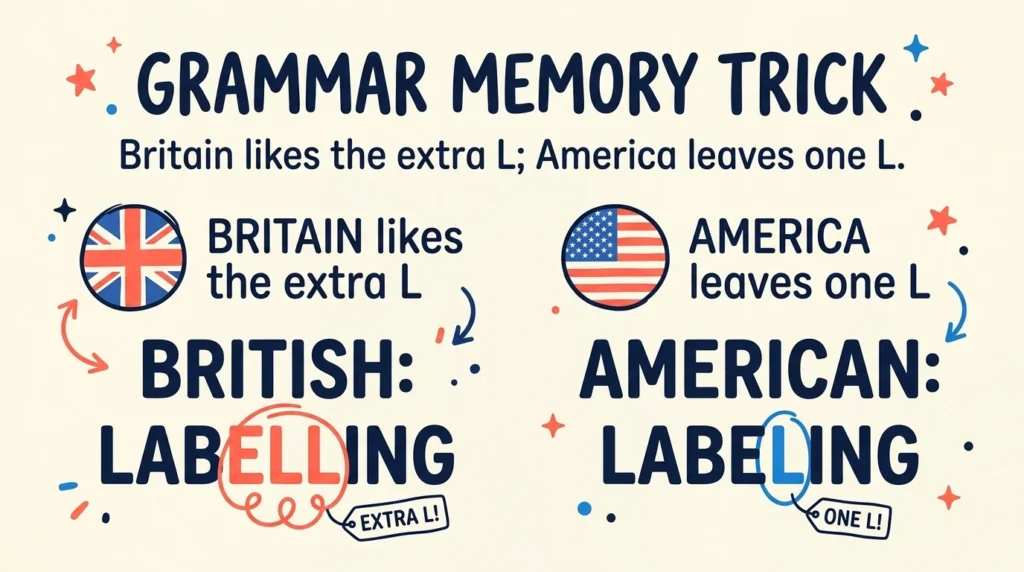
Memory Trick: One L or Two?
Use this simple memory trick:
Britain likes the extra L; America leaves one L.
- British → labelling
- American → labeling
Remember that the base word is label in both varieties. The difference appears when adding -ing.
This trick also helps with several similar spelling pairs, such as travelling/traveling and modelling/modeling. Always check the specific word if a spelling pattern seems uncertain.
Read More: Sneek vs Sneak: Which Spelling Is Correct?
Real-Life Situations: Which Spelling Should You Choose?
Scenario 1: Writing a UK business email
You are asking a warehouse team to prepare a shipment.
Preferred wording: “Please complete the labelling before the goods leave the warehouse.”
Why? The sentence follows a common British spelling convention.
Scenario 2: Preparing a US product manual
You are writing instructions for an American customer.
Preferred wording: “Complete the labeling before shipping the product.”
Why? Labeling is the standard American form.
Scenario 3: Submitting a university assignment
Your university requires British English.
Preferred wording: “The study evaluates the effects of product labelling on consumer decisions.”
Why? The spelling follows the institution’s specified convention.
Scenario 4: Publishing an international website
Your audience includes readers from several English-speaking countries.
Best approach: Choose a primary spelling standard for the website and use it consistently. If you maintain separate regional pages, adapt each page to its intended audience.
Scenario 5: Editing a quotation
A source document says, “The company is labeling the samples,” but your British article uses labelling.
Best approach: Preserve the source’s spelling inside the quotation. Use labelling in your own surrounding text where appropriate.
Mini Quiz: Labelling vs Labeling
Choose the spelling that best fits each situation. The answer key explains the reason.
| No. | Question | Answer | Explanation |
|---|---|---|---|
| 1 | Which spelling is generally preferred in British English: labelling or labeling? | Labelling | British English commonly doubles the final l in this word. |
| 2 | Which spelling is standard in American English: labelling or labeling? | Labeling | American English normally uses one l before -ing. |
| 3 | Fill in the blank for a British report: “The team is ___ the containers.” | Labelling | The sentence follows British spelling conventions. |
| 4 | Fill in the blank for an American manual: “The staff are ___ each package.” | Labeling | The spelling matches American English. |
| 5 | True or false: Labelling is always grammatically incorrect. | False | It is a standard British spelling. |
| 6 | True or false: Labeling and labelling have different meanings. | False | They have the same meaning; the difference is regional spelling. |
| 7 | Correct this sentence for American English: “The company is labelling the boxes.” | The company is labeling the boxes. | The revision matches the typical American spelling convention. |
| 8 | Correct this sentence for British English: “The researcher is labeling the samples.” | The researcher is labelling the samples. | The revision follows British spelling conventions. |
| 9 | A document uses colour, travelling, and labelling. Which spelling pattern does it most likely follow? | British English | All three spellings are common in British English. |
| 10 | A document uses color, traveling, and labeling. Which spelling pattern does it most likely follow? | American English | These are typical American spellings. |
Expert Tips for Choosing the Right Spelling
Set your English variant before writing
Decide whether your document will use American or British English before drafting. This prevents small spelling differences from spreading throughout a long article or website.
Check the whole document, not just one word
A document can be inconsistent in several places. Review related spellings such as travelled/traveled, modelling/modeling, and cancelled/canceled when checking labelling/labeling.
Use your audience as the guide
If you are writing for American customers, use the spelling they generally expect. If your readers are primarily British, follow British conventions. For a specific client, publisher, or university, its style guide takes priority.
Do not confuse spelling preference with correctness
A spellchecker may flag a word because it is configured for another regional variety. Before changing the spelling, check whether the form is accepted in the English variety you intend to use.
Read More: Connector vs Connecter: Which Spelling Is Correct?
Be consistent with related words
The base verb is label in both varieties. Other forms include labelled/labeled and labeller/labeler. British English commonly doubles the l in labelled and labeller, while American English typically uses labeled and labeler.
FAQ
Is labelling or labeling correct?
Both are correct. Labelling is the usual British English spelling, while labeling is the usual American English spelling. They have the same meaning.
Is labelling British or American?
Labelling is the standard spelling in British English. It is also common in other varieties that follow British spelling conventions.
Is labeling American or British?
Labeling is the standard American English spelling. It may also appear in British writing, but labelling is generally preferred under British conventions.
Why does British English use two Ls in labelling?
British spelling conventions commonly double the final l in words such as label when adding a suffix beginning with a vowel. The corresponding American form generally keeps one l in labeling.
Is labelling a spelling mistake in the United States?
Not inherently. It is a recognized British spelling. However, an American publisher may edit it to labeling to maintain consistency with American English.
Is labeling wrong in the United Kingdom?
No. It is an accepted spelling variant, but labelling is generally preferred in standard British English. A UK publication may require the double-l form as part of its house style.
Do labelling and labeling sound different?
No meaningful pronunciation difference is associated with the two spellings. They represent the same word and meaning.
What is the past tense: labelled or labeled?
Both are correct. Labelled is the usual British spelling, while labeled is the usual American spelling.
Is it labeller or labeler?
Both forms are accepted. Labeller is generally preferred in British English, while labeler is standard in American English.
Should I use labelling or labeling on my website?
Use the form that matches your target audience and overall spelling convention. For a UK-focused website, choose labelling. For a US-focused website, choose labeling. Apply the choice consistently across relevant pages.
Does the spelling affect SEO?
Neither spelling is inherently better for SEO. Choose the form that fits your readers and the search language relevant to your page. Search engines can often understand regional variants, but clear, audience-appropriate content remains important.
Which spelling should I use in an international report?
Follow the report’s editorial policy or the organization’s preferred English variant. If no standard is specified, choose one convention and apply it consistently throughout the report.
Quick Summary
Labelling and labeling are both correct spellings of the same word. The difference is regional: British English generally prefers labelling, while American English generally prefers labeling. Both forms refer to attaching a label or identifying, describing, or categorizing something. Neither spelling is more correct in every situation, and neither changes the meaning or pronunciation. For business documents, academic work, websites, and product information, follow the spelling convention required by your audience, publisher, or organization. Keep related words consistent too, such as labelled/labeled and labeller/labeler. If a spellchecker flags one form, check its regional language setting before assuming the spelling is wrong.