
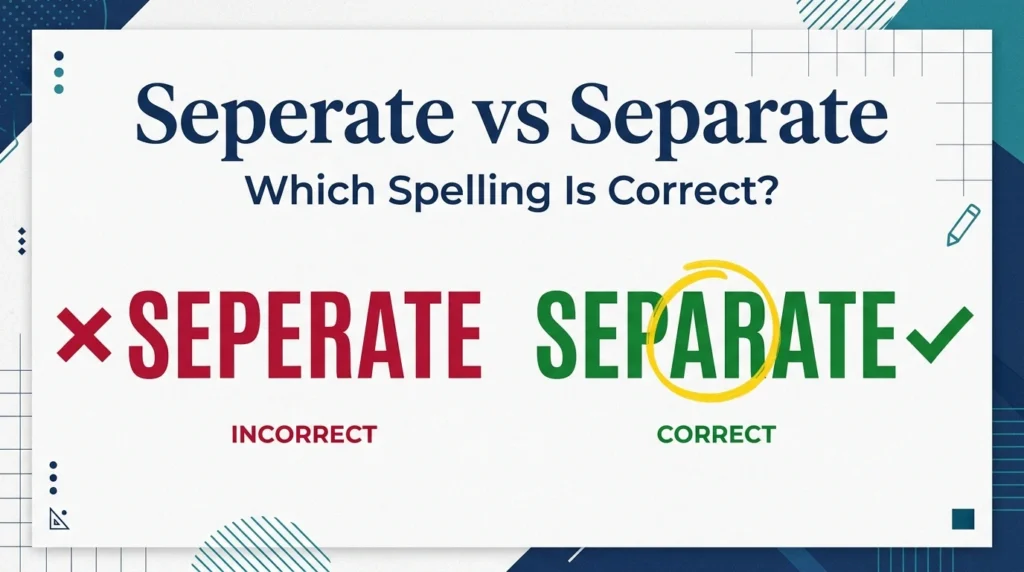

Separate is the correct spelling in both American and British English. Seperate is a misspelling and should not be used when you mean to divide something or describe things that are distinct. For example, write, “Please keep the documents in separate folders,” not “Please keep the documents in seperate folders.” Remember that separate contains two letter a’s, with an r between them.
What Is the Difference Between Seperate and Separate?
The difference between seperate and separate is spelling, not meaning. Only separate is the standard form of the word you need.
The correct word can function as an adjective or a verb. In certain contexts, it can also be used as a noun.
- Separate (adjective): Describes things that are apart, distinct, or independent.
- Separate (verb): Means to divide something, move things apart, or become disconnected.
- Separate (noun): In fashion, a separate is an individual clothing item that can be combined with other pieces to create an outfit.
- Seperate: An incorrect spelling of separate.
Consider these examples:
- Adjective: The two departments have separate budgets.
- Verb: Please separate the recyclable materials from the general waste.
- Noun: The boutique sells stylish separates that customers can mix and match.
- Incorrect spelling: The company maintains seperate records for each branch.
In the last example, the intended meaning is clear, but the spelling is incorrect. The sentence should use separate.
Why Does Correct Spelling Matter?
Spelling may seem like a small detail, but it affects how clearly and professionally you communicate.
The mistake seperate is especially easy to make because it looks believable and resembles the way many people hear the word. However, a familiar-looking spelling is not necessarily a correct one.
Using separate correctly matters in several situations.
1. Professional communication
A spelling error in a business proposal, client email, invoice, or report can make your work look less carefully prepared. Although one mistake does not automatically mean that someone lacks professional ability, accurate writing helps build confidence.
2. Academic writing
Students may lose marks for spelling errors, depending on the assignment and marking criteria. Correct spelling also makes essays, research papers, and examination answers easier to read.
3. Website content and SEO
A spelling mistake in a heading, product description, landing page, or blog post can distract readers. Search engines can often understand misspellings, but that is not a reason to publish incorrect spelling in polished content.
4. Everyday communication
Even in a text message or social media caption, the correct spelling helps your message look clear and intentional.
The goal is not to make every message formal. It is to choose the standard spelling whenever you use the word.
The Core Rule: Always Write Separate
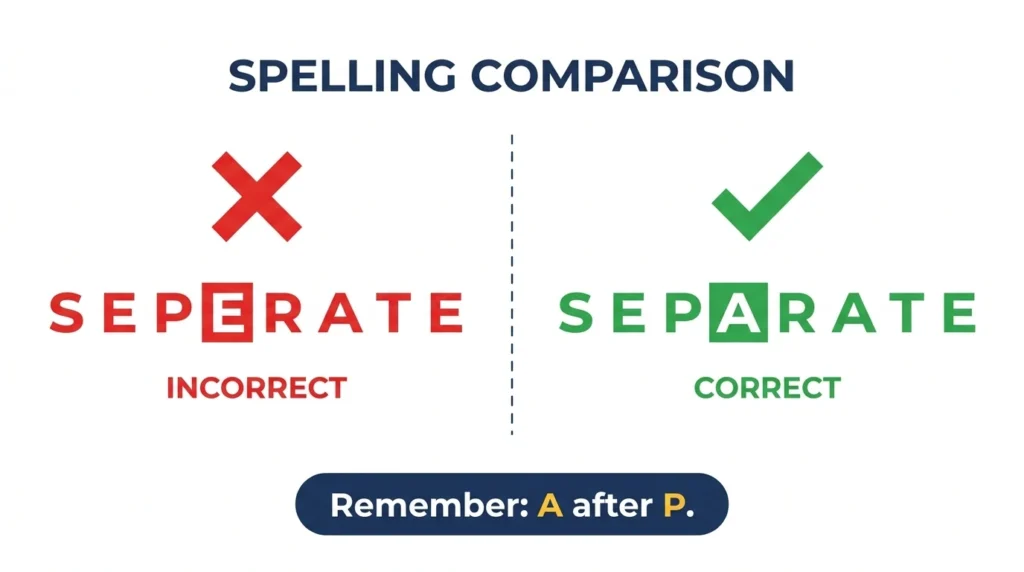
Spelling rule: Write separate, not seperate. The correct spelling contains an a after the first p and another a after the r.
The word is spelled:
S – E – P – A – R – A – T – E
It contains eight letters.
The incorrect form replaces the first middle a with an e:
- Correct: separate
- Incorrect: seperate
This is a spelling rule, not a choice between two regional versions of English. Neither American nor British English uses seperate as the standard spelling of this word.
How to Use Separate Correctly
To use separate correctly, first identify what you want to express. Are you describing two things that are distinct, asking someone to divide something, or explaining that things are no longer together?
Use Separate as an Adjective
An adjective describes a person, place, thing, or situation. When separate is an adjective, it describes something that is distinct, independent, or apart from something else.
Examples:
- We booked separate hotel rooms.
- Each branch has a separate manager.
- Please prepare a separate invoice for the second order.
- The school has separate entrances for students and visitors.
- These are two separate problems that require different solutions.
In these sentences, separate describes rooms, managers’ responsibilities, invoices, entrances, and problems.
Use Separate as a Verb
A verb expresses an action or state. As a verb, separate means to divide things, move them apart, or disconnect them.
Examples:
- Separate the white clothes from the dark ones.
- The manager asked us to separate the damaged products.
- We need to separate the facts from the assumptions.
- The teacher separated the students into smaller groups.
- Oil and water can separate into different layers.
The verb can appear in several forms:
- Present: separate
- Third-person singular: separates
- Present participle: separating
- Past tense: separated
- Past participle: separated
For example, “The supervisor separated the files by department” uses the past tense.
Use Separate as a Noun in Fashion
Although separate is most familiar as an adjective or verb, separates is also a fashion term for individual clothing items that can be worn in different combinations.
For example:
“The new collection includes skirts, trousers, and other separates.”
Here, separates refers to individual garments rather than complete outfits.
This is a specialized use. In most everyday sentences, you will encounter separate as an adjective or verb.
Use Related Words Without Changing the Spelling
The same spelling pattern appears in several related words.
| Word | Part of speech | Example |
|---|---|---|
| Separate | Adjective or verb | We need a separate room. |
| Separated | Past tense or past participle | The files were separated by date. |
| Separating | Present participle | She is separating the documents. |
| Separately | Adverb | The items are sold separately. |
| Separation | Noun | The separation of the two groups took several hours. |
Notice that the first a in separate remains in the related forms.
Avoid these misspellings:
- Seperated → separated
- Seperating → separating
- Seperately → separately
- Seperation → separation
Learning the base spelling helps you avoid mistakes in the entire word family.
15 Correct Examples of Separate in Everyday English
The following examples show how to use separate naturally in different situations.
Conversation
- “Let’s keep these two issues separate.”
- “My brother and I have separate hobbies.”
- “Can you separate the keys from the coins?”
Email and Business
- “Please send a separate quotation for installation.”
- “We maintain separate accounts for each business.”
- “I have attached the two reports as separate files.”
School and Education
- “The teacher divided the class into separate groups.”
- “Please write your answers on a separate sheet of paper.”
- “The experiment requires two separate containers.”
Social Media and Everyday Life
- “Good design separates useful information from unnecessary details.”
- “We ordered separate meals because we have different preferences.”
- “Keep your personal and professional goals separate when planning your schedule.”
Academic and Professional Writing
- “The study examines two separate variables.”
- “The researchers analyzed the results separately.”
- “The report treats the two findings as separate issues.”
These examples demonstrate that separate can describe physical distance, independent responsibilities, different categories, or ideas that should be considered individually.
Incorrect vs. Correct: 12 Common Spelling Errors
In each example, the intended meaning is understandable, but the incorrect spelling should be replaced with the standard form.
| ❌ Incorrect | ✅ Correct | Why |
|---|---|---|
| Please keep the files seperate. | Please keep the files separate. | The standard spelling contains an a after p. |
| We need a seperate meeting room. | We need a separate meeting room. | Separate describes a room distinct from others. |
| Send me a seperate invoice. | Send me a separate invoice. | The word retains the same spelling in business writing. |
| The teacher seperated the students. | The teacher separated the students. | The past-tense form is separated. |
| The products are sold seperately. | The products are sold separately. | The correct adverb is separately. |
| Their seperation was unexpected. | Their separation was unexpected. | The noun is spelled separation. |
| We are seperating the orders. | We are separating the orders. | The present participle retains the a. |
| Keep the clean and dirty clothes seperate. | Keep the clean and dirty clothes separate. | The adjective needs the standard spelling. |
| Each team has a seperate budget. | Each team has a separate budget. | The word does not change in this context. |
| The two departments operate seperately. | The two departments operate separately. | The adverb describes how they operate. |
| Please seperate these documents by date. | Please separate these documents by date. | The verb is separate. |
| There is a seperate issue to discuss. | There is a separate issue to discuss. | Separate means distinct or independent here. |
The key lesson is simple: changing the grammatical form does not make the misspelling acceptable. Use separate, separated, separating, separately, and separation.
Why Do People Spell Separate as Seperate?
There are several reasons this mistake occurs. Understanding them makes the correct spelling easier to remember.
1. Pronunciation Makes the Middle Vowel Unclear
The middle vowel in separate is often unstressed in ordinary speech. An unstressed vowel receives less emphasis than the stressed part of a word, so its sound may be less distinct.
As a result, some people hear a sound that suggests an e rather than the written a.
Pronunciation varies with accent and with whether separate is used as a verb or an adjective. Listening carefully can help, but pronunciation alone is not a reliable way to determine every letter.
2. The Word Looks Familiar With Either Vowel
The forms separate and seperate differ by only one letter. When reading quickly, the eye may not notice the error.
Because the incorrect form resembles the correct one, a writer may type it without realizing anything is wrong.
3. People Overgeneralize Spelling Patterns
English contains many words whose vowel sounds and written vowels are not easy to predict. Writers sometimes apply a familiar spelling pattern to a word that does not follow their expectation.
The result may look reasonable, even though it is not the standard spelling.
4. Autocomplete and Spellcheck Are Not Perfect
Typing tools can correct some mistakes automatically, but their behavior depends on the software, language settings, and context. A correction may be missed, ignored, or applied incorrectly.
A spellchecker is useful, but it should support proofreading rather than replace it.
5. Translation Can Influence Spelling
People learning English may mentally translate a word from another language before writing it. If the translated word has a different sound or spelling pattern, the writer may rely on pronunciation instead of remembering the English spelling.
This is a possible source of spelling mistakes for multilingual learners, not an explanation that applies to every person who writes seperate.
Read More: Honor vs Honour: The Spelling Difference Explained.
Common Mistakes Checklist
Use this checklist when proofreading your writing.
- Writing seperate instead of separate. The middle vowel is the main source of confusion. Check that an a follows the first p.
- Writing seperated. Adding -ed does not fix the original error. Start with the correct base word: separate, then write separated.
- Writing seperately. The adverb still contains the same first middle a. Remember the correct sequence: separate → separately.
- Writing seperation. The noun is separation, not seperation. Learn the full word rather than guessing its spelling from pronunciation.
- Assuming British and American English use different spellings. They do not. Separate is standard in both.
- Trusting pronunciation alone. The middle vowel may be reduced in speech. Confirm the written form when in doubt.
- Relying entirely on autocorrect. Read the finished sentence yourself and check the spelling in context.
A useful proofreading habit is to search your document for seper. If the intended word is separate or one of its related forms, correct the spelling before publishing or submitting the document.
Separate in Real English
Grammatically Correct
Separate is grammatically correct when it is used in a sentence as an adjective, verb, or appropriate noun form. For example, “The departments have separate budgets” uses the adjective correctly, while “Please separate the documents by date” uses the verb. Related forms such as separated, separating, separately, and separation are also standard when their grammatical roles fit the sentence.
Grammatically Possible but Unnatural
A sentence can be grammatically possible yet sound awkward because its wording is redundant or does not fit the intended meaning. For example, “Please separate the two items apart from each other” is understandable, but separate and apart from each other repeat much of the same idea. “Please keep the two items separate” is more concise. The issue is the sentence’s style, not the spelling of separate.
Natural, Everyday English
In everyday English, separate appears naturally in phrases such as “separate rooms,” “separate accounts,” “a separate issue,” and “keep them separate.” As a verb, it is common in instructions such as “separate the papers” or “separate the whites from the colors.” The related adverb separately is natural in expressions such as “Please email the files separately.” Choose the form that matches the sentence.
American vs. British English
There is no spelling difference between American and British English for this word.
Both varieties use separate, not seperate.
| Usage | American English | British English |
|---|---|---|
| Correct spelling | separate | separate |
| Incorrect spelling | seperate | seperate |
| Past tense | separated | separated |
| Adverb | separately | separately |
| Noun | separation | separation |
Pronunciation can vary between speakers and accents, but the spelling remains the same. You do not need to memorize two regional spellings.
Formal vs. Informal Usage
The correct spelling is separate in both formal and informal English.
In formal settings, such as academic essays, reports, legal documents, business proposals, and job applications, spelling accuracy is especially important because the writing may be reviewed closely.
In informal settings, such as text messages, online chats, and social media posts, the same spelling rule applies. A casual tone does not turn seperate into an accepted alternative.
The word itself is neutral. It is suitable for everyday conversation as well as professional writing.
Separate vs. Seperate: Comparison Table
| Feature | Separate | Seperate |
|---|---|---|
| Standard spelling | Correct | Incorrect |
| Meaning | Apart, distinct, or to divide | No separate standard meaning intended here |
| Part of speech | Adjective, verb, and specialized noun use | Not a standard form of the intended word |
| American English | Accepted | Misspelling |
| British English | Accepted | Misspelling |
| Formal writing | Appropriate | Should be corrected |
| Informal writing | Appropriate | Still a spelling error |
| Related adverb | separately | seperately is incorrect |
| Related noun | separation | seperation is incorrect |
| Example | Keep the documents separate. | Keep the documents seperate. |
The distinction is not complicated: one is the correct spelling, and the other is a common error.
An Easy Memory Trick for Separate
Remember this phrase:
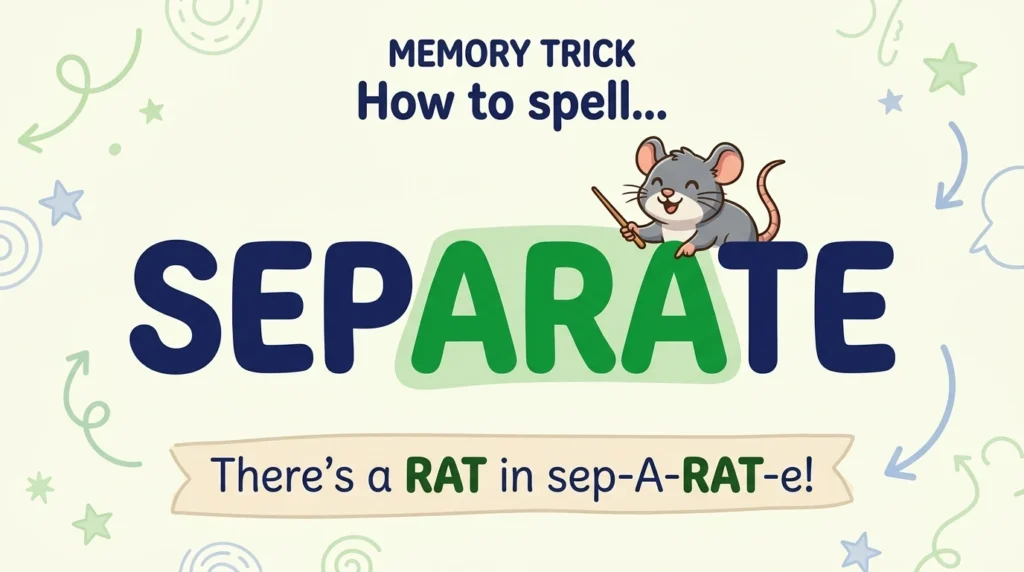
“There’s a RAT in sep-A-RAT-e.”
Break the word into a memorable pattern:
SEP + A + RAT + E = SEPARATE
The letters A-R-A appear in the middle of the correct spelling: sepa r ate.
You can also use a simple visual check:
- Write the word slowly: S-E-P-A-R-A-T-E.
- Find the first p.
- Confirm that the next letter is a, not e.
- Check that the word ends in rate.
The memory trick is not a formal spelling rule. It is a reminder that helps you recall the correct sequence of letters.
Real-Life Situations: Separate in Context
Situation 1: A Job Interview
A candidate explains how they manage responsibilities:
“I keep my personal finances separate from my business finances.”
The adjective separate describes two distinct sets of finances. Using the correct spelling helps maintain a professional impression.
Situation 2: A Business Email
A manager writes:
“Please prepare a separate invoice for each branch.”
The word describes an individual invoice for every branch. The correct spelling is separate.
Situation 3: A Classroom
A teacher gives this instruction:
“Separate the facts from your opinions in your answer.”
Here, separate is a verb because it tells students what action to take.
Situation 4: A Text Message
A friend asks:
“Can we discuss that as a separate issue?”
The word signals that the topic should be considered independently from the current discussion.
Read More: Eying vs Eyeing: Which Spelling Is Correct?
Situation 5: An Academic Report
“The survey results were analyzed separately for each age group.”
A researcher writes:
The adverb separately explains how the results were analyzed.
In every situation, the correct spelling remains consistent even though the word’s grammatical role changes.
Expert Tips for Remembering the Correct Spelling
These practical techniques can help you avoid repeating the mistake.
Learn the Word Family Together
Instead of memorizing only separate, learn the related forms as a group:
- Separate
- Separated
- Separating
- Separately
- Separation
This helps you recognize the spelling pattern when the word changes its grammatical form.
Use the Word in a Sentence
Write a sentence such as “I keep separate folders for each client.” Connecting the spelling to a meaningful example can make it easier to recall than repeating individual letters without context.
Proofread High-Visibility Writing
Before submitting a report or publishing a webpage, search for seper. This is particularly useful when the document is long or contains many related forms.
Do Not Confuse Separate With Similar-Looking Words
English has words such as desperate and separate that can be confusing because of their similar appearance. Do not assume that the middle vowels must match. Learn the spelling of each word individually.
Check the Sentence, Not Just the Word
When proofreading, confirm both spelling and meaning. For example, “The items were sold separately” is correct when each item was sold individually. In another sentence, separate may be needed as an adjective or verb.
Correct spelling and appropriate word choice work together to make writing clear.
Quick Summary
Separate is the correct spelling in both American and British English. Seperate is a common misspelling, not an accepted alternative. The word separate can describe things that are distinct, as in “separate rooms,” or express an action, as in “separate the documents.” Its related forms include separated, separating, separately, and separation. All retain the correct spelling pattern. People often make this mistake because the middle vowel is not strongly pronounced in everyday speech. To remember the spelling, think of “a rat” inside sep-a-rat-e. When proofreading, check for seper and correct it wherever the intended word is separate or one of its related forms.
Frequently Asked Questions
1. Is it spelled seperate or separate?
The correct spelling is separate. Seperate is a common spelling error. Always use separate when you mean apart, distinct, or to divide something.
2. Why is separate so often misspelled?
The middle vowel is often unstressed in speech, which can make it difficult to identify the correct letter by sound alone. Writers may hear an e-like sound and mistakenly write seperate.
3. Is seperate a real English word?
Seperate is not the standard spelling of the word separate. You may encounter it in online searches, unedited text, or discussions of spelling errors, but you should not use it as an alternative spelling in standard English.
4. Is separate spelled differently in American and British English?
No. Both American and British English use separate. There is no regional spelling distinction between these two forms.
5. What is the correct spelling of seperated?
The correct spelling is separated. It is the past-tense and past-participle form of the verb separate. The incorrect spelling seperated should be replaced with separated.
Read More: Labelling vs Labeling: Which Spelling Is Correct?
6. Is it separately or seperately?
Separately is correct. It is the adverb form of separate and means individually or apart from something else. For example, “Please submit the two applications separately.”
7. Is it separation or seperation?
The correct spelling is separation. It is a noun referring to the act or state of being separated. For example, “The separation of the departments improved the organization of their work.”
8. How can I remember how to spell separate?
Remember the phrase “a rat” inside the word: sep-a-rat-e. The word contains two a’s in the middle, with an r between them. Another useful method is to spell it slowly: S-E-P-A-R-A-T-E.
9. Can separate be used as both a noun and a verb?
Yes. It is commonly used as an adjective and a verb. It also has a specialized noun use in fashion, where separates refers to individual garments that can be combined into outfits.
10. Will spellcheck always correct seperate?
No. Many spellcheckers identify this misspelling, but their behavior varies by application and settings. Always review important writing yourself rather than relying entirely on automatic correction.
11. What is the difference between separate and separately?
Separate is commonly an adjective or verb, while separately is an adverb. For example, “We have separate files” uses the adjective, whereas “We saved the files separately” uses the adverb.
12. What should I do if I have already published a page containing seperate?
Edit the page and replace the misspelling with separate, separated, separately, or the appropriate related form. Check the title, headings, body text, image text, and metadata where applicable. Then proofread the revised page to ensure that the correction fits the sentence.
Mini Quiz: Separate vs. Seperate
Test your understanding with these 10 questions. Each question includes the correct answer and an explanation.
Try answering each question before revealing the solution.
Read More: Instalments vs Installments: Which Spelling Is Correct?
Spelling practice
0 of 10 answered
1. Choose the correct spelling.SeperateSeparateSeperete
Correct answer: Separate
Separate is the standard spelling, with an a after the first p.
2. Complete the sentence: Please keep these documents ___.seperateseparrateseparate
Correct answer: separate
Separate is the correct adjective describing documents kept apart.
3. Which is the correct past-tense form?SeperatedSeparatedSeparateed
Correct answer: Separated
Separated is formed from the correctly spelled verb separate.
4. Correct this sentence: The products are sold seperately.The products are sold separate.The products are sold seperatly.The products are sold separately.
Correct answer: The products are sold separately.
Separately is the correct adverb spelling.
5. Which spelling is standard in British English?SeperateSeparateBoth spellings are accepted.
Correct answer: Separate
Separate is the standard spelling in British English, just as it is in American English.
6. Fill in the blank: We need a ___ invoice for each order.separateseperateseperete
Correct answer: separate
Separate is the correct adjective before invoice.
7. Which sentence is spelled correctly?They seperated the files by date.They separated the files by date.They separateed the files by date.
Correct answer: They separated the files by date.
Separated is the correct past-tense form of separate.
8. Choose the correct noun.SeperationSeparrationSeparation
Correct answer: Separation
Separation is the correct noun form.
9. Correct the sentence: We are seperating the orders now.We are separating the orders now.We are separateing the orders now.We are seperatting the orders now.
Correct answer: We are separating the orders now.
Separating is the correct present-participle form.
10. Which memory trick can help you spell separate?Remember two e’s in the middle.Remember ‘a rat’ inside sep-a-rat-e.Remove the r from the word.
Correct answer: Remember ‘a rat’ inside sep-a-rat-e.
The phrase ‘a rat’ helps you remember the a-r-a sequence in separate.
Your score: 0/10
Review the explanations above, then try again to improve your score.Try again