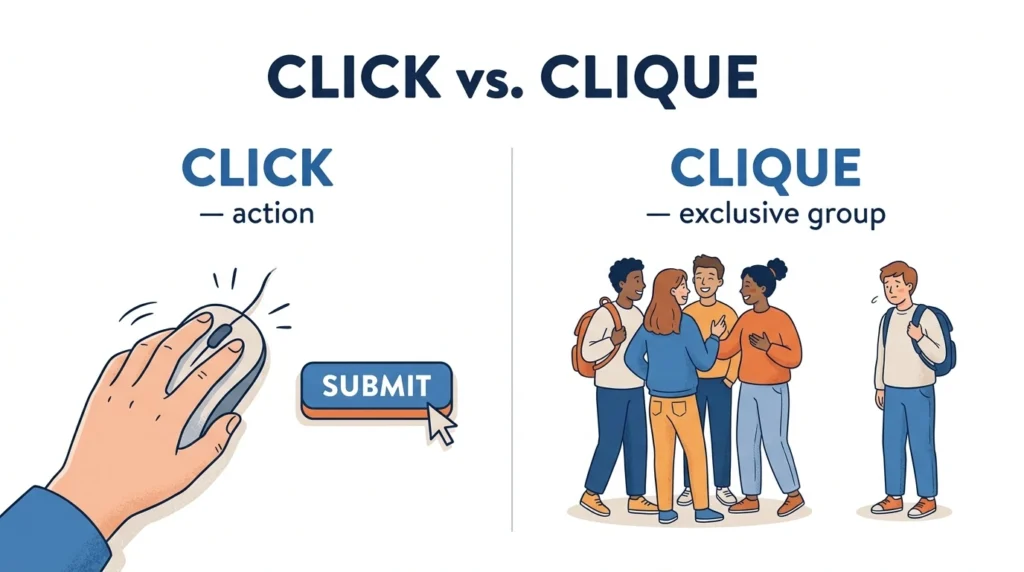

Click and clique are two different English words with different meanings. Click can mean to press a button or make a short, sharp sound. It can also mean to connect naturally with someone. Clique means a small, exclusive group of people who prefer to associate with one another and may exclude others. Use click for an action, sound, or connection; use clique for a social group.
What Is the Difference Between Click and Clique?
The main difference between click and clique is their meaning and grammatical use. Although the words sound identical in standard English pronunciation, they cannot be substituted for each other.
What Does Click Mean?
Click can function as both a verb and a noun.
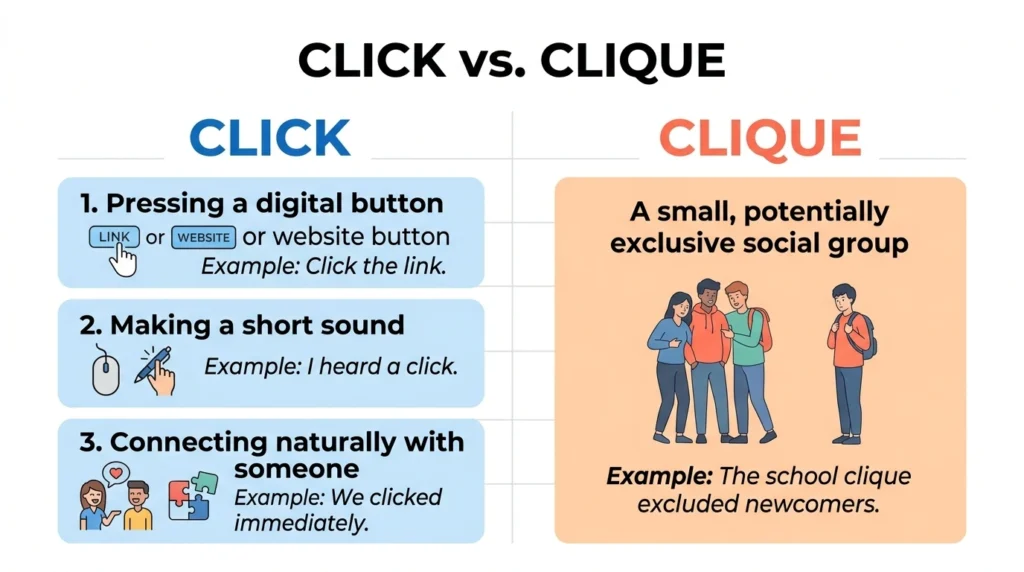
As a verb, it commonly means to press a mouse button, touchscreen control, or other digital interface. It can also describe a short, sharp sound or the moment when two people connect naturally.
Examples:
- Click the button to submit your application.
- The door clicked shut behind her.
- We clicked immediately when we met.
As a noun, click can refer to the sound, the act of pressing a control, or a selection made on a website or application.
Examples:
- I heard a click from the lock.
- One click will take you to the next page.
- The advertisement received thousands of clicks.
What Does Clique Mean?
Clique is a noun that refers to a small, close-knit group of people who associate mainly with one another and may be unfriendly or unwelcoming toward outsiders.
The word often appears in discussions about schools, workplaces, friendship circles, and social groups.
Examples:
- A clique of students sat together during lunch.
- New employees struggled to join the office clique.
- She disliked the exclusive clique that controlled the club.
A clique is not simply any group of friends. The word often suggests exclusivity, social barriers, or an unwillingness to include other people, although the degree of negativity depends on the context.
Why the Difference Matters
Confusing click with clique can change the meaning of a sentence completely.
Consider these two examples:
- Correct: Click the link to join the discussion.
- Correct: The clique refused to welcome new members.
In the first sentence, click describes an action. In the second, clique identifies a social group.
This distinction matters in several situations:
- Professional writing: Instructions such as “click here” must clearly describe an action.
- School assignments: Using clique when you mean a group of people helps communicate the intended social meaning.
- Digital marketing: A click is an interaction with an advertisement or link, not a group of people.
- Social commentary: Describing a group as a clique may suggest exclusion or an unhealthy social dynamic.
- Everyday conversation: Choosing the correct word prevents misunderstandings, especially in writing, where readers cannot rely on context or tone of voice.
Read More: Counselor vs Councilor: Meaning, Examples & Easy Trick.
The Core Rule
Use click for pressing, clicking sounds, or connecting naturally. Use clique for an exclusive social group.
Remember these distinctions:
- Click = action, sound, or connection.
- Clique = exclusive group of people.
- Clicked = past tense of the verb click.
- Cliques = plural of the noun clique.
Both words are correct English, but they serve different purposes.
How to Use Click and Clique Correctly
When to Use Click
Use click when describing a physical or digital action, a short sound, or a natural connection between people.
1. Digital actions
Use click when someone selects a button, link, icon, or other interactive element.
- Click the confirmation link in your email.
- Click the image to enlarge it.
- Please click the Submit button when you finish.
2. Sounds
Use click to describe a short, sharp sound.
- The camera made a click as she took the photograph.
- I heard the lock click into place.
- The old clock produced a steady click.
3. Personal connections
Use click informally when two people get along naturally or understand each other easily.
- We clicked during our first conversation.
- The new manager and her team clicked immediately.
- They did not click at first, but they eventually became friends.
4. Ideas or mechanisms coming together
Click can also describe a moment of sudden understanding or a mechanism engaging.
- Suddenly, the answer clicked.
- The pieces clicked into place.
- The latch clicked shut.
When to Use Clique
Use clique when referring to a group of people who associate closely with one another, often while keeping others at a distance.
1. School and university
- A clique of senior students dominated the common room.
- He felt left out because several classmates belonged to the same clique.
- The teacher encouraged students to mix instead of forming exclusive cliques.
2. Workplace relationships
- The office clique rarely invited new employees to lunch.
- She found it difficult to share ideas with an established clique.
- Managers should avoid allowing workplace cliques to influence important decisions.
3. Social groups
- The club became divided into several cliques.
- He wanted a welcoming community rather than an exclusive clique.
- Their friendship circle was open to everyone, so calling it a clique would have been unfair.
4. Politics and organizations
- A small clique of insiders controlled the organization.
- Critics accused the committee of becoming a clique.
- The article examined how an influential clique gained power within the institution.
Correct Examples of Click and Clique
The following examples show how the words work in different settings.
Everyday Conversation
- Click: “Click the switch to turn on the light.”
- Clique: “A clique of friends reserved the entire table.”
Email and Communication
- Click: “Please click the link below to confirm your attendance.”
- Clique: “I hope our department becomes a team rather than an exclusive clique.”
School and Education
- Click: “Click the correct answer before moving to the next question.”
- Clique: “The new student struggled to fit into the class clique.”
Workplace
- Click: “Click the attachment to review the updated report.”
- Clique: “The manager noticed that an office clique was excluding other colleagues.”
Social Media
- Click: “Users can click the profile picture to view the account.”
- Clique: “The discussion focused on how online cliques can discourage newcomers.”
Academic Writing
- Click: “The study recorded each click made by participants on the interface.”
- Clique: “The researcher examined the influence of peer cliques on students’ social experiences.”
Personal Relationships
- Click: “We clicked because we shared similar interests.”
- Clique: “She avoided the clique because its members frequently mocked outsiders.”
Each example uses the word according to its meaning. Neither spelling is a substitute for the other.
Read More: Nominator vs Nominee Differences: Meaning, Examples & Correct Usage.
Incorrect vs. Correct: Click vs. Clique
The most common mistake is choosing the spelling that sounds right rather than the word that fits the meaning.
| ❌ Incorrect | ✅ Correct | Why |
|---|---|---|
| The social click excluded everyone else. | The social clique excluded everyone else. | Clique refers to an exclusive social group. |
| Please clique the button below. | Please click the button below. | Click describes pressing a digital control. |
| I joined a click at university. | I joined a clique at university. | Clique names a close, potentially exclusive group. |
| The advertisement received 500 cliques. | The advertisement received 500 clicks. | Clicks is the plural of click and refers to interactions. |
| We cliqued as soon as we met. | We clicked as soon as we met. | Clicked informally means connected naturally. |
| The school has several social clicks. | The school has several social cliques. | The sentence refers to social groups. |
| Clicks of students controlled the club. | Cliques of students controlled the club. | Cliques is the plural form of clique. |
| I heard a clique when the lock opened. | I heard a click when the lock opened. | Click can describe a short, sharp sound. |
| The website tracks every clique on its links. | The website tracks every click on its links. | Website interactions are clicks, not cliques. |
| Our team is a close-knit click. | Our team is a close-knit clique. | Clique is the relevant word when describing a close, exclusive social group. |
| She clicked with an exclusive group of students, so it was a click. | She joined an exclusive clique of students. | Click can describe a personal connection, but clique identifies the group. |
| Click the link to meet the clique. | Click the link to meet the group. | The original sentence can be grammatically correct, but group is more neutral if exclusivity is not intended. |
Why People Confuse Click and Clique
1. They Sound the Same
In standard English, click and clique are homophones: words that share a pronunciation but have different meanings and spellings.
Both are commonly pronounced /klɪk/, rhyming with quick and brick.
Because their sounds are identical, listening alone cannot reliably tell you which spelling to use. You need to understand the meaning of the sentence.
2. Their Spellings Look Different but Seem Plausible
The spelling clique may look unfamiliar to learners who know the word click. Meanwhile, someone who has heard the expression “a social clique” might mistakenly write click because it is the more familiar spelling.
The solution is to connect each spelling with a specific meaning rather than memorize the sounds alone.
3. Spellcheck Does Not Always Catch the Error
Both click and clique are legitimate English words. A basic spellchecker may accept either spelling, even when the word is incorrect in context.
For example, “The office click excluded me” contains a real English word, but it does not communicate the intended meaning.
Always review the sentence’s meaning instead of relying entirely on automatic corrections.
4. Translation Can Cause Confusion
In some languages, a single word or expression may be used for a digital click, a clicking sound, or a social group depending on context. Learners may transfer that meaning directly into English.
When translating, identify the intended concept first: Is it an action, a sound, a personal connection, or a group of people?
5. Familiarity Can Override Meaning
People often choose the spelling they encounter most frequently. Because click is common in digital instructions and online marketing, writers may use it automatically when discussing a social group.
A simple meaning check prevents this error.
Common Mistakes Checklist
Before publishing or submitting your writing, check these frequent errors.
- Using click for a social group: Ask whether the sentence refers to people who associate with one another. If so, clique may be appropriate.
- Using clique for a digital action: If someone presses a button or link, use click.
- Writing cliques when you mean website interactions: The plural of click is clicks. The plural of clique is cliques.
- Assuming every friendship group is a clique: A clique often suggests exclusivity. A welcoming group of friends is not necessarily a clique.
- Trusting spellcheck without reviewing context: A correctly spelled word can still be the wrong word.
- Confusing clicked with cliqued: Clicked is the ordinary past-tense form for the action, sound, or informal connection. Cliqued is not the standard form for describing membership in a social group.
- Treating the words as regional spelling variants: Click and clique have different meanings; they are not American and British alternatives for the same word.
Click vs. Clique in Real English
Grammatically Correct
Both words are grammatically correct when used according to their meanings. “Click the icon” uses click as a verb, while “the clique excluded newcomers” uses clique as a noun. The key is the intended meaning, not pronunciation. Both words can appear naturally in formal or informal writing, depending on the sentence.
Grammatically Possible but Unnatural
A sentence can be grammatically possible yet communicate an unintended or awkward meaning. For example, “Our friendly team is a clique” is grammatically correct, but it may suggest that the team excludes outsiders. If you simply mean a group of colleagues who get along well, team or group is usually more precise.
Natural, Everyday English
In everyday English, people commonly say “click the link,” “I heard a click,” and “we clicked immediately.” The word clique appears naturally when people discuss exclusive social circles, such as school cliques or workplace cliques. Writers should not use clique merely as a sophisticated substitute for group, because it can imply social exclusion or insider status.
American vs. British English
There is no standard American-versus-British spelling difference for these words. Both varieties use click for an action or sound and clique for a social group.
| Feature | American English | British English |
|---|---|---|
| Digital action | Click the link. | Click the link. |
| Clicking sound | I heard a click. | I heard a click. |
| Exclusive social group | A school clique | A school clique |
| Plural of click | Clicks | Clicks |
| Plural of clique | Cliques | Cliques |
Pronunciation may vary slightly among individual speakers and accents, but the standard distinction in meaning and spelling remains the same.
Formal vs. Informal Usage
Formal Usage
Both words are acceptable in professional and academic writing.
- Click: “Participants clicked the control to advance to the next screen.”
- Clique: “The findings suggest that peer cliques may influence students’ social experiences.”
In formal writing, choose precise terms and avoid describing every social group as a clique unless exclusivity is relevant to your point.
Informal Usage
Both words are also common in conversation and casual writing.
- Click: “We clicked right away.”
- Clique: “That group acts like a clique.”
The informal expression “we clicked” means that two or more people connected or got along naturally. It does not mean they formed a clique.
Click vs. Clique: Comparison Table
| Feature | Click | Clique |
|---|---|---|
| Part of speech | Noun and verb | Noun |
| Main meaning | An action, sound, or natural connection | An exclusive social group |
| Pronunciation | /klɪk/ | /klɪk/ |
| Plural | Clicks | Cliques |
| Past tense | Clicked | No commonly used equivalent for ordinary group membership |
| Digital use | Clicking a link or button | Not normally used for digital interactions |
| Social use | Connecting naturally with someone | Describing a close, potentially exclusive group |
| Example | Click the icon. | The clique excluded newcomers. |
| Common phrase | “We clicked immediately.” | “A school clique” |
| Common error | Using it to mean a social group | Using it to mean a button press |
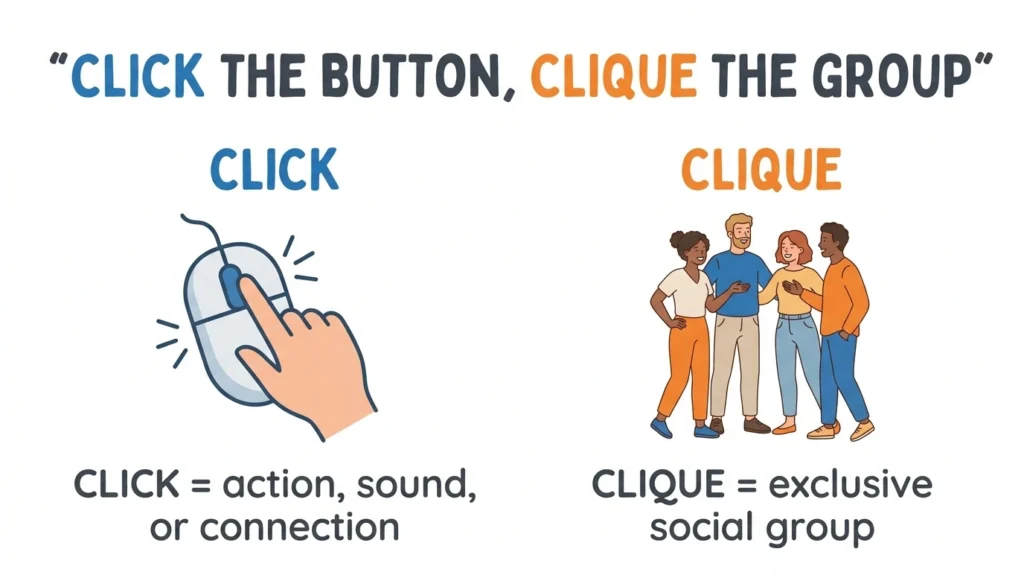
Memory Trick: Click the Button, Clique the Group
Use this simple mnemonic:
Click has a K for keyboard. Clique has a Q-like spelling for a group.
The association with a keyboard is a memory aid, not the origin of the word. Remember that click is used for pressing digital controls, making a short sound, or connecting naturally with someone. Clique is the word for an exclusive social group.
Test yourself with two questions:
- Are you pressing something or describing a sound? Use click.
- Are you describing a group of people who tend to exclude outsiders? Use clique.
If neither meaning fits perfectly, reconsider the sentence and choose the word that expresses your intended idea.
Click vs. Clique in Real-Life Situations
Situation 1: A Job Application
You receive an email asking you to complete an online application.
Correct: “Click the link to open the application form.”
Why? The sentence describes a digital action.
Situation 2: A New Employee
A new employee notices that several colleagues always socialize together and rarely welcome anyone else.
Correct: “An established workplace clique made it difficult for newcomers to feel included.”
Why? The sentence describes a potentially exclusive social group.
Situation 3: A First Meeting
Two colleagues meet for the first time and discover that they communicate easily.
Correct: “We clicked during our first meeting.”
Why? Clicked describes a natural personal connection.
Situation 4: A School Assignment
A student writes about social divisions among classmates.
Correct: “The researcher examined how school cliques affected students’ sense of belonging.”
Why? Cliques refers to social groups, not individual actions.
Situation 5: An Advertising Report
A marketing manager reviews a campaign’s performance.
Correct: “The advertisement generated 2,000 clicks during the campaign.”
Why? Clicks counts digital interactions with the advertisement.
Read More: Reining vs Reigning: Meaning, Examples, and the Right Spelling.
Expert Tips: How to Remember the Difference
- Replace the word with its meaning. If you can substitute press, sound, or connect, use click. If you mean an exclusive group, use clique.
- Check the surrounding words. Words such as button, link, mouse, and sound often signal click. Words such as exclusive, school, social, and outsiders may signal clique.
- Do not rely on pronunciation. These words sound the same in standard English, so context is essential.
- Check the plural carefully. Write website clicks but school cliques.
- Be careful with negative connotations. Calling a group a clique can imply that it is exclusive. Use group, team, or circle of friends when that implication is not intended.
- Proofread for meaning, not just spelling. A spellchecker may approve a correctly spelled word that is wrong for the context.
FAQ: Click vs. Clique
Is click or clique correct?
Both are correct English words. Click refers to an action, a short sound, or a natural connection. Clique refers to a close, often exclusive group of people. The correct choice depends on the meaning of your sentence.
Are click and clique homophones?
Yes. In standard English pronunciation, they are homophones because they sound alike but have different meanings and spellings.
What is the plural of clique?
The plural of clique is cliques. For example, “Several cliques formed within the organization.”
What is the plural of click?
The plural of click is clicks when used as a noun. For example, “The website recorded thousands of clicks.”
Can click be used as a verb?
Yes. Click is commonly used as a verb in digital instructions, descriptions of sounds, and informal expressions about personal connections. For example, “Click the button” and “We clicked immediately.”
Can clique be used as a verb?
Clique is not normally used as a verb in everyday standard English. Use phrases such as “form a clique,” “join a clique,” or “belong to a clique.”
Does clique always have a negative meaning?
Not necessarily, but it often carries a negative or critical suggestion of exclusivity. The word may be used neutrally in some contexts, but group is more appropriate when no exclusion is implied.
What does “we clicked” mean?
It means that two or more people connected naturally, understood each other, or got along well. It does not necessarily mean that they became close friends or joined the same social group.
Is “school click” correct?
If you mean an exclusive group of students, the correct expression is school clique. A click would refer to an action or sound, not the social group.
Is there a difference between click and clique in British English?
No standard spelling or meaning distinction separates British and American English here. Both varieties use click for the action or sound and clique for the social group.
Why does spellcheck sometimes miss click-versus-clique errors?
Both words are spelled correctly in isolation. A basic spellchecker may not understand that the selected word conflicts with the sentence’s intended meaning. Context-aware proofreading can help, but writers should still check the meaning themselves.
Quick Summary
Click and clique sound alike but have different meanings. Click can be a verb or a noun describing a button press, a short sound, or a natural connection between people. Clique is a noun for a close, often exclusive social group. Write “click the link,” “hear a click,” and “we clicked immediately,” but use “a school clique” or “an office clique” when describing social groups. Their plurals are clicks and cliques, respectively. Neither spelling is an American or British alternative to the other. To choose correctly, focus on the meaning of your sentence rather than pronunciation or spellcheck suggestions.