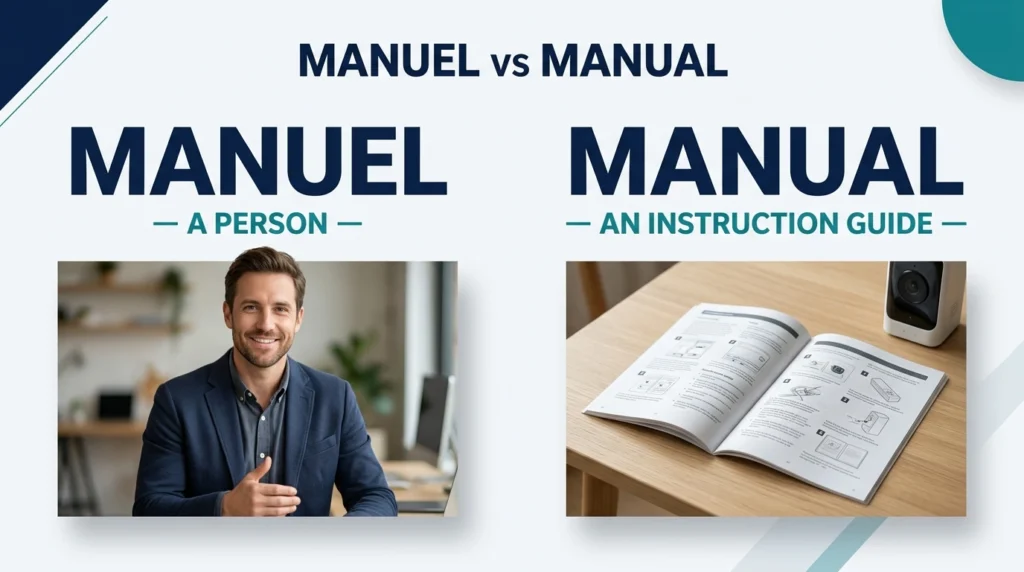

The correct spelling depends on what you mean. Manuel is usually a person’s name, while manual is an English word that refers to an instruction book or something done by hand. For example, write “Read the user manual” when referring to instructions, but write “Manuel sent the email” when referring to a person. The two spellings are not interchangeable in these contexts.
What Is the Difference Between Manuel and Manual?
Manuel and manual look almost identical, but they serve different purposes in English. The key difference is their meaning and grammatical function.
- Manuel: A proper noun, usually a person’s given name.
- Manual: A common noun meaning an instruction book, or an adjective describing something done by hand or operated directly by a person.
Consider these two sentences:
- Manuel checked the machine.
- Manuel checked the machine’s manual.
In the first sentence, Manuel is the person performing the action. In the second, the manual is the instruction book belonging to the machine.
Both spellings are valid, but you must choose the one that expresses your intended meaning.
What Does Manuel Mean?
Manuel is a personal name commonly used in Spanish- and Portuguese-speaking communities. It is also used in other cultures. When it refers to a person’s name, it is a proper noun and normally begins with a capital letter.
Examples of Manuel in a Sentence
- Manuel will attend the business meeting tomorrow.
- I asked Manuel to review the report.
- Manuel is learning how to drive.
- Our new colleague, Manuel, joined the team last Monday.
- The teacher asked Manuel to present his project.
In each example, Manuel identifies a person.
Is Manuel Ever Correct in English?
Yes. Manuel is correct when it is someone’s actual name. It is not an alternative English spelling of manual when you mean an instruction book or hand-operated activity.
For example:
- Correct: “Manuel prepared the presentation.”
- Incorrect for the intended meaning: “Please read the Manuel before installing the software.”
- Correct: “Please read the manual before installing the software.”
The distinction is about meaning, not simply which spelling looks right.
What Does Manual Mean?
The word manual has two common uses in English. It can be a noun or an adjective.
Manual as a Noun
As a noun, a manual is a book, document, or guide that explains how to use, operate, repair, or understand something.
Examples include:
- A user manual for a mobile phone
- An employee manual explaining workplace policies
- A training manual for new staff
- A repair manual for a vehicle
- An instruction manual for assembling furniture
Example sentence: “The technician consulted the repair manual before replacing the component.”
Here, manual means a guide containing useful instructions.
Read More: Click vs. Clique: Meaning, Difference, Examples & Common Mistakes.
Manual as an Adjective
As an adjective, manual describes work performed by hand or a process that requires direct human action rather than being automatic.
Examples include:
- Manual labor
- Manual data entry
- Manual inspection
- Manual control
- Manual operation
Example sentence: “The company replaced manual data entry with an automated system.”
In this sentence, manual describes how the data was entered.
Manual in Everyday English
You will encounter manual in many ordinary situations.
- Technology: “Download the software manual.”
- Education: “The teacher distributed a laboratory manual.”
- Business: “Every employee must follow the operations manual.”
- Automotive: “He prefers a car with a manual transmission.”
- Manufacturing: “The process still requires manual inspection.”
None of these examples should use Manuel unless the sentence is referring to a person with that name.
Why Does the Difference Matter?
A spelling mistake can change the meaning of a sentence, make instructions confusing, or create an unprofessional impression.
Imagine a company sending this message to new employees:
“Please read the employee Manuel before your first day.”
The reader might wonder whether Manuel is a colleague they need to contact. The intended phrase is employee manual, a document containing workplace rules and procedures.
The same problem can occur in academic assignments, product descriptions, customer support messages, and technical documentation.
Using the correct word helps you:
- Communicate your intended meaning clearly.
- Avoid confusing a person with a document.
- Write professional emails and reports.
- Produce accurate educational and technical content.
- Prevent simple spelling errors from distracting readers.
The mistake is easy to fix once you check the meaning of the sentence rather than relying only on how the word looks.
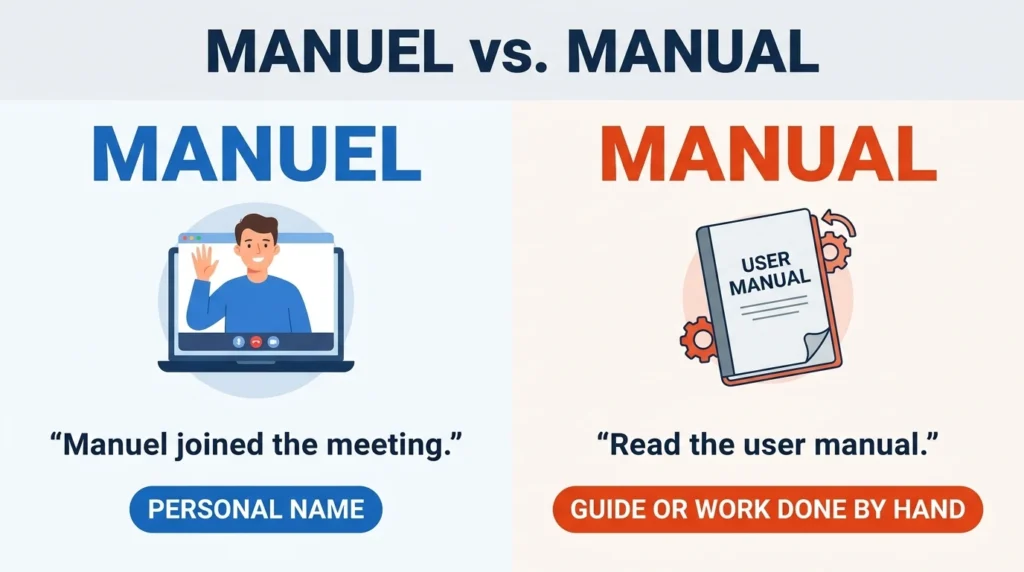
The Core Rule: When to Use Manuel or Manual
Use Manuel for a person’s name.
Example: Manuel will lead the meeting.
Use manual for a guide or instruction book.
Example: Read the installation manual.
Use manual to describe work done by hand.
Example: The team performed a manual inspection.
If the word refers to a person, choose Manuel. If it refers to instructions, handwork, or direct human control, choose manual.
How to Use Manuel and Manual Correctly
The easiest approach is to identify what the word represents in your sentence.
Step 1: Identify the Meaning
Ask yourself whether you are referring to a person, a guide, or an activity.
- A person: Manuel
- A guide or handbook: manual
- Work performed by hand: manual
Step 2: Check the Word’s Role
Look at how the word functions in the sentence.
When Manuel is a name:
“Manuel answered the customer’s question.”
Manuel identifies the person who answered.
When manual is a noun:
“The manual contains troubleshooting instructions.”
Manual identifies a document.
When manual is an adjective:
“The operator completed a manual check.”
Manual describes the type of check.
Step 3: Check the Spelling and Capitalization
Manuel normally starts with a capital M because it is a proper name. The common word manual is generally lowercase unless it begins a sentence or appears in a title where capitalization rules require it.
Compare:
- “Manuel downloaded the manual.”
- “The manual was downloaded by Manuel.”
Both sentences are correct. The capitalized name and lowercase common noun have different roles.
Correct Examples of Manuel vs Manual
The following examples show how the two spellings work in everyday writing.
| Context | Correct example | Why it is correct |
|---|---|---|
| Conversation | “Manuel, can you help me?” | Manuel is the person being addressed. |
| “Please send me the user manual.” | Manual refers to an instruction guide. | |
| School | “Manuel submitted his homework.” | Manuel identifies a student. |
| Workplace | “Read the employee manual before starting.” | Manual refers to a workplace guide. |
| Social media | “Thanks, Manuel, for sharing this advice.” | Manuel is a person’s name. |
| Academic writing | “The laboratory manual describes the experiment.” | Manual refers to a document. |
| Technology | “I downloaded the printer manual.” | Manual provides operating instructions. |
| Automotive | “Manuel drives a manual car.” | Manuel is the driver; manual describes the car’s transmission. |
| Manufacturing | “The factory still uses manual assembly.” | Manual describes work involving direct human effort. |
| Customer service | “Manuel from support sent me the setup manual.” | Manuel is an employee; manual is the guide. |
| Training | “The new staff manual explains the procedure.” | Manual refers to written guidance. |
| Research | “Manuel presented the findings at the conference.” | Manuel identifies the presenter. |
Notice that one sentence can correctly contain both words. Their meanings remain distinct even when they appear together.
Incorrect vs Correct: 12 Common Examples
Use this table to identify spelling mistakes and understand why each correction is needed.
| ❌ Incorrect | ✅ Correct | Why |
|---|---|---|
| Please read the user manuel. | Please read the user manual. | The sentence refers to an instruction guide. |
| I downloaded the car manuel. | I downloaded the car manual. | Manual is the correct noun for the guide. |
| The employee manuel explains the rules. | The employee manual explains the rules. | The document is an employee manual, not a person. |
| Check the printer manuel before printing. | Check the printer manual before printing. | The sentence concerns operating instructions. |
| Our training manuel needs updating. | Our training manual needs updating. | Manual names the training document. |
| The technician performed a manuel inspection. | The technician performed a manual inspection. | Manual is an adjective describing the inspection. |
| We use manuel data entry for these records. | We use manual data entry for these records. | Manual describes a process performed by a person. |
| This machine requires manuel operation. | This machine requires manual operation. | Manual describes direct human operation. |
| manuel will call you after lunch. | Manuel will call you after lunch. | A person’s name normally begins with a capital letter. |
| I asked Manuel to send the manuel. | I asked Manuel to send the manual. | Manuel is the person; manual is the document. |
| Please give Manuel the instruction manuel. | Please give Manuel the instruction manual. | The intended object is an instruction book. |
| The repair manuel is available online. | The repair manual is available online. | Manual is the standard English spelling for the guide. |
What About “Manual” at the Beginning of a Sentence?
The common word manual can also begin a sentence with a capital M.
For example:
“Manual inspection is required before the machine can be released.”
Here, Manual is not a person’s name. Its capitalization is required because it begins the sentence.
Therefore, capitalization is a useful clue, but meaning is the more reliable test.
Why People Confuse Manuel and Manual
Several factors can make these spellings difficult to distinguish, especially when typing quickly.
1. Similar Spelling
The words share five letters and differ in their final vowel sequence: Manuel ends in -uel, while manual ends in -ual.
When someone recognizes the general shape of a word rather than checking each letter, the wrong spelling can slip through.
2. Similar Pronunciation
The two forms may sound similar to some English speakers, particularly in fast speech or when the speaker is unfamiliar with the name Manuel.
However, pronunciation of the name can vary across languages and individuals. It is safer to use the meaning of the sentence to choose the spelling.
3. Typing Quickly
Writers may accidentally type manuel while intending to write manual. This can happen in emails, text messages, articles, and workplace documents.
A quick proofreading check can catch the error.
4. Autocorrect and Spellcheck
A spellchecker may recognize both forms as valid strings because Manuel is a real personal name and manual is a standard English word.
That means a sentence can contain a correctly spelled word that is still the wrong choice for the context.
For example, a spellchecker may not flag “Please read the user Manuel.”
5. Translation Interference
People who learn English alongside another language may encounter different spelling and grammatical conventions. In some languages, a form resembling manuel is itself a valid word related to a handbook or something done by hand.
A learner may therefore transfer a familiar spelling into English. When writing in English, use the standard English spelling manual for the instruction book or hand-related meaning.
Read More: Counselor vs Councilor: Meaning, Examples & Easy Trick.
Common Mistakes Checklist
Before publishing or submitting your writing, check these common problems.
- Using “manuel” for a guide: Replace it with manual when you mean an instruction book.
- Using “manuel” for work done by hand: Write manual labor, manual entry, or manual inspection.
- Writing a person’s name in lowercase: Use Manuel when it is the person’s actual name, except where a person’s chosen styling or a specific naming convention differs.
- Assuming spellcheck guarantees correct usage: Read the entire sentence and verify the meaning.
- Assuming British and American English use different spellings: Both use manual for the common English word.
- Changing a person’s name to fit a spelling rule: Preserve the person’s actual name, even if it resembles another word.
- Correcting only the spelling without checking meaning: Confirm that the word makes sense in the sentence.
A final read-through is especially useful for words that spellcheck may accept but that do not fit the intended meaning.
Manuel vs Manual in Real English
Grammatically Correct
Both forms can be correct in English, but they perform different jobs. Manuel is correct when it refers to a person whose name is Manuel. Manual is correct as a noun for a guide or as an adjective describing hand-performed work or direct human control. For example, “Manuel read the manual” is grammatically correct because each word has a distinct meaning and role.
Grammatically Possible but Unnatural
A sentence may be grammatically possible yet confusing if the writer chooses a word that does not fit the intended context. For example, “I downloaded the Manuel” could make sense if Manuel were the title of a specific work or a person’s name in a particular context, but it would not be the natural way to refer to an ordinary instruction guide. In standard English, write “I downloaded the manual.”
Natural, Everyday English
In everyday English, people commonly say user manual, instruction manual, manual labor, manual transmission, and manual process. When talking about someone named Manuel, they use the name itself. The words are not interchangeable simply because their spellings look similar. If you are unsure, ask whether you can replace the word with “a person named Manuel” or “a guide or hand-operated process.” That quick meaning check usually resolves the choice.
American vs British English
There is no standard American-versus-British spelling difference between Manuel and manual.
Both varieties use:
- Manuel for a person’s name.
- Manual for an instruction book or something done by hand.
Examples:
- American English: “Read the owner’s manual.”
- British English: “Read the owner’s manual.”
- American English: “Manuel is joining us tomorrow.”
- British English: “Manuel is joining us tomorrow.”
The spelling does not change based on the English variety. Regional differences in pronunciation, or the pronunciation of an individual’s name, do not make manuel a standard alternative spelling for the English word manual.
Formal vs Informal Usage
Both words are appropriate in formal and informal writing when used correctly.
Formal Usage
Use manual in technical documentation, reports, academic work, training materials, and business communication.
Examples:
- “The operating manual outlines the required safety procedures.”
- “Manual verification was completed before the report was approved.”
Use Manuel when referring to a person by that name:
– “Manuel will present the findings at the meeting.”
Informal Usage
The same distinction applies in everyday conversations, chats, and social media posts.
Examples:
- “Manuel is coming over later.”
- “Where did you put the manual?”
- “I prefer a manual car.”
There is no informal spelling variation that makes manuel correct when you mean an instruction book. The intended meaning, not the level of formality, determines which word to use.
Read More: Nominator vs Nominee Differences: Meaning, Examples & Correct Usage.
Comparison Table: Manuel vs Manual
| Feature | Manuel | Manual |
|---|---|---|
| Word type | Proper noun when used as a personal name | Common noun or adjective |
| Main meaning | A person’s name | A guide, or something done by hand |
| Typical spelling | Manuel | manual |
| Capitalization | Normally capitalized as a name | Normally lowercase, except where capitalization rules apply |
| Example as a noun | “Manuel arrived early.” | “The manual is on the desk.” |
| Example as an adjective | Not normally used this way in English | “The process requires manual input.” |
| Common contexts | Personal introductions, emails, records, conversations | Instructions, technology, work, vehicles, training |
| American/British spelling | Same personal-name spelling | Same common-word spelling |
| Can they be exchanged? | No, not when meanings differ | No, not when meanings differ |
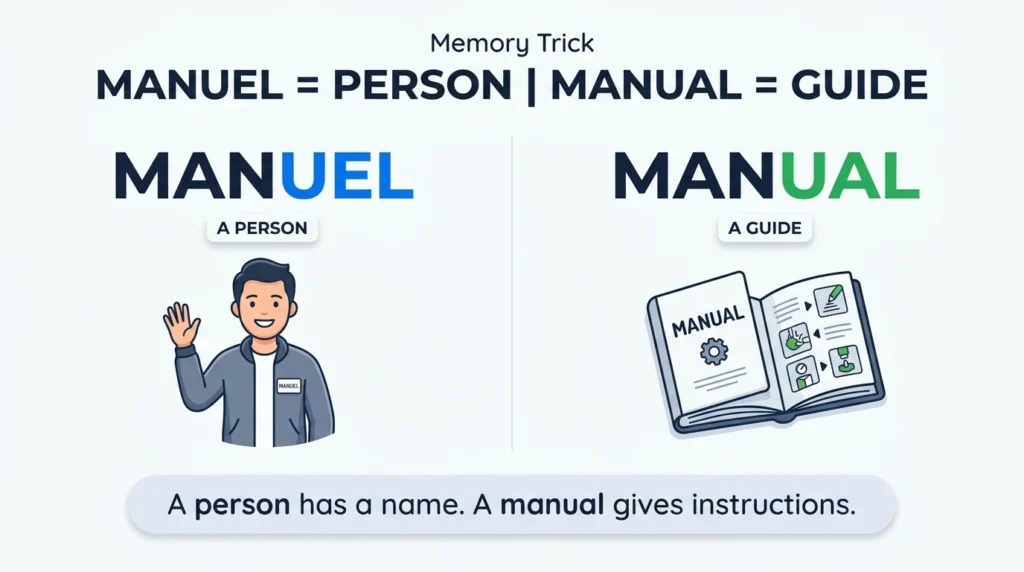
Memory Trick: One Is a Person, the Other Is a Guide
Use this simple mnemonic:
Manuel = a man or person. Manual = a guide or work done by hand.
The word manual is connected to the idea of hands. You may hold a manual while learning how to use a device, or perform a manual task without automation.
For example:
“Manuel used the manual to repair the machine.”
- Manuel is the person.
- Manual is the guide.
Remember the final letters, too: -uel in the name, -ual in the common English word.
This is a memory aid, not a general spelling rule for other English words.
Manuel vs Manual in Real-Life Situations
Situation 1: A Job Interview
A hiring manager asks you to review the company’s workplace policies.
Incorrect: “I reviewed the employee Manuel.”
Correct: “I reviewed the employee manual.”
The correct form refers to the document that explains workplace rules.
Situation 2: A Business Email
You need to send instructions to a customer who has purchased a product.
Incorrect: “Please find the product manuel attached.”
Correct: “Please find the product manual attached.”
The word manual identifies the attached guide.
Situation 3: A Text Message
You are arranging to meet a colleague.
Correct: “Manuel will meet us outside the office.”
Here, Manuel is the person’s name. There is no reason to use manual.
Situation 4: A School Assignment
You are describing a practical experiment that requires a student to check the instructions.
Incorrect: “Follow the laboratory manuel.”
Correct: “Follow the laboratory manual.”
The correct spelling refers to the document that explains the procedure.
Situation 5: A Technical Meeting
An engineer explains that a machine cannot complete a particular task automatically.
Correct: “The operator must use manual control.”
Manual describes the method of operating the machine.
Situation 6: A Conversation About Cars
You are explaining why someone prefers a particular vehicle.
Correct: “Manuel prefers driving a car with a manual transmission.”
The first word identifies the driver; the second describes the transmission type.
Expert Tips for Avoiding the Mistake
These practical checks are useful for writers, students, editors, and English learners.
- Check the meaning before the spelling. Decide whether the sentence refers to a person, a document, or an activity.
- Look at the surrounding words. Phrases such as user manual, repair manual, and manual process are strong clues that you need manual.
- Do not trust autocorrect alone. A correctly spelled name can still be incorrect in a sentence about instructions.
- Read the sentence aloud. Hearing the sentence in context may help you notice that the word does not make sense.
- Protect people’s names. If someone is named Manuel, use the correct spelling of their name rather than changing it to match the common word.
- Proofread high-visibility writing. Check product guides, business emails, website content, and academic submissions before sending or publishing them.
The most reliable technique is to replace the word mentally with its meaning. If you mean “the instruction book,” write manual. If you mean “the person,” write Manuel.
Quick Summary
Manuel vs manual is a spelling comparison involving two forms with different meanings. Manuel is usually a personal name and should normally be capitalized when referring to a person. Manual is the standard English word for an instruction book or something done by hand. It can function as a noun, as in “user manual,” or an adjective, as in “manual inspection.” Neither spelling is a standard substitute for the other in these contexts. American and British English follow the same distinction. To choose correctly, check the meaning of the sentence: a person is Manuel, while a guide or hand-performed activity is manual.
Frequently Asked Questions
1. Is Manuel or manual the correct spelling?
Both spellings are correct in different contexts. Use Manuel for a person’s name and manual for an instruction book or something performed by hand.
2. Is “manuel” a spelling mistake?
Not always. Manuel is a valid personal name. However, writing manuel when you mean an instruction book or manual task is a spelling mistake in standard English.
3. Is it user manuel or user manual?
The correct phrase is user manual. It refers to a document that explains how to use a product, device, or software application.
4. What is the plural of manual?
The plural of manual is manuals. For example: “The technician stored all the equipment manuals in a cabinet.”
5. Can manual be used as a verb?
In standard everyday English, manual is not normally used as a verb. It functions mainly as a noun or adjective. You can say “perform the task manually,” using manually as an adverb.
6. What is the difference between manual and manually?
Manual is a noun or adjective, while manually is an adverb describing how an action is performed.
Examples:
- “This is a manual process.”
- “The records were entered manually.”
7. Is manual the same as automatic?
No. Manual generally refers to something performed or controlled directly by a person, while automatic describes something that operates without requiring the same direct human action.
For example, manual data entry requires a person to enter the information, while an automated system can enter or transfer it automatically.
8. Is Manuel a male or female name?
Manuel is traditionally a masculine given name in Spanish and Portuguese usage. However, a person’s actual name should always be respected regardless of general naming conventions.
9. Is there a difference between Manuel and manual in British English?
No standard spelling difference exists between British and American English for these words. Both varieties use Manuel as a personal name and manual for an instruction guide or hand-performed activity.
10. How can I remember the difference between Manuel and manual?
Remember this simple association: Manuel is a person; a manual is a guide. If you are discussing instructions, a handbook, or work done by hand, choose manual. If you are referring to someone named Manuel, use the name.
Mini Quiz: Manuel vs Manual
Test your understanding with these 10 questions. Try answering each one before checking the explanation.
Knowledge check
0 of 10 answered
Choose one answer for each question, then check your results.
1. Please read the user ___ before installing the application.Manuelmanualmanually
2. ___ will present the report at the meeting.ManualManuelManually
3. The technician performed a ___ inspection.manuelManuelmanual
4. Which sentence is correct?I downloaded the printer manuel.I downloaded the printer manual.I downloaded the printer manually.
5. Correct this sentence: manuel sent me the instructions.Manuel sent me the instructions.Manual sent me the instructions.Manually sent me the instructions.
6. The records were entered ___.Manuelmanualmanually
7. Which phrase is correctly spelled?Employee manuelEmployee manualEmployee manually
8. Manuel prefers a ___ transmission.manuelmanualmanually
9. Is this sentence correct? “Manuel read the manual.”Yes, both words are correct.No, both words should be manual.No, both words should be Manuel.
10. Choose the correct spelling: “The process requires ___ data entry.”Manuelmanuelmanual.