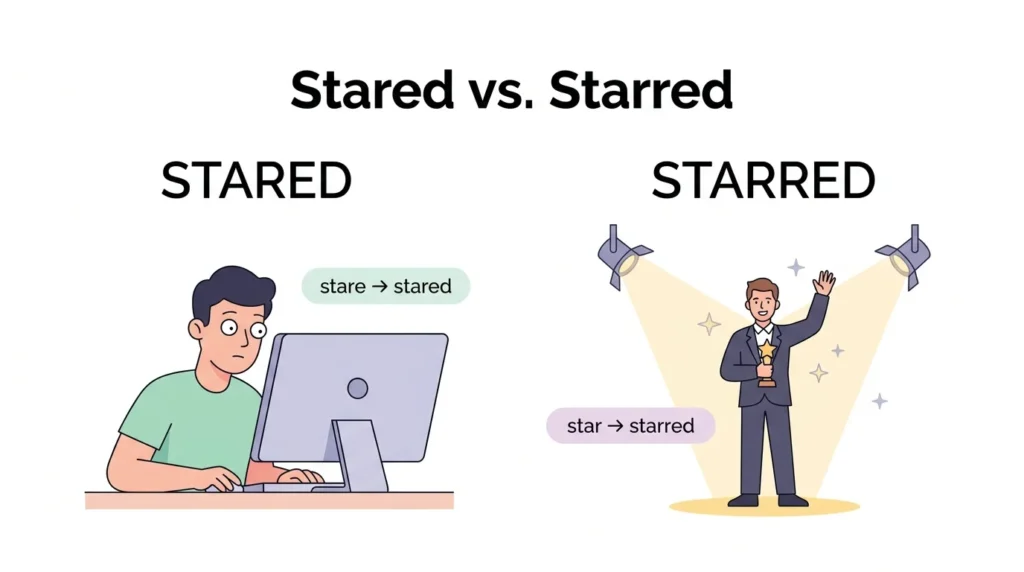

Stared is the past tense of stare, meaning to look at someone or something for a long time, often with fixed attention. Starred is the past tense of star, meaning to play a leading role, feature prominently, or mark something with a star or asterisk. Use stared when the sentence is about looking; use starred when it is about starring, featuring, or marking something.
What Is the Difference Between Stared and Starred?
Stared and starred are two different words formed from two different verbs:
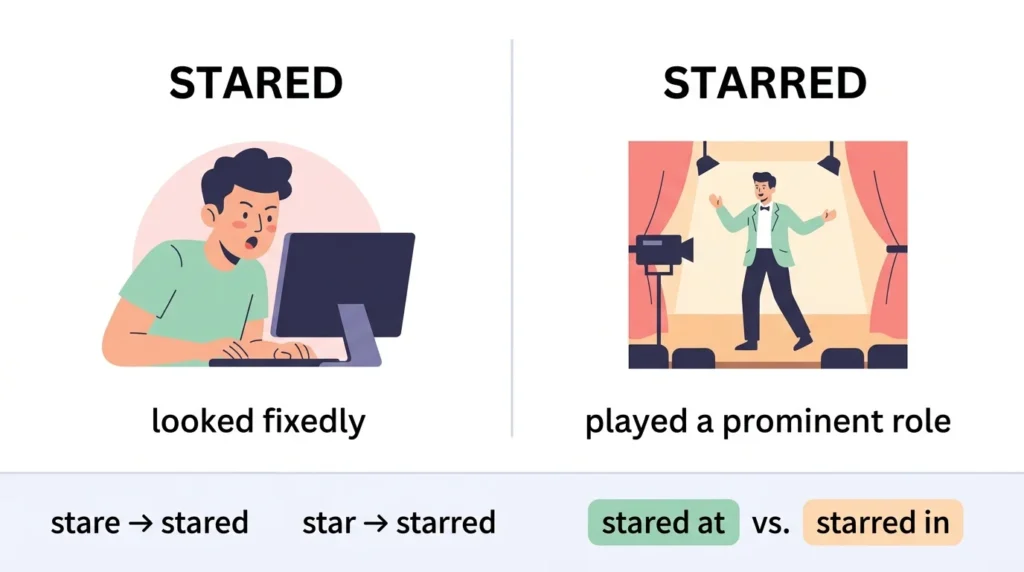
- Stared → past tense of stare → looked fixedly or intently.
- Starred → past tense of star → played a leading role, featured prominently, or marked something with a star.
The difference is only one letter, but the meanings are completely different.
Compare these sentences:
She stared at the screen.
She looked at the screen for a period of time.
She starred in the movie.
She had a leading or prominent role in the movie.
Both sentences are grammatically correct. Changing stared to starred, however, changes the meaning completely.
The verb stare is associated with a fixed or prolonged look. The verb star has several meanings, including playing a prominent role and marking something with a star or asterisk.
Why Does the Difference Matter?
This spelling difference matters because both stared and starred are legitimate English words. A spellchecker may therefore accept either one even when you have chosen the wrong word for your sentence.
For example:
❌ The actor stared in the new film.
The sentence suggests that the actor looked at something in the film rather than played a role.
✅ The actor starred in the new film.
Here, starred correctly means that the actor had a prominent role.
The reverse mistake can be just as confusing:
❌ He starred at the strange painting.
✅ He stared at the strange painting.
These errors can appear in emails, essays, social media posts, articles, captions, and professional writing. Because both spellings are valid words, simply running a spellcheck is not always enough.
The Core Rule
If someone is looking, use stared. If someone is starring, featuring, or marking something with a star, use starred.
An even shorter memory rule is:
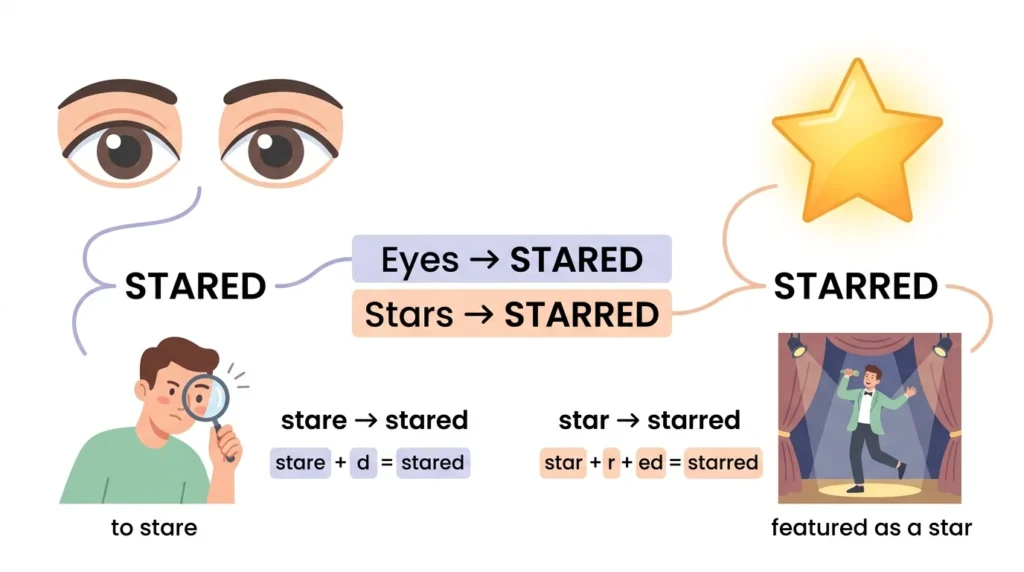
Eyes → stared.
Stars → starred.
If the sentence involves a person’s gaze, stared is usually the word you need.
If it involves a movie role, a prominent performance, an important item marked with an asterisk, or another use of the verb star, choose starred.
How to Use “Stared”
Stared is the simple past tense and past participle of stare.
To stare means to look directly or fixedly at someone or something for a relatively long time. It can express surprise, concentration, confusion, fear, curiosity, anger, or other reactions.
Stared at a person
Maya stared at her brother in disbelief.
She looked at him for a prolonged period because she was surprised.
Stared at an object
I stared at the broken computer, wondering what had happened.
Stared into the distance
He stared into the distance and said nothing.
Stared out the window
She stared out the window during the long train ride.
Stared blankly
The student stared blankly at the exam paper.
The expression stared at is particularly common, but stared can also occur with other structures such as stared into, stared out, or stared down. Cambridge and Merriam-Webster both give examples of these constructions.
How to Use “Starred”
Starred is the simple past tense and past participle of star.
The verb star has several uses, so starred is not limited to movies.
Starred in a movie or show
The actor starred in a popular television series.
Here, starred in means had a prominent role in the production.
Starred in a play
She starred in the school play last year.
Starred in a sports context
The verb can also describe someone who performed outstandingly in a sporting context.
The young player starred in the championship match.
Starred an important item
Starred can also mean marked something with a star or asterisk to identify it as important.
I starred the questions I needed to review.
The editor starred the paragraph that needed revision.
This broader use is important because starred does not always mean “acted in a movie.” Dictionary definitions include uses involving prominent performance, marking with a star, marking with an asterisk, and other star-related meanings.
Correct Examples
Here are examples showing how the two words work in different real-life situations.
- Conversation:
“Why are you stared at me?” is incorrect. Say, “Why did you stare at me?” or “Why did you stare at me?” - Past conversation:
“Everyone stared at the magician when the lights suddenly went out.” - Email:
“I starred your email so I could remember to respond later.” - Workplace:
“The manager starred the three proposals that needed immediate attention.” - Entertainment:
“The actress starred in the new drama.” - School:
“I starred the questions that I found difficult.” - Academic writing:
“The researcher stared at the data for several minutes before noticing the error.” - Social media:
“I stared at the post for a few seconds before deciding what to comment.” - Storytelling:
“The children stared at the enormous dinosaur model.” - Film review:
“The comedy starred several well-known performers.” - Meeting:
“Everyone stared at the presentation screen when the unexpected result appeared.” - Task management:
“I starred the most urgent tasks on my list.”
Notice that context determines the correct spelling.
Read More: Waring vs Wearing: Which Word Is Correct?
Incorrect vs. Correct
| ❌ Incorrect | ✅ Correct | Why |
|---|---|---|
| The actor stared in the movie. | The actor starred in the movie. | Starred means played a prominent role. |
| She starred at the painting. | She stared at the painting. | Stared describes prolonged looking. |
| He stared the important email. | He starred the important email. | The email was marked with a star. |
| They starred at each other. | They stared at each other. | The sentence describes fixed eye contact. |
| The actress stared in the play. | The actress starred in the play. | She had a leading or prominent role. |
| I stared the difficult questions. | I starred the difficult questions. | The questions were marked with a star. |
| We starred at the strange object. | We stared at the strange object. | The action is looking. |
| The film stared a famous actor. | The film starred a famous actor. | The film featured the actor prominently. |
| She starred at her phone all night. | She stared at her phone all night. | She was looking at the phone. |
| He stared in a Broadway production. | He starred in a Broadway production. | Starred in means performed a prominent role. |
| I stared the message for later. | I starred the message for later. | A message can be marked with a star. |
| The students starred at the teacher. | The students stared at the teacher. | The students were looking at the teacher. |
Why Do People Confuse Stared and Starred?
The confusion is understandable because the words are visually similar.
1. They contain almost the same letters
Compare:
stared
starred
The difference is easy to overlook when reading quickly.
2. They sound very similar
In many varieties of English, especially in rapid speech, the two forms can be difficult to distinguish by ear. This makes the problem particularly common in writing rather than speech.
3. Both are real words
This is one of the biggest problems.
A spelling checker can recognize both:
- stared
- starred
If you write the wrong one for your intended meaning, the software may not flag it as a spelling error.
4. The base verbs are easy to overlook
The safest way to solve the problem is to identify the base verb:
stare → stared
star → starred
Once you identify the base verb, the correct past-tense form becomes much easier to choose.
5. Translation can interfere
English learners who translate directly from another language may select the word that looks or sounds closest to the intended translation. This can produce a correctly spelled English word that is still wrong in context.
The solution is not to translate the individual word. Instead, identify the meaning of the entire sentence.
Common Mistakes Checklist
Mistake 1: Writing “stared in a movie”
Wrong:
He stared in the movie.
Correct:
He starred in the movie.
Why: The actor had a role in the movie, so the base verb is star, not stare.
Mistake 2: Writing “starred at”
Wrong:
She starred at the screen.
Correct:
She stared at the screen.
Why: She was looking at the screen. The correct base verb is stare.
Mistake 3: Forgetting the second “r”
Wrong:
The film stared two famous actors.
Correct:
The film starred two famous actors.
The past tense of star is starred, with two rs.
Mistake 4: Assuming spellcheck will catch everything
Spellcheck can identify many spelling mistakes, but it cannot always determine which correctly spelled word matches your intended meaning.
Mistake 5: Thinking “starred” only means acting
Starred can also mean marked with a star or asterisk and can describe outstanding performance in contexts beyond acting.
Stared vs. Starred in Real English
Stared: grammatically correct and natural
I stared at the screen for several minutes.
This is ordinary, natural English. Stared at is a standard construction used when someone looks fixedly or for a prolonged period.
Starred: grammatically correct and natural
She starred in the television series.
This is also natural English when discussing a prominent role in a film, show, play, or similar production.
Starred: natural outside entertainment
I starred the files that need immediate attention.
This is possible when the system or document uses a star or asterisk to mark items.
A subtle point about “stared”
Not every sentence involving visual attention needs stared. English has many alternatives:
- looked at
- watched
- glanced at
- gazed at
- observed
- studied
- peered at
Stared suggests a relatively fixed or prolonged look. It is therefore stronger than the neutral looked at. Cambridge describes staring as looking for a long time, often with the eyes wide open, while Merriam-Webster similarly defines it as looking fixedly.
A subtle point about “starred”
Do not automatically replace starred with featured. They can overlap, but starred can specifically indicate a prominent or leading role, especially in entertainment.
The movie starred two famous actors.
is more specific than simply:
The movie featured two famous actors.
The second sentence does not necessarily imply that they played the leading roles.
American vs. British English
There is no meaningful American-versus-British spelling difference between stared and starred.
Both varieties use:
- stared for the past tense of stare
- starred for the past tense of star
The pronunciation of stare can vary by accent, but that does not change the spelling rule.
Cambridge provides both UK and US pronunciation information for stare, while the spelling distinction remains the same.
Formal vs. Informal Usage
Both stared and starred are standard words and can appear in formal and informal English.
Formal examples
The committee starred the recommendations requiring further review.
The researcher stared at the results before revising the analysis.
Informal examples
I just stared at my phone for ten minutes.
She starred in that show everyone is talking about.
The important issue is not formality. It is meaning.
Comparison Table
| Feature | Stared | Starred |
|---|---|---|
| Base verb | stare | star |
| Basic meaning | Looked fixedly or intently | Played a prominent role or marked with a star |
| Past tense | stared | starred |
| Main idea | Looking | Featuring, marking, or performing prominently |
| Common phrase | stared at | starred in |
| Example | She stared at the door. | He starred in the film. |
| Can describe eye movement? | Yes | No |
| Can describe a movie role? | No | Yes |
| Can mean marked with an asterisk? | No | Yes |
| Extra letter | No doubled r | Double r |
The Spelling Rule Behind “Stared” and “Starred”
The spelling becomes easier when you start with the base verb.
Stare → stared
The verb stare ends in a silent e.
To form its regular past tense, the final e is removed before -d is added:
stare → stared
Star → starred
The verb star is a short verb ending in a single vowel followed by a consonant. In this past-tense formation, the final consonant is doubled before -ed:
star → starred
So:
stare → stared
but:
star → starred
Do not try to memorize stared and starred as isolated spellings. Remember their base verbs instead.
Memory Trick
Use this simple mnemonic:
Eyes have an E: stARE → stAREd.
Think:
stare → eyes → stared
For starred, think:
star → extra R → starred
You can also remember:
If you see with your eyes, you stared. If you see a star, you starred.
The second version is not a grammatical rule; it is simply a memory aid.
Real-Life Situations
In a job interview
The interviewer asked an unexpected question, and I stared at my notes for a moment before answering.
The action is looking, so stared is correct.
In a team meeting
The manager starred the three proposals that required immediate discussion.
The proposals were marked, so starred is correct.
In an email
I starred your email so I would remember to reply.
The email was marked with a star.
In a text message
I stared at your message for five minutes before deciding what to say.
The person was looking at the message.
In an exam
The student stared at the final question because she could not remember the answer.
Again, the meaning is prolonged looking.
In entertainment writing
The new drama starred two internationally known actors.
Here, starred means featured them in prominent roles.
Expert Tips
1. Look for “in”
When you see a sentence such as:
___ in a movie
the intended verb is often starred.
She starred in the movie.
2. Look for “at”
When you see:
___ at the screen
the intended verb is normally stared.
He stared at the screen.
This is not an absolute grammatical test, but it is a very useful practical clue.
3. Go back to the base verb
Ask:
Is the verb stare or star?
Then form the past tense:
stare → stared
star → starred
4. Do not trust pronunciation alone
If the words sound similar in your accent, listen for the meaning rather than trying to hear the extra r.
5. Do not trust spellcheck alone
Both words are correctly spelled. Context determines which one is appropriate.
6. Remember that “starred” has more than one meaning
If you learn starred = acted in a movie, you will still miss sentences where something is marked with an asterisk or star.
7. Learn the common patterns
Memorize these two:
stared at
starred in
They cover a large number of everyday cases.
Quick Summary
Stared and starred are different words with different meanings. Stared is the past tense of stare, meaning to look at someone or something fixedly or for a relatively long time. Starred is the past tense of star, which can mean to play a prominent role, perform outstandingly, or mark something with a star or asterisk. The easiest way to choose is to identify the base verb: stare → stared, while star → starred. Remember “eyes → stared” and “stars → starred.” When in doubt, look at the surrounding words: stared at commonly describes looking, while starred in commonly describes a prominent role in a production.
Frequently Asked Questions
Is “stared” the correct past tense of “stare”?
Yes. Stared is the simple past tense and past participle of stare.
She stared at the photograph.
The word describes looking fixedly or for a relatively long time.
Is “starred” the correct past tense of “star”?
Yes. Starred is the past tense and past participle of star.
He starred in the film.
It can also describe marking something with a star or asterisk.
Is it “stared in a movie” or “starred in a movie”?
The correct expression is starred in a movie when you mean that someone played a prominent role.
The actor starred in the movie.
Is it “stared at me” or “starred at me”?
The correct expression is stared at me when you mean someone looked at you intently.
She stared at me without saying anything.
Why does “starred” have two r’s?
The spelling comes from the base verb star. In this past-tense formation, the final consonant is doubled before -ed:
star → starred
By contrast:
stare → stared
The final e in stare is removed before -d is added.
Can “starred” mean “marked with a star”?
Yes. Starred can mean that something was marked with a star or asterisk to indicate importance, quality, or another special status.
I starred the most important points in my notes.
Can “stared” mean more than just looking?
Yes. Stare has some extended uses. For example, something can metaphorically “stare” from a page when it is extremely obvious or conspicuous. But the normal everyday meaning involves a fixed or prolonged look.
Are “stared” and “starred” pronounced differently?
They can be difficult to distinguish in speech, depending on accent and speaking speed. The safest way to choose between them is to identify the intended meaning and base verb rather than relying only on pronunciation.
Is “starred” only used for actors?
No. It can be used for prominent performers and outstanding performances in other contexts, and it can also mean marking something with a star or asterisk.
What is the easiest way to remember stared vs. starred?
Remember:
Eyes → stared.
Stars → starred.
Then connect each word to its base verb:
stare → stared
star → starred
Which is correct: “The movie stared him” or “The movie starred him”?
The movie starred him is correct when the movie featured him in a prominent role.
The movie starred him as a detective.
The verb star can be transitive, meaning it can take an object directly.
Mini Quiz
| # | Question | Answer | Explanation |
|---|---|---|---|
| 1 | The children ___ at the fireworks. (stared/starred) | stared | They were looking at the fireworks. |
| 2 | The actress ___ in three films last year. (stared/starred) | starred | She had prominent roles in the films. |
| 3 | I ___ the most important items on the list. (stared/starred) | starred | The items were marked with stars. |
| 4 | He ___ at the clock during the meeting. (stared/starred) | stared | He was looking at the clock. |
| 5 | Choose the correct sentence: A) She starred at me. B) She stared at me. | B | The sentence describes looking at someone. |
| 6 | Choose the correct sentence: A) He stared in the play. B) He starred in the play. | B | Starred in means played a prominent role. |
| 7 | Fill in the blank: “The manager ___ the applications that needed review.” | starred | The applications were marked for attention. |
| 8 | Fill in the blank: “She ___ blankly at the question.” | stared | She was looking fixedly at the question. |
| 9 | Correct this sentence: “The film stared two famous actors.” | The film starred two famous actors. | Starred means the film featured the actors prominently. |
| 10 | Correct this sentence: “He starred at the strange machine.” | He stared at the strange machine. | The sentence describes looking at the machine. |