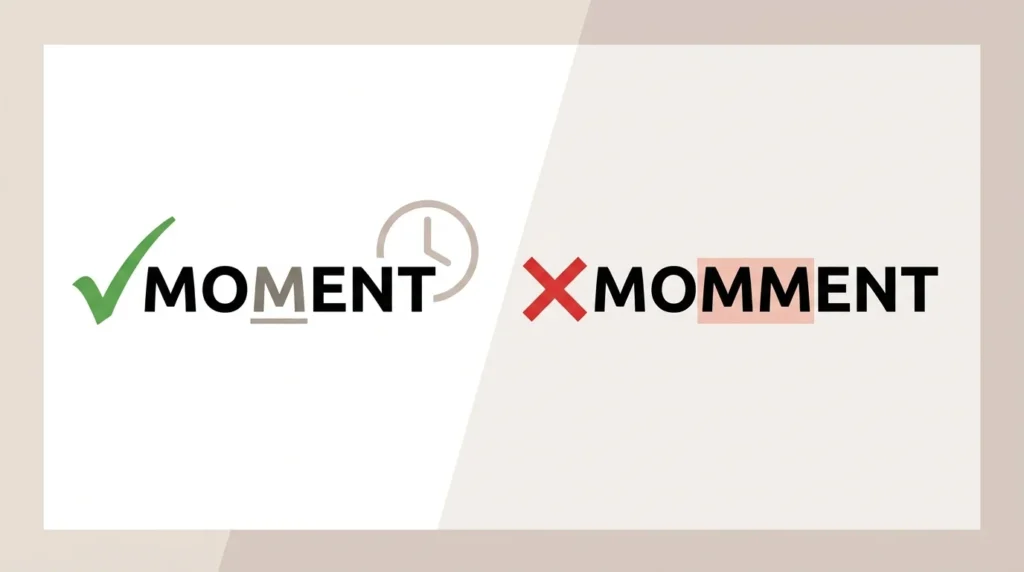

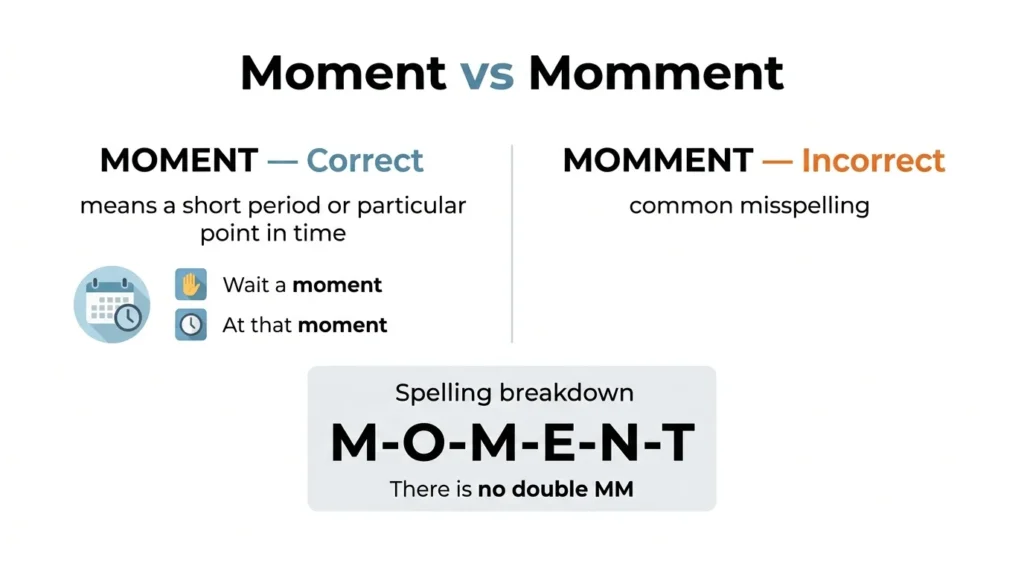
Moment is the correct spelling. Momment is a misspelling. Write moment with one m in the middle: m-o-m-e-n-t. A moment can mean a very short period of time, a particular point in time, the present time in certain phrases, or an important occasion. Momment is not the standard English spelling of this word.
The rule: Always write moment, never momment, when you mean a short period, a point in time, or an important occasion.
What Is a Moment?
Moment is a noun. A noun is a word used to name a person, place, thing, idea, event, or—in this case—a point or period of time.
In everyday English, a moment commonly means a short, unspecified amount of time:
“Give me a moment to check.”
It can also identify a particular point when something happens:
“At that moment, the lights went out.”
The word has several established meanings. It can refer to a brief period, a specific point in time, the present time, an important occasion, or significance. It also has specialized meanings in subjects such as physics and statistics.
Momment, by contrast, is simply an incorrect spelling when the intended word is moment.
Why the Correct Spelling Matters
A single extra letter may look like a small mistake, but spelling affects how readers judge a piece of writing.
Writing momment instead of moment can be especially noticeable in:
- job applications and résumés
- business emails
- school assignments
- reports and proposals
- website copy
- social media graphics
- presentations
- academic papers
- advertisements
- professional messages
A typo in a casual text may cause little trouble. The same typo in an email subject line, headline, application, or client proposal can make the writing look less carefully reviewed.
The meaning is usually still understandable, but correct spelling protects credibility.
The Core Rule for Moment vs Momment
The spelling rule could hardly be simpler:
Correct: moment
Incorrect: momment
The correct letter sequence is:
M-O-M-E-N-T
Notice that there are two m’s in the whole word—one at the beginning and one later in the word—but there is no double “mm.”
That distinction matters because saying “moment has only one m” would itself be inaccurate. It has two m letters in total. What it does not have is a doubled mm.
Read More: Faring vs Fairing: What’s the Difference?
Is Momment Ever Correct?
Not as the standard English spelling of moment.
If you are describing time, an occasion, an important point, or one of the word’s technical meanings, use moment.
A brand name, username, fictional name, or intentionally altered spelling could theoretically contain Momment, but that would not make it the normal English word.
How to Use Moment Correctly
Use moment when you mean a short period, a particular point in time, an opportunity, or an important occasion. Established dictionaries also record specialized and less common meanings beyond ordinary time expressions.
The most useful patterns are:
- a moment — a short amount of time
“Could you wait a moment?” - the moment — a particular or identifiable point in time
“I remember the moment we met.” - at the moment — now or currently
“I am busy at the moment.” - in a moment — very soon
“I will call you back in a moment.” - for a moment — for a short period
“She stopped for a moment.” - in the moment — focused on or fully experiencing the present situation
“Try to stay in the moment.” - a defining/important/critical moment — an important point or occasion
“The decision became a defining moment in the project.” - moments — the normal plural
“We shared several memorable moments.”
“A Moment,” “The Moment,” and “Moments”
The article before moment can change the meaning slightly.
A Moment
Use a moment when the exact point or duration is not specifically identified.
“Can I speak to you for a moment?”
The speaker means a short amount of time, not one previously identified moment.
The Moment
Use the moment when you mean a specific point in time that the listener can identify from context.
“That was the moment I changed my mind.”
Here, the speaker has a particular moment in mind.
The moment can also mean as soon as in constructions such as “The moment the meeting ended, she called me.” This use is established in standard English.
Moments
The regular plural is moments.
Moment → moments
Not:
Momment → momments
Correct Examples of Moment
Here are original examples across everyday conversation, education, work, digital communication, and formal writing.
- Conversation: “Give me a moment; I need to find my keys.”
- Customer service: “One moment, please, while I check your account.”
- Email: “I would appreciate a moment of your time to discuss the revised proposal.”
- Workplace: “This may be the right moment to raise the budget issue.”
- Meeting: “At that moment, the entire team understood the problem.”
- School: “The teacher gave us a moment to review our answers.”
- Academic writing: “The reform represented a significant moment in the development of the institution.”
- Social media: “Such a proud moment for everyone involved!”
- Text message: “Busy at the moment—I’ll call you later.”
- Interview: “One moment that shaped my career was leading my first major project.”
- Storytelling: “For a moment, the room became completely silent.”
- Presentation: “This is a critical moment for the organization because the next decision will shape our expansion.”
Incorrect vs. Correct: Moment or Momment
| ❌ Incorrect | ✅ Correct | Why |
|---|---|---|
| Please wait a momment. | Please wait a moment. | The standard spelling has no doubled mm. |
| I need a momment to think. | I need a moment to think. | Moment is the correct noun for a short period of time. |
| At that momment, I understood. | At that moment, I understood. | A particular point in time is a moment. |
| I’m busy at the momment. | I’m busy at the moment. | The established phrase is at the moment, meaning currently. |
| I’ll be ready in a momment. | I’ll be ready in a moment. | In a moment means very soon. |
| It was a proud momment for us. | It was a proud moment for us. | An important or emotional occasion can be called a moment. |
| Take a momment to read the instructions. | Take a moment to read the instructions. | The word for a brief amount of time is spelled moment. |
| This is a critical momment in the project. | This is a critical moment in the project. | Moment can describe an important stage or point in a process. |
| We shared several memorable momments. | We shared several memorable moments. | The plural of moment is moments. |
| Stay in the momment and focus. | Stay in the moment and focus. | In the moment is the standard expression for focusing on the present experience. |
Why Do People Spell Moment as Momment?
The error is understandable because English spelling contains many doubled consonants, but moment is not one of the words that doubles its middle m.
Read More: Check-In vs. Check In: Which One Is Correct?
Double-Letter Pattern Confusion
Writers see many familiar English words containing mm, so a doubled consonant can look visually plausible.
That does not mean every similar-looking word follows the same pattern. Moment must simply be learned with its established spelling.
The Word Contains Two M Sounds and Letters
The word begins with m and contains another m later:
mo-ment
When writers remember the rough visual shape rather than the exact sequence of letters, they may accidentally turn the second m into mm.
The pronunciation itself does not require a doubled consonant.
Fast Typing
Sometimes momment is not a spelling misunderstanding at all. A writer may simply strike the m key twice.
This is especially easy to miss when typing quickly on a phone.
Overgeneralising English Spelling Patterns
Learners often look for rules that can be applied to many words. That strategy is useful, but English spelling contains many individual word patterns.
A double consonant in one word does not prove that a visually similar word should also contain one.
Autocomplete and Spellcheck Are Helpful, Not Perfect
Most modern spelling tools can flag many obvious misspellings, but no proofreading system should replace careful reading.
Settings, custom dictionaries, formatting, application behavior, and user choices can affect whether a mistake is caught or corrected.
Translation Interference
Translation interference is not a major explanation that should automatically be blamed for this particular error.
An ESL learner’s first language may influence spelling habits in some situations, but momment is more straightforwardly explained by visual memory, doubled-letter confusion, or typing error unless there is evidence of a specific language-based pattern.
Common Mistakes Checklist
- Writing “momment” because it looks balanced: English words do not need visually symmetrical spellings. Memorize moment as a complete word rather than guessing from appearance.
- Thinking moment has only one m in total: It actually has two—m-o-m-e-n-t. The rule is that it has no double mm.
- Writing “momments” as the plural: The correct plural is moments.
- Confusing “at the moment” with “in a moment”: At the moment generally refers to now; in a moment points to the near future.
- Using “moment” only for a few seconds: The word can also identify a particular or important point in time, not merely a measurable short duration.
- Assuming every occurrence has the same meaning: “Wait a moment,” “a defining moment,” and “at the moment” use the same noun in different semantic contexts.
- Trusting autocorrect without proofreading: A tool can help, but visible headings, graphics, captions, and client-facing documents deserve a manual check.
- Confusing moment with momentum: The words are related historically but have different meanings in modern everyday English.
Moment in Real English
Grammatically Correct and Natural
Moment appears naturally in both everyday speech and more careful writing. Common expressions include “wait a moment,” “at the moment,” “for a moment,” “in a moment,” and “a memorable moment.” Native speakers do not normally notice these expressions as formal or unusual because they are ordinary parts of English. The exact phrase matters, however, because changing the preposition can change the meaning.
Grammatically Possible but Unnatural
A sentence can contain the correctly spelled word moment and still sound awkward. For example, “I will perform the task after one moment” is understandable, but in ordinary conversation “I’ll do it in a moment” is more natural when the speaker means “very soon.” Correct spelling does not guarantee natural phrasing; common combinations of words, called collocations, also matter.
Incorrect English
Momment should not be used as an alternative spelling simply because the text is casual, conversational, or online. Informal English allows contractions, slang, fragments, emojis, and many relaxed constructions, but ordinary informality does not turn a spelling error into a standard variant. If the intended word is the English noun referring to time, an occasion, or significance, the normal spelling remains moment.
Moment vs Momment Comparison Table
| Feature | Moment | Momment |
|---|---|---|
| Standard English spelling | ✅ Yes | ❌ No |
| Correct for a short period of time | ✅ Yes | ❌ No |
| Correct for a particular point in time | ✅ Yes | ❌ No |
| Can refer to an important occasion | ✅ Yes | ❌ No |
| Part of speech | Noun | No standard role as this word |
| Plural | Moments | Not the standard form |
| Used in “at the moment” | ✅ Yes | ❌ No |
| Used in “in a moment” | ✅ Yes | ❌ No |
| Suitable for formal writing | ✅ Yes | ❌ Not as the spelling of moment |
| Suitable for casual writing | ✅ Yes | ❌ Still a misspelling |
| American English | Moment | Incorrect |
| British English | Moment | Incorrect |
Moment, Momentum, and Movement
These words look related enough to create additional confusion, but they are not interchangeable.
| Word | Basic Meaning | Example |
|---|---|---|
| moment | a short period, particular point, or important occasion | “It was a special moment.” |
| momentum | force or progress that keeps something moving or developing | “The campaign gained momentum.” |
| movement | an act of moving, a change of position, or an organized group/campaign | “The camera detected movement.” |
Do not choose the word based only on visual similarity. Choose it according to meaning.
Memory Trick for Moment
Use this mnemonic:
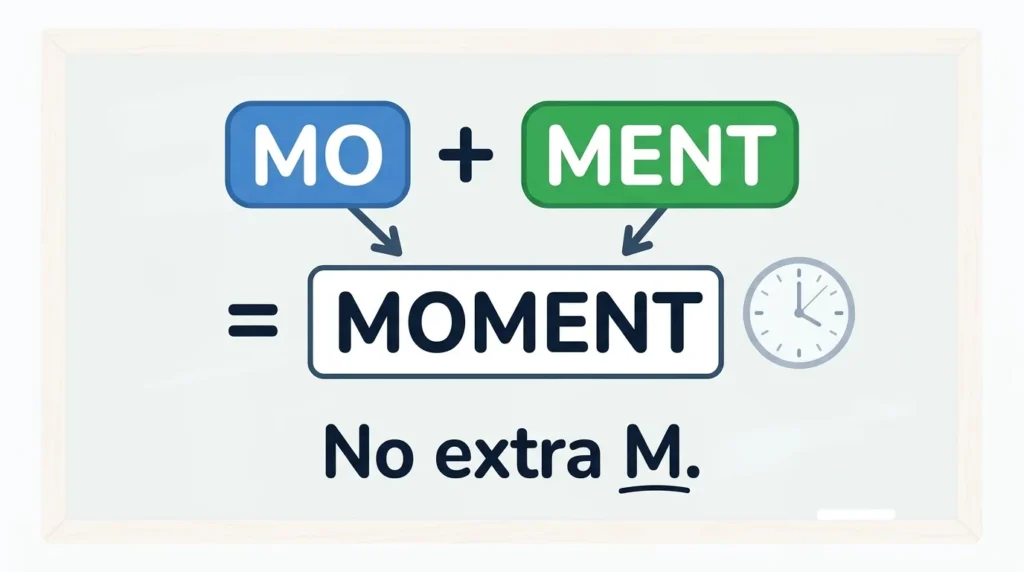
“MO + MENT = MOMENT. No extra M.”
Picture the word as two visual chunks:
MO | MENT
Put them together:
MO + MENT = MOMENT
Not:
MO + MMENT = MOMMENT
Another useful reminder is to connect the spelling with the familiar phrase:
“One moment, please.”
When you visualize that sentence, visualize MOMENT as six letters.
Read More: Skiid vs Skied: Which Spelling Is Correct?
Real-Life Situations
In an Interview
You need a second to organize your answer.
Natural: “That’s a good question. Give me a moment to think.”
Writing the same sentence in an interview task or follow-up document requires moment, not momment.
In a Meeting
The team reaches an important stage.
Natural: “This is a critical moment for the project.”
Here, moment means an important point in the project’s development, not necessarily a period lasting only a few seconds.
In an Email
You are currently unavailable.
Natural: “I’m tied up at the moment, but I can review the document this afternoon.”
At the moment means currently or now.
In a Text Message
A friend asks when you will be ready.
Natural: “I’ll be there in a moment.”
Here, in a moment points forward: the action will happen very soon.
In an Exam
The question asks you to correct:
“It was the happiest momment of her life.”
Write:
“It was the happiest moment of her life.”
The correction is spelling, not grammar or meaning.
Expert Tips for Remembering and Using Moment
Learn the Whole Word Instead of Inventing a Rule
Not every English spelling needs a complicated grammar rule. Some words are best remembered as complete letter patterns.
For moment, memorize:
M-O-M-E-N-T
Proofread the Most Visible Text Twice
Typos in body paragraphs can be missed. Typos in titles, headings, advertisements, thumbnails, email subject lines, and presentation slides are much more noticeable.
Check high-visibility text separately.
Search for Your Personal Misspelling
If you know you often type momment, use your document’s search function to look specifically for:
momment
This is faster than hoping your eyes catch every occurrence.
Learn Phrases, Not Just Individual Words
Learning moment inside common phrases improves both spelling and natural usage:
- a moment
- for a moment
- at the moment
- in a moment
- at that moment
- the right moment
- a defining moment
- memorable moments
Pay Attention to Prepositions
The spelling stays the same, but the phrase can change meaning:
at the moment = now
in a moment = very soon
for a moment = for a short time
in the moment = focused on the present experience
This distinction is more useful to learners than simply memorizing “moment means a short time.”
Mini Quiz: Moment vs Momment
| # | Question | Answer | Explanation |
|---|---|---|---|
| 1 | Which is correct: moment or momment? | Moment | The standard spelling contains no doubled mm. |
| 2 | Fill in the blank: “Please give me a ___ to finish this.” | moment | A brief period of time is a moment. |
| 3 | Correct the sentence: “This is an important momment for our company.” | “This is an important moment for our company.” | Momment contains an unnecessary extra m. |
| 4 | Which phrase means “currently”: at the moment or in a moment? | At the moment | At the moment commonly means now. |
| 5 | Fill in the blank: “I’ll be with you in a ___.” | moment | In a moment means very soon. |
| 6 | What is the plural of moment? | Moments | Add -s to form the regular plural. |
| 7 | Correct the sentence: “We enjoyed several unforgettable momments.” | “We enjoyed several unforgettable moments.” | The plural follows moment → moments. |
| 8 | Which is natural: “I need a moment to think” or “I need a momment to think”? | I need a moment to think. | The first sentence uses the standard spelling. |
| 9 | In “That was a defining moment,” does moment have to mean only a few seconds? | No | It can refer to an important point or occasion. |
| 10 | True or false: Momment becomes acceptable in informal messages. | False | Informal register does not make it the standard spelling of moment. |
Expert Tips
When the error appears repeatedly in your writing, do more than correct it once. Build a visual memory of MOMENT.
A practical method is:
See it → say it → type it → use it in a phrase.
For example:
MOMENT → “Give me a moment.”
This approach connects spelling with real language rather than an isolated list of letters.
Also remember that spelling and usage are separate skills. Once you can spell moment, learn its common phrases. A learner who writes at the moment and in a moment correctly has gained more useful English than someone who only knows that momment is wrong.
FAQ
Is “momment” a word?
Momment is not the standard English spelling of moment. When you mean a period of time, a point in time, an occasion, or the established noun with related technical meanings, write moment. Current standard dictionary entries use moment.
How do you spell moment correctly?
Spell it:
M-O-M-E-N-T
There are two m letters in the complete word, but they are separated. There is no mm.
What is the plural of moment?
The plural is moments.
One moment → two moments
You simply add -s.
What is the difference between “at the moment” and “in a moment”?
At the moment generally means now or currently:
“She’s unavailable at the moment.”
In a moment generally means very soon:
“She’ll call you in a moment.”
Standard learner dictionaries record these established patterns.
What does “in the moment” mean?
In the moment usually describes giving your attention to what is happening or what you are experiencing right now.
For example:
“During the performance, she stopped worrying and stayed in the moment.”
It should not be confused with in a moment, which normally points to something happening soon.
What does “for a moment” mean?
For a moment means for a short period of time.
Example:
“He stopped speaking for a moment.”
The phrase describes the duration of an action or state.
Does moment always mean a very short period?
No. That is one major meaning, but moment can also identify a particular point, an important occasion or stage, the present time in established expressions, or significance. It also has specialized technical meanings.
What is the difference between moment and momentum?
A moment commonly refers to time or a particular occasion.
Momentum commonly refers to the force or progress that keeps an object, activity, or process moving.
Compare:
“Winning the award was a special moment.”
“The team gained momentum after its first victory.”
What is the difference between moment and movement?
Moment concerns a point or period of time in everyday use.
Movement usually concerns motion, change of position, or an organized social or political effort.
Example:
“I noticed a sudden movement near the door.”
“Everything changed at that moment.”
Is the spelling different in American and British English?
No. The standard spelling is moment in both American and British English. There is no standard moment/momment regional spelling contrast.
Can I use “momment” in a casual text message?
If you intend the normal English word moment, it is still a spelling error. Casual communication may tolerate more typos, but the standard spelling does not change.
Is “one moment please” correct English?
Yes. “One moment, please” is a natural way to ask someone to wait briefly. In careful writing, the comma before please is appropriate because please functions as a polite marker added to the request.
Quick Summary
Moment is the correct spelling; momment is a misspelling. Write the word M-O-M-E-N-T, with two m’s in total but no doubled mm. A moment can refer to a short period of time, a particular point, an important occasion, or the present time in expressions such as at the moment. Remember that at the moment means currently, while in a moment usually means very soon. The plural is moments. The error momment often comes from double-letter confusion, visual memory, or fast typing. For an easy reminder, split the word into MO + MENT = MOMENT. Whether you are writing casually, academically, or professionally, use moment.