
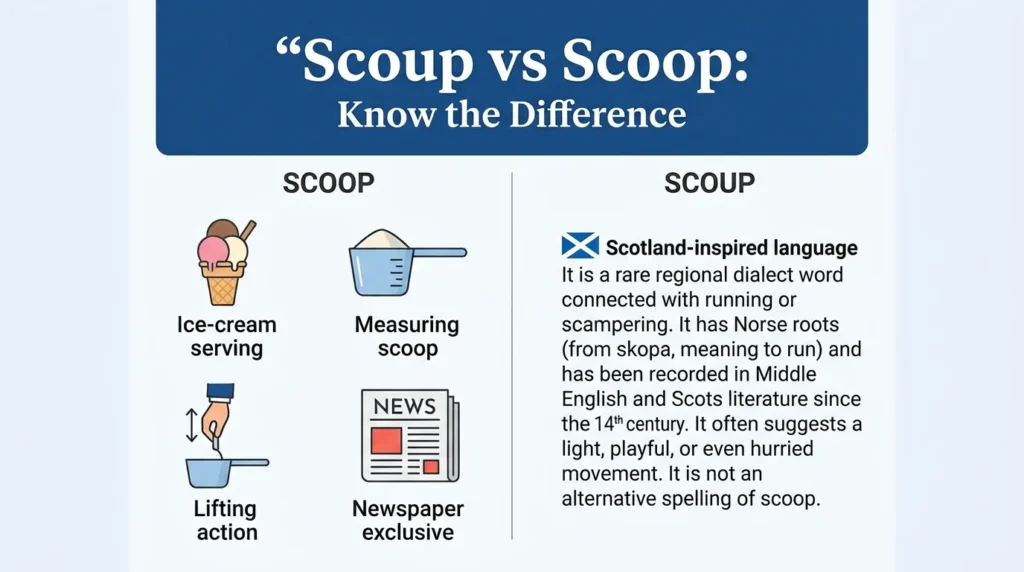
If you mean a spoon-like tool, a portion of something, the action of lifting or gathering, or an exclusive piece of news, scoop is the correct standard spelling. Scoup should not replace scoop in those meanings. However, scoup does exist as a rare Scottish or Scots verb connected with running, scampering, or moving with skips and leaps.
So, in almost every everyday sentence where you are choosing between scoup vs scoop, choose scoop.
What Is Scoup vs Scoop?
The confusion between scoup and scoop is mainly a spelling issue rather than a choice between two common words with similar meanings.
Scoop is a standard English word. It can function as a noun, which means it can name a thing, amount, or piece of information. It can also function as a verb, meaning an action such as lifting, collecting, or removing something with a curved movement. Dictionaries also record its familiar journalism meaning: an exclusive or important news story.
Scoup, by contrast, is not the standard spelling for any of those meanings. If you write a scoup of ice cream, scoup the rice, or an exclusive scoup, you have almost certainly misspelled scoop.
There is one useful exception. Scoup has been recorded in Scottish English and Scots as a regional word associated with running, rushing, bounding, or scampering. That dialect use does not make it an alternative spelling of scoop in ordinary modern writing.
Why It Matters
A one-letter spelling error may seem minor, but it can distract readers from your message.
If you write scoup when you mean scoop in a résumé, school assignment, business email, article, report, or professional social post, readers may see it as a spelling mistake. The problem becomes especially noticeable because scoop is a familiar everyday word.
Correct spelling also prevents meaning problems. A reader who knows the rare Scottish word scoup may recognize that it belongs to a completely different regional usage.
The safest approach is simple: match the spelling to the meaning you actually intend.
The Core Rule
Rule: If you mean a serving, spoon-like tool, lifting or gathering action, or exclusive information, write scoop. Use scoup only when you genuinely mean the rare Scottish/Scots regional verb—not as another spelling of scoop.
The Fastest Decision
- Ice cream or another serving → scoop
- A spoon-like or shovel-like tool → scoop
- Lift or collect something → scoop
- Remove something from inside → scoop out
- Gather something quickly → scoop up
- Exclusive news → scoop
- Inside information → the scoop
- Rare Scottish dialect meaning “run/scamper” → scoup
Read More: Naive vs Nieve: Which Spelling Is Correct?
How to Use Scoop
Scoop as a Noun for a Tool
A scoop can refer to a utensil or tool with a hollow or bowl-like part used for lifting or moving material.
Example:
I left the flour scoop inside the container.
Here, scoop names an object, so it functions as a noun.
Scoop as a Noun for an Amount
A scoop can also mean the amount held by that type of tool.
Example:
Add one scoop of powder to the water.
The word refers to a measured amount rather than the tool itself.
Scoop as a Verb
As a verb, scoop means to lift, collect, move, or remove something using a scoop or a similar curved movement.
Example:
She scooped rice into the bowls.
The main verb is scooped. Its standard forms are:
- scoop
- scoops
- scooped
- scooping
Do not change these to scoup, scoups, scouped, or scouping when you mean the standard verb.
Scoop Up
Scoop up often means to pick up or gather something quickly.
Example:
He scooped up the scattered papers before leaving.
It can also describe lifting a person or animal with the arms.
Example:
She scooped up the sleepy puppy and carried it inside.
Scoop Out
Scoop out means to remove material from the inside of something, often with a spoon or similar tool.
Example:
Scoop out the seeds before filling the peppers.
Scoop in Journalism
A scoop can mean an exclusive news story or information obtained before competitors. This sense is established in standard English and is especially associated with journalism and media.
Example:
The reporter landed a major scoop before the evening broadcast.
Get the Scoop
In everyday conversation, get the scoop or the scoop on something refers to getting useful, recent, or inside information.
Example:
Call Maya if you want the scoop on the new restaurant.
This use is more conversational than phrases such as obtain detailed information or receive an official briefing.
Correct Examples of Scoop
These examples show how scoop works naturally across everyday situations.
- Conversation: Can I have one scoop of vanilla and one of chocolate?
- Cooking: Scoop the batter into the muffin cups evenly.
- School: Liam used a small scoop to transfer soil into the experiment tray.
- Workplace: Scoop the loose packing material back into the storage bin.
- Email: Could you give me the scoop on what changed before tomorrow’s meeting?
- Journalism: The investigative team published the scoop before competing outlets.
- Social media: Here is the inside scoop on our upcoming launch.
- Parenting: She scooped up the toys before the guests arrived.
- Gardening: Use the hand scoop to add compost around the plant.
- Academic writing: Researchers used a calibrated scoop to measure equal portions of the sample.
- Pet care: He scooped the dry food into the dog’s bowl.
- Everyday speech: I scooped the fallen coins off the floor.
Incorrect vs. Correct
| ❌ Incorrect | ✅ Correct | Why |
|---|---|---|
| I ordered one scoup of strawberry ice cream. | I ordered one scoop of strawberry ice cream. | A serving of ice cream is a scoop. |
| Add a scoup of protein powder. | Add a scoop of protein powder. | The word describes an amount held by a scoop. |
| She scouped rice into the bowl. | She scooped rice into the bowl. | The past tense of scoop is scooped. |
| Please scoup out the pumpkin seeds. | Please scoop out the pumpkin seeds. | Scoop out is the standard phrasal verb for removing material from inside something. |
| He scouped up the papers. | He scooped up the papers. | Scoop up means gather or lift quickly. |
| The newspaper got an exclusive scoup. | The newspaper got an exclusive scoop. | An exclusive news story is a scoop. |
| Give me the scoup on the new manager. | Give me the scoop on the new manager. | The scoop can mean inside or recent information. |
| We need two scoups of flour. | We need two scoops of flour. | The plural of scoop is scoops. |
| She is scouping sand into the bucket. | She is scooping sand into the bucket. | The -ing form is scooping. |
| I bought a metal scoup for the garden. | I bought a metal scoop for the garden. | A tool used to lift loose material is a scoop. |
| The editor wanted the latest scoup. | The editor wanted the latest scoop. | News or privileged information takes scoop. |
| He used his hands to scoup water out. | He used his hands to scoop water out. | The standard verb for this curved lifting action is scoop. |
Why People Make the Scoup vs Scoop Mistake
The Long “oo” Sound Causes Spelling Guesswork
Scoop is pronounced /skuːp/ in both standard British and American pronunciation.
The sound itself does not tell a learner whether it should be written with oo, ou, u, or another letter pattern. English uses several spelling patterns for similar vowel sounds.
That makes guessing from pronunciation unreliable.
Read More: Transferred vs Transfered: Which Spelling Is Correct?
Familiar Words Use “ou”
Words such as soup and group can encourage writers to assume that the /uː/ sound in scoop should also contain ou.
That analogy feels logical, but English spelling does not apply one vowel pattern consistently across every word.
The correct established spelling is scoop.
Scoop and Scoup Look Very Similar
The two forms contain almost all the same letters:
- scoop
- scoup
The only difference is the position and combination of the vowel letters.
When someone types quickly, the incorrect form may not look obviously wrong at first glance.
Autocomplete and Spellcheck Are Not Perfect
A spelling checker may not always solve this mistake automatically.
One reason is particularly important here: scoup is recorded as a genuine regional word in some dictionaries, even though it is normally wrong when the writer intends scoop.
A computer therefore cannot always determine your intended meaning from spelling alone.
Context still matters.
Seeing the Error Repeatedly Makes It Look Familiar
Repeated exposure to a misspelling in comments, captions, product descriptions, or informal posts can make that spelling feel normal.
Recognition is not proof of correctness.
If you are unsure, connect the word to its meaning instead of choosing whichever spelling looks most familiar.
Translation Interference Is Usually Indirect
For many English learners, scoup vs scoop is not caused by translating one specific foreign word incorrectly.
The problem is more often spelling transfer: learners hear /skuːp/ and choose an English letter pattern they already associate with that sound.
That is why memorizing the whole spelling scoop works better than trying to construct it sound by sound.
Common Mistakes Checklist
- Writing “scoup of ice cream.” Use scoop because you mean a portion.
- Writing “scouped.” The correct past tense is scooped.
- Writing “scouping.” The correct -ing form is scooping.
- Assuming spellcheck proves the word is right. A checker may recognize rare regional scoup without understanding that you intended standard scoop.
- Treating scoup as an alternative US or UK spelling. It is not a normal regional spelling variant of scoop.
- Using scoup for journalism. An exclusive story is a scoop.
- Spelling from sound alone. The /uː/ sound does not reliably tell you whether English uses oo or ou.
- Correcting genuine dialect automatically. If a historical or Scottish text deliberately uses scoup, check the dialect context before changing it.
Read More: Commit vs Comit: Which Spelling Is Correct?
Scoup vs Scoop in Real English
Grammatically Correct and Natural
In ordinary modern English, sentences such as “She scooped the rice into a bowl,” “I ordered two scoops,” and “The reporter got the scoop” sound natural because scoop matches both the intended meaning and established usage. It works comfortably in conversation, instructions, journalism, and professional writing. Its noun and verb forms are common enough that readers normally process them without hesitation.
Grammatically Possible but Unnatural
A sentence may obey basic grammar rules and still sound unusual. For example, “The journalist acquired a scoop of information” is understandable, but native usage would more naturally favor “got a scoop,” “had a scoop,” or “got the inside scoop.” Likewise, perform a scoop of rice is structurally possible to interpret but unnatural. Natural English depends on normal word combinations, not grammar alone.
Nonstandard for the Intended Meaning
Sentences such as “I need a scoup of sugar” or “She scouped the food into the bowl” are not standard when the intended word is scoop. The rare dialect word scoup does not give those sentences a second acceptable spelling. Its regional meaning belongs to a different lexical tradition associated with running or scampering, rather than servings, lifting, tools, or journalism.
Regional Exception: Is Scoup Actually a Word?
Yes—but this needs careful explanation.
Authoritative historical and dialect records include scoup as a Scottish or Scots form. One dictionary describes it as chiefly Scottish and connects it with running with skips and leaps. Scottish lexical records also group scoup among forms referring to running, rushing, bounding, darting, or scampering.
That means the statement “scoup is not a word at all” is too absolute.
A more accurate rule is:
Scoup is not the standard spelling of scoop.
If you are writing about ice cream, measurements, gathering objects, removing material, or exclusive news, use scoop.
If you encounter scoup in Scottish literature, dialect writing, historical material, or linguistic discussion, it may be intentional rather than a typo.

Formal vs. Informal Usage
Neutral and Formal Uses
The ordinary physical senses of scoop are generally neutral.
Examples include:
- a measuring scoop
- scoop material into a container
- scoop out the contents
- two scoops of a substance
These forms can appear in instructions, reports, experiments, recipes, manuals, and professional communication.
Journalism
Using scoop for an exclusive story is well established in journalism.
Example:
The newspaper secured a major scoop.
The word is familiar rather than excessively casual.
Informal Information
Phrases such as “What’s the scoop?” and “Give me the inside scoop” are more conversational.
In a formal report, you might replace them with:
- latest information
- confidential information
- background information
- briefing
- details
Choose the expression that matches your audience.
Scoup vs Scoop Comparison Table
| Feature | Scoop | Scoup |
|---|---|---|
| Standard modern English word? | Yes | Rare regional word, not the standard alternative to scoop |
| Common everyday spelling? | Yes | No |
| Main role | Noun and verb | Dialectal verb |
| Tool meaning | Yes | No |
| Portion meaning | Yes | No |
| Lift or gather meaning | Yes | No |
| Journalism meaning | Yes | No |
| “Inside information” meaning | Yes | No |
| Regional dialect meaning | Not required for normal usage | Recorded in Scottish/Scots usage |
| Standard example | “Add one scoop.” | Not interchangeable with this use |
| Past tense when you mean scoop | scooped | scouped is not the standard form of scoop |
| Best choice in school or business writing | Scoop | Avoid unless intentionally discussing or reproducing dialect |
Memory Trick
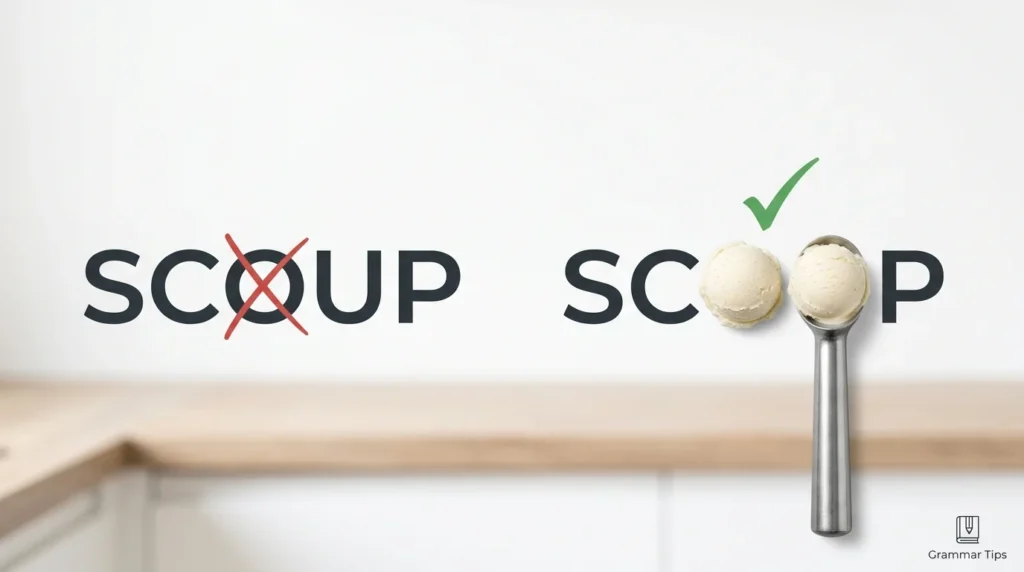
Picture the word SCOOP as a tiny ice-cream dish.
The two O’s sit together like two round scoops side by side:
SC + OO + P
Keep the two round O’s together.
If a U slips between them and creates SCOUP, stop and check your meaning. For ordinary English involving food, lifting, gathering, or news, put the two O’s back together:
SCOOP.
Read More: Pentoxide vs Pentaoxide: Which Spelling Is Correct in Chemistry?
Real-Life Situations
- Interview: You explain that you scooped data from several containers during a laboratory task. Use scooped, not scouped.
- Meeting: A colleague asks, “What’s the scoop on the client decision?” Here, scoop informally means the latest information.
- Email: You write, “Please add one scoop of the cleaning powder.” The noun refers to a measured portion.
- Text message: You send, “Get me the inside scoop when you hear what happened.” The phrase is conversational and natural.
- Exam: A sentence asks you to choose between scoup and scoop for a serving of ice cream. Choose scoop because the rare Scottish meaning of scoup is unrelated.
Expert Tips
Learn the Meaning With the Spelling
Do not memorize scoop as five isolated letters.
Connect it to a clear image or action:
scoop → rounded tool → lift → portion
A strong meaning connection makes the spelling easier to retrieve.
Proofread the Inflected Forms Too
Writers sometimes remember scoop correctly but make mistakes when adding endings.
Keep the base word unchanged:
- scoop
- scoops
- scooped
- scooping
The double oo remains.
Search for “Scoup” Before Publishing
If you frequently make this mistake, use your editor’s Find function and search for:
scoup
Check every occurrence before publishing.
Do not automatically replace genuine quotations, names, technical acronyms, or intentional dialect without checking context.
Do Not Trust Pronunciation Alone
Both UK and US dictionary pronunciation guides give standard scoop as /skuːp/.
Because English can represent similar vowel sounds with different letter combinations, hearing the word is not enough to reconstruct its spelling reliably.
Separate Scoop From Scope
Scoop and scope are different words.
- scoop = lift, gather, portion, or exclusive information
- scope = range, extent, or area covered by something
The informal phrasal verb scope out means to examine or look at something in order to get information.
So you might scope out a restaurant before deciding whether to visit it, but you scoop ice cream into a bowl.
Quick Summary
When choosing between scoup vs scoop, use scoop for almost every ordinary modern context. Scoop can name a spoon-like tool, an amount held by one, an exclusive news story, or the action of lifting, gathering, or removing something. Its forms include scoops, scooped, and scooping. Writing scoup, scouped, or scouping for these meanings is nonstandard. However, scoup is not completely invented: historical and regional dictionaries record it in Scottish or Scots usage with meanings connected to running or scampering. That rare dialect meaning does not make scoup an alternative spelling of scoop. The easiest memory aid is to keep the two round O’s together in SCOOP.
FAQ
Is scoup a real word?
Yes, but not in the way most people searching scoup vs scoop intend. Scoup is recorded as a rare Scottish/Scots verb associated with running or scampering. If you mean a portion, tool, lifting action, or news story, the correct word is scoop.
Is “scoup of ice cream” correct?
No. The standard phrase is a scoop of ice cream.
A scoop can refer both to the utensil and to the amount it holds.
Why might spellcheck accept scoup?
Some dictionaries record scoup as a genuine regional word, and software dictionaries may contain uncommon terms, names, or user-added entries. A spellchecker can therefore fail to identify that you intended scoop.
Always check meaning as well as spelling.
Is it scooped or scouped?
If the base verb is scoop, the correct past tense is scooped.
Correct: She scooped the beans into a container.
Incorrect for this meaning: She scouped the beans into a container.
Is it scooping or scouping?
Use scooping as the -ing form of scoop.
Correct: He is scooping sand into a bucket.
Can scoop mean news?
Yes. Scoop can refer to an exclusive or important piece of news, particularly one obtained before competitors.
What does “inside scoop” mean?
The inside scoop means information that is not widely known or that comes from someone with special knowledge.
It is especially common in conversational English.
Is “What’s the scoop?” formal?
It is natural but informal or conversational.
In a formal report, phrases such as latest information, current details, or official briefing may fit better.
What is the difference between scoop and scope?
Scoop can mean to lift or gather something, a serving, a tool, or exclusive information.
Scope usually concerns range or extent. In the phrase scope out, it means to examine something to get information.
How do you pronounce scoop?
Standard British and American pronunciation guides give scoop as /skuːp/, sounding roughly like “skoop.”
Can I use scoup in an academic essay?
Normally, no, if you simply mean scoop.
It could be appropriate when discussing Scottish dialect, historical language, linguistics, or a quotation in which scoup appears intentionally.
Should I automatically correct every scoup to scoop?
No.
Correct it when the writer clearly means the standard word scoop, but check the context first if the text contains dialect, historical quotations, proper names, product names, or acronyms.
Mini Quiz
| # | Question | Answer | Explanation |
|---|---|---|---|
| 1 | Fill in the blank: Add one ___ of chocolate ice cream. | scoop | A portion of ice cream is a scoop. |
| 2 | Multiple choice: Which is standard? A) scouped the rice B) scooped the rice | B) scooped the rice | The past tense of scoop is scooped. |
| 3 | Correct the sentence: “Can you scoup the flour into this jar?” | Can you scoop the flour into this jar? | The verb meaning lift or transfer is scoop. |
| 4 | Fill in the blank: The journalist hoped to get an exclusive ___. | scoop | Scoop can mean an exclusive news story. |
| 5 | Multiple choice: “Give me the ___ on the meeting.” A) scoop B) scoup | A) scoop | The scoop can mean the latest or inside information. |
| 6 | Correct the sentence: “She is scouping seeds out of the pumpkin.” | She is scooping seeds out of the pumpkin. | The -ing form of scoop is scooping. |
| 7 | True or false: Scoup has never existed as an English or Scots word. | False | Dictionaries record rare Scottish/Scots uses of scoup. |
| 8 | Fill in the blank: He ___ up the papers that fell from his desk. | scooped | Scoop up means gather or lift quickly. |
| 9 | Multiple choice: Which word refers to the range or extent of a project? A) scoop B) scope | B) scope | Scope refers to range or extent; scoop has different meanings. |
| 10 | Correct the sentence: “The recipe requires three scoups of powder.” | The recipe requires three scoops of powder. | The plural of scoop is scoops. |