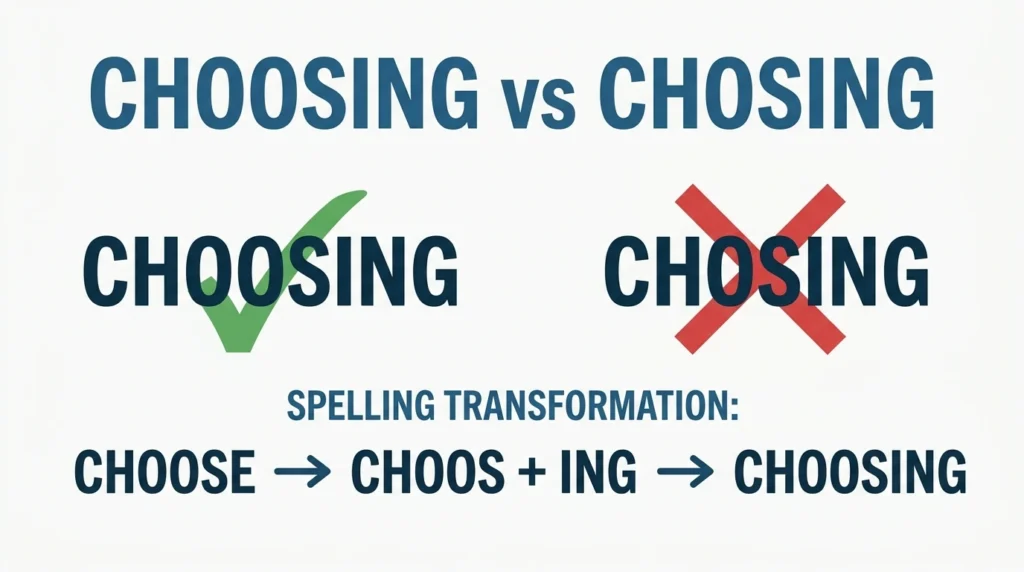

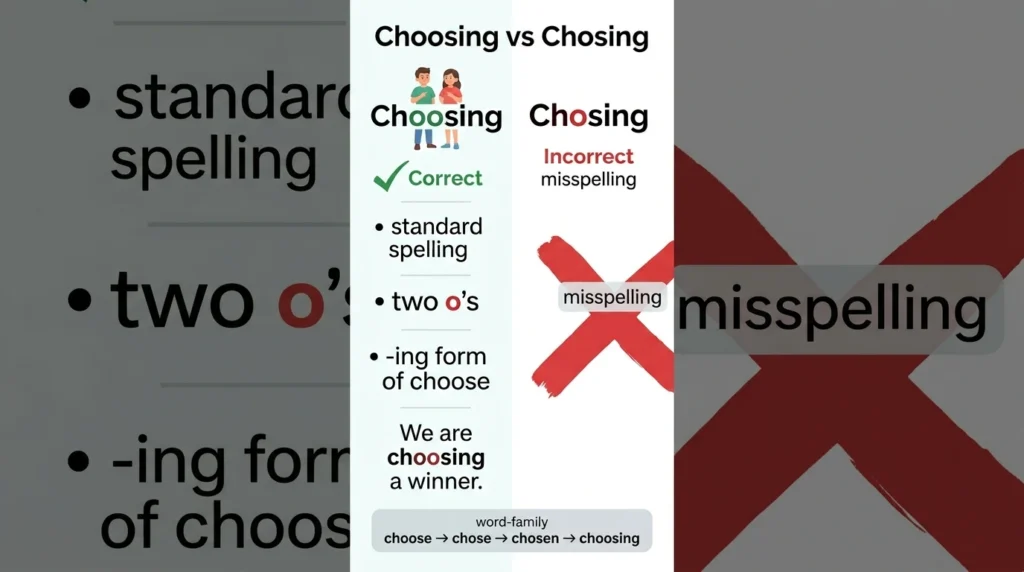
Choosing is the correct spelling. Chosing is a misspelling and should not be used in standard English. Choosing is the -ing form of the verb choose, meaning to select, decide, or pick from available options. To form it, remove the final silent e from choose and add -ing: choose → choos + ing → choosing. Both o’s remain.
What Is Choosing vs Chosing?
The difference between choosing vs chosing is not a difference in meaning. These are not two valid words with separate uses.
Choosing is a standard English word. It comes from the verb choose, which means to select something, prefer one possibility, or decide on a course of action.
Chosing is simply an incorrect spelling of choosing.
For example:
- Choosing a university can take time.
- We are choosing between two designs.
- She is choosing to work from home today.
In all three sentences, choosing describes selection or decision-making.
You should not write:
- Chosing a university can take time.
- We are chosing between two designs.
The intended meaning is understandable, but the spelling is wrong.
Why It Matters
A single spelling mistake usually will not stop someone from understanding your sentence. However, mistakes such as chosing are easy for readers to notice because choosing appears frequently in everyday, academic, and professional English.
The error matters most in situations where careful writing is expected, such as:
- job applications and résumés
- school assignments
- business emails
- reports and proposals
- website copy
- academic papers
- professional social media posts
Writing chosing instead of choosing may make otherwise strong writing look less carefully edited.
The good news is that this mistake becomes easy to avoid once you understand how the word is actually formed.
The Core Rule
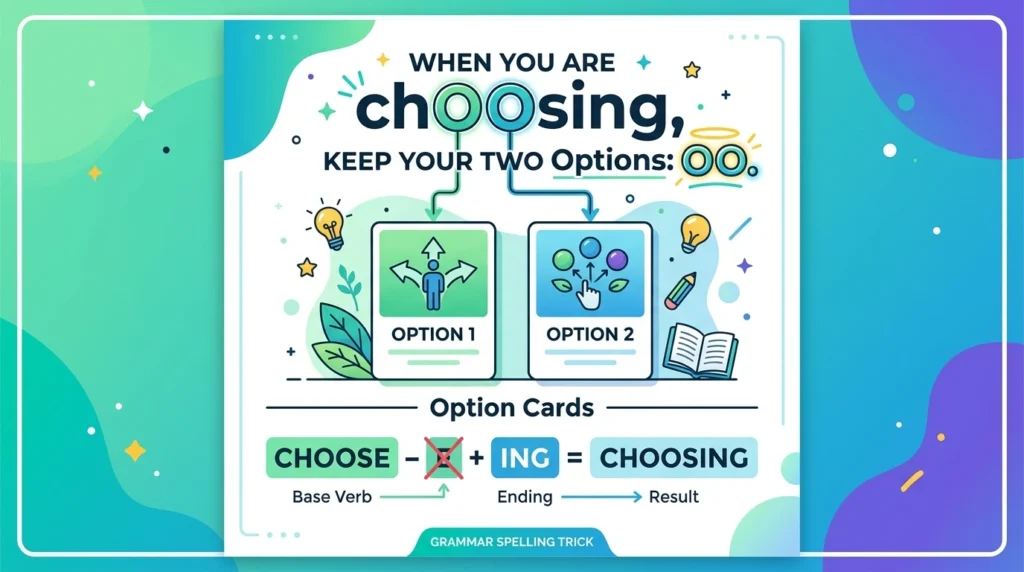
Rule: The -ing form of choose is always choosing. Remove the final e, keep both o’s, and add -ing.
The formation is:
choose → choos + ing → choosing
This point is important because a misleading explanation sometimes appears online: that choose simply keeps its final e before -ing. It does not.
The final e disappears.
What stays is the oo in the middle of choose.
Use this three-step process:
- Start with the base verb choose.
- Remove its final e, giving you choos.
- Add -ing, giving you choosing.
So:
CHOOSE – E + ING = CHOOSING
Not:
CHOSE + ING = CHOSING
That second pattern is the source of much of the confusion.
Read More: Unaffected vs Uneffected: Which Is Correct?
How to Use Choosing
Choosing is the standard -ing form of choose. Traditional grammar describes different uses of an -ing form as a present participle or a gerund, depending on the job it performs in the sentence.
In plain English, choosing can either help form a verb phrase or appear in a noun-like position.
Choosing in Progressive Verb Forms
Use choosing with a form of be when the act of selecting is in progress.
I am choosing a new laptop.
The decision has not necessarily been completed.
Other examples include:
- She is choosing her courses.
- We were choosing a restaurant when you called.
- They are choosing a new team leader.
Choosing as a Gerund
A gerund is an -ing form used in a noun-like position.
For example:
Choosing carefully can prevent mistakes.
Here, choosing carefully is the subject of the sentence.
You can also say:
I enjoy choosing gifts for my friends.
The -ing clause comes after enjoy.
Choosing After a Preposition
Choosing can follow prepositions such as before, after, by, without, and instead of.
Examples:
- Compare the prices before choosing.
- Think carefully about your needs before choosing a plan.
- She left without choosing a dessert.
- You can save time by choosing your seats online.
Choosing to Do Something
The structure choose to + verb means to decide deliberately to perform an action.
Its -ing form is choosing to + verb.
For example:
He is choosing to stay home tonight.
Other examples:
- She is choosing to remain silent.
- They are choosing to invest more cautiously.
- We are choosing to focus on quality.
When You Should Not Use Choosing
Correct spelling does not automatically mean choosing is the correct verb form for every sentence.
Use chose for a completed action in the simple past:
Yesterday, I chose the blue jacket.
Not:
Yesterday, I choosing the blue jacket.
Use chosen after forms of have:
We have chosen the final design.
Use choose for many simple-present constructions:
I usually choose tea instead of coffee.
The main verb family is:
| Verb Form | Correct Form | Example |
|---|---|---|
| Base form | choose | Please choose one. |
| Third-person singular | chooses | She chooses carefully. |
| Simple past | chose | He chose the window seat. |
| Past participle | chosen | We have chosen a winner. |
| -ing form | choosing | They are choosing a date. |
Correct Examples of Choosing
Here are original examples from different kinds of real-world writing.
- Conversation: I’m still choosing what to wear tonight.
- Email: Thank you for choosing our team for the project.
- School: Mia spent the afternoon choosing a topic for her presentation.
- Workplace: We are choosing a supplier based on cost, reliability, and delivery time.
- Social media: Choosing my favorite photo from this trip is impossible.
- Academic writing: Choosing an appropriate research method depends on the question being investigated.
- Customer service: Thank you for choosing the annual membership option.
- Meeting: The committee is choosing between the three final proposals.
- Text message: Are you still choosing a movie, or can we start dinner?
- Interview: I was careful when choosing examples that showed my leadership experience.
- Planning: Choosing a realistic deadline will help the team avoid unnecessary pressure.
- Everyday English: She took ten minutes choosing a birthday card for her sister.
Notice that choosing can appear at the beginning, middle, or end of a sentence. Its spelling does not change.
Incorrect vs. Correct
| ❌ Incorrect | ✅ Correct | Why |
|---|---|---|
| I am chosing a new phone. | I am choosing a new phone. | The -ing form of choose is choosing. Both o’s remain. |
| Thank you for chosing us. | Thank you for choosing us. | After for, the correct -ing form is choosing. |
| She is chosing her classes. | She is choosing her classes. | Chosing is not the standard -ing form of choose. |
| We had trouble chosing a winner. | We had trouble choosing a winner. | The word comes from choose, not from the past-tense form chose. |
| Chosing the right words is important. | Choosing the right words is important. | The gerund form is spelled choosing. |
| They are chosing between two apartments. | They are choosing between two apartments. | Removing the final e from choose leaves choos, not chos. |
| He is chosing to work remotely. | He is choosing to work remotely. | The structure is choosing to + verb. |
| Think carefully before chosing. | Think carefully before choosing. | A preposition such as before can be followed by choosing, but not chosing. |
| The manager was chosing candidates. | The manager was choosing candidates. | Progressive verb forms require the correct -ing form. |
| Chosing carefully can save money. | Choosing carefully can save money. | The correct noun-like -ing form retains both o’s. |
Why People Make This Mistake
The spelling chosing looks plausible, which is why even writers who know the word choose can hesitate.
Several factors contribute to the mistake.
Confusion With Chose
The biggest source of confusion is often chose, the simple past tense of choose.
Compare:
choose → chose
A writer may remember chose and then incorrectly add -ing:
chose + ing → chosing ❌
But English does not normally form the -ing form from the past tense. You return to the base form, choose.
The correct process is:
choose → choosing
Read More: Rug vs Rag: What Is the Difference?
The Pronunciation Does Not Reveal the Spelling
Choosing is pronounced with the same vowel sound found in choose. Hearing the word does not tell you whether its middle should be written o or oo.
That makes this mainly a spelling problem rather than a pronunciation problem.
The imaginary spelling chosing can easily be read as if it represented the intended word, so sound alone is not a reliable reminder.
Spelling Overlap
The four forms choose, chose, chosen, and choosing look very similar.
That similarity helps once you know the pattern, but it can also create confusion:
- choose
- chose
- chosen
- choosing
The vowel spelling changes in the past forms but returns to the base-word pattern in choosing.
Overgeneralising the Wrong Pattern
English learners often search for a single pattern that works across a whole verb family.
Because choose becomes chose in the past tense, someone may assume the shorter o spelling should also appear in choosing.
It does not.
The past tense is irregular. The -ing form is built from the base form instead.
Misunderstanding the Silent-E Rule
English commonly drops a final silent e before adding -ing:
- make → making
- write → writing
- hope → hoping
- choose → choosing
The important detail is what gets removed.
In choose, only the final e disappears.
The two o’s are part of the remaining stem:
choos + ing
Writers who accidentally reduce oo to o are changing more than the silent-e rule requires.
Autocomplete and Spellcheck Limits
Many spelling tools will detect chosing, but software should not replace understanding.
Autocorrect settings vary between devices and applications. A misspelling can also remain in drafts if suggestions are ignored, dictionaries are customized, or proofreading is rushed.
Knowing the pattern yourself is more reliable.
Translation Interference
For some English learners, the structure of another language can influence how English verb forms are built.
A learner who expects one obvious stem for every tense may connect chose too closely with choosing.
A safer method is simple: whenever you need -ing, return to the English base verb choose first.
Common Mistakes Checklist
Use this checklist when proofreading.
- Writing chosing because chose looks familiar: Remember that chose is past tense. Build the -ing form from choose.
- Deleting one of the o’s: The silent-e rule removes only the final e. Keep oo.
- Writing chooseing: The opposite error is keeping too much. Remove the final e before adding -ing.
- Confusing choosing with chosen: Choosing usually presents selection as an activity or process; chosen is the past participle used in forms such as has chosen.
- Using choosing when the sentence needs chose: “Yesterday I chose” describes a completed past decision.
- Using choosing when a simple-present form fits better: For a regular habit, “I usually choose the cheapest option” is normally clearer than “I am usually choosing the cheapest option.”
- Trusting pronunciation alone: The sound does not show you how many o’s to write. Remember the base form visually: CHOOSE.
- Depending entirely on autocorrect: Learn the spelling pattern so you can spot the error even when software does not.
Choosing vs Chosing in Real English
Natural, Everyday English
Choosing is completely normal in everyday conversation when someone is actively deciding among options. Sentences such as “I’m choosing a restaurant,” “We’re choosing a movie,” and “She’s choosing between two jobs” sound straightforward because the decision is still being made. The word is also natural in phrases such as “Thanks for choosing us.” There is no informal spelling chosing.
Grammatically Correct but More Deliberate
The construction choosing to + verb is correct and often emphasizes that an action is deliberate: “She is choosing to wait” or “They are choosing to remain independent.” In some contexts, simply saying “She decided to wait” may be shorter. However, choosing to is useful when the speaker wants to stress personal agency, intention, or an available alternative.
Grammatically Possible but Unnatural Without Context
A sentence such as “I am choosing coffee every morning” is grammatically possible, but it needs a special context, perhaps describing a temporary change in behavior. For an ordinary repeated habit, “I choose coffee every morning” is clearer and more natural. The issue is not the spelling of choosing. It is the difference between an ongoing or temporary pattern and a normal habitual statement.
Formal vs. Informal Usage
The spelling choosing stays the same in every register. It is suitable for conversation, academic work, business writing, journalism, and professional communication.
What can change is the word you select around it.
Choose/choosing is generally neutral:
We are choosing a new provider.
Pick/picking often sounds more conversational:
We’re picking a place for lunch.
Select/selecting can sound more formal or technical:
The panel is selecting candidates for the final interview.
Opt for/opting for emphasizes selecting one alternative:
Customers are increasingly opting for digital delivery.
Do not use chosing as an informal alternative. It remains a spelling error even in casual writing.
Read More: Quantify vs Qualify: What’s the Difference?
Choosing vs Chosing Comparison Table
| Feature | Choosing | Chosing |
|---|---|---|
| Standard English spelling | Yes | No |
| Derived from choose | Yes | Incorrect formation |
| Number of o’s | Two | One |
| Can be a present participle | Yes | No |
| Can be used as a gerund | Yes | No |
| Suitable in formal writing | Yes | No |
| Suitable in informal writing | Yes | No |
| Used after “am/is/are” | Yes: is choosing | No |
| Used after prepositions | Yes: before choosing | No |
| Should appear in edited English | Yes | Usually only when discussing the misspelling |
Choosing, Choose, Chose, Chosen, and Choice
Another useful comparison is the full word family.
| Word | Function | Example |
|---|---|---|
| choose | base/present verb | I usually choose carefully. |
| chooses | third-person singular | She chooses the music. |
| chose | simple past | We chose the earlier flight. |
| chosen | past participle | They have chosen a date. |
| choosing | -ing form | He is choosing a gift. |
| choice | noun | That was a difficult choice. |
The most important distinction for this spelling problem is:
chose ≠ base form for choosing
Even though the words belong to the same verb family, choosing is built from choose, not chose.
Memory Trick
Remember this sentence:
When you are chOOsing, keep your two Options: OO.
The two O’s in choosing can represent the two or more options you are deciding between.
Visually:
CH + OO + S + ING
If there are options to choose from, keep your OO.
Real-Life Situations
Interview
You want to explain why you applied for a position.
Correct: “When choosing my next role, I wanted more opportunities to lead projects.”
Using choosing shows that you are discussing the decision-making process.
Meeting
Your team has not selected a vendor yet.
Correct: “We are choosing between the two suppliers that passed the final review.”
The progressive form fits because the decision is still in progress.
A customer has signed up for your service.
Correct: “Thank you for choosing our annual plan.”
This is a common and natural customer-service construction.
Text Message
Your friend wants to know why you have not ordered dinner.
Correct: “I’m still choosing what I want.”
Short, natural, and correctly spelled.
Exam
The question asks you to describe an important decision.
Correct: “Choosing the right subject required me to consider my interests and career goals.”
Here, choosing begins a noun-like clause that acts as the sentence’s subject.
Expert Tips
Build the Word From Choose, Not Chose
When unsure, mentally return to the base form:
choose
Then remove only the final e:
choos
Then add:
ing
This method prevents both chosing and chooseing.
Learn the Whole Verb Family Together
Do not memorize the spellings as unrelated words.
Learn them as one set:
choose – chose – chosen – choosing
Seeing the pattern makes it easier to notice where the double o appears.
Separate a Spelling Error From a Tense Error
Consider:
Yesterday, I choosing a new computer.
Changing choosing to chosing would not solve the problem.
The spelling choosing is correct, but the sentence needs the past tense:
Yesterday, I chose a new computer.
Good editing checks both spelling and grammar.
Watch for Chooseing Too
Once writers learn that chosing is wrong, some overcorrect by writing:
chooseing ❌
That is also incorrect.
The final silent e is removed:
choose → choosing
Use Simple Present for Normal Habits
Compare:
I choose the same seat every Monday.
This describes a regular habit.
I am choosing a seat now.
This describes a decision being made at the moment.
The spelling does not change, but the verb form changes the time perspective.
Replace the Word to Test the Meaning
If you are unsure whether choosing makes sense, temporarily substitute selecting or picking.
We are choosing a venue.
→ We are selecting a venue.
If the meaning still works, choosing is probably being used appropriately.
Do not use this test for spelling, however. The only standard spelling remains choosing.
Read More: Courtesy vs Curtesy: What’s the Difference?
Quick Summary
Choosing is the correct -ing form of choose, while chosing is a misspelling. The easiest way to spell the word is to start with choose, remove only its final silent e, and add -ing: choose → choos + ing → choosing. Keep both o’s. Do not build the word from chose, because chose is the irregular simple-past form. Choosing can appear in progressive constructions such as “She is choosing a dress” and in noun-like uses such as “Choosing carefully matters.” It is correct in both formal and informal English. When discussing a completed past decision, use chose; after have, has, or had, use chosen.
FAQ
Is chosing ever correct in informal English?
No. Chosing is not a casual or informal variant of choosing. In standard edited English, it is treated as a spelling mistake. You may see chosing online, but frequency of a typo does not make it a standard spelling.
Why isn’t choosing spelled chosing if the final e is removed?
Because removing the final e from choose gives you choos, not chos.
The correct sequence is:
choose → choos → choosing
Writing chosing removes an o that should remain.
Is chooseing correct?
No. Chooseing keeps the final e when it should be dropped. The correct spelling is choosing.
Think:
choose – e + ing = choosing
Is choosing a verb or a noun?
It can perform different grammatical jobs. In “She is choosing a dress,” it forms part of the verb phrase. In traditional grammar, “Choosing a dress can take time” uses an -ing form in a noun-like clause, commonly called a gerund construction.
Is choosing the past tense of choose?
No. The simple past tense is chose.
- Present/base: choose
- Past: chose
- Past participle: chosen
- -ing form: choosing
For example: “I chose the red one yesterday.”
What is the difference between choosing and chosen?
Choosing usually presents the act of selection as a process:
They are choosing a winner.
Chosen is the past participle:
They have chosen a winner.
The second sentence tells us that the selection has been completed.
What is the difference between choosing and choice?
Choosing comes from the verb choose and refers to the activity or process of selecting.
Choice is normally a noun.
Compare:
Choosing was difficult.
It was a difficult choice.
Can a sentence begin with choosing?
Yes.
Choosing the cheapest product is not always the best strategy.
Here, the phrase beginning with choosing functions as the subject of the sentence.
Is “choosing to” grammatically correct?
Yes. Choosing to + verb is a standard construction used to emphasize a deliberate decision.
For example:
She is choosing to wait until Monday.
By choosing to leave early, we avoided the traffic.
Should I write “I choose” or “I am choosing”?
It depends on your meaning.
Use I choose for a general preference, repeated action, or direct decision:
I usually choose the vegetarian option.
Use I am choosing when you want to present the selection as currently in progress:
I am choosing my courses now.
Mini Quiz
| # | Question | Answer | Explanation |
|---|---|---|---|
| 1 | Which is correct: choosing or chosing? | Choosing | The -ing form of choose keeps both o’s. |
| 2 | Fill in: “She is ___ a birthday gift.” | choosing | A progressive construction uses is + choosing. |
| 3 | Correct the sentence: “Thank you for chosing our company.” | Thank you for choosing our company. | Chosing must be replaced with choosing. |
| 4 | Which is correct: chooseing, choosing, or chosing? | choosing | Drop the final e from choose, keep oo, and add -ing. |
| 5 | Fill in: “Yesterday, we ___ the cheaper option.” | chose | A completed past action requires the simple past chose. |
| 6 | Fill in: “We have ___ the final candidate.” | chosen | After have, use the past participle chosen. |
| 7 | Correct the sentence: “Chosing a career takes careful thought.” | Choosing a career takes careful thought. | The noun-like -ing form is spelled choosing. |
| 8 | Which is better for a regular habit: “I choose tea every morning” or “I am choosing tea every morning”? | I choose tea every morning. | Simple present normally expresses a regular habit. |
| 9 | Fill in: “Think carefully before ___ a password.” | choosing | After the preposition before, the -ing form is appropriate. |
| 10 | True or false: Choosing is formed by adding -ing to chose. | False | It is formed from choose: remove the final e and add -ing. |