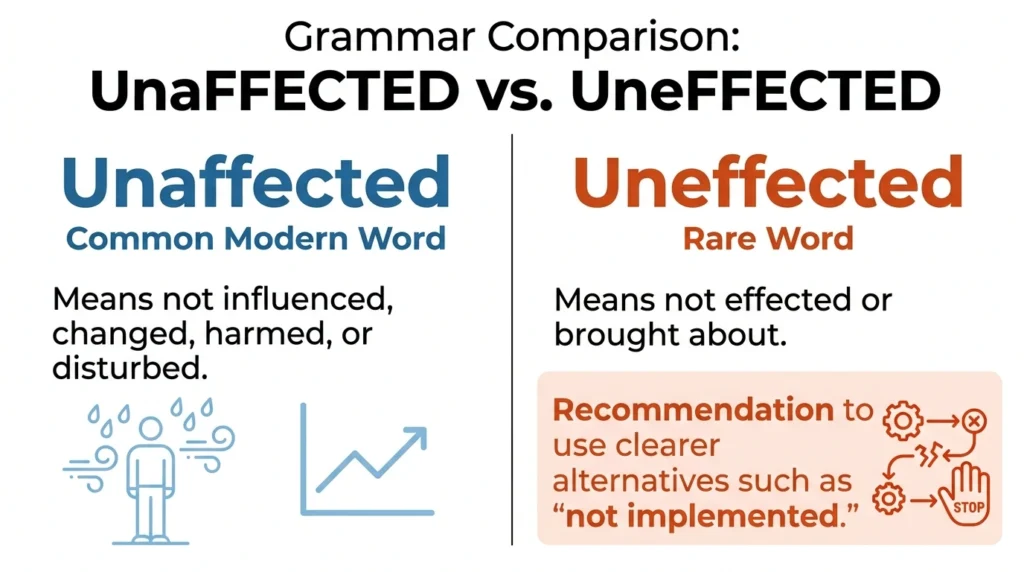

Unaffected is the standard word when you mean not changed, influenced, harmed, interrupted, or emotionally moved. Uneffected does exist, but it is rare and has a different meaning: not effected, or not brought about, carried out, or established. In normal conversation, schoolwork, business writing, and academic writing, unaffected is almost always the word you need.
Simple rule: If you could say “not affected,” write unaffected. If you truly mean “not brought about or implemented,” use clearer wording such as not effected, not implemented, or not carried out.
What Is the Difference Between Unaffected and Uneffected?
Unaffected is an adjective formed from affected with the negative prefix un-. It describes someone or something that has not been influenced or changed. It can also describe a person or style that is natural and genuine rather than artificial or pretentious.
For example:
- The equipment was unaffected by the power surge.
- Her confidence remained unaffected by the criticism.
- He has an unaffected and friendly manner.
Uneffected is much rarer. It is built from effected, the past form of the verb effect, which can mean to cause, accomplish, or bring something about. Therefore, uneffected can mean something has not been effected, established, or put into action.
In modern writing, however, that sense is usually clearer when rewritten:
- Rare: The proposed reform remained uneffected.
- Clearer: The proposed reform was not implemented.
- Clearer: The proposed reform was never carried out.
That distinction is the central answer to unaffected vs uneffected: the two forms are theoretically meaningful, but they are not interchangeable.
Why the Difference Matters
Using uneffected when you mean unaffected can make an otherwise professional sentence look like a spelling mistake.
Consider a workplace email:
“Customer accounts were uneffected by the outage.”
Most readers will assume the writer meant unaffected, because the intended meaning is that the accounts were not changed or harmed.
The correct sentence is:
“Customer accounts were unaffected by the outage.”
The distinction matters even more in technical, legal, academic, and business writing, where effect can also function as a verb meaning to bring something about.
The Core Rule
The Rule Box
Use UNAFFECTED when you mean:
- not changed
- not influenced
- not harmed
- not interrupted
- not emotionally moved
- natural or genuine
Avoid UNEFFECTED for those meanings.
Use uneffected only if you deliberately mean not effected—not brought about or carried out. Because that form is extremely uncommon in ordinary modern prose, clearer alternatives are usually preferable.
Read More: Rug vs Rag: What Is the Difference?
The Fastest Test
Ask yourself:
“Am I trying to say ‘not affected’?”
If yes, use unaffected.
That single test solves nearly every everyday case.
How to Use Unaffected Correctly
When Something Does Not Change
Use unaffected when an event could have changed something but did not.
The final price remained unaffected by the delay.
The delay existed, but it did not change the price.
When Something Is Not Harmed
Unaffected often describes people, places, systems, products, or areas that escape damage.
The eastern part of the building was unaffected by the fire.
Here, unaffected means the fire did not harm that part.
When Someone Is Not Influenced
The word also works when opinions, decisions, or behavior remain unchanged.
Her decision was unaffected by outside pressure.
Outside pressure existed, but it did not influence her decision.
When Someone Is Not Emotionally Moved
A person can appear unaffected by bad news, praise, criticism, or another emotional event.
He seemed unaffected by the negative comments.
This does not necessarily mean the person felt nothing. It means the visible or meaningful impact was limited or absent.
When Someone Seems Natural and Genuine
Unaffected also has an established meaning connected with behavior: natural, sincere, and free from artificial attempts to impress others.
Her unaffected manner made the interview feel relaxed.
This sense has nothing to do with surviving damage. Context tells the reader which meaning is intended.
When Could Uneffected Be Correct?
The verb effect can mean to cause something to happen or bring something about. For example, someone can effect a change, meaning they cause that change to happen.
From that verb comes effected:
The new leadership effected major changes.
That means the leadership brought about those changes.
The rare adjective uneffected can therefore mean not effected, not established, or not brought about. This use is attested, so saying that uneffected is never a word under any circumstances is too absolute.
Still, modern readers may interpret uneffected as a typo. Clear writing usually favors:
- not implemented
- not carried out
- not accomplished
- not brought about
- not put into effect
These alternatives communicate the intended idea immediately.
Correct Examples of Unaffected
Here are original examples across everyday conversation, education, work, social media, and formal writing.
- Conversation: “Luckily, our neighborhood was unaffected by the storm.”
- Email: “Your existing subscription will remain unaffected by the pricing update.”
- Workplace: “The accounting team was unaffected by the office relocation.”
- Customer support: “Saved files should remain unaffected after the update.”
- School: “Her exam score was unaffected by the extra-credit assignment.”
- Academic writing: “The control group remained largely unaffected by the treatment.”
- Social media: “My weekend plans are unaffected, so I’m still going!”
- Technology: “The security issue affected older devices, while newer models were unaffected.”
- Finance: “Long-term investments were unaffected by the temporary processing delay.”
- Personal description: “Despite his success, he remained warm, relaxed, and unaffected.”
- Meeting: “The delivery date is unaffected by today’s scheduling change.”
- Travel: “Flights from the northern terminal were unaffected by the closure.”
In each case, unaffected indicates either an absence of influence or change, or natural and unpretentious behavior.
Read More: Quantify vs Qualify: What’s the Difference?
Incorrect vs Correct
| ❌ Incorrect | ✅ Correct | Why |
|---|---|---|
| The files were uneffected by the update. | The files were unaffected by the update. | The files were not changed or harmed, so the base idea is affected, not effected. |
| Her mood was uneffected by the criticism. | Her mood was unaffected by the criticism. | Criticism failed to influence her mood. |
| The storm left our area uneffected. | The storm left our area unaffected. | The intended meaning is “not damaged or changed.” |
| My schedule is uneffected by the meeting. | My schedule is unaffected by the meeting. | The meeting does not change the schedule. |
| The medication left his appetite uneffected. | The medication left his appetite unaffected. | His appetite did not change. |
| Existing customers are uneffected by the new fee. | Existing customers are unaffected by the new fee. | The fee does not influence existing customers. |
| Her grades remained uneffected. | Her grades remained unaffected. | The grades did not change because of the situation. |
| Production was uneffected by the outage. | Production was unaffected by the outage. | The outage did not interrupt or alter production. |
| He seemed uneffected by their comments. | He seemed unaffected by their comments. | The comments did not visibly influence or disturb him. |
| The final result was uneffected by the error. | The final result was unaffected by the error. | The error caused no change in the result. |
| The western offices were uneffected by flooding. | The western offices were unaffected by flooding. | They escaped the effect of the flooding. |
| My opinion remains uneffected by the rumor. | My opinion remains unaffected by the rumor. | The rumor did not influence the opinion. |
The pattern is consistent: when you mean not influenced or changed, the correct form is unaffected.
Why People Make This Mistake
Affect and Effect Sound Similar
The biggest source of confusion is the familiar affect vs effect problem.
Affect is usually a verb meaning to influence or change something:
The weather affected our plans.
Effect is usually a noun meaning a result:
The weather had an effect on our plans.
However, effect can also be a verb meaning to cause or bring something about:
The negotiations effected a compromise.
Those overlapping grammatical roles help explain why unaffected and uneffected can become confused.
The Spellings Look Almost Identical
Only one letter changes:
- unaffected
- uneffected
Because both contain -ffected, a writer working quickly may choose the wrong vowel without noticing it.
Writers Overgeneralize the Word Effect
People learn that effect means “result,” then assume anything related to an effect should use an e.
But unaffected is normally built from the verb affect:
affect → affected → unaffected
That word-building pattern is more useful than thinking about the noun effect.
Autocomplete Is Not a Grammar Teacher
Typing tools can suggest uncommon words because those words exist in their databases or have appeared in published material.
A suggestion therefore does not prove that a word fits your sentence.
If a tool accepts uneffected, ask what the sentence actually means rather than relying only on the absence of a red underline.
Translation Can Encourage Literal Word Building
English learners sometimes construct words logically from familiar parts:
un + effected = uneffected
Morphologically, that construction is possible, and the rare form is attested. The problem is meaning: if the intended idea is “not changed or influenced,” English normally uses unaffected.
Common Mistakes Checklist
- Writing “uneffected by.”
When something is not influenced by another thing, unaffected by is normally the correct phrase. - Assuming uneffected can never exist.
It has been recorded with the meaning “not effected,” but this does not make it interchangeable with unaffected. - Thinking effect is always a noun.
Effect can be a verb meaning to bring something about, especially in formal contexts. - Using uneffected simply because effected is a valid word.
A logically possible construction is not automatically the natural choice in a particular sentence. - Confusing unaffected with ineffective.
Unaffected means not influenced or changed. Ineffective means not producing the intended result. - Replacing every occurrence with unchanged.
Unaffected can also mean unharmed, uninfluenced, emotionally unmoved, or natural and genuine. - Ignoring the base verb.
Ask whether the positive version would use affected or effected. That usually reveals the correct form.
Unaffected vs Ineffective
These words are sometimes confused because both involve the idea of an effect, but they answer different questions.
Unaffected describes something that does not experience a change.
The second server was unaffected by the failure.
Ineffective describes something that fails to achieve its purpose.
The temporary repair was ineffective.
A repair could even be ineffective while another object remains unaffected by the problem. The words are not synonyms.
Unaffected vs Unaltered
Unaltered specifically means not altered or modified.
Unaffected is broader. It can mean not influenced, damaged, interrupted, emotionally moved, or changed.
For example:
The document remained unaltered.
This focuses on its content or form.
The document remained unaffected by the software bug.
This focuses on the lack of impact from an outside cause.
Read More: Courtesy vs Curtesy: What’s the Difference?
Unaffected vs Untouched
Untouched can sometimes replace unaffected, particularly when discussing damage or physical impact.
Several rooms were untouched by the fire.
However, untouched can also literally mean that nobody touched something.
The food remained untouched.
Because of that extra meaning, unaffected can be more precise when discussing influence, policies, systems, or abstract ideas.
Unaffected vs Uneffected Comparison Table
| Feature | Unaffected | Uneffected |
|---|---|---|
| Base word | affected | effected |
| Part of speech | adjective | adjective |
| Main meaning | not influenced, changed, harmed, or emotionally moved | not effected, brought about, established, or carried out |
| Modern frequency | common | very rare |
| Normal everyday use | yes | generally no |
| Business writing | common and clear | usually better rewritten |
| Academic writing | normal where meaning fits | avoid unless deliberately discussing the rare form |
| Example | The deadline was unaffected by the delay. | The planned reform remained uneffected. |
| Best alternative | unchanged, unharmed, uninfluenced | not implemented, not effected, not carried out |
| Risk of reader confusion | low | high |
The rare sense of uneffected is documented, while unaffected is the established everyday adjective for something not influenced or changed.
Unaffected vs Uneffected in Real English
Grammatically Correct and Natural
Unaffected is both grammatically correct and natural when describing something that remains unchanged, unharmed, or uninfluenced. Sentences such as “The schedule was unaffected by the delay” or “She seemed unaffected by the criticism” sound normal in everyday and professional English. The adjective also works naturally for sincere, unpretentious behavior.
Grammatically Possible but Unnatural
A sentence using uneffected can be defensible when it literally means not effected—not brought about or established. However, many modern readers may hesitate over the word or assume it is a typo. Even when the intended meaning is technically possible, expressions such as not implemented, not carried out, or not brought about usually communicate the idea more efficiently.
Natural Everyday English
In everyday English, think in terms of affected → unaffected. If a storm did not damage your house, your house was unaffected. If criticism did not change your decision, your decision was unaffected. If an update caused no problem for your files, the files were unaffected. You are unlikely to need uneffected in ordinary conversation.
Formal vs Informal Usage
Unaffected belongs comfortably in both formal and informal English.
Informal:
“Our plans are unaffected, so we’re still going.”
Professional:
“Current customers will remain unaffected by the policy change.”
Academic:
“The control samples were unaffected by the treatment.”
Uneffected, by contrast, is rare enough that using it may slow the reader down. In formal writing, precision matters more than preserving an unusual word, so not effected, not implemented, or another exact alternative is normally clearer. The verb effect, meaning “bring about,” itself tends to occur more often in formal contexts.
Read More: Excited vs Exited: What Is the Difference?
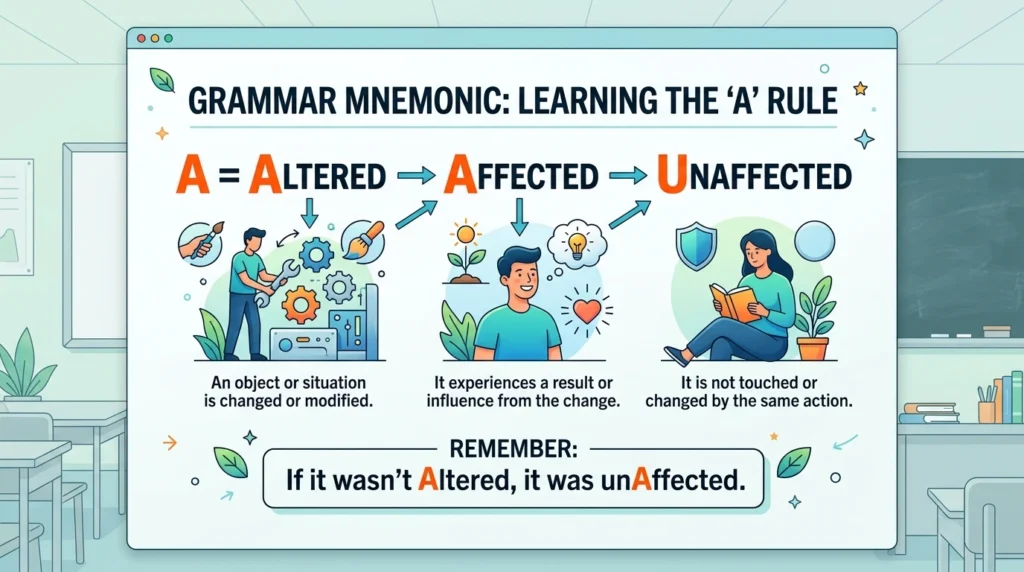
Memory Trick
Remember:
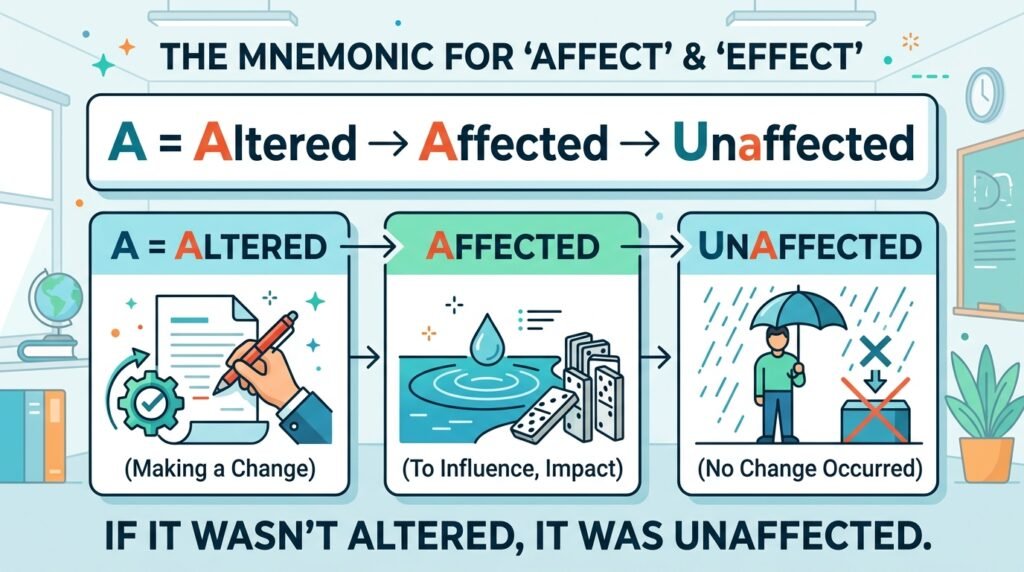
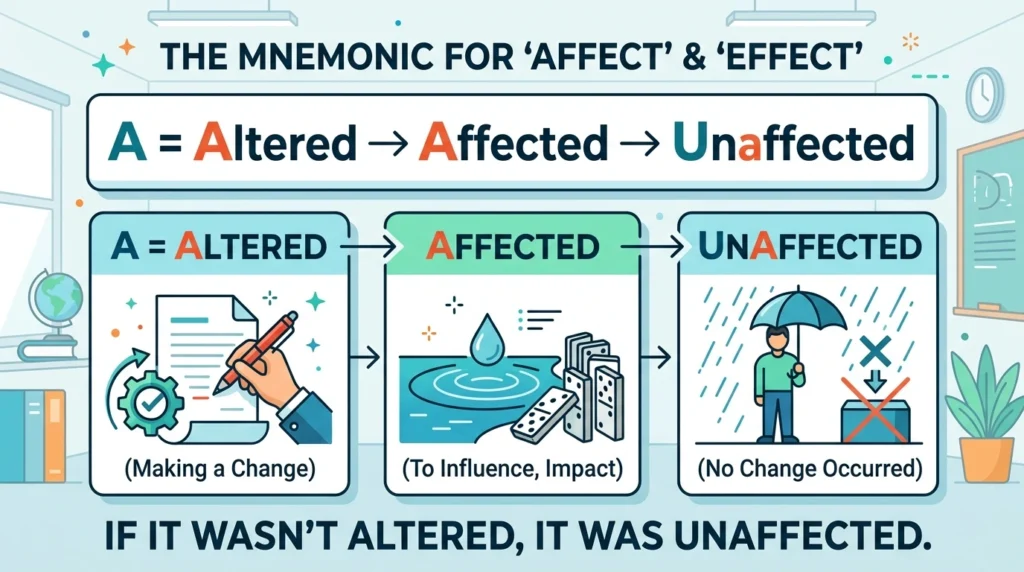
A = Altered
If something was not Altered, it was unAffected.
Both important words begin with A:
Altered → Affected → Unaffected
So when you mean “nothing changed,” keep the A.
Do not switch to E simply because the noun effect is in your mind.
Real-Life Situations
Interview
An interviewer asks whether working under pressure changes your judgment.
“My decision-making is generally unaffected by short-term pressure.”
Here, unaffected means your judgment is not significantly influenced.
Meeting
A manager explains a minor scheduling problem.
“The launch date is unaffected by the supplier delay.”
The supplier delay has not changed the launch date.
You need to reassure customers after a technical issue.
“Your saved information remains unaffected by the service interruption.”
The data was not changed or harmed.
Text Message
Your friend asks whether the rain changed your weekend plans.
“Nope, our plans are unaffected. See you Saturday.”
The word works naturally even in casual communication.
Exam
The sentence says:
“The results were _____ by the change in temperature.”
If the results did not change, choose unaffected.
Policy Discussion
A writer wants to say that a proposed reform was never carried out.
Instead of the rare:
“The reform remained uneffected.”
Prefer:
“The reform was never implemented.”
The second version removes any possible confusion.
Expert Tips
Start With the Positive Form
Remove un- from the sentence.
The accounts were ___ by the outage.
Would you say:
The outage affected the accounts?
Yes.
Therefore:
The accounts were unaffected by the outage.
This is one of the fastest ways to solve the spelling problem.
Test With “Influenced”
If not influenced makes sense, unaffected probably does too.
Her decision was not influenced by public criticism.
Therefore:
Her decision was unaffected by public criticism.
Test Uneffected With “Brought About”
If you are considering uneffected, replace effected with brought about.
The reform was not brought about.
That meaning is possible, but the sentence is usually clearer as:
The reform was not implemented.
Do Not Let the Noun Effect Control the Spelling
Seeing the noun effect nearby does not mean you need uneffected.
Correct:
The medication had no effect on him; he remained unaffected.
The first clause uses the noun effect. The second uses the adjective unaffected.
Choose Clarity Over Rarity
A rare word can be legitimate and still be a poor choice for your audience.
If readers may stop to wonder whether uneffected is a typo, replace it with a clearer phrase unless the exact lexical distinction matters.
Quick Summary
Unaffected is the word you normally need when something is not changed, influenced, harmed, interrupted, or emotionally moved. It can also describe natural, sincere behavior. Uneffected is not simply an alternative spelling. It is a rare, attested adjective related to the verb effect, meaning to bring something about. Therefore, uneffected can mean not effected or not carried out, but clearer wording such as not implemented is usually better. To remember the difference, start with the base word: affected → unaffected. If you can replace the phrase with not influenced, not changed, or not harmed, use unaffected.
FAQ
Is it unaffected or uneffected?
Use unaffected when you mean not changed, influenced, harmed, interrupted, or emotionally moved. That is the correct choice in nearly all everyday uses.
Is uneffected a real word?
Yes, it is attested, but it is rare. It can mean not effected, or not brought about, established, or carried out. It should not be used as a substitute for unaffected.
Is “uneffected by” correct?
Usually no. If something was not influenced by another thing, write unaffected by.
Correct:
The schedule was unaffected by the weather.
Which is correct: “unaffected by the change” or “uneffected by the change”?
Unaffected by the change is correct when you mean the change caused no influence or alteration.
Can I use uneffected in academic writing?
Only if you deliberately mean not effected and have a strong reason to preserve that rare form. In most academic writing, not implemented, not carried out, or another precise phrase will be clearer.
What does unaffected mean emotionally?
When a person is unaffected by something, it can mean that the event does not appear to disturb, influence, or emotionally move them.
She appeared unaffected by the criticism.
Can unaffected mean sincere?
Yes. Unaffected can describe behavior that is natural, genuine, or free from artificial attempts to impress others.
What is the opposite of unaffected?
The most direct opposite is affected when discussing influence or change.
Unaffected equipment remained operational.
Affected equipment was shut down.
The best opposite can vary with context.
Is unaffected the same as unchanged?
Sometimes, but not always. Unchanged focuses specifically on absence of change. Unaffected can also mean unharmed, uninfluenced, emotionally unmoved, or natural in behavior.
What is the difference between affected and effected?
Affected usually means influenced or changed.
The delay affected production.
Effected comes from the less common verb effect, meaning caused or brought about.
The negotiations effected a settlement.
Should I write “not affected” or “unaffected”?
Both can be correct.
The system was not affected by the outage.
The system was unaffected by the outage.
Unaffected is often more concise, while not affected may be useful when you want stronger emphasis on the negative.
Mini Quiz
| # | Question | Answer | Explanation |
|---|---|---|---|
| 1 | The storm left our neighborhood unaffected / uneffected. | Unaffected | The storm did not damage or change the neighborhood. |
| 2 | Fill in the blank: Existing customers will remain ______ by the new rule. | unaffected | The customers will not be influenced or changed by the rule. |
| 3 | Correct the sentence: “Her confidence was uneffected by the criticism.” | Her confidence was unaffected by the criticism. | Criticism did not influence her confidence. |
| 4 | Which word normally means “not influenced or changed”? A) uneffected B) unaffected C) ineffective | B) unaffected | Unaffected is the standard adjective for something not influenced or changed. |
| 5 | Fill in the blank: The software bug affected old devices, but newer devices were ______. | unaffected | The newer devices experienced no impact. |
| 6 | Correct the sentence: “Our deadline is uneffected by the delay.” | Our deadline is unaffected by the delay. | The delay does not change the deadline. |
| 7 | Which sentence uses effected correctly? A) The rain effected my mood. B) The agreement effected major reforms. | B | Here effected means brought about or caused. |
| 8 | Choose the clearer modern sentence: A) The reform remained uneffected. B) The reform was never implemented. | B | The second version expresses the rare intended meaning without making the reader decode an unusual word. |
| 9 | Fill in the blank: Despite becoming famous, she remained relaxed and ______. | unaffected | Here the word means natural and unpretentious. |
| 10 | True or false: “Uneffected” is simply another spelling of “unaffected.” | False | The rare form is related to effected and has a different meaning. |