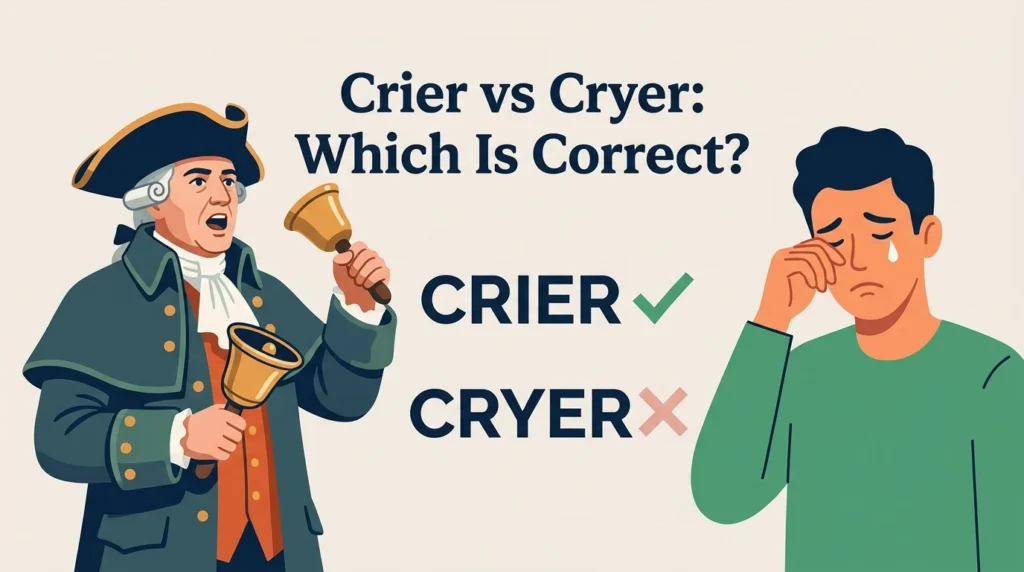

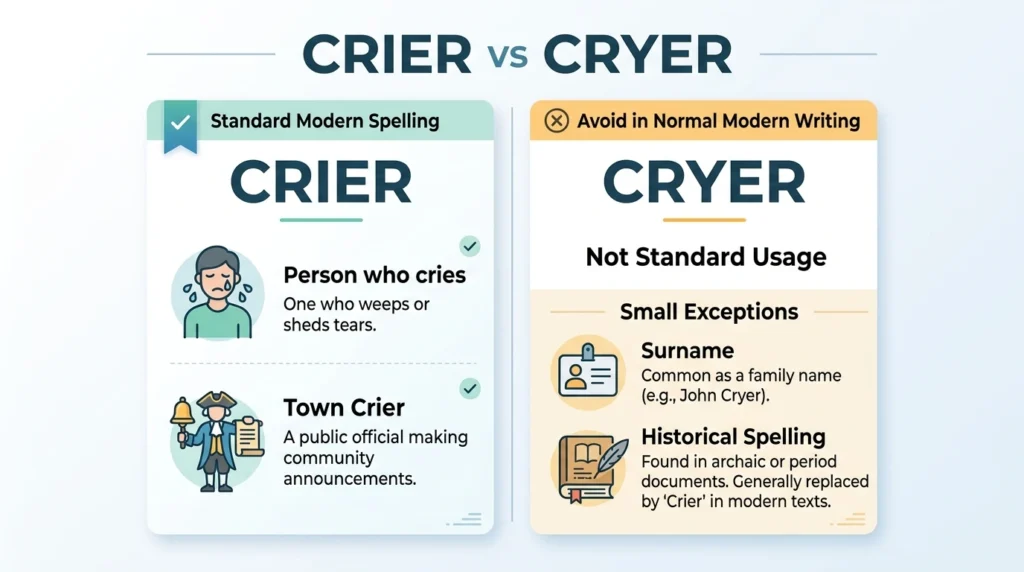
Crier is the standard spelling in modern English. It can mean someone who cries, someone who calls something out loudly, or an official announcer, as in town crier. Cryer is an old or nonstandard spelling and should normally be avoided. However, Cryer can be correct when it is a person’s surname or another established proper name.
What Are Crier and Cryer?
Crier is a countable noun formed from the verb cry. In simple terms, it describes a person who cries or a person whose role involves calling or announcing something aloud.
It commonly appears in two situations:
- Someone who cries, especially someone who cries easily.
- Someone who publicly announces information, particularly a town crier.
For example:
Maya says she is a crier whenever she watches emotional films.
The same spelling appears in the historical expression:
The town crier announced the beginning of the festival.
Cryer may look logical because the original verb is spelled cry, but it is not the normal modern spelling of this noun.
There is one important exception. Cryer can be a surname or another proper name. Proper names keep their established spelling, so you should never automatically change someone’s name from Cryer to Crier.
Why Does the Difference Matter?
Confusing crier and cryer will rarely make a sentence impossible to understand. However, spelling mistakes can still make otherwise professional writing appear less polished.
The difference matters particularly in:
- school and university assignments
- professional emails
- articles and blog posts
- reports and presentations
- subtitles and captions
- historical writing
- job-related documents
If you write town cryer in ordinary modern prose, readers may recognize what you mean, but town crier is the standard form.
Accuracy becomes even more important when the word appears in a heading, title, advertisement, academic paper, or other highly visible text.
The Core Rule
Rule: Use crier as the standard noun formed from cry. Avoid cryer in normal modern English unless Cryer is an established name or you are deliberately reproducing an older spelling.
The easiest comparison is:
cry → crier
not
cry → cryer
The spelling change follows a familiar English pattern in which a final y after a consonant changes to i before certain suffixes.
Compare:
- cry → crier
- try → trier
- carry → carrier
This explains why simply attaching -er to cry and writing cryer can lead to the wrong modern spelling.
Read More: Convertor vs Converter: Which Spelling Is Correct?
How to Use Crier Correctly
When Someone Cries Easily
You can use crier for someone who tends to cry.
For example:
I was never much of a crier until I became a parent.
Here, crier describes a person who cries.
This use is especially common in conversational English when people describe their emotional reactions.
When Someone Announces Information
Crier can also refer to someone who calls out information publicly.
The best-known expression is town crier.
Traditionally, a town crier announced public information aloud so that people in a community could hear it.
For example:
A costumed town crier opened the historical celebration.
When Referring to an Official or Ceremonial Role
The noun can also appear in historical, ceremonial, or institutional contexts involving someone responsible for proclaiming information.
For example:
The crier called the room to attention before the proceedings began.
The exact role depends on context, but the spelling remains crier.
When Cryer Is Actually Correct
Do not replace Cryer when it is a proper name.
For example:
Daniel Cryer signed the document.
In that sentence, Cryer is a surname. Changing it to Crier would actually create an error because personal names must retain their established spelling.
An older text may also contain cryer as a historical spelling. When quoting such material exactly, you may preserve the original spelling.
Correct Examples of Crier
Here are examples showing how crier works in different kinds of English.
- Conversation: I’m usually a crier during emotional movies.
- Family conversation: Her brother was never much of a crier as a child.
- Workplace: Even the toughest person on our team admitted that he was a crier at farewell parties.
- Email: I’m a bit of a crier, so don’t be surprised if the retirement speech makes me emotional.
- School: The students learned how a town crier spread important news before modern communication systems.
- History: The town crier walked through the square announcing the new regulations.
- Social media: Apparently, I’ve become a happy-ending crier.
- Academic writing: The ceremonial crier played an important role in communicating public announcements.
- Event description: A traditional town crier welcomed visitors to the heritage festival.
- Personal writing: I became more of a crier after having children.
- News-style writing: The town crier opened the ceremony with a formal proclamation.
- Historical fiction: The crier entered the marketplace and called the villagers together.
Incorrect vs. Correct Usage
| ❌ Incorrect | ✅ Correct | Why |
|---|---|---|
| She is a big cryer during sad movies. | She is a big crier during sad movies. | Crier is the standard noun for someone who cries. |
| The town cryer announced the celebration. | The town crier announced the celebration. | The established modern expression is town crier. |
| I’ve always been an emotional cryer. | I’ve always been an emotional crier. | The noun formed from cry is normally spelled crier. |
| The village cryer rang a bell. | The village crier rang a bell. | A public announcer is a crier. |
| He’s not normally a cryer. | He’s not normally a crier. | Use crier for a person who cries. |
| The historical cryer read the announcement. | The historical crier read the announcement. | Standard modern historical descriptions use crier. |
| Every cryer reacts differently to emotional scenes. | Every crier reacts differently to emotional scenes. | Crier is the standard countable noun. |
| A costumed town cryer greeted us. | A costumed town crier greeted us. | The conventional spelling is town crier. |
| My sister has always been a quiet cryer. | My sister has always been a quiet crier. | The regular modern noun is crier. |
| The cryer shouted the news across the square. | The crier shouted the news across the square. | Someone making a public proclamation can be called a crier. |
There is one major exception to this correction pattern:
❌ John Crier if the person’s actual surname is Cryer
✅ John Cryer
A dictionary spelling rule does not override the established spelling of someone’s name.
Why Do People Confuse Crier and Cryer?
The Words Sound the Same
The biggest reason is simple: crier and cryer are normally pronounced the same way.
You cannot hear the difference in ordinary speech, so someone who has only heard the word may reasonably guess the wrong spelling.
Cry Keeps the Y in Other Forms
Learners already know forms such as:
- cry
- crying
- cries
- cried
Because crying keeps the y, cryer can look more natural than crier at first.
However, different suffixes follow different spelling patterns. The spelling of crying does not determine the spelling of crier.
People Apply the “Add -er” Rule Too Literally
Many English nouns are created by simply adding -er to a verb:
- teach → teacher
- work → worker
- speak → speaker
- read → reader
A learner may therefore assume:
cry + er = cryer
The problem is that words ending in consonant + y often require a spelling change.
That gives us:
cry + er → crier
Autocomplete Is Not a Grammar Teacher
Phones, search engines, keyboards, and spellcheck systems sometimes accept unusual spellings because those spellings exist somewhere.
For example, Cryer exists as a surname. It also has historical use.
That means software may not always flag cryer as an error.
A word appearing in autocomplete therefore does not automatically make it the standard choice for your sentence.
Translation Can Encourage Literal Word Building
English learners sometimes construct a noun by translating the idea “a person who cries” and then adding -er directly to cry.
This reasoning is understandable, but English spelling is not always perfectly transparent.
Learning the complete form crier is more reliable than rebuilding the word every time.
Read More: Convertor vs Converter: Which Spelling Is Correct?
Common Mistakes Checklist
Before publishing your sentence, check these points:
- Writing “cryer” because the verb is “cry.”
Remember that the noun normally changes the final y to i: crier. - Writing “town cryer.”
The standard expression is town crier. - Assuming crier only means a historical announcer.
It can also describe someone who cries. - Assuming cryer and crier have two separate modern meanings.
In ordinary standard usage, crier covers both the emotional and announcing senses. - Correcting a person’s surname.
If someone’s actual name is Cryer, leave it unchanged. - Trusting spellcheck without checking context.
Software may recognize Cryer because it exists as a name or older spelling. - Using crier when clearer wording would be better.
In very formal or technical contexts, someone who cries frequently may communicate your meaning more precisely.
Crier vs Cryer in Real English
Grammatically Correct English
Crier is the standard choice when the noun means a person who cries or someone who publicly calls out information. Sentences such as “I’m a crier” and “The town crier announced the results” are structurally normal and clearly understandable. The word functions as a countable noun, so forms such as a crier, the crier, and several criers are all possible.
Grammatically Possible but Unnatural English
Some sentences containing crier can be technically understandable but sound less natural because the noun is unnecessary. For example, “He is a crier of tears when watching films” is awkward even though readers can probably interpret it. Everyday English would normally say “He cries during films” or “He’s a crier.” Correct spelling cannot rescue a phrase that has been built unnaturally.
Natural Everyday English
In casual conversation, I’m a crier, she’s a crier, and I’ve always been a crier sound natural when someone is describing a tendency to cry. When discussing public announcements, town crier is by far the most recognizable expression. Outside historical or ceremonial contexts, English speakers would usually choose words such as announcer, caller, or speaker instead of using crier for every person who shouts.
American vs. British English
There is no important American-versus-British spelling difference here.
Standard modern usage favors crier in both varieties when referring to someone who cries or to a town crier.
The pronunciation may sound slightly different because British and American accents treat the final r differently, but that does not change the spelling rule.
Therefore:
American English: town crier
British English: town crier
You do not need to switch between crier and cryer when writing for American or British readers.
Formal vs. Informal Usage
Informal English
Using crier for someone who cries is perfectly natural in conversational and personal writing.
Examples include:
I’m such a crier at weddings.
She’s always been a crier.
This usage is concise and easy to understand.
Formal English
In academic, medical, psychological, or highly formal writing, a more precise description may sometimes be preferable.
Instead of:
The participant was a frequent crier.
you might write:
The participant cried frequently during the observation period.
The first sentence is not automatically ungrammatical. The second is simply more precise and objective for formal reporting.
For historical or ceremonial contexts, town crier remains appropriate even in formal writing.
Crier vs Cryer Comparison Table
| Feature | Crier | Cryer |
|---|---|---|
| Standard modern spelling | Yes | Usually no |
| Pronunciation | “cry-er” | Usually the same |
| Person who cries | Yes | Avoid in standard writing |
| Town announcer | Yes | Avoid in standard writing |
| Common expression | Town crier | Not normally town cryer |
| Countable noun | Yes | Not recommended as the standard form |
| Plural | Criers | Cryers only where the form itself is legitimate |
| Appropriate in professional writing | Yes | Usually no |
| Can appear historically | Yes | Yes, as an older spelling |
| Can be a surname | Possible | Yes |
| American English | Crier | Not the standard alternative |
| British English | Crier | Not the standard alternative |
The Easiest Memory Trick
Remember this sentence:
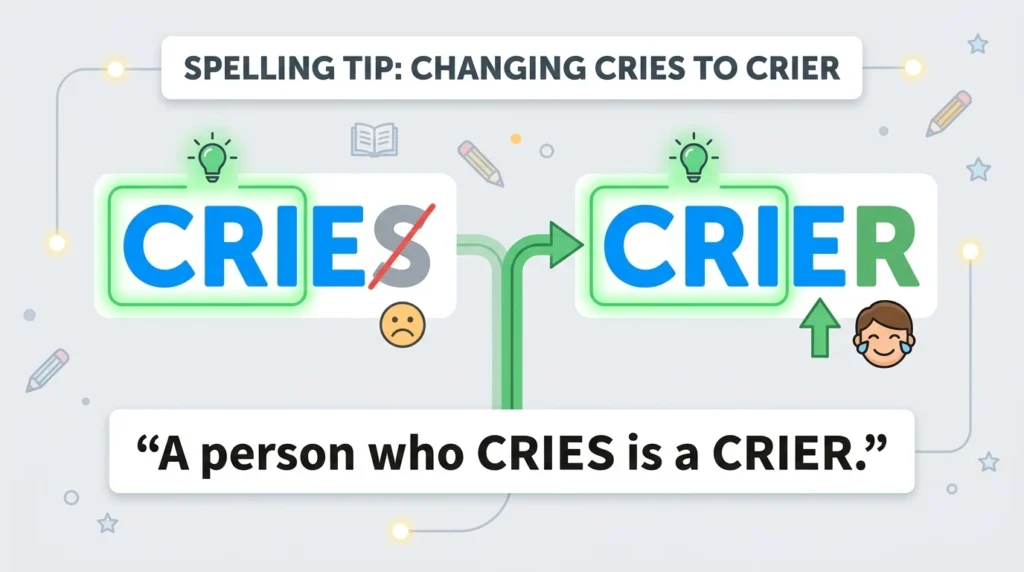
A person who CRIES is a CRIER.
Look at the shared letters:
CRIEs
CRIEr
Both begin with crie-.
So when deciding between the spellings, think:
cries → crier
not
cry → cryer
This connects the noun to a spelling you probably already know.
Real-Life Situations
Job Interview
You are describing yourself casually after mentioning an emotional company farewell.
Natural:
I’m definitely a crier when people give heartfelt speeches.
Avoid:
I’m definitely a cryer when people give heartfelt speeches.
Workplace Meeting
Your team is planning a medieval-themed event.
Natural:
We should hire a town crier to announce each activity.
The phrase town crier is the established expression.
Professional Email
You want to warn coworkers that an upcoming retirement speech may make you emotional.
Natural:
Fair warning: I’m a crier at retirement speeches.
For a highly formal email, you might simply avoid the label and say:
Fair warning: retirement speeches tend to make me emotional.
Text Message
A friend asks whether a sad movie will affect you.
Natural:
Definitely. I’m a crier.
Short, simple, and idiomatic.
School Exam
Question:
The town _____ announced the king’s message.
Correct answer:
crier
Unless the exam specifically asks about historical variant spellings, cryer should not be your choice.
A Simple Three-Step Test
When you are unsure which spelling to use, follow this process:
- Ask whether you mean a person who cries or announces something.
If yes, choose crier. - Check whether Cryer is someone’s official name.
If yes, preserve Cryer exactly. - Check whether you are reproducing an old quotation.
If an original historical source uses cryer, keep the spelling when quoting it exactly.
For almost every ordinary modern sentence, this process leads to crier.
Expert Tips
Learn “Town Crier” as One Unit
Instead of remembering town and crier separately, memorize the complete phrase:
town crier
Fixed expressions are often easier to recall than isolated spelling rules.
Connect Crier With Cries
If you hesitate between crier and cryer, write the third-person verb first:
She cries.
Then replace the final s with r:
crier
It is not a formal grammar rule, but it is an effective memory device.
Do Not Create a Meaning Difference That Does Not Exist
A tempting explanation is that crier means an announcer while cryer means someone who sheds tears.
Do not rely on that distinction.
Standard modern English can use crier for both meanings.
Context tells the reader which meaning is intended.
Check Proper Names Separately
Automatic spelling rules should never be applied blindly to people’s names.
If a person’s surname, company name, character name, or brand is officially spelled Cryer, retain that spelling.
Prefer a Verb When the Noun Sounds Heavy
Sometimes crier is correct but not the smoothest wording.
Instead of:
She became a frequent crier during stressful meetings.
you might write:
She frequently cried during stressful meetings.
Good writing involves choosing natural phrasing as well as correct spelling.
FAQ
Is crier or cryer correct?
Crier is the standard spelling in modern English when referring to someone who cries or someone who makes public announcements. Cryer should normally be avoided unless it is an established proper name or is intentionally preserved as an older spelling.
Is it “I’m a crier” or “I’m a cryer”?
Write “I’m a crier.”
Here, crier means someone who cries, particularly someone who cries relatively easily or often.
Is a person who cries called a crier?
Yes. Crier can describe a person who cries.
For example:
I’ve always been a crier at weddings.
The word does not refer only to historical announcers.
Is cryer a real word?
Cryer has existed as an older spelling and also occurs as a surname. However, that does not make it the normal modern spelling of the common noun. For ordinary contemporary writing, use crier.
Why is it crier if the verb is cry?
English commonly changes a final consonant + y to i before certain suffixes.
That gives us:
cry → crier
A similar pattern appears in:
carry → carrier
and
try → trier
Is it town crier or town cryer?
The standard expression is town crier.
A town crier traditionally announced public information aloud.
What is the plural of crier?
The plural is criers.
For example:
Several ceremonial criers attended the festival.
Can crier mean someone who cries emotionally?
Yes.
For example:
I’m not usually a crier, but that ending got me.
The emotional meaning is standard and does not require the spelling cryer.
Is cryer acceptable in informal writing?
If you mean the common noun for a person who cries, crier remains the safer standard spelling even in informal writing.
Informality changes tone, not necessarily spelling conventions.
Should I correct Cryer when it is someone’s last name?
No.
If Cryer is the person’s actual surname, changing it would be incorrect.
Proper names retain their established spelling.
Does British English prefer cryer?
No. There is no major British-versus-American split requiring cryer. Crier is the standard modern form in both varieties.
Mini Quiz
| # | Question | Answer | Explanation |
|---|---|---|---|
| 1 | Fill in the blank: I’m usually a _____ during emotional films. | crier | A person who cries is a crier. |
| 2 | Which is standard: town crier or town cryer? | town crier | Town crier is the established modern expression. |
| 3 | Correct the sentence: “She’s always been a cryer.” | She’s always been a crier. | The standard noun is crier. |
| 4 | True or false: Crier can only mean a public announcer. | False | It can also mean someone who cries. |
| 5 | Choose the correct sentence: A) I’m a crier. B) I’m a cryer. | A | Crier is the normal modern spelling. |
| 6 | Fill in the blank: The village _____ called everyone to the square. | crier | The person publicly announcing information is a crier. |
| 7 | A person’s surname is officially “Cryer.” Should you change it to “Crier”? | No | Proper names retain their official spelling. |
| 8 | Correct the sentence: “The town cryer announced the festival.” | The town crier announced the festival. | The standard expression is town crier. |
| 9 | Which spelling fits both someone who cries and a public announcer? | crier | Context determines which meaning of crier is intended. |
| 10 | Why can spellcheck fail to flag cryer? | It can exist as a name or older form. | Software recognition does not prove that a spelling is standard in your context. |
Quick Summary
Crier is the standard modern spelling when you mean someone who cries, someone who calls something out, or a traditional public announcer such as a town crier. Although cryer may look logical because the base verb is cry, modern spelling normally changes the final y to i before -er, producing crier. Do not assume crier and cryer have separate modern meanings: crier can cover both emotional crying and public announcing. The main exceptions involve proper names, such as the surname Cryer, and historical texts that preserve older spelling. For everyday, academic, professional, and general online writing, remember the simplest rule: when you mean a person who cries, write crier.