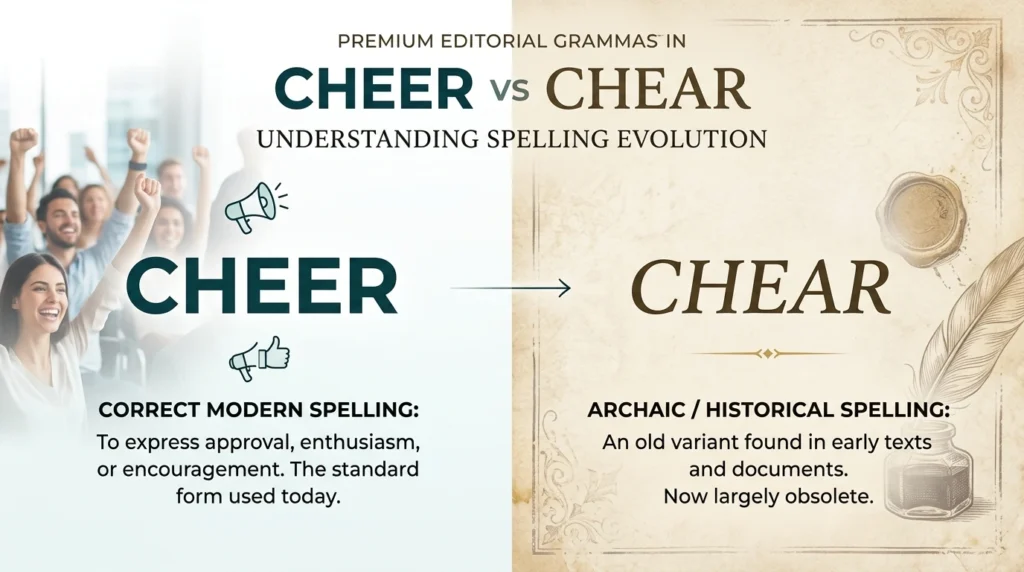

The difference between cheer vs chear is mainly historical. Cheer is the correct modern spelling and can function as a noun or verb. Chear is an old variant spelling that survives mainly in historical texts and exact quotations. For normal modern English, choose cheer every time.
What Is the Difference Between Cheer and Chear?
Cheer is a standard modern English word connected with happiness, encouragement, approval, or enthusiastic support.
As a verb, it can mean to shout in support of someone:
The crowd began to cheer when the players entered.
It can also mean to make someone feel happier:
Her message cheered me up.
As a noun, cheer can describe a shout of encouragement or a feeling of happiness:
A loud cheer came from the audience.
The decorations added some holiday cheer.
Chear, by contrast, is an archaic spelling of cheer. You may encounter it in old books, letters, poems, or historical records. It is not the spelling normally used in modern English.
Why the Difference Matters
Using chear in ordinary modern writing can make an otherwise polished sentence look misspelled.
That matters especially in:
- school and university assignments
- job applications and résumés
- professional emails
- business reports
- website content
- advertising copy
- social media posts
- examination answers
There is one important qualification. If you are reproducing an old quotation exactly, changing chear to cheer may alter the historical source. In that situation, keeping the original spelling can be correct.
The Core Rule
Rule: Use cheer in modern English. Use chear only when intentionally preserving or discussing an archaic spelling.
An easy three-step check is:
- Writing normal modern English? Use cheer.
- Quoting an old source exactly? Keep chear if that is how the original spells it.
- Discussing historical spelling? You may mention chear while explaining that modern English uses cheer.
For almost every everyday writing situation, you only need step one.
Read More: Present vs Presant Differences: Meaning, Spelling, and Correct Usage
How to Use Cheer Correctly
Cheer as a Verb for Applause or Support
Use cheer when people express approval, enthusiasm, or encouragement, often by shouting.
Thousands of supporters gathered to cheer the runners.
We will cheer for whichever team reaches the final.
The verb changes normally:
cheer → cheers → cheered → cheering
She cheers for her school team.
Everyone cheered when the announcement was made.
Fans were cheering from the stands.
Cheer as a Noun
As a countable noun, a cheer can mean a shout of approval or encouragement.
A huge cheer went through the stadium.
Its plural is cheers:
Cheers erupted when the winner crossed the finish line.
Cheer can also refer more generally to happiness, optimism, or a pleasant atmosphere.
The lights brought some cheer to the dark room.
Cheer Up
Cheer up is a common phrasal verb.
It can mean become happier:
He cheered up after speaking with his friends.
It can also mean make another person happier:
I brought her some flowers to cheer her up.
In the second pattern, a pronoun normally goes between cheer and up:
✅ Cheer him up.
Rather than:
❌ Cheer up him.
Cheer Someone On
Cheer someone on means to encourage someone while they are doing something difficult, competitive, or important.
Her classmates cheered her on during the final lap.
This expression is especially natural in sports, competitions, performances, and personal challenges.
When Chear Can Appear
There is one real exception to the modern spelling rule.
You may retain chear when:
- quoting historical writing exactly
- transcribing an old manuscript
- discussing obsolete English spellings
- analyzing the language of an older text
In those cases, chear is evidence of historical usage rather than a modern spelling choice.
Correct Examples of Cheer
Here are original examples showing how cheer works across different situations.
- Conversation: We stayed to cheer for Maya during her final race.
- Text message: I hope this photo cheers you up after your long day.
- Email: The whole department will be there to cheer you on.
- Workplace: Employees cheered when the results appeared on the screen.
- School: Our class gave the debate team a loud cheer.
- Academic writing: Public celebrations often involve collective cheering and applause.
- Social media: One more win to cheer about this season!
- Sports: The supporters continued to cheer despite the rain.
- Community event: Volunteers brought music and cheer to the neighborhood festival.
- Presentation: The announcement received a warm cheer from the audience.
- Personal support: A short conversation with her sister helped cheer her up.
- Competition: We stood beside the track and cheered the younger runners on.
Notice that the spelling remains cheer regardless of whether the word is being used formally or casually.
Cheer vs Chear: Incorrect and Correct Examples
| ❌ Incorrect | ✅ Correct | Why |
|---|---|---|
| We came to chear for our team. | We came to cheer for our team. | Modern English spells the verb cheer with two e’s. |
| The audience gave a loud chear. | The audience gave a loud cheer. | The noun meaning a shout of approval is cheer. |
| Your message really cheared me up. | Your message really cheered me up. | The past tense follows cheer + ed = cheered. |
| She is chearing from the front row. | She is cheering from the front row. | The present participle is cheering. |
| Let us chear him on. | Let us cheer him on. | The standard phrasal verb is cheer someone on. |
| Everyone chears when she scores. | Everyone cheers when she scores. | The third-person form is cheers. |
| The decorations added holiday chear. | The decorations added holiday cheer. | The noun referring to happiness or festive spirit is spelled cheer. |
| I tried to chear my friend up. | I tried to cheer my friend up. | Chear is not the normal modern spelling. |
| A chear came from the crowd. | A cheer came from the crowd. | A shout of support is a cheer. |
| We were chearing for you online. | We were cheering for you online. | Forms derived from modern cheer retain the double e. |
| Her friends cheared when she graduated. | Her friends cheered when she graduated. | Modern past-tense spelling is cheered. |
| The news gave us something to chear about. | The news gave us something to cheer about. | The idiomatic expression is something to cheer about. |
Why People Confuse Cheer and Chear
Phonetic Similarity
The biggest problem is that spelling cannot always be predicted from pronunciation.
A learner may hear cheer correctly but still be unsure whether the vowel sound should be represented by ee or ea.
English uses several letter combinations for similar sounds, so pronunciation alone does not guarantee the correct spelling.
Spelling Overlap With Familiar Words
Writers see ea in common words such as:
- hear
- fear
- clear
- near
- year
That pattern can tempt someone to spell cheer as chear.
However, English spelling patterns are not completely regular. Knowing how hear is spelled does not mean cheer follows the same letter pattern.
Overgeneralizing English Patterns
Learners naturally look for patterns.
For example:
hear → ear
may lead someone to imagine:
cheer → chear
But English contains many words whose pronunciations overlap even though their spellings do not follow one universal rule.
The safer approach is to learn cheer as a complete spelling unit.
Historical Examples Online
Unlike a completely invented typo, chear really has appeared in English.
Digitized books, scanned manuscripts, historical poems, and archived documents can therefore show the spelling in search results.
A reader who sees those examples without historical context may assume both forms remain acceptable today.
They do not.
Autocomplete and Spellcheck Limits
Writing tools can catch many spelling errors but they should not replace language knowledge.
A system may recognize archaic vocabulary, proper names, specialist terminology, or unusual strings differently depending on its dictionary.
If a tool fails to flag chear, that does not make it the preferred modern spelling.
Translation Interference
English learners sometimes transfer spelling expectations from another language or rely heavily on sound-to-letter matching.
That strategy can work for highly phonetic languages but English spelling contains many historical patterns.
For cheer, memorizing the standard written form is more reliable than trying to reconstruct it from pronunciation.
Common Mistakes Checklist
Use this checklist before publishing or submitting your writing.
- Writing “chear” in ordinary sentences: This often happens because ea feels plausible. Replace it with cheer.
- Writing “cheared”: The correct past tense is cheered.
- Writing “chearing”: The correct form is cheering.
- Assuming “chear” is British spelling: It is not the normal modern British spelling.
- Changing historical quotations automatically: Preserve the original spelling when quotation accuracy matters.
- Confusing cheer with chair: Chair refers mainly to a seat while cheer relates to encouragement or happiness.
- Using “cheer up” carelessly: Grammatically correct wording can still sound insensitive when someone is dealing with something serious.
- Assuming every use of “cheers” means applause: Depending on context, cheers can also be a toast or an informal expression used in some varieties of English.
Cheer vs Chear in Real English
Grammatically Correct English
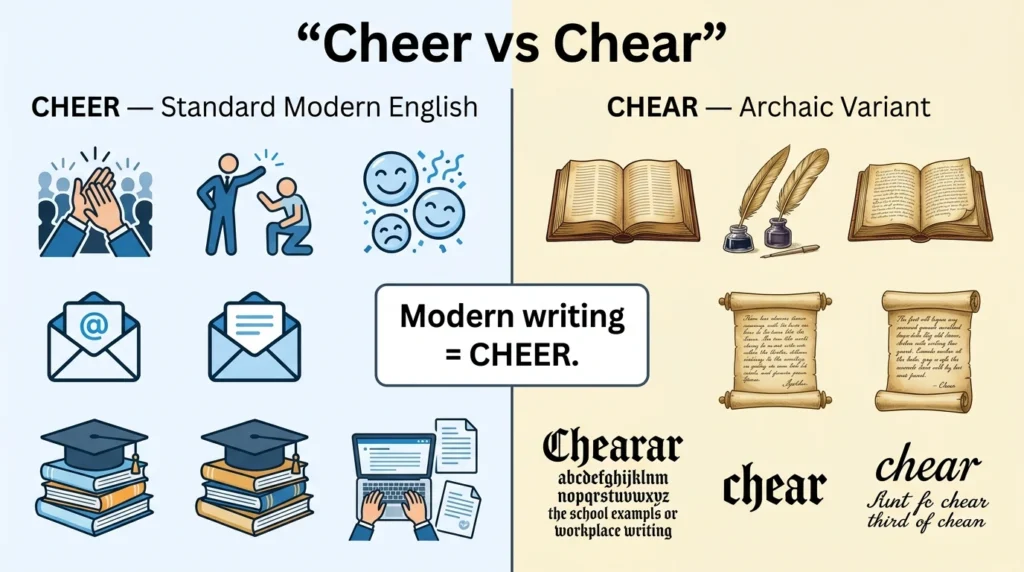
In standard modern writing, cheer works naturally as both a noun and a verb: “The crowd gave a cheer,” “We cheered the players,” and “I tried to cheer him up.” Related forms such as cheered, cheering, and cheers are also standard. Chear should not replace these forms in ordinary contemporary sentences, although it may legitimately appear when historical spelling itself is being discussed.
Grammatically Possible but Unnatural English
A sentence can follow basic grammar rules and still sound unusual. For example, “The manager cheered the disappointed employee” is interpretable but many speakers would choose encouraged the employee or cheered the employee up, depending on the intended meaning. Similarly, abstract phrases such as “The report created cheer among management” are possible but may sound less natural than “The report lifted morale.”
Natural Everyday English
In everyday conversation, cheer appears most naturally in expressions such as cheer up, cheer someone on, cheer for a team, and give a cheer. People also talk about holiday cheer or having something to cheer about. These combinations are worth learning as complete phrases because they help you choose not only the correct spelling but also wording that sounds natural in context.
Formal vs Informal Usage
The spelling cheer stays the same in formal and informal English. What changes is the expression you choose.
Informal Usage
Common informal expressions include:
Cheer up!
I’m cheering for you.
We’ve finally got something to cheer about.
Come on, everyone—cheer them on!
One caution matters with cheer up. Although perfectly grammatical, directly telling an upset person to “cheer up” can sometimes sound dismissive. Context and tone matter.
Read More: Trauma vs Trama Difference: Which Spelling Is Correct?
Formal Usage
In more formal writing, writers may choose precise alternatives depending on the meaning:
The audience cheered the announcement.
The initiative helped improve morale.
Participants expressed enthusiastic support.
The news encouraged investors.
There is nothing inherently informal about the word cheer, however. Formal writers simply choose the wording that most accurately matches the situation.
Cheer vs Chear Comparison Table
| Feature | Cheer | Chear |
| Standard modern spelling | Yes | No |
| Historical English form | Yes, including older senses | Yes, as an archaic variant |
| Modern noun | Yes | Not normally |
| Modern verb | Yes | Not normally |
| Meaning | Happiness, encouragement, approval, support | Historical form of cheer |
| Used in emails | Yes | Avoid |
| Used in essays | Yes | Avoid unless discussing historical language |
| Used in professional writing | Yes | Avoid unless historically relevant |
| Can appear in old quotations | Yes | Yes |
| Related modern forms | cheers, cheered, cheering, cheerful | Not used for normal modern inflections |
| Best choice today | Cheer | Historical contexts only |
Memory Trick
Remember:
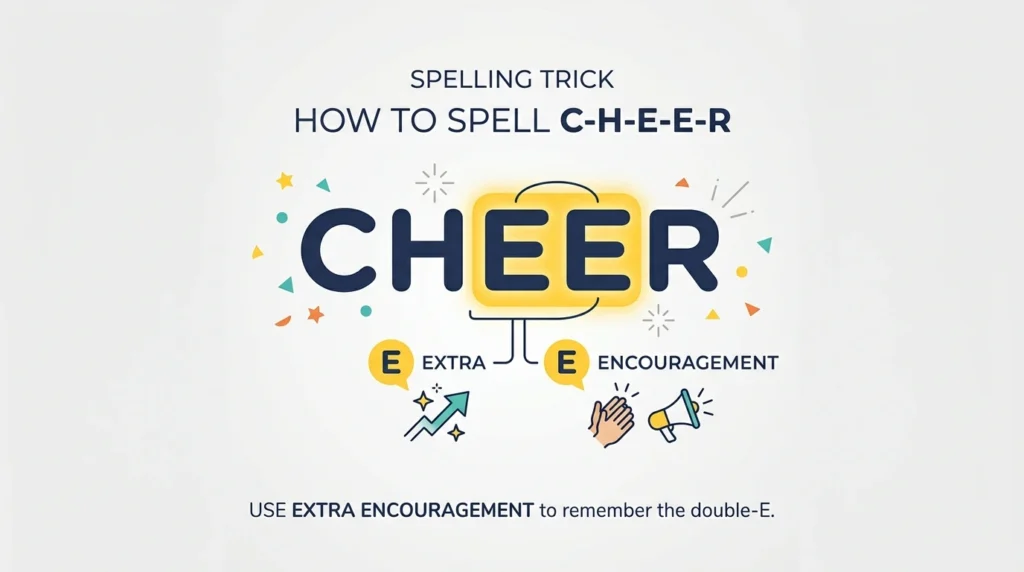
A cheer needs Extra Encouragement: two E’s.
The phrase Extra Encouragement gives you two prominent E sounds to associate with the middle of chEEr.
You can also connect the spelling family:
cheer → cheerful → cheering → cheerleader
Every common modern member keeps cheer at its core.
Real-Life Situations
Job Interview
You are describing how your previous team supported one another:
“We would always cheer each other on during difficult projects.”
Use cheer, not chear.
Workplace Meeting
A successful quarter is announced and everyone reacts enthusiastically:
The sales team cheered after hearing the final figures.
Here cheered is the past-tense verb.
Professional Email
You want to encourage a colleague before a presentation:
We’ll all be there to cheer you on tomorrow.
The expression sounds warm and supportive.
Text Message
A friend has had a disappointing day:
Want to grab coffee? It might cheer you up.
This is more natural than simply writing “Cheer up!” when you want to sound supportive rather than dismissive.
School Exam
The question asks you to complete the sentence:
The crowd began to ______ when the winner appeared.
Write cheer.
Writing chear would normally count as a spelling error.
Historical Literature Class
You reproduce a line from an old text containing chear.
If the task requires an exact quotation, keep the original spelling and, when useful, explain that chear is an archaic form of modern cheer.
Expert Tips
Learn the Whole Word Instead of Guessing From Sound
Trying to rebuild cheer from pronunciation can create uncertainty because English does not have a one-to-one sound-and-letter system.
Memorize C-H-E-E-R as a unit.
Learn the Word Family Together
Study these forms together:
cheer, cheers, cheered, cheering, cheerful, cheerfully, cheerleader
Seeing the repeated cheer base reinforces the spelling automatically.
Check the Purpose of an Old Spelling Before Correcting It
If chear appears in a modern blog post, correcting it is usually sensible.
If it appears inside an eighteenth-century quotation, changing it may be editorially wrong.
Ask whether the spelling is a mistake or historical evidence.
Distinguish Spelling From Register
You do not need separate formal and informal spellings.
The difference lies in phrasing.
Cheer up! is conversational.
The announcement improved morale is more formal.
Both can express related ideas but they suit different situations.
Watch the Meaning of Cheer With Different Complements
Compare:
We cheered for Maria.
You supported Maria.
We cheered Maria on.
You actively encouraged her while she was doing something.
We cheered Maria up.
You made Maria happier.
The small words for, on, and up change the relationship expressed by the verb.
Read More: Kinesthesiology vs Kinesiology: What’s the Difference?
Frequently Asked Questions
Is chear a real word?
Chear has historical legitimacy as an archaic variant of cheer, so it is more accurate to call it an obsolete or archaic form than a completely invented word. In ordinary modern English, however, use cheer.
Is chear the wrong spelling?
In normal contemporary writing, yes. If you write “We came to chear for the team,” chear should be corrected to cheer.
The exception is intentional historical usage.
Is chear an American or British spelling?
No. Chear is not the normal modern British equivalent of American cheer. Contemporary writing uses cheer.
Why does chear appear in old books?
English spelling was historically less standardized than it is today. Older texts may therefore contain forms that later disappeared from everyday written English. Chear is one such form.
How do you spell cheer when supporting someone?
Spell it cheer:
We came to cheer for you.
You can also say:
We came to cheer you on.
What is the past tense of cheer?
The past tense and past participle are cheered.
Everyone cheered when she finished.
Do not write cheared in normal modern English.
Is it cheering or chearing?
The correct modern spelling is cheering.
The children were cheering from the sidelines.
What is the difference between cheer and chair?
Cheer relates to happiness, encouragement, approval, or support.
Chair usually refers to a piece of furniture designed for sitting, although it can also refer to the person leading a meeting or organization.
What does “cheer someone on” mean?
To cheer someone on means to actively encourage or support them while they are attempting something.
We cheered her on during the race.
What does “cheer someone up” mean?
To cheer someone up means to make that person feel happier or less sad.
The surprise visit cheered him up.
Can cheer be both a noun and a verb?
Yes.
As a noun:
The crowd gave a cheer.
As a verb:
The crowd began to cheer.
Should I change chear to cheer inside a quotation?
Not automatically. If you are reproducing an old source exactly, keep the original spelling unless your editorial method requires modernization. You can explain the archaic spelling separately if readers may find it confusing.
Mini Quiz: Cheer vs Chear
| # | Question | Answer | Explanation |
| 1 | Choose the correct spelling: “We came to ___ for the players.” A) chear B) cheer | B) cheer | Modern English uses cheer for showing support. |
| 2 | Fill in the blank: “The children were ___ loudly.” | cheering | The -ing form is cheering, retaining the double e. |
| 3 | Correct the sentence: “Her friends cheared when she won.” | Her friends cheered when she won. | The past tense is cheered. |
| 4 | True or false: Chear is the standard British spelling of cheer. | False | Chear is archaic, not a normal modern British variant. |
| 5 | Choose the correct sentence: A) Let’s chear him on. B) Let’s cheer him on. | B | Cheer someone on is the standard expression. |
| 6 | Fill in the blank: “A huge ___ came from the audience.” | cheer | Here cheer is a countable noun meaning a shout of approval. |
| 7 | When may “chear” appropriately remain in text? A) Business email B) Exact historical quotation C) Modern résumé | B | Historical quotation can preserve the original archaic spelling. |
| 8 | Correct the sentence: “I bought her flowers to chear her up.” | I bought her flowers to cheer her up. | Cheer up is the correct modern phrasal verb. |
| 9 | Which means “encourage someone during an activity”? A) cheer someone on B) cheer someone up | A | Cheer on means encourage; cheer up means become or make happier. |
| 10 | Fill in the blank: “The decorations brought some holiday ___ to the office.” | cheer | Here cheer refers to happiness or festive spirit. |
Quick Summary
Cheer is the standard modern spelling while chear is an archaic or obsolete variant that belongs mainly to historical writing. Use cheer when referring to encouragement, applause, happiness, support, or making someone feel better. Common forms include cheers, cheered, cheering, cheerful, cheer up, cheer for, and cheer someone on. Do not assume chear is an alternative British spelling or a modern variant. However, avoid automatically “correcting” it inside an exact historical quotation because preserving original spelling may be important. The easiest memory trick is to connect cheer with its word family: cheerful, cheering, and cheerleader all keep the same double-e spelling.