
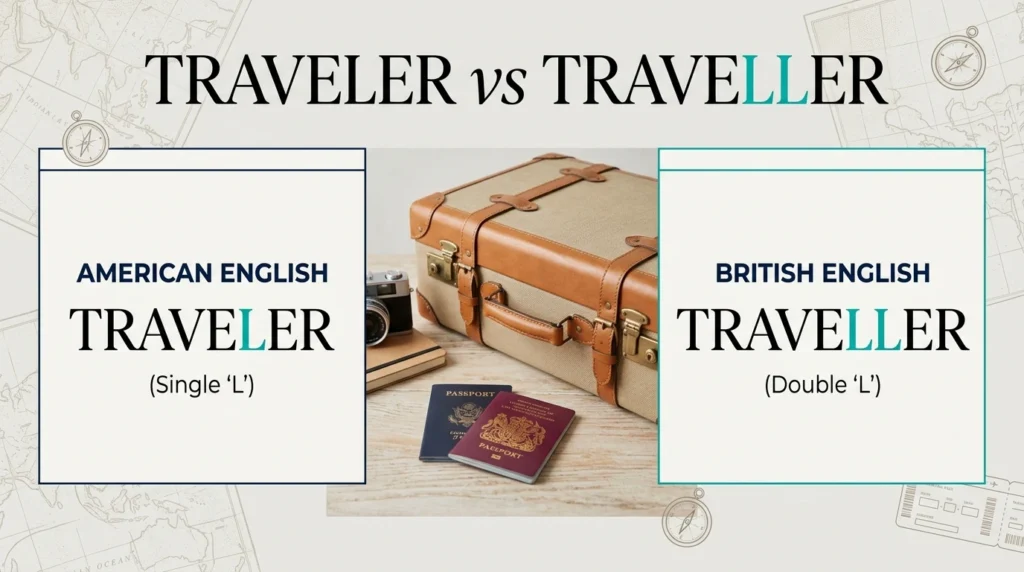

Both “traveler” and “traveller” are correct spellings. The difference depends mainly on the variety of English you use. Traveler is the standard spelling in American English, while traveller is standard in British English and many other varieties, including Canadian and Australian English. Both words mean a person who travels. The key is to choose the spelling that matches your
What Is the Difference Between Traveler and Traveller?
The difference is spelling, not meaning. Both words refer to someone who travels from one place to another, whether for business, leisure, education, or another purpose.
- Traveler: Standard American English spelling.
- Traveller: Standard British English spelling, also used in Australian English and commonly in Canadian English.
Examples:
- American English: “The traveler booked a hotel near the airport.”
- British English: “The traveller booked a hotel near the airport.”
Both sentences are correct. The choice depends on the English variety you are following.
Why Does the Difference Matter?
Choosing the right spelling helps keep your writing consistent and appropriate for your audience.
This distinction matters when you are:
- Writing articles for an American or British audience.
- Publishing travel blogs or destination guides.
- Preparing school assignments or university essays.
- Creating marketing campaigns for international customers.
- Editing books, reports, or business documents.
Using one spelling does not automatically make your writing incorrect. However, switching between traveler and traveller without a reason can make a document look inconsistent.
For example, an article written in American English would normally use traveling, traveled, and traveler. A British English article would normally use travelling, travelled, and traveller.
The Core Rule
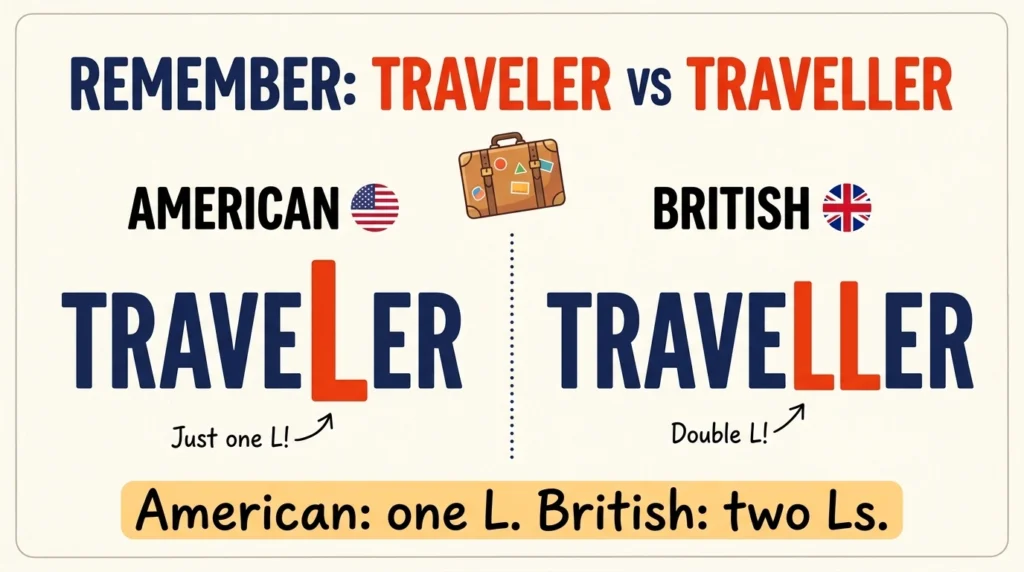
American English: Traveler
Use one L in traveler, traveling, and traveled.
Example: The traveler is traveling across Texas.
British English: Traveller
Use two Ls in traveller, travelling, and travelled.
Example: The traveller is travelling across England.
Remember: Choose the spelling convention that suits your audience, then use it consistently throughout your writing.
How to Use Traveler and Traveller
When to Use Traveler
Use traveler when writing in American English.
Examples:
- “The traveler arrived at the airport early.”
- “Every traveler should check the weather before leaving.”
- “She is a frequent traveler who visits several countries each year.”
- “The travel company offers discounts to young travelers.”
American English generally uses one L in related forms such as traveling and traveled.
When to Use Traveller
Use traveller when writing in British English. It is also the conventional spelling in Australian English and is commonly used in Canadian English.
Examples:
- “The traveller arrived at the station before noon.”
- “Every traveller should carry valid identification.”
- “She is an experienced traveller who enjoys visiting historic cities.”
- “The travel company offers discounts to young travellers.”
British English generally doubles the L in travelling and travelled.
What About Other Forms of Travel?
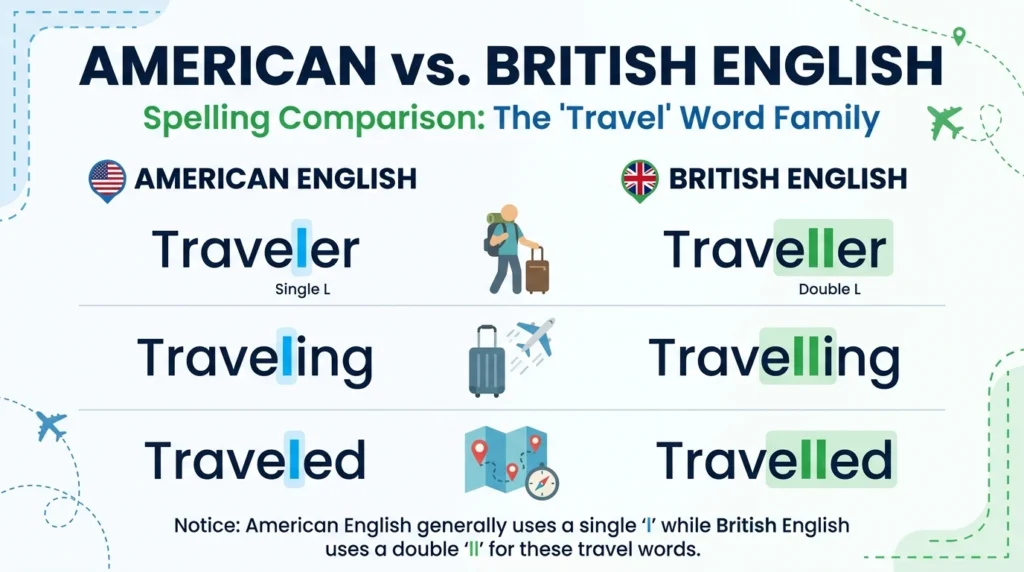
The spelling difference extends to several related words.
| American English | British English |
|---|---|
| Traveler | Traveller |
| Travelers | Travellers |
| Traveling | Travelling |
| Traveled | Travelled |
| Traveler’s guide | Traveller’s guide |
| Travelers’ experiences | Travellers’ experiences |
The possessive forms follow ordinary apostrophe rules. Traveler’s refers to something belonging to one traveler, while travelers’ refers to something belonging to multiple travelers.
Correct Examples of Traveler vs Traveller
The following examples show how both spellings work across different contexts.
| Context | American English | British English |
|---|---|---|
| Everyday conversation | The traveler is waiting outside. | The traveller is waiting outside. |
| A traveler requested a refund. | A traveller requested a refund. | |
| School assignment | The traveler crossed the desert. | The traveller crossed the desert. |
| Workplace | Every traveler must submit a report. | Every traveller must submit a report. |
| Social media | I’m a solo traveler exploring the world. | I’m a solo traveller exploring the world. |
| Academic writing | The study examined traveler behavior. | The study examined traveller behaviour. |
| Travel blog | A first-time traveler needs careful planning. | A first-time traveller needs careful planning. |
| Tourism marketing | Discover experiences for every traveler. | Discover experiences for every traveller. |
| News report | The traveler was safely reunited with family. | The traveller was safely reunited with family. |
| Travel policy | Each traveler must show identification. | Each traveller must show identification. |
| Hotel website | Every traveler deserves a comfortable stay. | Every traveller deserves a comfortable stay. |
| Personal journal | I became a more confident traveler. | I became a more confident traveller. |
The examples demonstrate the same meaning in both varieties. The spelling changes, but the basic grammatical role does not.
Incorrect vs Correct: Common Spelling Mistakes
The following table shows errors that can occur when writers mix American and British spelling conventions.
| ❌ Incorrect or inconsistent | ✅ Correct | Why |
|---|---|---|
| An American article uses “traveller” throughout. | Use “traveler” in standard American English. | American English normally uses one L. |
| A British article uses “traveler” throughout. | Use “traveller” in standard British English. | British English normally uses two Ls. |
| The American traveler is travelling through Florida. | The American traveler is traveling through Florida. | The verb should follow American spelling conventions. |
| The British traveller is traveling through Wales. | The British traveller is travelling through Wales. | The verb should follow British spelling conventions. |
| Many travelers visited the museum. (in a consistently British text) | Many travellers visited the museum. | The plural should follow the chosen variety. |
| The traveller travelled across California. (in a consistently American text) | The traveler traveled across California. | Standard American spelling uses one L in these forms. |
| The travel guide welcomes all traveller’s. | The travel guide welcomes all travellers. | A plural noun does not need an apostrophe. |
| All travelers’ must show their tickets. | All travelers must show their tickets. | The ordinary plural does not take an apostrophe. |
| She is a frequent traveller in an otherwise American article. | She is a frequent traveler. | Consistent American spelling improves editorial consistency. |
| He is a solo traveler in an otherwise British article. | He is a solo traveller. | Consistent British spelling matches the document’s style. |
A spelling is not automatically wrong simply because it belongs to another English variety. The important distinction is whether it is appropriate for the chosen style and used consistently.
Why People Confuse Traveler and Traveller
1. Different Regional Conventions
American and British English developed different spelling conventions. Words such as color/colour, center/centre, and traveling/travelling illustrate the same broader pattern.
Writers who read material from both varieties may encounter both forms regularly.
2. The Double-L Pattern
Many writers remember that British English often doubles the L in words such as travelled and travelling, but they may forget the noun traveller.
Remembering the entire word family is more useful than memorizing only one spelling.
3. Spellcheck Settings
A spellchecker configured for American English may flag traveller, while a British English spellchecker may prefer traveller over traveler.
A flagged word is not necessarily universally incorrect. Check the language setting before changing the spelling.
4. Autocomplete and Typing Habits
Phones, browsers, and writing applications may suggest a form based on their language settings or your previous typing. Writers can unintentionally switch spelling conventions when copying and editing text from different sources.
5. Translation and Language Learning
English learners may encounter one spelling in textbooks and another on websites. They may assume one is a mistake when both are accepted regional forms.
The solution is to identify the English variety required for the assignment, publication, or audience.
Common Mistakes Checklist
- Mixing regional spellings: Choose American or British English before drafting.
- Forgetting related forms: Match traveler with traveling and traveled, or traveller with travelling and travelled.
- Treating one spelling as universally wrong: Both forms are correct in their respective conventions.
- Trusting spellcheck without checking its language setting: Confirm whether the document is set to American or British English.
- Adding apostrophes to ordinary plurals: Write travelers or travellers, not traveler’s or traveller’s, when you simply mean more than one person.
- Changing spellings in quoted material or official names: Preserve original wording when accuracy requires it.
- Assuming every country follows one convention without exceptions: Follow the publication’s style guide, especially for Canadian or international content.
Traveler vs Traveller in Real English
Grammatically Correct
Both traveler and traveller are grammatically correct nouns. Each refers to a person who travels. The difference is regional spelling, not grammar. “The traveler arrived early” and “The traveller arrived early” are both correct sentences. The first is conventional in American English; the second is conventional in British English. Neither form changes the tense, meaning, or grammatical structure of the sentence.
Grammatically Possible but Inconsistent
A sentence such as “The traveller is traveling through London” is understandable and grammatically structured correctly. However, it mixes conventional British spelling for the noun with conventional American spelling for the verb. A British-style version would be “The traveller is travelling through London.” An American-style version would be “The traveler is traveling through London.” Mixed forms may be acceptable in some international contexts, but consistency is usually preferable.
Natural, Everyday English
Both forms are natural in everyday English when they match the speaker’s or writer’s spelling convention. American publications commonly use traveler, while British publications commonly use traveller. Readers generally understand both. You do not need to change the spelling when quoting a source or reproducing an official title, but for your own writing, choose a consistent style that fits your audience.
Read More: Aswell vs As Well: The Simple Rule That Ends the Confusion.
American vs British English
This is a genuine American-versus-British spelling difference.
| Feature | American English | British English |
|---|---|---|
| Singular noun | Traveler | Traveller |
| Plural noun | Travelers | Travellers |
| Present participle | Traveling | Travelling |
| Past tense | Traveled | Travelled |
| Common related spelling | Travel counselor may follow US conventions in related words | Travel counsellor may follow UK conventions in related words |
| Example | The traveler is traveling abroad. | The traveller is travelling abroad. |
British-style spellings are also common in Australia. Canadian English often uses traveller and travelling, although Canadian spelling conventions can vary by word and publication.
For international websites, follow your organization’s style guide and the needs of your main audience rather than changing spellings randomly from page to page.
Formal vs Informal Usage
There is no difference in formality between traveler and traveller. Both are suitable for professional, academic, casual, and commercial writing when used according to the appropriate spelling convention.
Formal examples:
- American: “The traveler must provide proof of identification.”
- British: “The traveller must provide proof of identification.”
Informal examples:
- American: “I’m a solo traveler.”
- British: “I’m a solo traveller.”
In both cases, the choice reflects spelling convention rather than tone or formality.
Comparison Table: Traveler vs Traveller
| Feature | Traveler | Traveller |
|---|---|---|
| Standard variety | American English | British English |
| Meaning | A person who travels | A person who travels |
| Grammatical category | Noun | Noun |
| Number | Traveler / travelers | Traveller / travellers |
| Related verb form | Traveling | Travelling |
| Past tense | Traveled | Travelled |
| Pronunciation | Generally the same | Generally the same |
| Formality | Neutral | Neutral |
| Correct in its standard variety? | Yes | Yes |
| Best use | American-facing content | British-facing content |
Memory Trick
Use this simple mnemonic:
America travels light with one L; Britain doubles the L.
- American: traveler, traveling, traveled.
- British: traveller, travelling, travelled.
The mnemonic is designed to help you remember this particular spelling pattern. It is not a universal rule for every English word.
Traveler vs Traveller in Real-Life Situations
Situation 1: Writing a Travel Blog
You run a website aimed at American readers.
Use: “Every traveler should visit these five national parks.”
For a British audience, write: “Every traveller should visit these five national parks.”
Situation 2: Sending a Business Email
Your company uses British English in its official documents.
Use: “Each traveller must complete the registration form before departure.”
The spelling should match the company’s established style.
Situation 3: Posting on Social Media
Your account targets American tourists.
Use: “I’m a solo traveler discovering the best food in New York.”
If your account primarily targets British readers, solo traveller is the conventional choice.
Situation 4: Completing a School Assignment
Your teacher requests British English.
Use: “The traveller crossed three countries during the journey.”
Use traveler if the assignment requires American English instead.
Situation 5: Publishing a Tourism Report
Your report follows American English.
Use: “The survey measured traveler satisfaction at international airports.”
If the report follows British English, use traveller satisfaction.
Expert Tips for Choosing the Right Spelling
- Set your language variety first. Choose American or British English before writing a long document.
- Check the entire word family. Search for traveler/traveller, traveling/travelling, and traveled/travelled together.
- Configure your spellchecker. Select the appropriate English language setting.
- Follow the publication’s style guide. A publisher’s rules take priority over your personal spelling preference.
- Keep quotations accurate. Do not silently change a spelling in a direct quotation when the original form matters.
- Check the audience, not just the country. An international publication may follow American or British conventions regardless of where its writers live.
- Do a consistency search before publishing. A simple search for both spellings can identify accidental mixing.
Read More: Manuel vs Manual: Meaning, Spelling, and Correct Usage.
Quick Summary
Traveler and traveller are both correct spellings of a noun meaning a person who travels. The main difference is regional: American English normally uses traveler, while British English normally uses traveller. The same pattern appears in traveling/travelling and traveled/travelled. Neither spelling is more grammatically correct than the other. The best choice depends on your audience, publication, or style guide. To keep your writing professional, select one English variety and use it consistently. Remember the simple rule: American English uses one L, while British English usually uses two Ls in this word family.
Read More: Click vs. Clique: Meaning, Difference, Examples & Common Mistakes.
Frequently Asked Questions
1. Is traveler or traveller correct?
Both are correct. Traveler is standard in American English, while traveller is standard in British English and common in Australian and Canadian English.
2. Which spelling should I use for an international website?
Choose the spelling convention that best matches your primary audience or your website’s established style guide. Consistency matters more than choosing one spelling for every country.
3. Is traveller British or American?
Traveller is the conventional British spelling. American English generally uses traveler.
4. Why does traveller have two Ls?
British English commonly doubles the L in this word family, producing traveller, travelling, and travelled. American English generally uses one L in these forms.
5. Is traveling or travelling correct?
Both are correct. Use traveling in American English and travelling in British English.
6. Is it travelers or travellers?
Both plurals are correct. Travelers is the standard American form, and travellers is the standard British form.
7. Does traveler have a different meaning from traveller?
No. Both words have the same basic meaning. The difference is spelling convention, not definition.
8. Which spelling is used in Australia?
Australian English generally uses traveller, travelling, and travelled, following the British-style pattern.
9. Which spelling is used in Canada?
Traveller is commonly used in Canadian English. However, Canadian spelling has its own conventions, and individual publications may specify their preferred style.
10. Can I use both spellings in the same article?
You can if there is a specific reason, such as discussing regional differences or quoting original material. Otherwise, use one convention consistently throughout the article.
Mini Quiz: Traveler vs Traveller
Choose the best answer for each question.
| No. | Question | Answer | Explanation |
|---|---|---|---|
| 1 | Which spelling is standard in American English? | Traveler | American English normally uses one L. |
| 2 | Which spelling is standard in British English? | Traveller | British English normally uses two Ls. |
| 3 | Complete the American sentence: “She is ___ across Europe.” | Traveling | This is the standard American spelling. |
| 4 | Complete the British sentence: “He ___ to Scotland last year.” | Travelled | This is the conventional British spelling. |
| 5 | Which plural is standard in American English: travelers or travellers? | Travelers | The American form uses one L. |
| 6 | Correct this British-style sentence: “The traveller is traveling abroad.” | The traveller is travelling abroad. | The noun and verb now follow British spelling conventions. |
| 7 | Is “traveler” grammatically incorrect in British English? | No | It is a recognized spelling, but traveller is the conventional British form. |
| 8 | Complete the sentence: “Every ___ needs a valid ticket.” | Traveler or traveller | Both are correct; the choice depends on the English variety. |
| 9 | Which spelling should you use in an American-facing article? | Traveler | It matches standard American spelling. |
| 10 | True or false: Traveler and traveller have different meanings. | False | They have the same meaning but different regional spellings. |