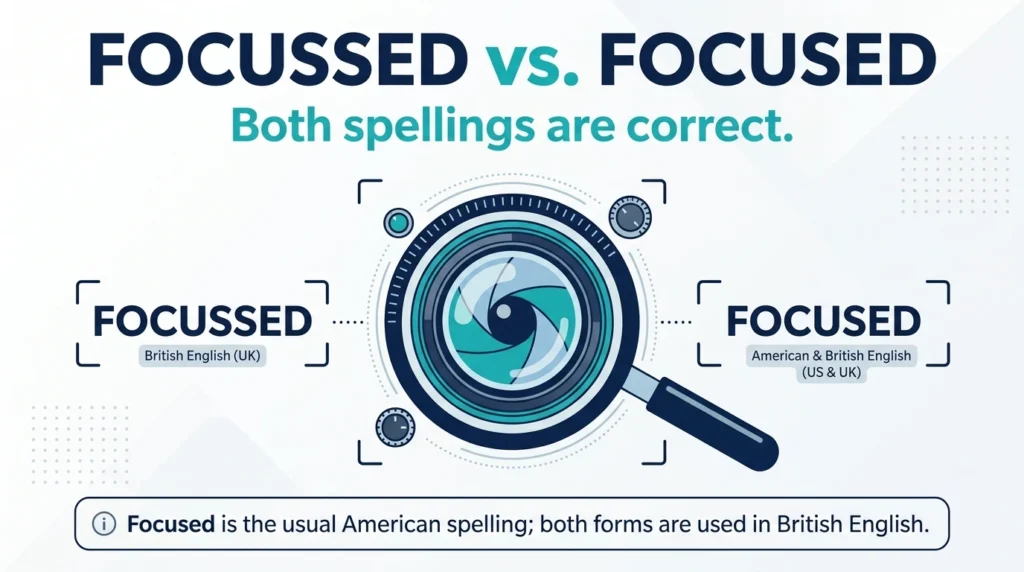

Both focussed and focused are correct spellings of the past tense and past participle of focus, as well as the adjective meaning concentrated or directed toward something. Focused is the standard spelling in American English and is also widely used in British English. Focussed is an accepted alternative, particularly in British and other varieties of English. For most international writing, focused is the simplest choice.
What Is the Difference Between Focussed and Focused?
The difference is spelling, not meaning. Both words come from the verb focus, which means to direct attention toward something or to adjust something so that it becomes clear.
- Focused: The more widely preferred spelling, especially in American English.
- Focussed: An accepted alternative spelling, especially in British English and some other varieties.
Both forms can function as the past tense of focus, the past participle used with helping verbs, or an adjective.
Examples:
- The team focused on customer service.
- The team focussed on customer service.
- She remained focused during the examination.
- She remained focussed during the examination.
All four sentences are grammatically correct. The best spelling depends on your chosen English variety, audience, and style guide.
Why the Spelling Matters
Choosing a consistent spelling makes your writing look professional and helps readers recognize the English variety you are following.
The distinction matters in several situations:
- Academic writing: Universities and publishers may require a particular spelling convention.
- Business communication: Consistency across proposals, reports, and emails makes documents look polished.
- Content writing: Writers targeting American readers will generally use focused, while some British publications accept or prefer focussed.
- Examinations: Following the spelling conventions expected by your examination board is sensible.
- Editing and proofreading: A document containing both spellings may look inconsistent, even though both forms are valid.
The important point is that focussed is not automatically a spelling mistake. The choice is largely a matter of regional preference and editorial consistency.
Read More: Aswell vs As Well: The Simple Rule That Ends the Confusion.
The Core Rule
Use focused as your default spelling unless your audience, publication, or style guide specifically prefers focussed.
Remember these practical rules:
- American English: focused is the standard choice.
- British English: focused and focussed are both used; preferences vary.
- International writing: focused is a broadly safe choice.
- Consistency: Choose one form and use it throughout the same document.
How to Use Focused and Focussed
When to Use Focused
Use focused when writing in American English or when you want a spelling that is widely accepted across English varieties.
1. Directing attention
- I focused on the most important task.
- The students focused on their revision.
- Our team is focused on improving customer satisfaction.
2. Describing concentration
- She stayed focused throughout the presentation.
- A focused learner is less likely to be distracted.
- He gave a focused answer to the interviewer’s question.
3. Describing a clear purpose
- The company developed a focused marketing strategy.
- We need a focused discussion rather than a long, unfocused meeting.
- The report provides a focused analysis of the problem.
4. Photography and optics
Focused can also describe an image or optical system in which the subject appears clear.
- The photographer focused the camera on the distant building.
- The image remained sharply focused.
- The lens was focused on the subject.
When to Use Focussed
Use focussed when it matches the spelling conventions of your audience or the publication you are writing for.
Examples:
- The committee focussed on the proposed changes.
- She remained focussed on her long-term goals.
- The company has focussed its efforts on staff development.
- The photographer focussed the lens on the subject.
These examples have exactly the same meanings as their focused equivalents. The spelling difference does not create a difference in grammar, tense, or emphasis.
What About Focusing and Focussing?
The same spelling pattern appears in the present participle and gerund forms of focus.
- Focusing: The standard spelling in American English and a widely used form internationally.
- Focussing: An accepted alternative, particularly in British English and some other varieties.
Examples:
- She is focusing on her studies.
- She is focussing on her studies.
Both sentences are correct. Choose the form that matches your preferred spelling convention.
What About Focuses and Focusses?
The third-person singular present tense is also worth distinguishing from the past-tense spelling.
- Focuses: The standard form in American English and widely used internationally.
- Focusses: An accepted alternative in some varieties of English, particularly British English.
Examples:
- He focuses on quality rather than quantity.
- He focusses on quality rather than quantity.
The noun plural focuses can also mean central points of attention. In context, focusses may be interpreted as a verb form, so clarity matters.
Correct Examples of Focussed and Focused
The following examples demonstrate how both spellings work in everyday and professional English. The sentences use focused for consistency, but focussed can replace it without changing the meaning.
Everyday Conversation
- I focused on finishing my work before dinner.
- She stayed focused despite the noise outside.
Email and Communication
- Please keep your reply focused on the three questions in my email.
- I have focused the revised proposal on the client’s main concerns.
School and Education
- The students focused on preparing for their final examinations.
- A focused study plan can make revision easier to manage.
Workplace and Business
- The management team focused on improving employee retention.
- Our next meeting will be focused on the product launch.
Social Media and Marketing
- The campaign focused on helping small businesses reach new customers.
- We created a focused message for our target audience.
Academic Writing
- The research focused on the relationship between sleep and concentration.
- The study provides a focused examination of the available evidence.
Photography and Technology
- The camera focused on the subject’s face.
- The photographer kept the background softly blurred while the main subject remained focused.
Personal Development
- He remained focused on his long-term goals.
- She has focused her energy on learning a new skill.
These examples show that both spellings serve the same grammatical and semantic functions.
Incorrect vs. Correct: Focussed vs. Focused
Because both spellings are accepted, it is important to distinguish a genuine spelling error from a style inconsistency.
| ❌ Incorrect or inconsistent | ✅ Correct | Why |
|---|---|---|
| I am focus on my studies. | I am focused on my studies. | The adjective or participle focused is needed after am. |
| She focus on the details yesterday. | She focused on the details yesterday. | The past-tense form is required. |
| He is focussing on his goals. (in a document using American spelling) | He is focusing on his goals. | Focussing is a valid form, but focusing matches the document’s American spelling convention. |
| The report is focused and focussed on the same issue. (unintended spelling variation) | The report is focused on the same issue throughout. | Use one spelling consistently when both forms have the same meaning. |
| They have focus on quality. | They have focused on quality. | The present perfect requires the past participle focused or focussed. |
| The camera was focus on the bird. | The camera was focused on the bird. | The sentence requires a participle or adjective, not the base form focus. |
| Our team are focussed on the target. (when the document uses American spelling) | Our team is focused on the target. | This revision follows standard American spelling and typical American agreement with a collective noun. The original may be grammatical in British English. |
| She stayed focussd throughout the meeting. | She stayed focused throughout the meeting. | Focussd is a misspelling; it omits the necessary letter. |
| We are focusning on customer needs. | We are focusing on customer needs. | The correct -ing form is focusing or focussing. |
| The company has focued its strategy. | The company has focused its strategy. | Focued is a misspelling of the past participle. |
| The students focused their attention to the lecture. | The students focused their attention on the lecture. | In this construction, the natural preposition is on. |
| The team focused to the problem. | The team focused on the problem. | The verb focus normally takes on when identifying the subject of attention. |
Important: The spelling focussed is not inherently incorrect in American English, although it is nonstandard compared with the usual American preference for focused. Likewise, focused is entirely acceptable in British English.
Why People Confuse Focussed and Focused
1. Different Spelling Rules and Preferences
English spelling includes words that double a final consonant before certain endings and words that do not. Writers may remember the doubling pattern from words such as planned or stopped and assume that focus must always become focussed.
However, spelling conventions vary by word and region. Both focused and focussed are established forms, and the preferred spelling depends on usage and editorial convention.
2. British and American English Overlap
Many learners are taught that British English doubles consonants more often than American English. This is a useful generalization in some cases, but it does not mean every British writer uses focussed.
Both forms occur in British writing. American English strongly favors focused, while focussed is less common there.
3. Spellcheck Settings
A spellchecker configured for American English may flag focussed, while a different dictionary or writing tool may accept it.
A spelling warning does not always mean that a word is universally wrong. Check the language settings and the style guide you need to follow.
4. Inconsistent Editing
A writer may begin with focused, paste a passage containing focussed, and overlook the difference during proofreading.
The document can remain understandable, but the mixed spelling may appear careless. A final search for both forms can help you standardize the text.
5. Confusion About Grammar and Spelling
Some learners assume that changing focused to focussed changes the tense or meaning. It does not.
The difference concerns spelling preference. Both forms can be used as the past tense, past participle, or adjective, depending on the sentence.
Common Mistakes Checklist
- Calling focussed universally wrong: It is an accepted spelling. Check the English variety and editorial requirements before correcting it.
- Assuming every British writer prefers focussed: British usage includes both forms. Do not impose a universal rule where actual usage varies.
- Using both spellings without a reason: Choose a consistent form for each document unless you are reproducing original quotations or official names.
- Confusing the verb and adjective: Both forms can describe an action or a state. For example, “She focused the camera” describes an action, while “She remained focused” describes a state.
- Using the wrong tense: Write “She focused yesterday,” not “She focus yesterday.”
- Forgetting the preposition: When describing the subject of attention, write “focus on the issue.”
- Applying consonant-doubling rules mechanically: Learn accepted word forms rather than assuming one spelling rule applies to every word.
- Ignoring a publisher’s style guide: A publication may prefer one form even when both are correct.
Focussed vs. Focused in Real English
Grammatically Correct
Both focused and focussed are grammatically correct as past-tense forms, past participles, and adjectives. For example, “She focused on the task” and “She focussed on the task” express the same action. The same applies to “a focused team” and “a focussed team.” The choice is a spelling preference, not a difference in grammatical structure.
Grammatically Possible but Unnatural
A sentence can use the correct spelling but still sound awkward because of its construction. For example, “She focused to her studies” uses a valid form of focus but the wrong preposition for the intended meaning. “She focused on her studies” is the natural correction. Changing focused to focussed would not fix the preposition error.
Natural, Everyday English
Both spellings occur in real English. Focused is the safer default for American English and for international audiences who expect widely recognized spelling. Focussed is also used, especially by writers following certain British or Commonwealth conventions. In everyday writing, the best choice is the one that matches your audience and remains consistent throughout the document.
Read More: Manuel vs Manual: Meaning, Spelling, and Correct Usage.
American vs. British English
The main distinction is regional preference, not a strict rule that makes one spelling correct and the other incorrect.
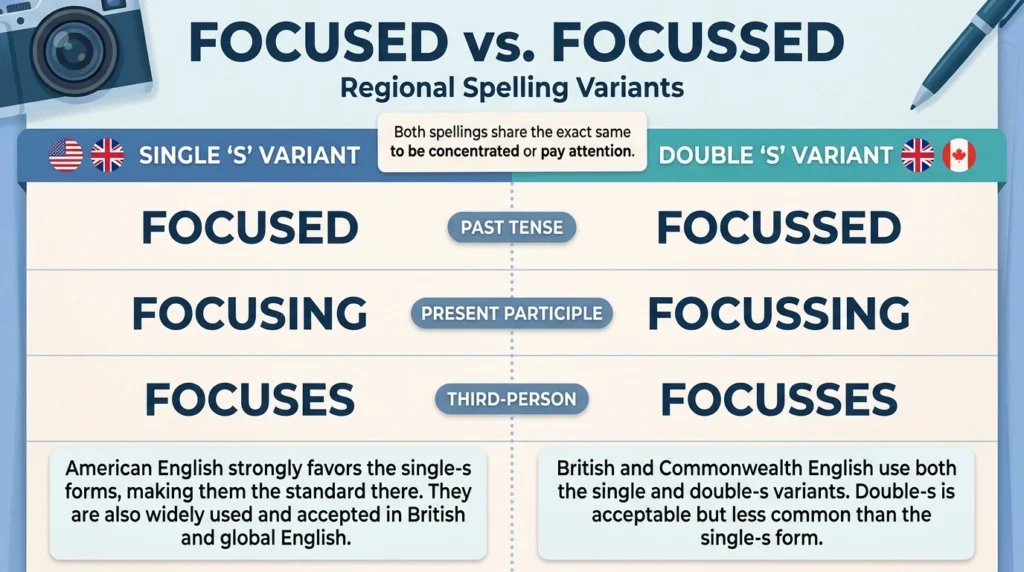
| Feature | American English | British English |
|---|---|---|
| Past tense | Focused | Focused or focussed |
| Past participle | Focused | Focused or focussed |
| Adjective | Focused | Focused or focussed |
| Present participle | Focusing | Focusing or focussing |
| Third-person singular | Focuses | Focuses or focusses |
| General recommendation | Use focused | Follow your chosen style guide |
American English consistently favors the forms without the extra s. British English accepts both spellings, and individual publications may have different preferences.
For formal work, do not assume that the country alone determines the answer. Check the relevant publication, employer, university, or examination guidelines.
Formal vs. Informal Usage
There is no difference in formality between focused and focussed. Both can appear in formal and informal writing.
Formal Writing
Use the form required by your style guide in academic papers, business reports, proposals, and official documents.
- The investigation focused on three key factors.
- The team remained focused on its objectives.
A British publication that prefers double consonants in this word may use focussed instead.
Informal Writing
Both forms are acceptable in personal messages, everyday communication, and casual online writing.
- I need to stay focused today.
- I’ve been really focussed on this project.
The second example is correct, but writers using American English would normally choose focused.
Comparison Table: Focused vs. Focussed
| Feature | Focused | Focussed |
|---|---|---|
| Meaning | Concentrated or directed toward something | Same meaning |
| Past tense | Correct | Correct |
| Past participle | Correct | Correct |
| Adjective | Correct | Correct |
| American English | Standard preference | Less common |
| British English | Widely used | Accepted alternative |
| International writing | Broadly safe choice | May be suitable when matching a chosen style |
| Present participle counterpart | Focusing | Focussing |
| Example | She focused on the report. | She focussed on the report. |
| Recommendation | Best general default | Use when preferred by your style guide |
Memory Trick: One S or Two?
Remember this simple rule:
Focused is the default; focussed is an accepted alternative.
If you are writing for an American audience or an international audience and have no special style requirements, choose focused. If you are following a British publication that uses focussed, use that spelling consistently.
You can also remember the related forms:
- Focused / focussed
- Focusing / focussing
- Focuses / focusses
Do not change spellings randomly within the same piece of writing. Consistency is more important than treating one accepted form as universally wrong.
Read More: Click vs. Clique: Meaning, Difference, Examples & Common Mistakes.
Focussed vs. Focused in Real-Life Situations
Situation 1: A Job Interview
You want to explain how you manage competing priorities.
Example: “I stayed focused on the main objective while helping my colleagues.”
Why it works: Focused describes your concentration. Focussed would also be correct if it matched your spelling convention.
Situation 2: A Business Meeting
Your manager wants the team to avoid unrelated discussions.
Example: “Let’s keep the meeting focused on the launch plan.”
Why it works: The adjective describes a discussion directed toward a clear subject.
Situation 3: An Academic Essay
You are describing the scope of a research project.
Example: “The research focused on the effects of screen time on sleep.”
Why it works: The past-tense verb describes what the research examined.
Situation 4: A Marketing Email
You are describing a campaign’s strategy.
Example: “Our latest campaign is focused on helping small businesses grow.”
Why it works: The adjective or participle describes the campaign’s main purpose.
Situation 5: A Personal Message
A friend asks how you are preparing for an exam.
Example: “I’ve been focusing on the subjects I find most difficult.”
Why it works: Focusing is the standard American spelling and a widely accepted form internationally. Focussing is also accepted in some varieties.
Situation 6: A Photography Assignment
You are explaining how you captured a sharp image.
Example: “I focused the lens on the bird before taking the photograph.”
Why it works: Focused is the past tense of the verb describing the adjustment.
Mini Quiz: Focussed vs. Focused
Choose the correct answer for each question. When both spellings are valid, the question specifies the required style or asks about meaning.
| No. | Question | Answer | Explanation |
|---|---|---|---|
| 1 | Which spelling is standard in American English: focused or focussed? | Focused | American English strongly favors the single-s spelling. |
| 2 | Fill in the blank: She remained ___ throughout the exam. (focused / focus) | Focused | The sentence needs an adjective or participle after remained. |
| 3 | Is focussed always incorrect? | No | It is an accepted alternative spelling, particularly in British and other varieties of English. |
| 4 | Correct the sentence: “He focus on the presentation yesterday.” | He focused on the presentation yesterday. | The sentence requires the past-tense form. |
| 5 | Which form is the usual American spelling: focusing or focussing? | Focusing | American English generally uses one s in this form. |
| 6 | Fill in the blank: The report has ___ on customer satisfaction. | Focused or focussed | Both past participles are correct; the preferred spelling depends on the chosen convention. |
| 7 | True or false: Focused and focussed have different meanings. | False | They are spelling variants with the same meaning. |
| 8 | Correct the preposition: “The team focused to the problem.” | The team focused on the problem. | Focus on is the usual construction for directing attention toward something. |
| 9 | A British publication requires the spelling focussed. Which should you use? | Focussed | Follow the publication’s style guide. |
| 10 | You are writing an international business report with no specified style guide. Which form is a safe default? | Focused | It is widely accepted and avoids an unnecessary spelling choice for most audiences. |
Expert Tips: Getting the Spelling Right Every Time
- Decide on your English variety before drafting. This reduces inconsistent spelling throughout longer documents.
- Use the publication’s style guide when one exists. A house style can settle questions that general spelling rules leave open.
- Search for both spellings when proofreading. Find-and-replace tools can help, but review each replacement to avoid changing quotations or special cases.
- Remember that grammar and spelling are separate issues. A sentence can contain the accepted spelling and still have an incorrect tense or preposition.
- Do not overcorrect British writing. Replacing every instance of focussed with focused may be unnecessary if the original follows a consistent, accepted convention.
- Prefer clarity over artificial rules. You do not need to invent a difference in meaning between the two forms. The real distinction is their spelling preference.
Read More: Counselor vs Councilor: Meaning, Examples & Easy Trick.
FAQ
Is focussed a real word?
Yes. Focussed is an accepted spelling of the past tense and past participle of focus, and it can also function as an adjective. It has the same meaning as focused.
Which spelling do dictionaries prefer?
Dictionary entries and editorial conventions may differ in how they present alternative spellings. In general, focused is the standard American form and is widely used in British English as well. Check the dictionary and style guide relevant to your audience if a specific preference matters.
Is focussed more British than focused?
Focussed is associated with British and some Commonwealth spelling preferences, but it is not exclusively British. Focused is also common in British English. It is more accurate to describe focussed as a regional or editorial variant than as the only British spelling.
Why does focus have two accepted past-tense spellings?
English has variation in how certain words form their past tense and participles. The forms focused and focussed developed as accepted spelling variants. Modern usage favors focused in American English, while both forms remain in use elsewhere.
Should I write focused or focussed on my CV?
Use focused unless the employer or the style convention you are following specifically favors focussed. Both forms are understandable, but consistency throughout your CV matters more than choosing the less common variant.
Is “highly focused” correct?
Yes. “Highly focused” is a natural and grammatically correct phrase. For example, “She is a highly focused project manager.” You can also write “highly focussed” when following a convention that prefers that spelling.
Is “focus on” or “focus upon” better?
Both constructions are grammatical, but focus on is more common in everyday modern English. Focus upon can sound more formal or emphatic. For most business, academic, and general writing, focus on is the straightforward choice.
Can I use focussed in academic writing?
Yes, if your institution or publication accepts it and you use it consistently. Academic writing should follow the specified style guide rather than assuming that one spelling is universally correct.
Is focusing or focussing correct?
Both are accepted spellings of the present participle and gerund. Focusing is the standard American form and is widely used internationally. Focussing is an accepted alternative in some British and Commonwealth contexts.
Does focused mean the same as concentrated?
Often, yes. Both can describe directing attention toward something. However, focused can also describe a clear purpose, a specific scope, or an image in which the subject appears sharp. Choose the word that best fits the context.
Is “more focused” correct?
Yes. More focused is the standard comparative construction when comparing levels of concentration or direction. For example, “The revised plan is more focused than the original.” The alternative spelling more focussed is also possible where that spelling convention is used.
Quick Summary
Focussed and focused are both correct spellings of the past tense, past participle, and adjective derived from focus. They have the same meaning; the difference is regional or editorial preference. American English strongly favors focused, which is also widely used in British English. Focussed remains an accepted alternative, especially in some British and Commonwealth contexts. The related forms are focusing and focussing, and focuses and focusses. For international writing, use focused unless your audience or style guide specifies otherwise. Most importantly, keep your spelling consistent and make sure the sentence uses the correct tense, adjective, and preposition.