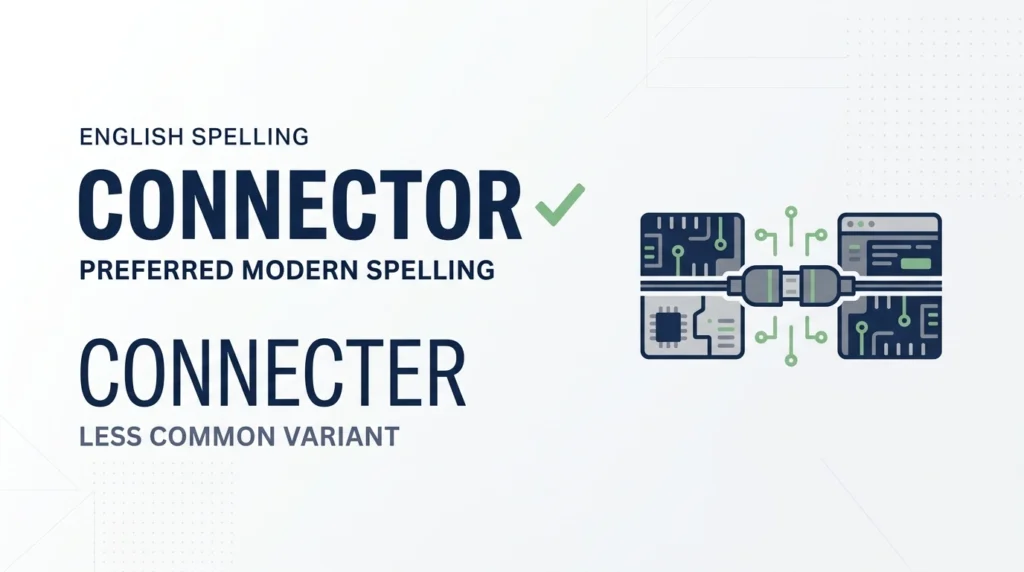

Connector is the standard and widely preferred spelling in modern English for a person or thing that connects two or more things. Connecter is also recorded as a word, but it is much less common. In most everyday, academic, and professional writing, choose connector. In technical contexts, such as electronics, cables, and computer networks, connector is the established form.
What Is the Difference Between Connector and Connecter?
The main difference is spelling frequency and established usage. Both forms are associated with the verb connect, but connector is the usual choice in modern English.
A connector can be a physical device that joins components, a person who brings people together, or a word that links ideas in writing. Connecter may appear as an alternative noun, but it is uncommon and is not the preferred spelling in most contexts.
Examples:
- Correct and preferred: The technician replaced the damaged cable connector.
- Uncommon alternative: The technician replaced the damaged cable connecter.
- Correct and preferred: She is a connector who introduces people with shared interests.
For clear, natural writing, use connector unless a specific product name, historical source, or established terminology requires another spelling.
Why the Difference Matters
Choosing the usual spelling helps readers recognize your meaning quickly. This matters particularly when the word appears in technical instructions, product descriptions, résumés, academic assignments, and business communication.
For example, a product listing that says “USB connecter” may look less professional than one that uses the standard industry term “USB connector.” Similarly, a writer describing someone who builds professional relationships will normally choose connector.
The difference does not usually change the intended meaning. The main concern is using the spelling readers expect.
The Core Rule
Connector — preferred spelling
Use it in ordinary English, technical writing, electronics, networking, and descriptions of people or things that connect.
Connecter — uncommon alternative
The form is recorded in English, but it is far less common. Avoid it when writing for a general audience unless you have a specific reason to retain it.
The safest rule is simple: choose connector by default. It is the established spelling in the vast majority of modern contexts where this noun is needed.
Read More: Traveler vs Traveller: Which Spelling Is Correct?
How to Use Connector Correctly
1. Use Connector for Electronic Devices
In electronics, a connector is a component that joins electrical circuits, cables, or devices.
Examples:
- The technician inspected the power connector.
- This USB connector fits the port on my laptop.
- The audio connector is loose.
- Check that the network connector is firmly attached.
In technical product descriptions and manuals, connector is the normal choice.
2. Use Connector for Cables and Networks
The word also describes parts that allow cables or network components to join.
Examples:
- The Ethernet connector needs to be replaced.
- The cable connector became damaged during installation.
- A faulty connector interrupted the signal.
- The engineer tested each connector before starting the system.
Avoid switching to connecter simply because the word comes from connect. Established technical vocabulary favors connector.
3. Use Connector for People Who Bring Others Together
A connector can also describe someone who introduces people, builds relationships, or helps different groups work together.
Examples:
- Maya is a natural connector who brings business owners together.
- Our community needs a connector who understands both students and employers.
- He became a valuable connector between the research team and local businesses.
This use is common in business networking and community discussions.
4. Use Connector for Words and Ideas
In grammar and writing, a connector can be a word or expression that links ideas, sentences, or parts of a text. Depending on the context, terms such as conjunction, linking word, and transition may be more precise.
Examples:
- The teacher explained how connectors show relationships between ideas.
- The writer used a connector to show contrast between two arguments.
- Words such as however and therefore can function as connectors in a text.
The exact grammatical label depends on how the word is used.
5. Use Connector in Software and Data Systems
In computing, a connector may be software that allows two systems, services, or applications to exchange information.
Examples:
- The team installed a connector between the sales platform and the reporting tool.
- The database connector failed during the update.
- This application uses a connector to retrieve customer records.
Again, connector is the standard choice.
Correct Examples of Connector in Sentences
Here are original examples showing how connector works across different situations.
Everyday Conversation
- The connector on my headphones is loose.
- Can you find a connector that fits this cable?
- This small connector joins the two pipes.
- We need another connector to link these parts.
Emails and Workplace Communication
- Please check the connector before approving the equipment.
- The supplier has sent the wrong type of connector.
- Our team needs a reliable connector between the two software systems.
- I will contact the technician about the damaged connector.
School and Academic Writing
- The student identified a connector between the two arguments.
- The teacher explained how a connector can link ideas in a paragraph.
- This section serves as a connector between the theory and the practical results.
- The researcher examined how social connectors influence professional networks.
Social Media and Networking
- She is a natural connector who brings creative people together.
- Our networking event is designed for people who want to become better connectors.
- A strong community connector can help local projects reach more volunteers.
Technology and Business
- The USB-C connector supports the device’s charging connection.
- The engineer replaced the faulty network connector.
- The company built a connector to exchange data between its applications.
- Check the audio connector before recording the interview.
- The new pipe connector prevents water from leaking at the joint.
These examples use connector, the standard spelling. The intended meaning changes with the context, but the spelling does not.
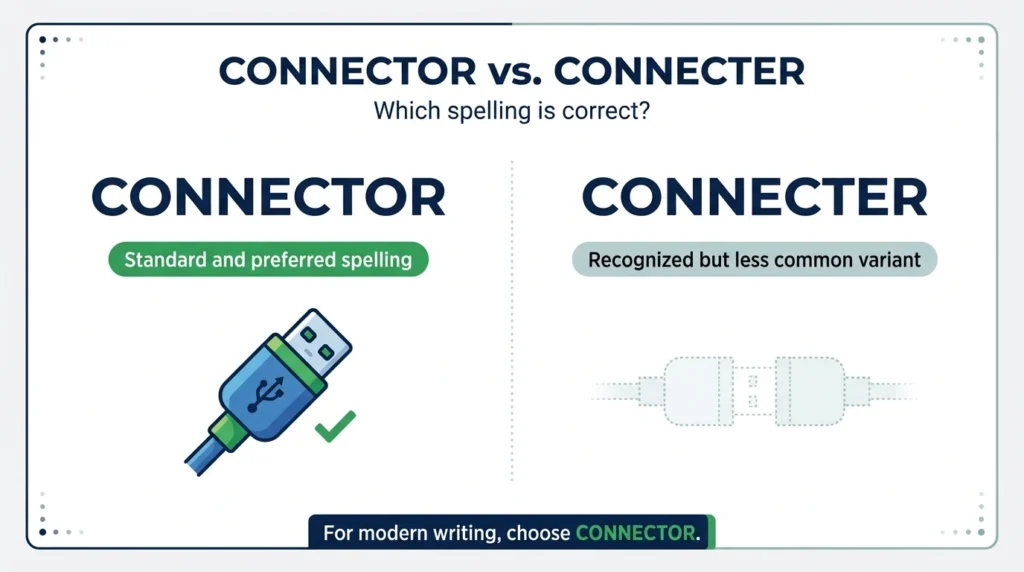
Incorrect vs. Correct: 10 Common Examples
Because connecter is a recognized but much less common variant, it is not accurate to call every appearance of it an absolute spelling error. However, connector is normally the better editorial choice in modern writing.
| Less-preferred or potentially confusing | Preferred form | Why |
|---|---|---|
| The cable connecter is broken. | The cable connector is broken. | Connector is the established technical term. |
| Replace the USB connecter. | Replace the USB connector. | Product and hardware terminology normally uses connector. |
| The audio connecter is loose. | The audio connector is loose. | The preferred spelling is more familiar to readers. |
| Check the electrical connecter. | Check the electrical connector. | Technical writing favors the standard form. |
| We need a network connecter. | We need a network connector. | Connector is the usual term in networking. |
| The pipe connecter is leaking. | The pipe connector is leaking. | Connector is conventional in plumbing terminology. |
| She is a natural connecter. | She is a natural connector. | Connector is the more familiar term for someone who builds relationships. |
| The software connecter failed. | The software connector failed. | Modern software documentation generally uses connector. |
| Install the data connecter. | Install the data connector. | The preferred spelling makes the instruction clearer and more conventional. |
| This device uses a special connecter. | This device uses a special connector. | Use the established spelling unless the alternative is part of a specific name or source. |
The practical lesson is to use connector consistently. If you are quoting an original document, preserving its spelling may be appropriate; otherwise, standardize the word to connector.
Why Do People Confuse Connector and Connecter?
Several features of English make the alternative spelling seem reasonable.
1. The Pronunciation Is Almost Identical
In ordinary English pronunciation, connector and connecter are generally pronounced the same or very similarly. The difference is in the final written vowel, not usually in a clearly audible sound.
When a writer hears the word but has not often seen it written, the correct spelling may be harder to recall.
2. The Verb Connect Encourages the -er Spelling
Many English nouns are formed by adding -er to a verb:
- teach → teacher
- write → writer
- drive → driver
- connect → connecter (a plausible formation)
The last example looks logical, but established English usage favors connector. Word formation is not always predictable from a single suffix rule.
3. English Uses Both -er and -or Endings
English contains many nouns ending in -er and -or. For example, teacher, writer, actor, and collector follow different established patterns.
There is no universal rule that lets you select the right ending for every noun by looking only at its verb. Learning common word forms and checking unfamiliar ones is more reliable.
4. Spellcheckers May Treat Rare Words Differently
A spelling tool may flag connecter, accept it, or suggest connector, depending on its dictionary and settings. Because connecter is an attested variant, software behavior may differ.
Do not treat a spellcheck result as the only authority. For general writing, choose the form readers are most likely to expect: connector.
5. Translation and Direct Word Formation Can Cause Confusion
English learners sometimes create a noun by translating a verb and adding the suffix they know best. This is a reasonable learning strategy, but English has many established forms that must be learned individually.
The best approach is to memorize the complete word family:
- Connect: to join or link.
- Connector: a person or thing that connects.
- Connection: a link or relationship.
- Connected: joined or associated.
- Connecting: joining or linking.
Learning connector as part of this family helps you recognize it when writing.
Read More: Aswell vs As Well: The Simple Rule That Ends the Confusion.
Common Mistakes Checklist
Before publishing or submitting your writing, check these points.
- Using connecter by habit: It follows a plausible spelling pattern, but connector is the usual modern form. Replace it unless the context requires the variant.
- Assuming the two forms are equally common: Their basic meaning overlaps, but their usage frequency differs considerably. Prefer connector for general audiences.
- Using the wrong term for a physical port: A port is the socket or interface that accepts a connection; a connector is typically the joining component on a cable or device. The exact terminology depends on the hardware.
- Confusing connector with connection: A connector is the person, device, or component that joins things. A connection is the link or relationship itself.
- Assuming every linking word is called a connector: In grammar, a connector is a broad term. Depending on the word and its function, conjunction, transition, or linking expression may be more precise.
- Treating the less common spelling as nonexistent: Connecter is recorded as a variant. The accurate advice is to prefer connector, not to claim that the alternative can never occur.
- Changing spelling without checking a proper name: If a product, company, or quoted source deliberately uses Connecter, preserve the exact name when necessary.
- Trusting autocomplete without review: Suggestions may depend on context. Check the intended word before sending or publishing.
Connector vs. Connecter in Real English
Grammatically Correct
Connector is the standard, widely used noun for a person or thing that connects. Connecter is also an attested variant, so it is too absolute to claim that the form does not exist in English. However, the two spellings are not equally common. In ordinary contemporary writing, technical documentation, and product descriptions, connector is the established choice.
Grammatically Possible but Unnatural
A sentence can use the standard word connector and still sound awkward if the word does not fit its context. For example, “The friendship was a connector between them” may be understandable, but “The friendship connected them” or “Their friendship created a strong connection” is usually clearer. Choosing the standard spelling is only one part of good writing; the noun must also suit the intended meaning.
Natural, Everyday English
In everyday English, connector sounds natural when describing a cable component, a joining part, or a person who brings people together. Examples include “The connector on this cable is damaged” and “She’s a great connector in the local business community.” Connecter may be understood, but it is much less familiar. For natural, professional writing, use connector unless you need to preserve a specific alternative spelling.
American vs. British English
There is no significant standard American-versus-British spelling difference for this pair. Connector is the preferred form in both varieties.
| Feature | American English | British English |
|---|---|---|
| Preferred spelling | connector | connector |
| Alternative spelling | connecter is less common | connecter is less common |
| Technical usage | connector | connector |
| Business and general writing | connector | connector |
You do not need to change connector when writing for a British audience instead of an American one.
Formal vs. Informal Usage
The preference for connector applies in both formal and informal English. The word itself is not especially formal or informal; the context determines how it is used.
| Context | Example | Recommendation |
|---|---|---|
| Casual conversation | “The connector on my charger is damaged.” | Use connector. |
| Text message | “Can you bring the cable connector?” | Use connector. |
| Professional email | “Please inspect the connector before installation.” | Use connector. |
| Academic writing | “The connector links the two components.” | Use connector. |
| Technical manual | “Insert the connector into the appropriate port.” | Use connector. |
| Business networking | “She is a valuable connector in the industry.” | Use connector. |
The less common form is not necessary to make writing sound more sophisticated or specialized.
Connector vs. Connecter vs. Connection
These words are related, but connection has a different grammatical role and meaning.
| Word | Part of speech | Meaning | Example |
|---|---|---|---|
| Connect | Verb | To join or link | Connect the two cables. |
| Connector | Noun | A person or thing that joins or links | The connector is damaged. |
| Connecter | Noun, uncommon variant | A person or thing that connects | The alternative spelling is rarely preferred. |
| Connection | Noun | A link, relationship, or state of being connected | The connection is unstable. |
| Connected | Adjective or verb form | Joined or associated | The devices are connected. |
| Connecting | Verb form or adjective | Joining or linking | The connecting cable is missing. |
Remember the distinction between connector and connection: one typically refers to the thing doing the connecting, while the other refers to the link or relationship.
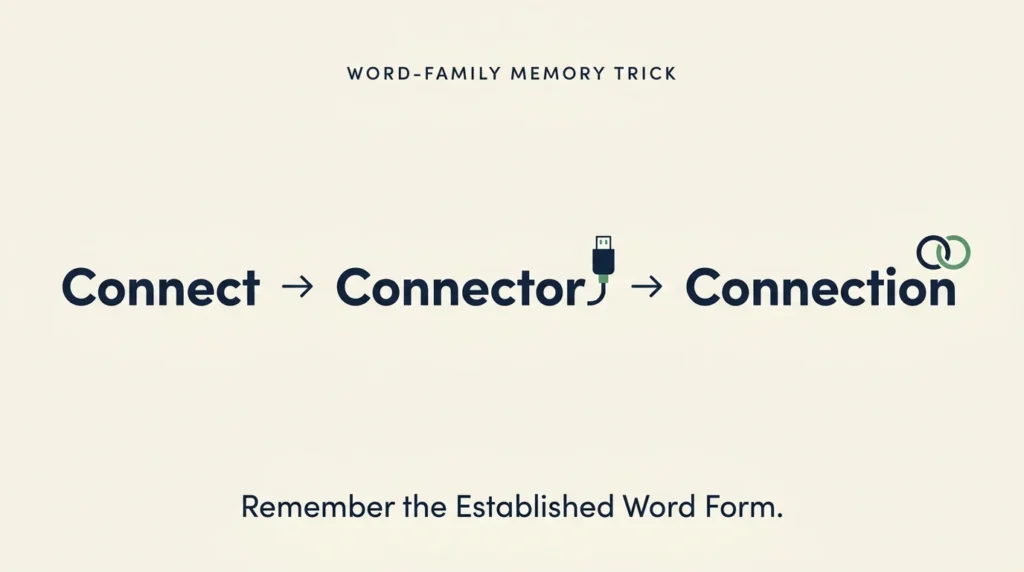
Memory Trick: Connector Has the -or Ending
Use this simple memory trick:
Connect → Connector → Connection.
Remember connector as the standard name for the component or person that connects. Then associate connection with the relationship or link that results.
A quick way to test your choice is to put the word into a familiar phrase:
- USB connector
- Cable connector
- Network connector
- Community connector
These common combinations make the preferred spelling easier to recall.
Read More: Manuel vs Manual: Meaning, Spelling, and Correct Usage.
Connector in Real-Life Situations
During a Job Interview
An applicant is explaining a strength in networking.
Correct: “I am a strong connector who enjoys bringing people and teams together.”
Here, connector describes a person who builds relationships.
In a Technical Meeting
An engineer discusses a damaged cable.
Correct: “We need to replace the connector before testing the equipment.”
The word refers to the component that joins the cable to another part.
In a Professional Email
A supplier has delivered equipment with a faulty component.
Correct: “Please arrange a replacement for the damaged connector.”
The standard spelling is clear and appropriate for business communication.
In a Text Message
A friend asks why a device is not charging.
Correct: “Check whether the connector is fully inserted.”
The word is used naturally in a short, informal instruction.
In an Academic Assignment
A student describes the relationship between two sections of an argument.
Correct: “This paragraph acts as a connector between the two main ideas.”
Here, connector is being used figuratively to describe a linking element.
Expert Tips for Choosing the Right Word
- Choose established usage over spelling guesswork. Even if connecter seems logical, connector is the familiar modern form.
- Use the right technical term. A connector, port, adapter, and cable are different components. Check which part you mean.
- Understand the difference between a word’s existence and its popularity. A form may be recorded in English without being the best choice for everyday writing.
- Be consistent within a document. Use connector throughout your technical guide, product catalogue, or article unless quoting a source that uses a different spelling.
- Use context to clarify meaning. A connector can be a physical part, a software component, or a person who brings people together. If readers could misunderstand, specify the type.
- Check specialist terminology when precision matters. Hardware manufacturers may distinguish between a connector and the port into which it fits. Do not use the terms interchangeably without checking the device.
- Do not invent an American or British rule. This pair does not require a regional spelling change.
FAQ: Connector vs Connecter
Is connector or connecter the correct spelling?
Connector is the standard and preferred spelling in modern English. Connecter is also recorded as a less common variant, but most writers should choose connector for everyday, professional, and technical writing.
Is connecter a real English word?
Yes. Connecter is an attested English noun variant associated with connector. However, it is much less common, so its existence does not mean it is equally suitable in every context.
Do connector and connecter mean the same thing?
Generally, yes. Both forms can refer to a person or thing that connects. The main difference is conventional usage: connector is far more widely established in modern English.
Why is connector spelled with or instead of er?
English noun formation follows several patterns. Although adding -er to a verb is common, it does not work predictably for every word. The established noun from connect is connector.
Is connector correct in American English?
Yes. Connector is the normal spelling in American English and is widely used in electronics, computing, engineering, business, and general writing.
Is connector also correct in British English?
Yes. British English uses connector as well. There is no standard regional spelling distinction that requires British writers to use connecter.
What is a connector in technology?
A connector is a component that joins cables, wires, circuits, or devices. Examples include USB connectors, audio connectors, and network connectors. The precise term depends on the type of equipment.
What does connector mean when describing a person?
A connector is someone who helps people meet, build relationships, or discover useful contacts. For example, a business connector might introduce entrepreneurs to potential clients or partners.
What is the difference between connector and connection?
A connector is typically a person, component, or device that joins things. A connection is the link, relationship, or state of being connected. For example, a cable has a connector that creates a connection.
Can I use connecter in a formal document?
Although connecter is a recognized variant, connector is the safer choice in a formal document. Use the less common form only when preserving a specific spelling, name, quotation, or established source terminology.
Is a connector the same as an adapter?
Not necessarily. A connector joins components, while an adapter allows connections between components or interfaces that may otherwise be incompatible. Some devices combine both functions, so the precise distinction depends on the product.
What is the easiest way to remember connector?
Remember the familiar word combinations USB connector, cable connector, and network connector. The ending -or is part of the established spelling. When unsure, choose connector.
Mini Quiz: Test Your Understanding
Complete these ten questions to check whether you understand the difference.
| No. | Question | Answer and explanation |
|---|---|---|
| 1 | Choose the preferred spelling: (A) Connector (B) Connecter | Answer: A — Connector. It is the standard modern form. |
| 2 | Fill in the blank: “The technician replaced the damaged cable ___.” | Answer: connector. This is the established technical term. |
| 3 | Correct this sentence for standard modern usage: “The USB connecter is loose.” | Answer: The USB connector is loose. Explanation: Connector is the usual spelling in technical contexts. |
| 4 | Is connecter completely nonexistent in English? | Answer: No. It is recorded as a less common variant of connector. |
| 5 | Fill in the blank: “She is a natural ___ who introduces people to one another.” | Answer: connector. The word can describe someone who builds relationships. |
| 6 | Choose the standard term: “The ___ allows the cable to join the device.” (A) connection (B) connector | Answer: B — connector. A connector is the component; a connection is the resulting link. |
| 7 | Correct this sentence: “Please inspect the electrical connecter before installation.” | Answer: Please inspect the electrical connector before installation. Explanation: Connector is the conventional technical spelling. |
| 8 | Does British English require connecter instead of connector? | Answer: No. Connector is standard in both British and American English. |
| 9 | Fill in the blank: “The software ___ transfers information between the two applications.” | Answer: connector. This describes a software component linking systems. |
| 10 | Which spelling should you normally use in a business report? (A) Connector (B) Connecter | Answer: A — Connector. It is the more familiar and widely preferred form in professional writing. |
Quick Summary
When comparing connector vs connecter, connector is the standard and preferred spelling in modern English. It describes a person, device, component, or other thing that joins or links two or more things. Connecter is also a recognized English variant, but it is much less common. For everyday writing, academic assignments, professional emails, product descriptions, and technical documents, choose connector. The word is used in expressions such as USB connector, network connector, and community connector. Both American and British English generally use the same spelling. Remember the simple rule: connect → connector. When you are unsure, use connector for the clearest and most familiar wording.