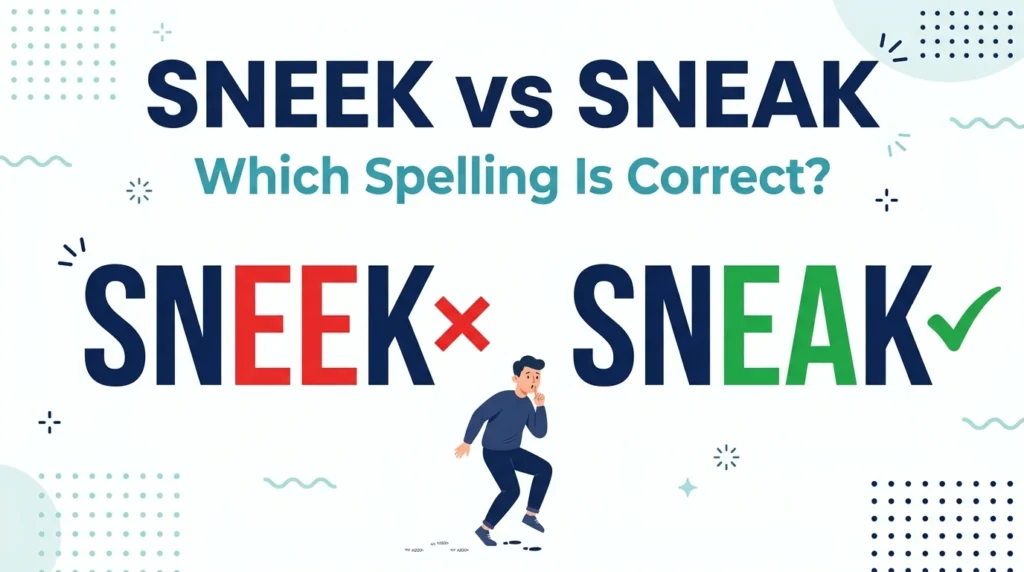

Sneak is the correct standard English word. Sneek is generally a spelling mistake when someone intends to write sneak.
The word sneak can function as a verb, a noun, or part of an informal expression. Its meaning depends on how it is used in a sentence.
- Sneak (verb): To move quietly or secretly to avoid being noticed.
- Sneak (noun): A person who behaves secretly or dishonestly, often to gain an advantage.
- Sneak (adjective): Used informally in expressions such as sneak preview, meaning an early or limited viewing before a full release.
Examples:
- “The cat tried to sneak into the kitchen.”
- “Don’t be a sneak and read someone else’s messages.”
- “We got a sneak preview of the new film.”
In ordinary English writing, use sneak, not sneek.
Why Does the Difference Matter?
A spelling mistake can make your writing look careless, particularly in professional or educational settings. Since sneek resembles the correct word, readers may understand what you mean, but that does not make it standard spelling.
Using the correct spelling matters when you are:
- Writing school assignments or examinations.
- Sending professional emails.
- Publishing articles, blog posts, or social media captions.
- Creating subtitles or scripts.
- Learning English vocabulary and spelling patterns.
For example, “He tried to sneek out of the classroom” is understandable, but the standard spelling is “He tried to sneak out of the classroom.”
The correction is simple: remember the a in sneak.
The Core Rule
Correct: Sneak
Use this spelling for the standard English word.
Example: She tried to sneak past the guard.
Incorrect in ordinary English: Sneek
Avoid this spelling when you mean the verb or noun sneak.
Incorrect: He tried to sneek away.
Remember: The correct spelling is s-n-e-a-k. The vowel in the middle is a, not e.
How to Use Sneak Correctly
Sneak as a Verb
A verb describes an action. As a verb, sneak usually means moving quietly or secretly, often to avoid being seen or heard.
Examples:
- The children tried to sneak downstairs.
- He sneaked out before the meeting ended.
- She is sneaking a snack into the cinema.
- They sneaked past the sleeping dog.
The verb can describe a physical movement or a secret action.
Sneak as a Noun
As a noun, sneak can describe someone who acts secretly or dishonestly, particularly when their behavior involves spying, informing on others, or gaining an unfair advantage.
Examples:
- “Don’t be such a sneak.”
- “He called his classmate a sneak for secretly reporting the incident.”
This use is informal and can sound critical or insulting, depending on the context.
Sneak in Common Expressions
The word appears in several familiar English expressions.
- Sneak out: Leave quietly or secretly.
- Sneak in: Enter quietly or without being noticed.
- Sneak up on: Approach someone or something without being noticed.
- Sneak a look: Take a quick, often secret glance.
- Sneak preview: An early or limited viewing of something before its official release.
Examples:
- “We tried to sneak out without waking anyone.”
- “The cat sneaked into the bedroom.”
- “The deadline sneaked up on me.”
- “I sneaked a look at the surprise gift.”
- “The studio released a sneak preview of its new film.”
The spelling remains sneak in these expressions, although the verb’s form can change.
Sneak, Sneaked, and Snuck
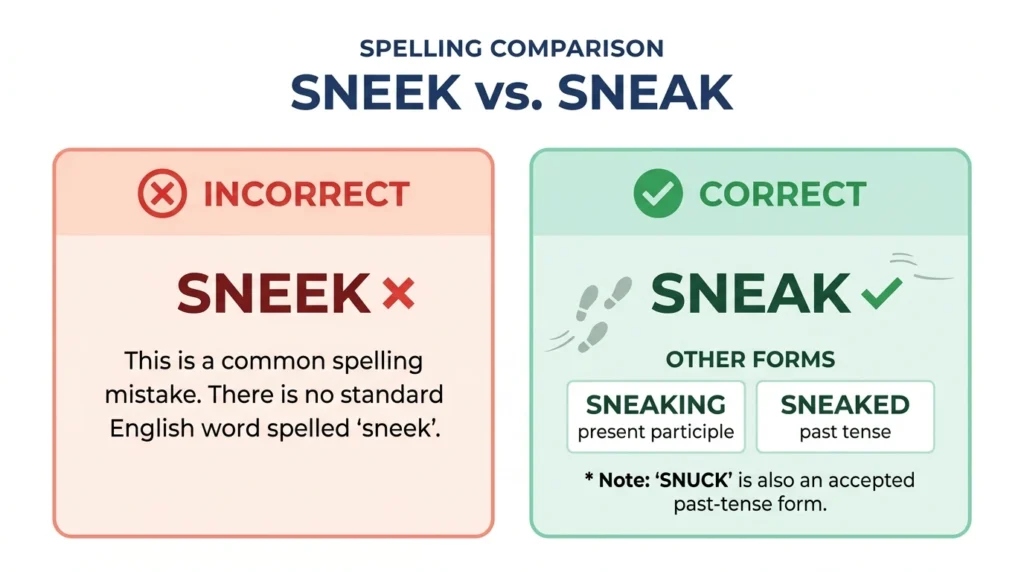
The past tense of sneak can be sneaked or snuck.
- Sneak: Present tense — “I sneak out early sometimes.”
- Sneaked: Past tense — “I sneaked out yesterday.”
- Snuck: Past tense — “I snuck out yesterday.”
- Sneaking: Present participle — “I am sneaking out.”
Both sneaked and snuck are established forms. Snuck is especially common in American English, while sneaked is also widely used and is often preferred in some formal or editorial contexts.
Neither form changes the spelling of the base word sneak.
Correct Examples of Sneak in Sentences
Here are 12 examples showing how to use sneak in different situations.
| Context | Correct example | Explanation |
|---|---|---|
| Conversation | “Let’s sneak out before the rain starts.” | Sneak means leave quietly or discreetly. |
| “I managed to sneak in a final review before sending the report.” | The expression means finding a small opportunity to do something. | |
| School | “The students tried to sneak snacks into the classroom.” | Sneak describes an attempt to do something without being noticed. |
| Workplace | “He sneaked away from his desk for a quick break.” | Sneaked is the past tense of sneak. |
| Social media | “I took a sneak peek at the new collection.” | Sneak peek means a quick or early look. |
| Academic writing | “The researcher examined how errors can sneak into a dataset.” | Sneak is used figuratively to describe errors appearing unnoticed. |
| Family life | “The children sneaked downstairs to see their presents.” | Sneaked describes quiet, secret movement. |
| Travel | “We sneaked out of the hotel to watch the sunrise.” | Sneak out means leave quietly or discreetly. |
| Technology | “A software bug can sneak into an update.” | Sneak is used figuratively to describe something appearing unnoticed. |
| Entertainment | “Fans received a sneak preview of the upcoming film.” | A sneak preview offers an early viewing. |
| Friendship | “I sneaked a glance at my friend’s reaction.” | Sneak a glance means look quickly, often discreetly. |
| Daily life | “Time can sneak up on you when you’re busy.” | The expression means something arrives or becomes noticeable unexpectedly. |
Sneek vs Sneak: Incorrect and Correct Examples
The following table highlights common spelling mistakes and their corrections.
| ❌ Incorrect | ✅ Correct | Why |
|---|---|---|
| He tried to sneek outside. | He tried to sneak outside. | Sneak is the standard spelling. |
| She will sneek into the room. | She will sneak into the room. | The base verb uses ea. |
| The children were sneeking around. | The children were sneaking around. | The -ing form is sneaking. |
| I sneek a look at the screen. | I sneak a look at the screen. | The present-tense form is sneak. |
| He sneeked out after dinner. | He sneaked out after dinner. | The regular past-tense form is sneaked. |
| They are trying to sneek past us. | They are trying to sneak past us. | After to, use the base form sneak. |
| Don’t be such a sneek. | Don’t be such a sneak. | The noun also uses the spelling sneak. |
| We got a sneek preview of the show. | We got a sneak preview of the show. | The expression is sneak preview. |
| The deadline sneeked up on me. | The deadline sneaked up on me. | The standard past-tense forms are sneaked and snuck. |
| He was sneeking into the building. | He was sneaking into the building. | The correct -ing form is sneaking. |
| She wants to sneek a snack inside. | She wants to sneak a snack inside. | The infinitive uses the base form. |
| I accidentally typed “sneek” in my essay. | I accidentally typed “sneak” in my essay. | Use sneak when referring to the standard English word. |
Why Do People Confuse Sneek and Sneak?
1. Similar Pronunciation
In many English accents, sneak has a long vowel sound, often represented by /iː/. This is the same vowel sound found in words such as see and green.
Because the sound is similar to the letter name E, learners may mistakenly write sneek. However, English spelling does not always follow pronunciation directly.
2. Confusion About Vowel Patterns
English uses several spelling patterns to represent long vowel sounds. For example:
- Sneak uses ea.
- Seek uses ee.
- Speak uses ea.
- Week uses ee.
These examples show why hearing a word is not always enough to determine its spelling. The correct spelling must be learned as part of the word’s vocabulary.
3. Typing Too Quickly
When writing quickly, people may type the vowel that seems most natural to them. The error can appear in text messages, captions, blog posts, and school assignments.
A quick proofreading pass can catch it.
4. Spellcheck Limitations
Spellcheck tools can detect many spelling errors, but they may not catch every mistake. Some unusual spellings may also occur in names, usernames, or fictional settings.
Do not rely entirely on automatic correction. If the sentence uses the standard English word for moving secretly, confirm that it is spelled sneak.
5. Translation Interference
Learners may transfer spelling patterns from another language or from their own pronunciation habits. A word that sounds like sneak may seem as though it should be written sneek.
The solution is to learn the written form together with its meaning and example sentences.
Common Mistakes Checklist
Use this checklist when proofreading your writing.
- Writing sneek instead of sneak: Memorize the standard spelling, especially for school and professional writing.
- Writing sneeking instead of sneaking: Add -ing to the correct base form, sneak.
- Writing sneeked instead of sneaked: Use sneaked or snuck for the past tense.
- Assuming the spelling follows the vowel sound: Remember that ea and ee can represent similar sounds in different words.
- Trusting autocorrect completely: Check the meaning and spelling yourself.
- Confusing sneak with sneak peek: The expression is sneak peek, not sneek peek.
- Using the wrong verb form: Write “to sneak,” “is sneaking,” and “has sneaked” or “has snuck.”
The most reliable method is to recognize sneak as the base form and build its other forms from that spelling.
Sneek vs Sneak in Real English
Grammatically Correct
Sneak is the standard English spelling and can function as a verb or noun. It also appears in expressions such as sneak out, sneak a look, and sneak preview. For example, “She tried to sneak out quietly” is grammatically correct. The past tense can be sneaked or snuck, and the -ing form is sneaking.
Grammatically Possible but Unnatural
The spelling sneek might appear in a fictional character’s name, a brand, a username, or a deliberately altered spelling. Such uses are possible as names or creative choices, but they do not make sneek a standard alternative spelling of the English word. In ordinary prose, writing “He tried to sneek out” would be treated as a spelling error.
Natural, Everyday English
In everyday English, people commonly say “sneak out,” “sneak in,” “sneak a peek,” and “sneak up on someone.” Both sneaked and snuck are used for the past tense, though their frequency varies by region and context. If you mean moving secretly or doing something without being noticed, sneak is the natural standard spelling.
American vs British English
There is no standard American-versus-British spelling difference between sneek and sneak. Sneak is the correct standard spelling in both varieties.
| Feature | American English | British English |
|---|---|---|
| Base form | Sneak | Sneak |
| Present participle | Sneaking | Sneaking |
| Past tense | Sneaked or snuck | Sneaked or snuck |
| Noun | Sneak | Sneak |
| Sneak preview | Correct | Correct |
| Sneek | Nonstandard as the ordinary word | Nonstandard as the ordinary word |
Regional preferences may affect how frequently speakers use snuck or sneaked, but they do not make sneek a standard spelling.
Formal vs Informal Usage
The word sneak can be used in both formal and informal contexts, although some expressions are more conversational than others.
Formal Usage
In professional or academic writing, sneak may be used when its meaning is precise and appropriate.
Examples:
- “A coding error can sneak into a software release.”
- “The report examined how bias can sneak into the decision-making process.”
In more formal contexts, you may choose alternatives such as enter unnoticed, introduce covertly, or appear inadvertently, depending on the meaning.
Read More: Connector vs Connecter: Which Spelling Is Correct?
Informal Usage
In conversation, informal writing, and social media, expressions such as sneak out, sneak a peek, and sneak up on are common.
Examples:
- “I sneaked out for a coffee.”
- “Let me sneak a peek at your photos.”
- “That deadline really snuck up on me.”
The spelling of sneak does not change with formality.
Comparison Table: Sneek vs Sneak
| Feature | Sneek | Sneak |
|---|---|---|
| Standard English spelling | No | Yes |
| Meaning as an ordinary English word | No standard meaning intended in this comparison | Move secretly or act without being noticed |
| Verb usage | Nonstandard spelling | Correct |
| Noun usage | Nonstandard spelling | Correct |
| -ing form | Sneeking is nonstandard for the intended word | Sneaking |
| Past tense | Sneeked is nonstandard for the intended word | Sneaked or snuck |
| Use in formal writing | Avoid unless it is a proper name or intentional creative spelling | Appropriate when the meaning fits |
| American English | Not the standard spelling | Correct |
| British English | Not the standard spelling | Correct |
Memory Trick: Sneak Has “EA”
Remember this sentence:
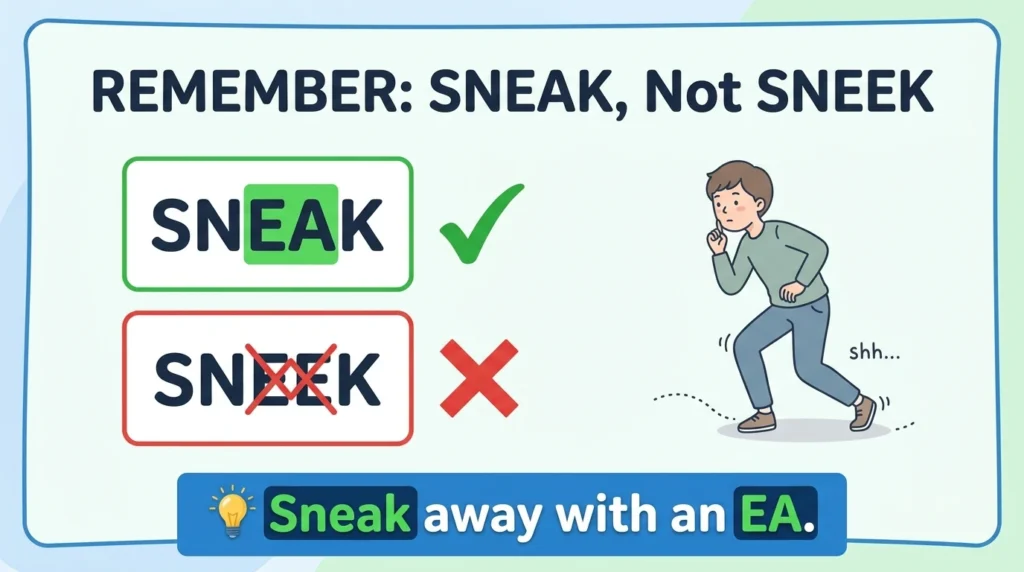
“Sneak away with an EA.”
The word sneak contains the letters E-A, in that order. It does not contain two Es.
You can reinforce the pattern by remembering these related words:
- Sneak
- Speak
- Break
- Weak
These words share the ea spelling, although their vowel sounds are not all identical.
Whenever you are unsure, spell the word aloud as letters: S-N-E-A-K.
Read More: Traveler vs Traveller: Which Spelling Is Correct?
Sneek vs Sneak in Real-Life Situations
Situation 1: A School Assignment
Incorrect: “The student tried to sneek out of class.”
Correct: “The student tried to sneak out of class.”
The standard spelling is required in ordinary academic writing.
Situation 2: A Workplace Email
Incorrect: “I managed to sneek a quick review into the schedule.”
Correct: “I managed to sneak a quick review into the schedule.”
Here, sneak in means finding an opportunity to do something within a limited time.
Situation 3: A Text Message
Incorrect: “Let’s sneek out before everyone arrives.”
Correct: “Let’s sneak out before everyone arrives.”
The correction changes only the spelling.
Situation 4: A Social Media Caption
Incorrect: “Sneek peek at tomorrow’s launch!”
Correct: “Sneak peek at tomorrow’s launch!”
The established expression is sneak peek, meaning an early look.
Situation 5: A Story or Novel
Incorrect: “The thief began sneeking through the hallway.”
Correct: “The thief began sneaking through the hallway.”
The -ing form is sneaking, formed from the base verb sneak.
Expert Tips for Remembering the Correct Spelling
- Learn the whole word family: Remember sneak, sneaking, and sneaked together.
- Use the word in a sentence: Writing “I tried to sneak out quietly” helps connect the spelling with its meaning.
- Notice the vowel sequence: The standard spelling uses ea, not ee.
- Do not confuse sound with spelling: English has multiple ways to represent similar vowel sounds.
- Proofread common expressions: Check phrases such as sneak peek, sneak out, and sneak up on.
- Learn both past-tense forms: Sneaked and snuck are accepted, so you do not need to invent sneeked.
- Use a dictionary when uncertain: This is especially helpful when a spelling looks plausible but unfamiliar.
Quick Summary
Sneek vs sneak is a spelling comparison in which sneak is the correct standard English word. It means to move quietly or secretly, act without being noticed, or gain an advantage discreetly. The word can function as a verb or noun and appears in expressions such as sneak out, sneak a look, and sneak preview. Its -ing form is sneaking, while its past tense can be sneaked or snuck. American and British English both use sneak. To remember the spelling, focus on the letters EA: sneak, not sneek.
Frequently Asked Questions
1. Is sneek a real word?
Sneek is not the standard spelling of the ordinary English word sneak. It may appear as a name, brand, username, or deliberate creative spelling, but use sneak in normal English writing.
2. Why is sneak spelled with EA instead of EE?
English spelling reflects historical patterns and word conventions rather than sound alone. Although sneak and words such as seek have similar vowel sounds, they use different letter combinations.
3. Is sneaked or snuck correct?
Both are accepted past-tense forms of sneak. The preferred form can vary by region, speaker, and editorial style.
4. What is the past tense of sneak?
The past tense is sneaked or snuck. For example: “She sneaked out early” and “She snuck out early” are both correct.
5. What is the present participle of sneak?
The present participle is sneaking. For example: “The cat is sneaking into the room.”
6. Is sneak a verb or a noun?
It can be both. As a verb, it describes secret or unnoticed movement or action. As a noun, it can refer informally to a person who behaves secretly or dishonestly.
7. Is sneak peek or sneek peek correct?
Sneak peek is correct. It means an early or limited look at something before its full release or public presentation.
8. Is sneak an informal word?
It is common in informal English, but it can also be used in formal writing when its meaning is appropriate. Some expressions, such as sneak a peek, are more conversational.
9. Is sneak spelled differently in British English?
No. Sneak is the standard spelling in both British and American English.
10. How do I stop writing sneek by mistake?
Practice the sequence S-N-E-A-K, learn related forms such as sneaking and sneaked, and proofread your writing. Spellcheck can help, but learning the correct vowel sequence is more reliable.
Mini Quiz: Sneek vs Sneak
Choose the correct answer and review the explanation.
| No. | Question | Answer | Explanation |
|---|---|---|---|
| 1 | Which is the standard spelling? | Sneak | Sneak is the correct ordinary English word. |
| 2 | Complete: “He tried to ___ out quietly.” | Sneak | The base form is used after to. |
| 3 | Which is correct: sneeking or sneaking? | Sneaking | The -ing form is sneaking. |
| 4 | Complete: “She ___ out before sunrise.” | Sneaked or snuck | Both are accepted past-tense forms. |
| 5 | Which phrase is correct: sneek peek or sneak peek? | Sneak peek | This is the established expression for an early look. |
| 6 | Correct the sentence: “They were sneeking into the garden.” | They were sneaking into the garden. | The correct present participle is sneaking. |
| 7 | Is sneek the standard spelling in British English? | No | British English also uses sneak. |
| 8 | Complete: “Don’t be such a ___.” | Sneak | Sneak can be used as an informal noun. |
| 9 | Which sentence is correct? | “I sneaked a look at the gift.” | Sneaked is an accepted past-tense form, and sneak a look is a standard expression. |
| 10 | True or false: Sneaked and snuck are both accepted. | True | Both are established past-tense forms of sneak. |