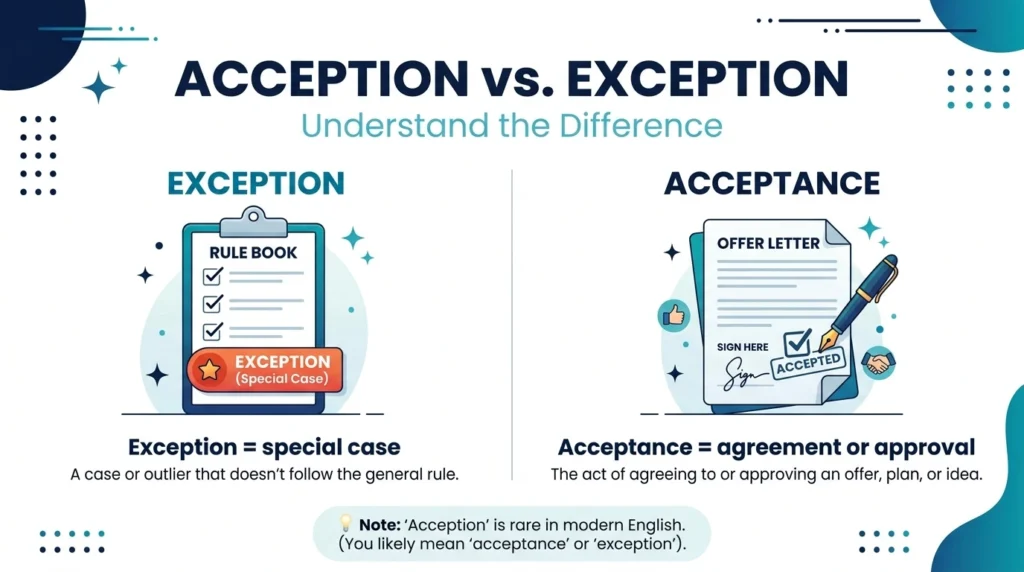

Exception is the correct, commonly used word when you mean someone or something excluded from a rule or a case that does not follow the general pattern. Acception is a rare word found mainly in historical or specialized contexts, where it can mean acceptance or a particular interpretation. In everyday modern English, use exception for the usual meaning and acceptance when you mean the act of accepting something.
What Is the Difference Between Acception and Exception?
Although acception and exception look similar, they have different meanings and levels of use. The confusion often arises because both resemble the familiar word accept, but only exception is common in everyday expressions about rules and unusual cases.
What Does Exception Mean?
Exception is a noun. It refers to a person or thing that does not follow a general rule, or to something excluded from a statement or requirement.
Examples:
- Everyone must attend the meeting, with one exception.
- The store is open every day except Sunday.
- This rule applies to all employees without exception.
The word is widely used in education, business, law, everyday conversation, and formal writing.
What Does Acception Mean?
Acception is a rare noun historically used to mean acceptance or a particular sense or interpretation of a word. It is not the normal modern English word for the act of accepting something.
For example, older or specialized texts may use acception when discussing a particular meaning or interpretation of a term. In contemporary writing, however, acceptance, interpretation, or meaning will usually be clearer and more natural.
If you are writing a modern email, school assignment, business report, or general article, you will rarely need acception.
Why the Two Words Are Not Interchangeable
The difference becomes clear when you replace each word with a simpler expression.
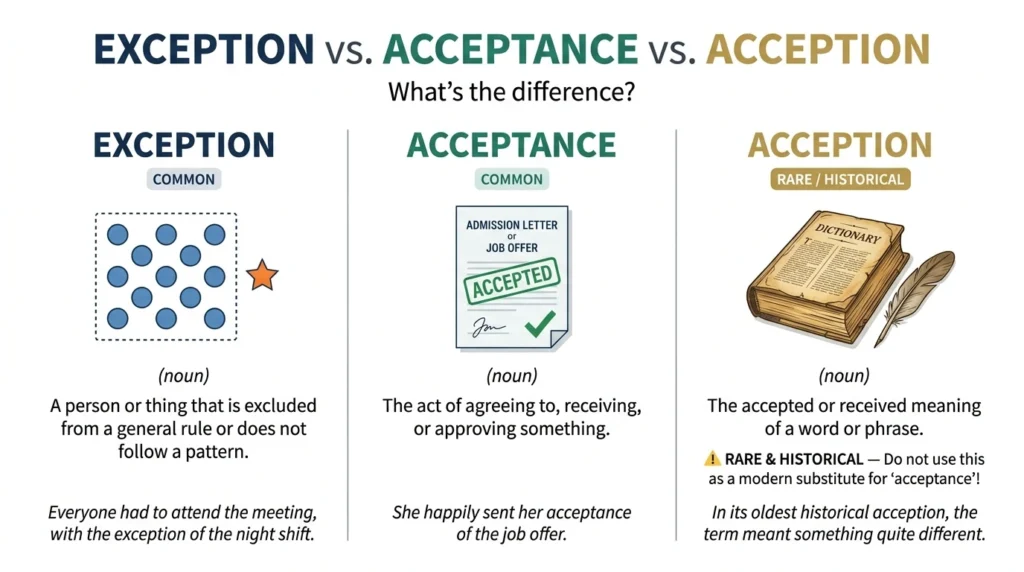
- Exception = a case that does not follow a rule.
- Acceptance = the act of agreeing to, receiving, or approving something.
- Acception = a rare historical or specialized term, not the usual substitute for acceptance.
For example:
- Correct: “The manager made an exception to the policy.”
- Correct: “She received acceptance into the program.”
- Unusual in modern English: “She received acception into the program.”
The last sentence should normally use acceptance, not acception.
Read More: Connector vs Connecter: Which Spelling Is Correct?
Why the Difference Matters
Using acception instead of exception can make a sentence confusing or appear incorrectly spelled. The distinction is particularly important when describing rules, permissions, applications, or decisions.
Consider these situations:
- Workplace policies: “Employees may request an exception to the rule.”
- School assignments: “There is one exception to the grammar rule.”
- Applications: “Her acceptance into the program arrived by email.”
- Legal writing: “The agreement includes an exception to the general requirement.”
- Everyday conversation: “I agree with the plan, with one exception.”
In each example, the intended meaning determines the word. Using the correct term makes your writing more precise and prevents readers from having to guess what you mean.
The Core Rule
Use exception for something that does not follow a rule. Use acceptance for the act of accepting something. Avoid acception in ordinary modern English unless you are discussing its historical or specialized use.
Remember these examples:
- An exception to a rule.
- An exception to a policy.
- Acceptance of an offer.
- Acceptance into a university.
- Acceptance of responsibility.
The words exception and acceptance are both common, but they do different jobs.
How to Use Exception Correctly
When to Use Exception
Use exception when a person, case, condition, or situation is excluded from a general rule or differs from what is normally expected.
1. Rules and policies
- The discount applies to every item, with one exception.
- Visitors must sign in, without exception.
- The company made an exception for employees working remotely.
2. School and education
- Every student passed the test except one.
- The teacher explained an exception to the usual spelling rule.
- There is an exception to this formula that students should remember.
3. Work and business
- The refund policy allows an exception in special circumstances.
- All applications are reviewed within five working days, with the exception of incomplete submissions.
- The director approved an exception to the usual procedure.
4. Everyday conversation
- I enjoy all kinds of fruit, with one exception.
- Everyone was ready except Daniel.
- This restaurant is excellent, with the exception of its slow service.
5. Formal and legal contexts
- The contract contains an exception to the general restriction.
- The regulation applies to all applicants unless a specific exception is granted.
- The court considered whether the circumstances justified an exception.
When to Use Acceptance Instead
Use acceptance when referring to the act or state of accepting something, such as an offer, invitation, responsibility, idea, or application.
Examples:
- She received acceptance into the university.
- The company confirmed its acceptance of the proposal.
- He found acceptance among his new colleagues.
- Acceptance of the terms is required before registration.
- The campaign encourages acceptance of different perspectives.
Although acception has historical uses related to acceptance or interpretation, it is not the standard choice in these situations.
When Acception May Appear
You may encounter acception in older dictionaries, historical texts, or specialized discussions of language. In those contexts, the author may be using the word in a historical sense rather than in ordinary modern English.
If you are quoting an older source or explaining the history of a word, preserve the term when necessary and explain its intended meaning. If you are writing for a general audience, choose a familiar modern word such as acceptance, meaning, or interpretation.
Correct Examples of Exception and Acceptance
The following examples show the most useful modern forms across different settings.
Everyday Conversation
- “I eat almost every vegetable, with one exception.”
- “Everyone came to dinner except my brother.”
Email and Communication
- “We can approve the request, with one exception to the usual procedure.”
- “Thank you for confirming your acceptance of the invitation.”
School and Education
- “This spelling rule has one important exception.”
- “Her acceptance into the graduate program arrived yesterday.”
Workplace and Business
- “The manager approved an exception to the attendance policy.”
- “The client sent written acceptance of the revised proposal.”
Social Media
- “There is an exception to every general rule.”
- “Our campaign promotes acceptance and respect in the workplace.”
Academic Writing
- “The theory explains most observations, with one notable exception.”
- “The study examines public acceptance of renewable energy policies.”
Formal and Legal Writing
- “The agreement makes an exception for emergencies.”
- “Acceptance of the contract terms must be documented in writing.”
These examples use common modern English. In most cases, acception would sound unfamiliar or would not express the intended meaning.
Incorrect vs. Correct: Acception vs. Exception
| ❌ Incorrect or unsuitable | ✅ Correct | Why |
|---|---|---|
| There is one acception to the rule. | There is one exception to the rule. | Exception is the standard word for a case that does not follow a rule. |
| The teacher explained an acception to the policy. | The teacher explained an exception to the policy. | The sentence refers to a rule that has a special case. |
| Everyone attended with one acception. | Everyone attended with one exception. | Exception identifies the person or case that differs from the general statement. |
| The contract includes an acception for emergencies. | The contract includes an exception for emergencies. | A contractual exclusion or special provision is an exception. |
| She received acception into the university. | She received acceptance into the university. | Acceptance is the usual word for being admitted or welcomed. |
| Thank you for your acception of my offer. | Thank you for your acceptance of my offer. | The normal modern noun is acceptance. |
| The company made an acception for the customer. | The company made an exception for the customer. | The sentence describes a special allowance. |
| The rule applies without acception. | The rule applies without exception. | “Without exception” is the standard expression meaning that no cases are excluded. |
| The manager granted an acception to the deadline. | The manager granted an exception to the deadline. | An exception permits a departure from the usual requirement. |
| His acception of responsibility was appreciated. | His acceptance of responsibility was appreciated. | Acceptance is the standard noun for taking responsibility. |
| There are no acception to this requirement. | There are no exceptions to this requirement. | The plural of exception is exceptions, and the verb must agree with the plural subject. |
| Her exception of the invitation surprised everyone. | Her acceptance of the invitation surprised everyone. | The intended meaning is agreeing to the invitation, not a departure from a rule. |
A note on accuracy: Calling acception universally nonexistent would be inaccurate. It is a rare historical or specialized word. The corrections above apply to ordinary modern English and the meanings intended in those sentences.
Why People Confuse Acception and Exception
1. The Words Look Similar
Both words contain similar letters and have several syllables. When typing quickly, a writer may substitute one for the other without noticing that the meanings differ.
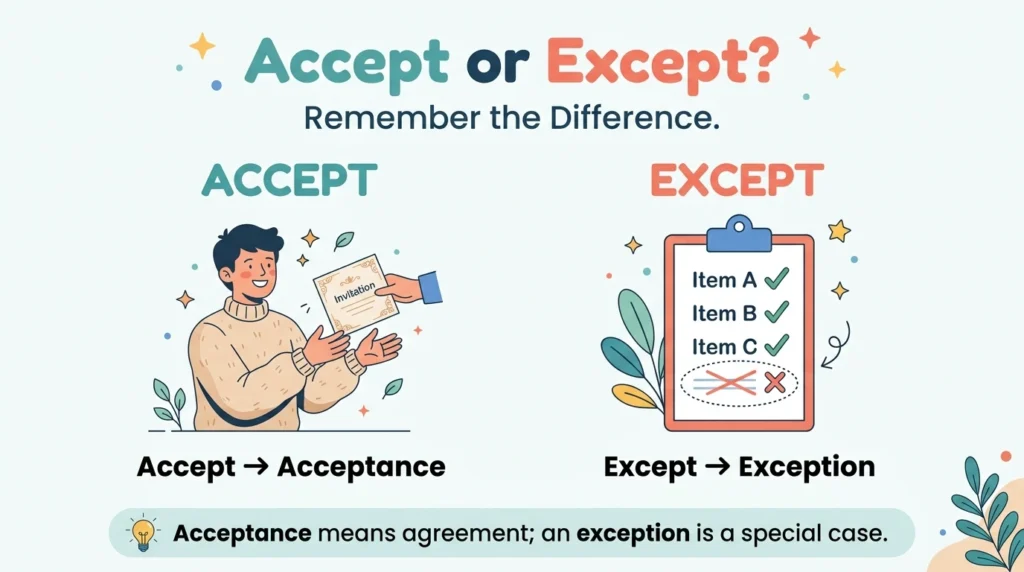
The best solution is to connect each word to a clear meaning: an exception is a special case, while acceptance is the act of accepting.
2. The Words Are Related in Appearance to Accept
Learners may recognize accept and assume that acception is its usual noun form. In modern English, however, the standard noun is acceptance.
Similarly, exception is associated with except, as in “everyone except Maria.” Recognizing this connection helps distinguish the words.
3. Spellcheck May Not Catch the Problem
A spelling tool may recognize acception as an existing word or may not flag it in every context. Yet a valid word can still be inappropriate for a particular sentence.
Always ask whether you mean a special case, an act of accepting, or a particular interpretation.
4. Overgeneralizing Word-Formation Rules
English uses many noun endings, including -tion, -sion, and -ance. Learners may assume that adding a familiar ending to a verb automatically produces the correct modern noun.
Unfortunately, English word formation is not completely predictable. Learning acceptance and exception as established vocabulary items is more reliable than guessing from spelling patterns.
5. Translation Interference
A word in another language may cover several related ideas that English expresses with different words. Translating it directly as acception can therefore produce an unnatural sentence.
Translate the intended meaning rather than the spelling. If you mean approval, use acceptance. If you mean a special case, use exception.
Read More: Traveler vs Traveller: Which Spelling Is Correct?
Common Mistakes Checklist
- Writing acception when you mean a special case: Use exception. Connect it with the phrase “except for.”
- Using acception for an admission decision: Use acceptance, as in “acceptance into the university.”
- Confusing except and accept: Except usually excludes something; accept means to receive, agree to, or approve something.
- Assuming acception is never a word: It has rare historical and specialized uses. The issue is whether it fits the modern sentence.
- Writing exception when you mean approval: “Thank you for your exception” usually does not express gratitude for approval. Write “Thank you for your acceptance” if that is the intended meaning.
- Forgetting the plural: The plural of exception is exceptions. For example, “The policy has two exceptions.”
- Using a spellchecker as the only test: Check meaning and context even when a word is not flagged.
Acception vs. Exception in Real English
Grammatically Correct
“An exception to the rule” and “acceptance of the offer” are standard modern expressions. Exception is a common noun referring to a special case, while acceptance names the act or state of accepting something. Acception does occur as a rare historical or specialized word, but it is not the ordinary modern noun for acceptance.
Grammatically Possible but Unnatural
A sentence such as “We received acception from the university” may communicate the intended idea to some readers, but it is not natural standard modern English for an admission decision. The expected sentence is “We received acceptance from the university” or, more specifically, “We were accepted into the university.” The problem is word choice, not simply a missing or extra letter.
Natural, Everyday English
In everyday English, people commonly say “with one exception,” “without exception,” “accept an offer,” and “receive acceptance.” The word acception is uncommon enough that most general readers will find it unfamiliar. Unless you are discussing historical usage or a specialized linguistic meaning, choose the established modern term that expresses your intended idea.
American vs. British English
There is no meaningful standard American-versus-British spelling distinction between acception and exception. In both varieties, exception is the normal word for a special case, and acceptance is the usual noun for the act of accepting.
| Meaning | American English | British English |
|---|---|---|
| A case outside a rule | Exception | Exception |
| The act of accepting | Acceptance | Acceptance |
| A rare historical or specialized term | Acception | Acception |
| Standard expression | Without exception | Without exception |
| Admission to a university | Acceptance into a university | Acceptance into a university |
The main issue is not regional spelling. It is selecting the correct word for the meaning you want to express.
Formal vs. Informal Usage
Formal Writing
Use exception in formal policies, contracts, academic papers, and business documents when describing a special case or exclusion.
Examples:
- The regulation contains an exception for emergency circumstances.
- Acceptance of the revised terms is required before implementation.
Avoid acception in ordinary formal writing unless you are explicitly discussing a historical or specialized use of the term.
Informal Writing
In everyday conversation, use familiar expressions such as:
- “There’s one exception.”
- “I’ll make an exception this time.”
- “Thanks for accepting my invitation.”
- “I’m happy about my acceptance.”
These expressions sound natural and clearly communicate the intended meaning.
Comparison Table: Acception vs. Exception vs. Acceptance
| Feature | Acception | Exception | Acceptance |
|---|---|---|---|
| Modern usage | Rare or specialized | Common | Common |
| Main meaning | Historical or specialized sense or interpretation; historically also associated with acceptance | A special case or something excluded from a rule | The act or state of accepting |
| Part of speech | Noun | Noun | Noun |
| Everyday use | Usually avoided | Very common | Very common |
| Example | A term discussed in a historical text | An exception to the rule | Acceptance of an offer |
| Common phrase | Rare in current general English | Without exception | Letter of acceptance |
| Recommended for general writing? | Usually no | Yes, when referring to a special case | Yes, when referring to accepting something |
Memory Trick: Except = Exception
Remember this simple connection:
Except leaves something out; an exception is the special case left out. Accept means to receive or agree; acceptance is the act of accepting.
For example:
- Everyone came except Ali. There was one exception.
- I accept your offer. Thank you for your acceptance.
This connection helps you remember the difference without relying on similar-looking spellings.
Read More: Aswell vs As Well: The Simple Rule That Ends the Confusion.
Acception vs. Exception in Real-Life Situations
Situation 1: A Workplace Rule
Your manager says all employees must attend a training session, but one employee is on approved leave.
Correct: “The manager made an exception for the employee on leave.”
Why? The employee’s situation differs from the general rule.
Situation 2: A University Application
A student receives an email confirming admission.
Correct: “She received an acceptance letter from the university.”
Why? The word refers to being accepted, not to a special case.
Situation 3: A Customer Request
A customer asks a business to extend a payment deadline.
Correct: “The company agreed to make an exception to its payment policy.”
Why? The company is allowing a departure from the usual policy.
Situation 4: An Email Invitation
A colleague invites you to a professional event, and you agree to attend.
Correct: “Thank you for the invitation. I am happy to accept.”
You could also write, “Thank you for confirming my acceptance,” depending on the context.
Situation 5: An English Examination
A student must explain a rule that has a special case.
Correct: “This grammar rule has one important exception.”
Why? The student is describing a case that does not follow the general rule.
Expert Tips: Choose the Word by Meaning
- Start with the intended meaning. If something is excluded from a rule, choose exception. If something is received or approved, choose acceptance.
- Use word families. Remember except → exception and accept → acceptance. These familiar connections help prevent spelling substitutions.
- Replace rare words with familiar ones when possible. In modern general writing, acceptance, meaning, or interpretation will usually be clearer than acception.
- Read the full sentence aloud. Ask whether the word makes sense in context, rather than checking only whether the spelling looks plausible.
- Check historical context before editing quotations. If acception appears in an older text, do not automatically change it. It may reflect the vocabulary of its period.
- Avoid invented rules. Acception is rare, not universally nonexistent. Explain its limited use accurately instead of declaring it impossible English.
FAQ: Acception vs. Exception
Is acception a correct English word?
Yes, acception is a rare word with historical and specialized uses, including senses related to interpretation or acceptance. However, it is not the standard modern word for accepting an offer or being admitted to a university. In everyday writing, acceptance is usually the correct choice.
Is acception a misspelling of exception?
It can be a mistake when the writer intends to mean exception, but the word acception itself has existed in English. Check the intended meaning before correcting it. If the sentence refers to a special case or departure from a rule, use exception.
What is the difference between acceptance and exception?
Acceptance means receiving, agreeing to, or approving something. Exception means a case that does not follow a general rule or is excluded from it. For example, “Her acceptance was confirmed” refers to approval, while “The rule has one exception” refers to a special case.
Can I use acception in academic writing?
You can use acception when discussing a historical text or a specialized linguistic usage where the term is relevant. For ordinary academic writing, however, choose acceptance, interpretation, or meaning, depending on the intended idea.
What is the plural of exception?
The plural is exceptions. For example, “The policy includes two exceptions.” The word exception is a countable noun, so it can refer to one special case or several.
What does without exception mean?
“Without exception” means that a statement or rule applies to everyone or everything in the specified group, with no cases excluded. For example, “All visitors must register without exception” means every visitor must register.
Is except the same as exception?
They are related but have different grammatical roles. Except is commonly a preposition or conjunction used to exclude someone or something, as in “Everyone came except Sara.” Exception is a noun, as in “Sara was the only exception.”
What is the difference between accept and except?
Accept means to receive, agree to, or approve something. Except usually means to exclude. For example, “I accept the invitation” means you agree to attend, while “Everyone accepted except Omar” means Omar did not accept.
Is “make an acception” correct?
Not in ordinary modern English when you mean allowing a special case. The natural expression is “make an exception.” For example, “The teacher made an exception to the deadline for a student who was ill.”
What word should I use instead of acception?
Choose the word that matches your intended meaning. Use acceptance for agreeing to or receiving something, exception for a special case, and interpretation or meaning when explaining what a word or statement signifies.
Quick Summary
Acception and exception look similar but differ in meaning and everyday usage. Exception is the standard word for a special case that does not follow a rule, as in “an exception to the policy.” Acceptance is the normal noun for agreeing to, receiving, or approving something, as in “acceptance of an offer.” Acception is a rare historical or specialized term, not the usual modern substitute for either word. To avoid confusion, remember the word families: except → exception and accept → acceptance. In everyday, academic, and professional writing, choose the word that expresses your intended meaning clearly.