
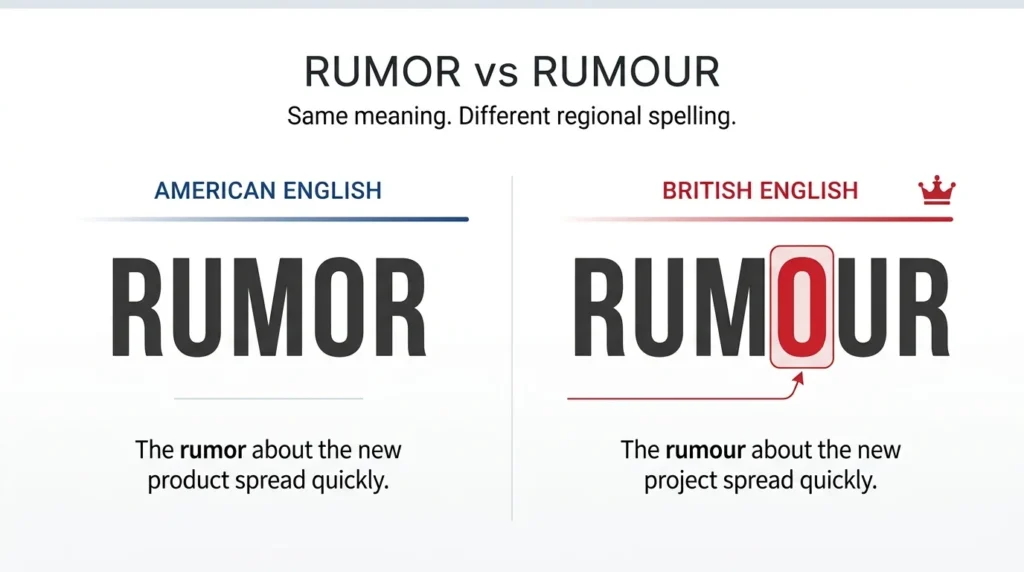

Use rumor when writing in American English and rumour when writing in British English. Both mean an unconfirmed story, statement, or piece of information that is being passed from one person to another. The pronunciation is essentially the same, and neither spelling is inherently more correct than the other. The important rule is to choose the spelling that matches your English variety and remain consistent throughout your writing.
What Is the Difference Between Rumor and Rumour?
Rumor and rumour are two regional spellings of the same English word.
The word refers to information, a story, or a claim that is circulating without being confirmed as true. A rumor may eventually prove to be true, partly true, or false. The word itself does not tell us whether the information is accurate; it tells us that the information is not confirmed.
The spelling changes according to the English variety:
- rumor — American English
- rumour — British English
For example:
- American English: There is a rumor that the company will move its headquarters.
- British English: There is a rumour that the company will move its headquarters.
The meaning remains the same.
Cambridge identifies rumor as the US spelling of rumour and rumour as the UK spelling of rumor.
Why It Matters
This spelling difference usually does not create a problem in conversation because rumor and rumour are pronounced alike. The issue appears mainly in writing.
Using the spelling associated with your chosen English variety helps your writing remain consistent and professional.
This matters particularly in:
- Academic assignments
- Business documents
- Websites and blogs
- News writing
- Marketing materials
- Formal letters and emails
- School examinations
- Professional reports
- Books and manuscripts
For example, if an American company’s website consistently uses American spelling, writing rumour in one article may look like an accidental spelling error even though the word itself is valid English.
Likewise, a British publication normally uses rumour, not rumor, when following British spelling conventions.
The important point is this: the problem is usually inconsistency, not the existence of either spelling.
The Core Rule
Use “rumor” in American English and “rumour” in British English. Both forms have the same meaning.
Think of the difference as:
American English → rumor
British English → rumour
The extra u is the entire spelling difference.
You do not need to learn two different meanings or two different grammar rules.
Read More: Authorization vs Authorisation: Which Is Correct?
How to Use Rumor
Rumor is the American English spelling.
It can be used as a noun and as a verb.
Rumor as a noun
As a noun, rumor refers to information or a story that is circulating without confirmation.
Examples:
- A rumor about the merger spread quickly.
- I heard a rumor about the new manager.
- The company denied the rumor.
- Several rumors appeared on social media.
The plural form is rumors.
Rumor as a verb
Rumor can also be used as a verb, particularly in constructions such as “it is rumored that”.
Examples:
- It is rumored that the company will open a new office.
- She is rumored to be joining the project.
- The actor is rumored to be working on a new film.
Dictionary sources also recognize rumor as a verb meaning to circulate or report something as a rumor.
How to Use Rumour
Rumour has exactly the same grammatical functions in British English.
Examples:
- A rumour about the merger spread quickly.
- I heard a rumour about the new manager.
- The company denied the rumour.
- Several rumours appeared on social media.
The plural is rumours.
The verb can also be written as rumoured:
- It is rumoured that the company will open a new office.
- She is rumoured to be joining the project.
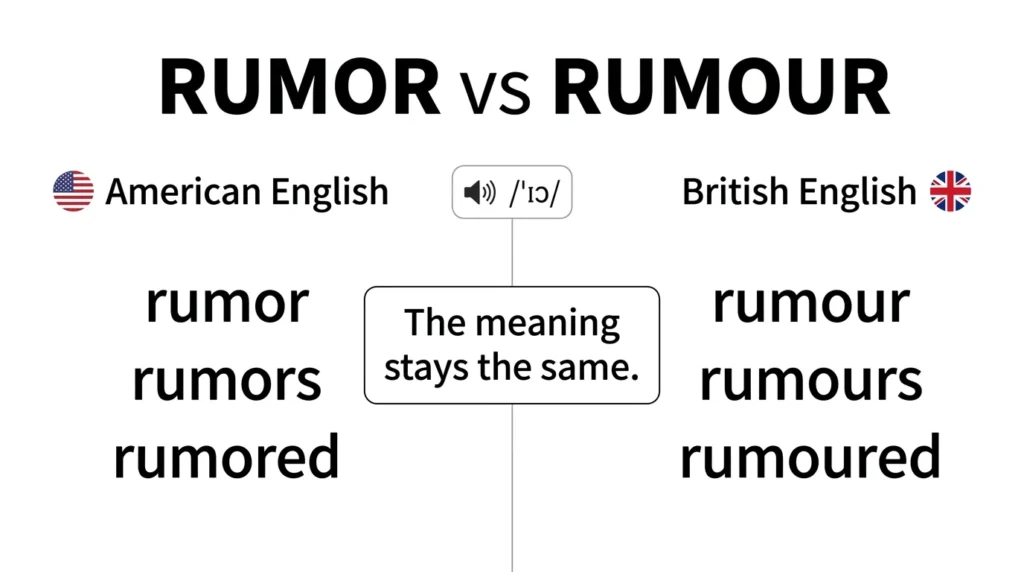
So the spelling difference extends to related forms:
| American English | British English |
|---|---|
| rumor | rumour |
| rumors | rumours |
| rumored | rumoured |
| rumor-related | rumour-related |
Correct Examples
Here are examples showing how the two spellings work in real situations.
Conversation
American English:
“I heard a rumor that Sarah is moving abroad.”
British English:
“I heard a rumour that Sarah is moving abroad.”
American English:
“We have heard a rumor about changes to the department.”
British English:
“We have heard a rumour about changes to the department.”
School
American English:
“The teacher asked us to explain how the rumor spread.”
British English:
“The teacher asked us to explain how the rumour spread.”
Workplace
American English:
“The CEO addressed the rumor during the meeting.”
British English:
“The CEO addressed the rumour during the meeting.”
Social Media
American English:
“That rumor has already been shared thousands of times.”
British English:
“That rumour has already been shared thousands of times.”
News Writing
American English:
“A rumor about the proposed merger circulated on Monday.”
British English:
“A rumour about the proposed merger circulated on Monday.”
Academic Writing
American English:
“The study examined how a rumor can spread through social networks.”
British English:
“The study examined how a rumour can spread through social networks.”
Read More: Heros vs Heroes: Which Spelling Is Correct?
Customer Communication
American English:
“We would like to clarify a rumor concerning our services.”
British English:
“We would like to clarify a rumour concerning our services.”
Business Report
American English:
“The rumor affected investor confidence.”
British English:
“The rumour affected investor confidence.”
Everyday Writing
American English:
“That is only a rumor, so we should wait for confirmation.”
British English:
“That is only a rumour, so we should wait for confirmation.”
Incorrect vs. Correct
The following examples are not about one spelling being universally wrong. They show situations where a writer has mixed American and British spelling conventions or has chosen the spelling that does not match the stated variety.
| ❌ Incorrect | ✅ Correct | Why |
|---|---|---|
| The rumour spread quickly. (American English style) | The rumor spread quickly. | American English normally uses rumor. |
| The rumor spread quickly. (British English style) | The rumour spread quickly. | British English normally uses rumour. |
| Several rumour were circulating. | Several rumours were circulating. | The plural requires -s after the chosen spelling. |
| Several rumor were circulating. | Several rumors were circulating. | The American plural is rumors. |
| It was rumored that the company would close. (British style) | It was rumoured that the company would close. | British spelling retains the u. |
| It was rumoured that the company would close. (American style) | It was rumored that the company would close. | American spelling drops the u. |
| The article uses rumor and rumour randomly. | Choose one spelling and use it consistently. | Mixing regional conventions can make a document look inconsistent. |
| I heard a rumor, but it has not been confirmed. | I heard a rumor, but it has not been confirmed. | The spelling is correct; the key point is that a rumor is unconfirmed information. |
| The newspaper reported the rumour as confirmed fact without evidence. | The newspaper reported the rumour as unconfirmed information. | A rumor should not automatically be treated as established fact. |
| She rumour that he was leaving. | She rumored that he was leaving. / She rumoured that he was leaving. | Rumor/rumour can function as a verb, but the verb must be conjugated. |
Why People Make This Mistake
The confusion usually happens because the two forms sound the same.
When people hear the word, they cannot tell whether it should contain a u. They must remember which spelling convention they are following.
Several factors make the confusion more common.
Phonetic Similarity
Rumor and rumour are pronounced the same way in ordinary English pronunciation. Because there is no audible difference corresponding to the extra u, learners have to remember the spelling separately.
Spelling Overlap
English contains many words with American -or and British -our spellings:
- color / colour
- honor / honour
- favor / favour
- humor / humour
- labor / labour
- neighbor / neighbour
- rumor / rumour
Once learners notice this pattern, the choice becomes easier.
Overgeneralisation
A learner may learn that British English uses -our and then assume every related word must follow that pattern in every English variety.
The opposite can happen too: someone accustomed to American English may automatically remove the u from words when writing for a British audience.
Autocomplete and Spellcheck
Word processors can make this confusing because they may flag one form depending on the selected language.
For example, a document set to American English may prefer rumor, while a British English dictionary may prefer rumour.
The software is responding to a language setting. It is not necessarily telling you that the other spelling is universally wrong.
Translation Interference
Learners who study English alongside another language may remember a spelling from a textbook, dictionary, website, or teacher using a particular English variety.
The safest solution is to identify the English variety required for the task and follow it consistently.
Common Mistakes Checklist
1. Thinking “rumour” is always wrong
It is not. Rumour is the standard British spelling.
2. Thinking “rumor” is always wrong
It is not. Rumor is the standard American spelling.
3. Mixing the two forms
A document can contain both forms if it is discussing regional spelling, but ordinary writing should normally follow one consistent spelling system.
4. Changing the meaning
The spelling does not create a different meaning.
Rumor and rumour refer to the same concept.
5. Forgetting the plural
The plural changes according to the spelling:
- American: rumors
- British: rumours
6. Forgetting related verb forms
The past form is:
- American: rumored
- British: rumoured
7. Treating a rumor as a confirmed fact
This is a meaning and writing problem rather than a spelling problem.
Calling something a rumor generally signals that it has not been confirmed. A rumor can later turn out to be true, but the word itself does not establish that it is true.
Rumor vs. Rumour in Real English
Grammatically correct
Both forms are grammatically correct when they match the English variety being used.
For example:
The rumor spread quickly.
is correct American English.
The rumour spread quickly.
is correct British English.
There is no grammatical difference between the two. The distinction is spelling-based rather than a difference in sentence structure or meaning.
Grammatically possible but inconsistent
A sentence such as:
The rumor spread quickly, but the newspaper later described the rumour as false.
is grammatically understandable, but if the writer is following one English variety throughout the document, switching spellings without a reason creates unnecessary inconsistency.
The issue is not that the second spelling suddenly becomes meaningless. The issue is that the document is using two regional conventions.
Natural everyday English
Both forms are completely natural in the English variety where they are standard.
An American speaker or writer would naturally use rumor, while a British writer would naturally use rumour.
For an international audience, either form can be understood easily. However, a publication, company, school, or author may have a preferred style. In that situation, follow the required house style rather than switching between forms.
American vs. British English
This is a genuine American/British spelling difference.
| Feature | American English | British English |
|---|---|---|
| Singular | rumor | rumour |
| Plural | rumors | rumours |
| Past/participle form | rumored | rumoured |
| Pronunciation | Same | Same |
| Meaning | Same | Same |
| Grammar | Same | Same |
The broader -or/-our pattern appears in several English words, although spelling conventions should be learned word by word rather than treated as an exception-free rule.
Formal vs. Informal Usage
The spelling difference is not a formal-versus-informal distinction.
You can use rumor in formal American writing:
The report addressed the rumor concerning the proposed acquisition.
You can also use rumour in formal British writing:
The report addressed the rumour concerning the proposed acquisition.
Likewise, both forms can appear in casual conversation and informal messages.
What determines the choice is primarily the English spelling convention, not the level of formality.
Rumor vs. Rumour Comparison Table
| Feature | Rumor | Rumour |
|---|---|---|
| Standard variety | American English | British English |
| Meaning | Unconfirmed information or story | Same |
| Pronunciation | Same | Same |
| Part of speech | Noun and verb | Noun and verb |
| Singular | rumor | rumour |
| Plural | rumors | rumours |
| Past form | rumored | rumoured |
| Extra letter | No u | Includes u |
| Formal usage | Yes | Yes |
| Informal usage | Yes | Yes |
| Meaning difference | None | None |
Memory Trick
Use this simple memory trick:
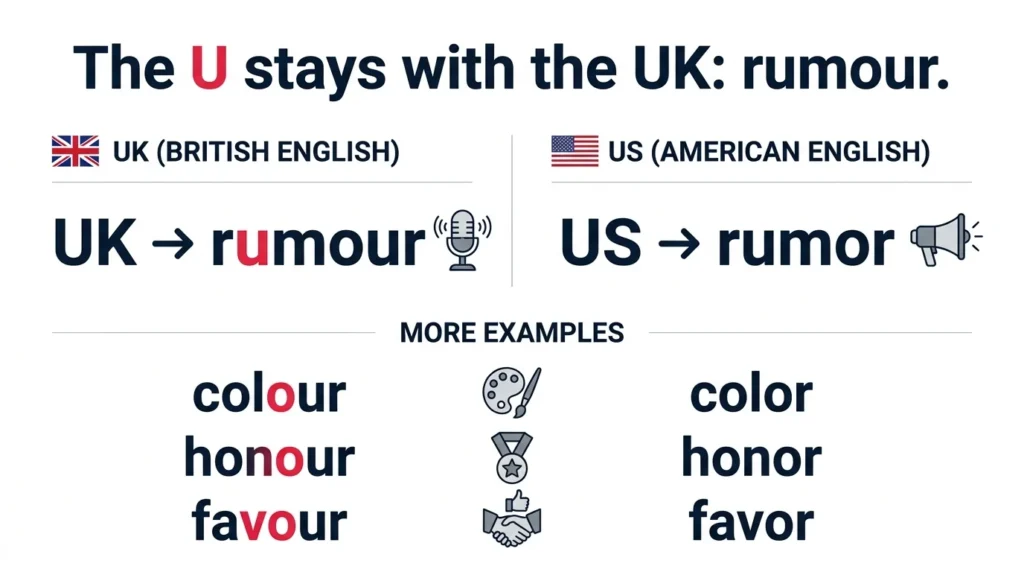
The U stays with the UK: rumour.
So:
US → rumor
UK → rumour
The extra u can remind you of UK.
This same visual pattern can also help with familiar pairs such as color/colour, honor/honour, and favor/favour.
Real-Life Situations
Job Interview
You are writing an American-style résumé or preparing an American business document.
Use:
I would avoid repeating a rumor until the information is verified.
For British English:
I would avoid repeating a rumour until the information is verified.
Read More: Flys vs Flies: Which Spelling Is Correct?
Workplace Meeting
An employee says:
There is a rumor that the department is being reorganized.
In British English, the same sentence becomes:
There is a rumour that the department is being reorganised.
Notice that the spelling system can affect more than one word in the same sentence.
American:
I wanted to clarify a rumor that has been circulating among the team.
British:
I wanted to clarify a rumour that has been circulating among the team.
Text Message
American:
Is that rumor actually true?
British:
Is that rumour actually true?
Exam
If an English examination requires British English, write:
The rumour spread throughout the school.
If it requires American English, write:
The rumor spread throughout the school.
The important thing is to follow the spelling convention expected by the examination or institution.
Mini Quiz
| # | Question | Answer | Explanation |
|---|---|---|---|
| 1 | Which spelling is standard in American English: rumor or rumour? | Rumor | American English uses rumor. |
| 2 | Which spelling is standard in British English? | Rumour | British English retains the u. |
| 3 | Fill in the blank: “I heard a ___ about the new manager.” (American English) | rumor | The American spelling is rumor. |
| 4 | Fill in the blank: “I heard a ___ about the new manager.” (British English) | rumour | The British spelling is rumour. |
| 5 | Is “rumour” an incorrect spelling? | No | It is the standard British spelling. |
| 6 | Is there a difference in meaning between rumor and rumour? | No | They have the same meaning. |
| 7 | Correct the sentence for American English: “Several rumours were circulating.” | Several rumors were circulating. | The American plural is rumors. |
| 8 | Correct the sentence for British English: “It was rumored that she was leaving.” | It was rumoured that she was leaving. | British spelling uses rumoured. |
| 9 | Which is better for a consistent American English article: “rumor” or “rumour”? | Rumor | The spelling should match American English. |
| 10 | True or false: “Rumor” and “rumour” have different pronunciations. | False | The spelling differs, but the words are pronounced the same in standard usage. |
Expert Tips
Match the audience, not the search result
If you are writing for Americans, use rumor. If you are writing in British English, use rumour.
Do not change your spelling simply because you found the other version on a website.
Check the document language
If you are unsure which spelling your word processor expects, check its language setting.
A document set to American English may prefer rumor, while one set to British English may prefer rumour.
Stay consistent
Do not switch between American and British spelling without a clear reason.
If the document begins with rumor, continue with rumor, rumors, and rumored when those forms are needed.
If it begins with rumour, continue with rumours and rumoured.
Do not confuse spelling with truth
A rumor is not automatically false.
The word indicates that information is circulating without confirmation. The information may later be confirmed as true or shown to be false.
Remember the whole word family
Learning only rumor vs. rumour is useful, but remembering the related forms makes your writing more consistent:
American: rumor → rumors → rumored
British: rumour → rumours → rumoured
FAQ
Is “rumor” or “rumour” correct?
Both are correct. Rumor is the standard American English spelling, while rumour is the standard British English spelling. They have the same meaning.
Does rumor mean something different from rumour?
No. The two spellings represent the same word and the same meaning: information or a story that is circulating without confirmation.
Is “rumour” British or American?
Rumour is the British spelling. American English normally uses rumor.
Is “rumor” American English?
Yes. Rumor is the standard American English spelling of the word.
What is the plural of rumor?
The American English plural is rumors.
What is the plural of rumour?
The British English plural is rumours.
Is “rumored” British or American?
Rumored is the American English spelling. British English normally uses rumoured.
Can rumor be a verb?
Yes. Rumor can function as a verb, particularly in expressions such as It is rumored that the company will expand. The British spelling is rumour and rumoured.
Can I use rumor and rumour in the same article?
You can, but normally you should not mix regional spelling conventions without a specific reason. Choose the English variety appropriate for your audience and remain consistent.
How do you pronounce rumor and rumour?
They are pronounced the same in standard usage. The spelling difference does not create a meaningful pronunciation difference.
Which spelling should I use in professional writing?
Use the spelling required by your audience, organization, publication, or style guide. American English generally uses rumor, while British English uses rumour.
Quick Summary
Rumor and rumour are not different words. They are two spellings of the same word. Rumor is the standard American English form, while rumour is the standard British English form. Both describe information or a story that is circulating without confirmation, and both can function as a noun or verb. Their pronunciation and meaning are the same. The related forms also follow the same regional pattern: rumors/rumours and rumored/rumoured. The easiest way to remember the difference is: the U stays with the UK — rumour. When writing, choose the spelling that matches your English variety and use it consistently throughout the document.