

Quick Answer: Authorization and authorisation are both correct spellings of the same noun. They have the same meaning: official permission, approval, or the power to allow something to happen. Authorization is the standard spelling in American English. Authorisation is widely used in British English, although some British publications, especially those following Oxford spelling, use authorization. The best choice depends on the English style you are following.
What Is the Difference Between Authorization and Authorisation?
The difference between authorization and authorisation is primarily a spelling difference, not a difference in meaning.
Both words are nouns related to the verb authorize/authorise. They describe official permission, approval, or the granting of power to do something.
For example:
- The bank requires authorization before processing the payment.
- The bank requires authorisation before processing the payment.
The meaning of both sentences is the same.
The important difference is the spelling system being followed.
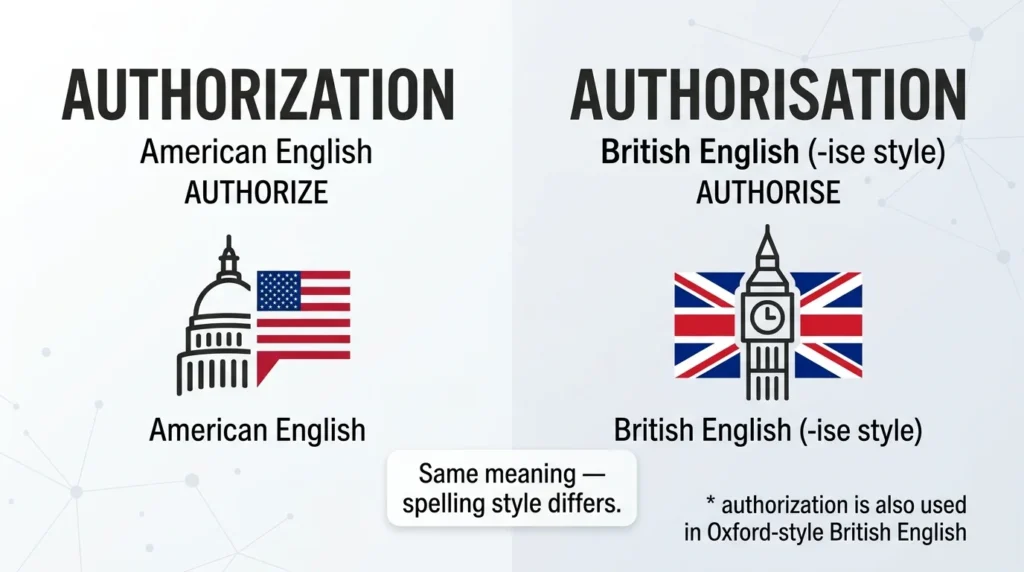
Authorization uses z and is the standard American English spelling.
Authorisation uses s and is a common British English spelling.
However, it is too simple to say that every British writer must use authorisation. British English contains both -ise and -ize spelling traditions. Oxford-style English uses forms such as authorize and authorization, while many other British publications use authorise and authorisation.
So the safest rule is:
Use authorization for American English. Use authorisation when following a British -ise spelling style. If your British style guide uses -ize, authorization is also correct.
Why It Matters
At first glance, changing s to z may seem unimportant. In many situations, the reader will understand either spelling immediately.
The issue becomes more important when you are writing documents that follow a particular English standard.
This includes:
- Business emails
- Legal documents
- Government forms
- Academic writing
- Company policies
- Technical documentation
- Banking and financial documents
- Healthcare documents
- Software interfaces
- International websites
- Professional reports
Consistency is especially important.
For example, if a document uses:
The organisation requires written authorisation.
then switching later to:
The organization requires written authorization.
creates an inconsistent spelling style.
Neither sentence is inherently grammatically wrong. The problem is that the document has changed its spelling convention.
For professional writing, choose a style and maintain it throughout the document.
Read More: Heros vs Heroes: Which Spelling Is Correct?
The Core Rule
Authorization and authorisation have the same meaning. The choice is mainly determined by the spelling system you are following: American English normally uses authorization, while the common British -ise style uses authorisation. British English can also use authorization under Oxford-style spelling.
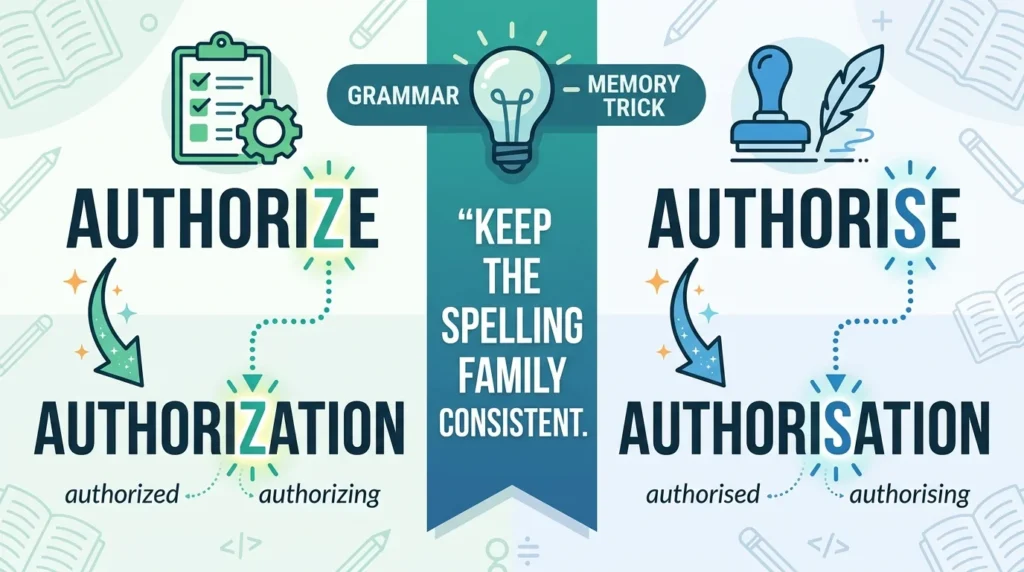
A useful way to remember the relationship is:
American English:
authorize → authorization
British -ise style:
authorise → authorisation
The spelling of the noun normally follows the spelling of the related verb.
How to Use Authorization and Authorisation
Use Authorization in American English
Use authorization when your document follows standard American English spelling.
Examples include:
- The payment requires authorization.
- We received authorization to begin the project.
- The manager gave authorization for the purchase.
- Employees need authorization before accessing the database.
- The bank requested additional authorization.
American English commonly uses related forms such as:
- authorize
- authorized
- authorizing
- authorization
For example:
The director authorized the payment.
becomes:
The director provided authorization for the payment.
Use Authorisation in British -ise Style
Use authorisation when your document follows the common British -ise spelling convention.
Examples include:
- The payment requires authorisation.
- We received authorisation to begin the project.
- The manager gave authorisation for the purchase.
- Employees need authorisation before accessing the database.
- The bank requested additional authorisation.
The related British forms are:
- authorise
- authorised
- authorising
- authorisation
For example:
The director authorised the payment.
becomes:
The director provided authorisation for the payment.
Follow the Existing Style
If you are editing an existing document, do not automatically change every s to z, or every z to s.
First identify the spelling system already being used.
Look at words such as:
- organisation / organization
- recognise / recognize
- realise / realize
- authorised / authorized
If the document consistently uses the -ise pattern, authorisation will normally fit that style.
If it consistently uses the -ize pattern, authorization will normally fit.
Correct Examples
Here are examples showing how both forms work naturally.
| Situation | Example |
|---|---|
| Business email | We need your authorization before releasing the payment. |
| British business writing | We need your authorisation before releasing the payment. |
| Workplace | The manager gave authorization to proceed. |
| Government | The project requires official authorisation. |
| Banking | The transaction is waiting for payment authorization. |
| Technology | The application requires user authorization. |
| Legal writing | The agreement requires written authorisation. |
| Academic writing | The researchers obtained authorization before collecting the data. |
| Healthcare | Patient records cannot be released without authorization. |
| Everyday formal communication | We cannot enter the restricted area without authorisation. |
| Company policy | Employees must obtain authorization before making large purchases. |
| UK-style administration | Written authorisation is required before the records are released. |
Both spellings can perform the same grammatical role.
The important question is not simply, “Which one is correct?”
The better question is:
Which spelling matches the English style of my document?
Incorrect vs. Correct
The following examples focus on spelling consistency and common usage mistakes.
| ❌ Incorrect or Poor Choice | ✅ Correct Choice | Why |
|---|---|---|
| The US company requires authorisation. | The US company requires authorization. | Use the American spelling when following American English. |
| The British report requires authorization. | The British report requires authorisation. | This is appropriate when the report follows the common British -ise style. |
| The document uses organisation and authorization throughout. | The document uses organisation and authorisation throughout. | Matching the spelling system improves consistency. |
| We received authorisation from the American office. | We received authorization from the American office. | Use the organization’s established style rather than mixing conventions. |
| Please obtain authorization before the procedure. | Please obtain authorization before the procedure. | Authorization is correctly spelled with z in American English. |
| Please obtain authorisation before the procedure. | Please obtain authorisation before the procedure. | Authorisation is correct in British -ise spelling. |
| The manager authorises the payment and gives authorization. | The manager authorises the payment and gives authorisation. | Keep related forms consistent when using the British -ise system. |
| The manager authorizes the payment and gives authorisation. | The manager authorizes the payment and gives authorization. | Avoid switching spelling systems without a reason. |
| We need an authorisation form. | We need an authorisation form. | This is correct when the document follows British -ise spelling. |
| We need an authorization form. | We need an authorization form. | This is correct in American English and Oxford-style -ize usage. |
Notice something important: some entries in the first column are not universally “wrong” English.
They may simply be wrong for the spelling system being used in that particular document.
That distinction matters.
Why People Make This Mistake
Phonetic Similarity
The pronunciation does not clearly tell most writers whether the spelling should contain s or z.
The spoken word sounds essentially the same regardless of which spelling is written.
As a result, learners often remember the sound but not the regional spelling.
Spelling Overlap
English contains many related words that use different spelling conventions.
For example:
- organize / organise
- recognize / recognise
- realize / realise
- authorize / authorise
- authorization / authorisation
Seeing both versions regularly can make writers unsure which one belongs in a particular document.
Overgeneralisation
A learner may learn:
“British English uses s and American English uses z.”
That is a useful starting shortcut, but it is not a complete description of British spelling.
Some British publishers and institutions use -ize spellings. Oxford-style English is a well-known example.
So treating every British -ize word as an error is too simplistic.
Autocomplete and Spellcheck
Modern writing software can make the issue more confusing.
A spellchecker configured for American English may prefer authorization.
A British English dictionary or spellchecker may accept or prefer authorisation.
The software is not necessarily telling you that the other form is universally wrong. It may simply be applying a particular language setting.
Translation Interference
Learners who use English alongside another language may encounter one spelling repeatedly in translated documents, software, legal forms, or educational material.
If that spelling becomes familiar, they may assume it is the only correct form.
The better approach is to identify the English variety being used rather than memorize one form as universally correct.
Common Mistakes Checklist
Mistake 1: Thinking Authorisation Is a Misspelling
What happens: A writer sees authorisation and changes it to authorization.
Why it happens: American English is often the default in international software and online content.
How to avoid it: Check the English style of the document before changing the spelling.
Mistake 2: Thinking Authorization Is Always American-Only
What happens: A writer assumes authorization cannot appear in British English.
Why it happens: Many simplified grammar explanations teach “US = -ize, UK = -ise.”
How to avoid it: Remember that British English has more than one established spelling tradition. Oxford-style spelling uses authorization.
Mistake 3: Mixing Both Forms
What happens: One document contains both authorisation and authorization without a deliberate reason.
Why it happens: Different sources or writers contribute to the same document.
How to avoid it: Choose a house style and proofread related words together.
Mistake 4: Changing Only the Noun
What happens: A writer uses authorise with authorization or authorize with authorisation without intending to follow a mixed style.
Why it happens: The writer remembers the noun but forgets its related verb.
How to avoid it: Check the whole word family.
Mistake 5: Assuming Different Spelling Means Different Meaning
What happens: A learner searches for a semantic difference between the two words.
Why it happens: Different spellings sometimes indicate different words in English.
How to avoid it: Here, the distinction is primarily orthographic—meaning it concerns spelling—not meaning.
Authorization vs Authorisation in Real English
Grammatically Correct
Both authorization and authorisation are grammatically correct nouns.
For example:
The company requires written authorization.
and:
The company requires written authorisation.
Both sentences use the noun correctly. The difference is the spelling convention.
The noun can refer to official permission, the act of granting permission, or in some contexts a document that gives someone official permission.
Grammatically Possible but Style-Inconsistent
A sentence such as:
The organisation requires authorization before access is granted.
is grammatically understandable and authorization itself is a valid spelling.
But if the document otherwise follows a consistent British -ise style—using forms such as organisation, recognise, and authorise—then authorisation may be the more consistent editorial choice.
The problem is not grammar. It is style consistency.
Natural Everyday English
In everyday conversation, people often use simpler words such as permission or approval.
For example:
Do I have permission to use your car?
sounds more conversational than:
Do I have authorization to use your car?
Authorization is especially natural in formal, administrative, legal, technical, financial, and institutional contexts.
This does not make it an unnatural word. It simply has a more formal tone in many situations.
American vs. British English
There is a genuine regional spelling difference, but it needs one important qualification.
| English style | Common spelling | Related verb |
|---|---|---|
| American English | authorization | authorize |
| British English, common -ise style | authorisation | authorise |
| British English, Oxford-style -ize | authorization | authorize |
American English uses authorization as the standard spelling.
British English commonly uses authorisation, particularly in styles that prefer -ise endings.
However, British English also accepts the -ize spelling in certain established styles. Oxford’s learner dictionary gives authorization as the headword and identifies authorisation as a British form.
This is why the simple rule “authorization is American and authorisation is British” is useful for beginners but incomplete for advanced writers.
Formal vs. Informal Usage
Both spellings are relatively formal because authorization/authorisation is itself a formal noun.
In casual conversation, permission is often more natural.
Compare:
I got permission to leave early.
with:
I received authorization to leave early.
The second sentence sounds more official and administrative.
However, authorization is completely normal in specialized everyday contexts.
For example:
The payment is waiting for authorization.
In banking or technology, the formal word may actually be the normal term used by the system.
The same applies to authorisation in British-style professional contexts.
Authorization vs Authorisation Comparison Table
| Feature | Authorization | Authorisation |
|---|---|---|
| Meaning | Official permission or approval | Official permission or approval |
| Part of speech | Noun | Noun |
| Key spelling | z | s |
| American English | Standard | Not the usual US spelling |
| British English | Used in some styles | Common in -ise style |
| Oxford-style English | Used | Alternative British form |
| Pronunciation | Essentially the same | Essentially the same |
| Related verb | authorize | authorise |
| Formality | Formal/professional | Formal/professional |
| Meaning difference | None | None |
| Main issue | Regional/style consistency | Regional/style consistency |
Memory Trick
Use the Z-to-Z rule:
Authorize → Authorization
Authorise → Authorisation
If the verb has Z, the noun normally keeps the Z.
If the verb has S, the noun normally keeps the S.
Think:
Z → Z
S → S
This makes it easier to keep the whole word family consistent.
Real-Life Situations
1. Job Interview
An American company asks:
“Do you have authorization to work in the United States?”
The z spelling fits American English.
2. British Workplace
A British organisation following an -ise style might write:
“Written authorisation is required before the purchase can be approved.”
The s spelling matches the surrounding style.
3. Banking
A payment system may display:
“Payment authorization required.”
This is a normal technical and financial use of the word.
4. Government
A British government document may use:
“Additional authorisation is required.”
Official British government material commonly uses the -isation spelling.
5. Academic Writing
A researcher might write:
“The study was conducted after obtaining authorization from the relevant committee.”
The word fits formal academic writing.
6. Text Message
A friend is unlikely to say:
“Do I have your authorization to borrow your jacket?”
They would more naturally say:
“Can I borrow your jacket?”
This shows that correctness and naturalness are not always the same question.
Read More: Flys vs Flies: Which Spelling Is Correct?
Mini Quiz
| # | Question | Answer | Explanation |
|---|---|---|---|
| 1 | Which spelling is standard in American English: authorization or authorisation? | Authorization | American English normally uses the -ization form. |
| 2 | Fill in: “We need written ______ before entering the laboratory.” British -ise style | authorisation | The British -ise spelling uses authorisation. |
| 3 | True or false: Authorisation is always a spelling mistake. | False | It is an established spelling used especially in British English. |
| 4 | Which is consistent? “The organisation requires authorisation.” | Correct | Both words follow the common British -ise pattern. |
| 5 | Choose the American spelling: authorisation / authorization | authorization | American English uses z here. |
| 6 | Correct this American English sentence: “The manager gave authorisation.” | The manager gave authorization. | The American spelling uses z. |
| 7 | Is there a difference in meaning between the two spellings? | No | They represent the same noun and meaning. |
| 8 | Complete: “The manager ______ the payment.” American English | authorized | The related American verb is authorize. |
| 9 | Complete: “The manager ______ the payment.” British -ise style | authorised | The related British -ise verb is authorise. |
| 10 | Which is the best approach in a professional document? | Follow one consistent spelling style. | Consistency matters more than treating one form as universally correct. |
Expert Tips
1. Look at the whole document
Do not decide based on this word alone.
Check related words such as:
- organization / organisation
- recognize / recognise
- authorize / authorise
- authorization / authorisation
The pattern will usually reveal the style being followed.
2. Check the client’s style guide
If you are writing for a company, university, government department, or publication, its house style takes priority.
A company may have its own localization rules even when several English varieties would be acceptable.
3. Do not “correct” a valid regional spelling
If a British document uses authorisation, changing it to authorization does not automatically improve it.
Likewise, changing an American document from authorization to authorisation is not an improvement.
First determine the intended English variety.
4. Pay attention to software localization
Software products often maintain different language versions.
A US interface may use:
Authorization required.
A UK interface may use:
Authorisation required.
The underlying function can be identical.
5. Remember that British spelling is not one single system
This is the detail many short grammar articles leave out.
British English commonly uses -ise, but -ize forms are also established in some British styles, including Oxford-style usage.
6. Do not confuse spelling with pronunciation
The s/z difference in writing does not create a different meaning.
You are choosing a spelling convention, not choosing a different word.
7. Use “permission” when the situation is casual
If the context is informal, permission may sound more natural:
Can I have permission to leave?
rather than:
Can I have authorization to leave?
But in banking, law, technology, administration, and similar contexts, authorization or authorisation may be the normal technical term.
FAQ
Is authorization or authorisation correct?
Both are correct. Authorization is the standard American spelling, while authorisation is widely used in British English. British English also includes styles that use authorization, so the choice depends on the spelling system being followed.
Do authorization and authorisation mean the same thing?
Yes. Both refer to official permission, approval, or the granting of authority. The spelling does not create a different meaning.
Is authorisation British or American?
Authorisation is primarily associated with British English and other varieties that follow the British -ise spelling convention. It is not the standard American spelling.
Is authorization British English?
Yes. Although authorisation is very common in British English, authorization is also used in British English, particularly in Oxford-style spelling.
Should I use authorization in academic writing?
Use the spelling required by your academic institution, publisher, or style guide. If no specific style is required, choose a consistent English variety and use it throughout the paper.
Which spelling should I use in American English?
Use authorization.
The related forms are authorize, authorized, and authorizing.
Which spelling should I use in British English?
If your British style follows the common -ise convention, use authorisation.
If your publication or institution follows Oxford-style -ize spelling, authorization is appropriate.
Is authorization more formal than permission?
Usually, yes in terms of register. Authorization is strongly associated with official, legal, administrative, technical, and professional contexts. In ordinary conversation, permission is often simpler and more natural.
Is authorization a noun?
Yes. Authorization is a noun. It can refer to official permission, the act of giving permission, or in some contexts a document that provides official permission.
What is the verb form of authorization?
The corresponding verbs are authorize and authorise.
For example:
The manager authorized the payment.
or:
The manager authorised the payment.
Can I use authorization and authorisation in the same document?
You can, but normally you should not switch between them without a deliberate reason. Choose the spelling convention appropriate for your audience or style guide and maintain consistency.
Which spelling is better for international English?
There is no universal winner. For an international audience, the most important factors are clarity, the organization’s established style, and consistency. If the content is localized for the United States, use authorization. If it follows a British -ise style, use authorisation.
Quick Summary
Authorization and authorisation are two spellings of the same noun. Both mean official permission, approval, or the granting of authority. Authorization is the standard spelling in American English, while authorisation is widely used in British English. However, British spelling is not completely uniform: Oxford-style English also uses authorization. The key is therefore not to memorize that one form is “right” and the other is “wrong.” Instead, identify the English variety and style guide being used, then stay consistent. In formal writing, especially business, legal, academic, technical, and government documents, consistency across related forms such as authorize/authorise and authorization/authorisation is more important than treating one spelling as universally correct.