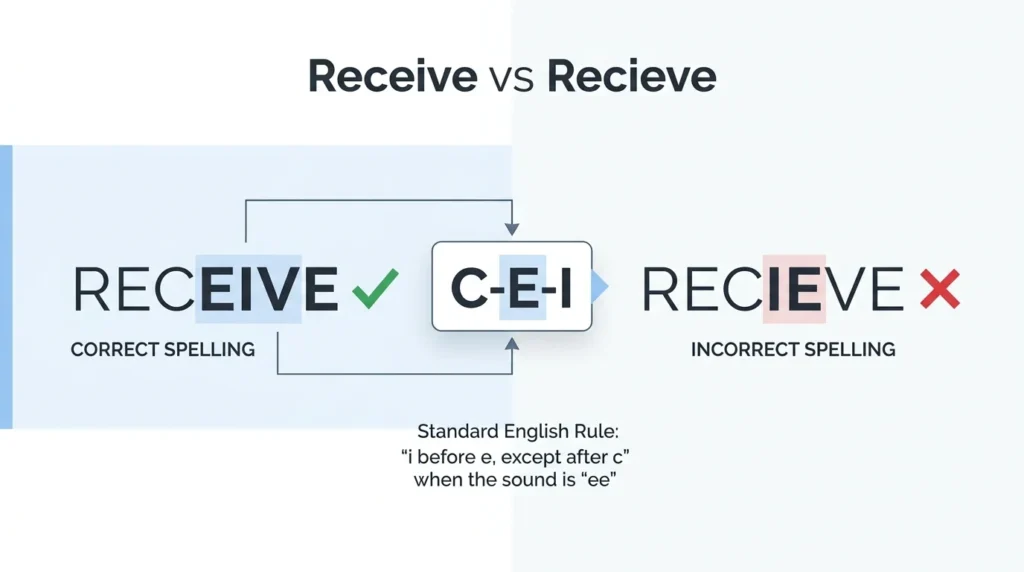

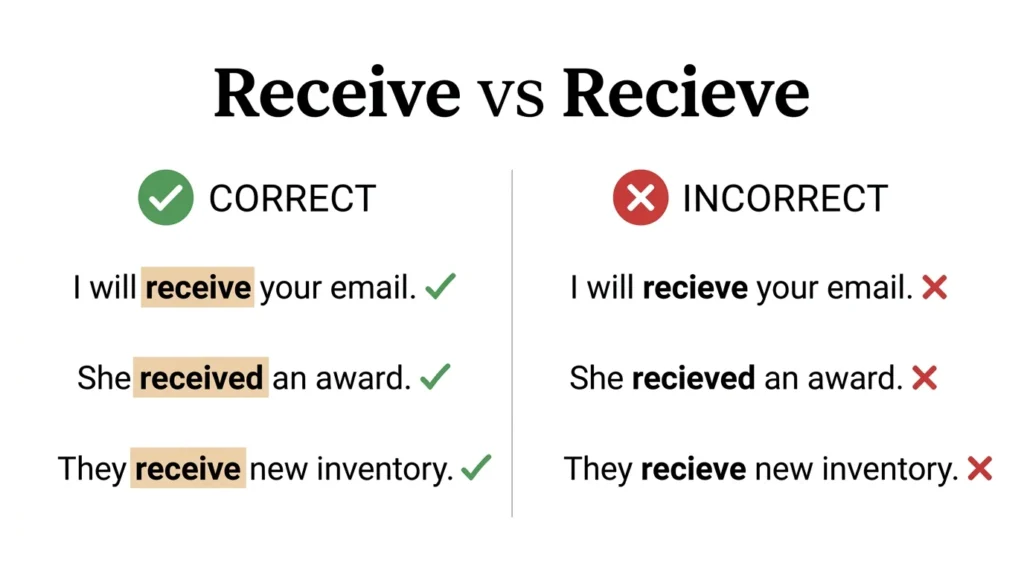
Receive is the correct spelling. Recieve is a common misspelling and should not be used in standard English. Receive is a verb meaning to get, accept, or be given something, such as an email, gift, payment, message, or award. The spelling is r-e-c-e-i-v-e, with ei after c. A useful memory aid is: “i before e, except after c.”
What Is the Difference Between Receive and Recieve?
The difference is simple: receive is the standard English spelling, while recieve is a spelling error.
Receive is a real English verb. It can mean to get something that someone gives or sends to you, accept something, be given something, or experience something. For example:
- I will receive the package tomorrow.
- Did you receive my email?
- She received an award for her work.
Recieve is not an alternative spelling of receive. It is the result of putting the i and e in the wrong order. Standard English uses receive, not recieve.
So, if you are wondering:
Is it receive or recieve?
The answer is:
Receive is correct. Recieve is incorrect.
Why Does the Difference Matter?
At first, recieve may look like a tiny spelling mistake. After all, the two forms differ by only two letters.
But spelling errors can affect how clearly and professionally your writing is received by other people.
The mistake can appear in:
- Emails
- Job applications
- School assignments
- Business documents
- Reports
- Social media posts
- Customer messages
- Academic writing
- Websites
- Professional correspondence
Consider these two sentences:
We will receive your application by Friday.
We will recieve your application by Friday.
The meaning is easy to understand in both cases, but only the first sentence uses the standard spelling.
This is especially important when writing in situations where accuracy matters. A correctly spelled word does not guarantee strong writing, but an avoidable spelling error can distract the reader from your message.
Read More: Rumor vs Rumour: Which Spelling Is Correct?
The Core Rule
Use receive, not recieve.
The correct spelling is r-e-c-e-i-v-e.
The important letter sequence is:
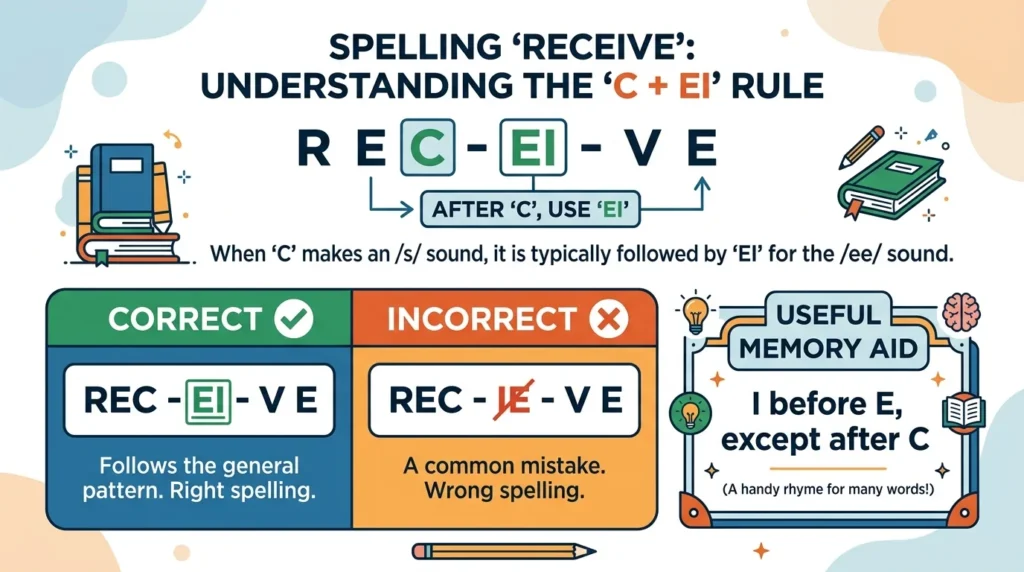
c + ei
So:
rec-ei-ve ✅
not:
rec-ie-ve ❌
The familiar spelling rule “i before e, except after c” helps explain why receive has ei rather than ie.
However, this rhyme is only a memory aid, not a universal law of English spelling. English has many exceptions, so it is better to treat it as a useful guide rather than an absolute rule.
How to Spell Receive Correctly
Break the word into parts:
R — E — C — E — I — V — E
The easiest part to confuse is the middle:
CEI
Not:
CIE
Compare them:
| Spelling | Status |
|---|---|
| receive | ✅ Correct |
| recieve | ❌ Incorrect |
| receeve | ❌ Incorrect |
| recive | ❌ Incorrect |
| receve | ❌ Incorrect |
The correct spelling is always receive when you mean “get,” “accept,” or “be given.”
Receive, Received, and Receiving
The same spelling pattern appears in related forms, although the word changes when suffixes are added:
- receive — I will receive the package.
- receives — She receives many emails.
- received — We received your application.
- receiving — They are receiving new orders.
A particularly common mistake is writing recieved instead of received, or recieving instead of receiving.
Correct:
- received ✅
- receiving ✅
Incorrect:
- recieved ❌
- recieving ❌
The standard verb forms are receive, receives, received, and receiving.
What Does Receive Mean?
Receive generally means to get, accept, or be given something.
For example:
Get something
I received a package this morning.
Be given something
She received a scholarship.
Get information
We received the news yesterday.
Accept something
He received the invitation with gratitude.
The word can also be used in several other contexts. A person can receive guests, receive an award, receive payment, receive a signal, or receive criticism.
The exact meaning depends on the context. Dictionaries describe receive as having uses connected with getting something, welcoming people, accepting something, experiencing something, and receiving signals or information.
Correct Examples of Receive
Here are examples from different types of real-world writing.
Conversation
“Did you receive the message I sent you?”
Here, receive means “get.”
I have received your email and will respond shortly.
The past form received is appropriate because the email has already arrived.
Workplace
All employees will receive their updated schedules by Monday.
The word refers to getting something.
School
Students who pass the examination will receive a certificate.
The certificate is something given to them.
Academic Writing
The participants received detailed instructions before the experiment.
The participants were given instructions.
Customer Service
We have received your complaint and are reviewing the matter.
The company has obtained the complaint.
Social Media
I can’t believe I received so many kind messages today.
The writer got the messages.
Business
The supplier confirmed that we will receive the shipment next week.
The shipment will be delivered to the company.
Formal Writing
The committee received several proposals for consideration.
The committee was given or submitted the proposals.
Everyday English
I received a birthday card from my cousin.
The person got the card.
Incorrect vs. Correct
The following examples show how the spelling mistake appears in real sentences.
| ❌ Incorrect | ✅ Correct | Why |
|---|---|---|
| I will recieve your email tomorrow. | I will receive your email tomorrow. | The standard spelling is receive, with ei after c. |
| Did you recieve my message? | Did you receive my message? | Recieve is a misspelling. |
| She recieved an award. | She received an award. | The past form is received, not recieved. |
| We have recieved your application. | We have received your application. | The correct past participle keeps ei. |
| He is recieving calls all day. | He is receiving calls all day. | The -ing form is receiving. |
| I hope you recieve the package soon. | I hope you receive the package soon. | Use the base form receive after hope you. |
| They will recieve payment next week. | They will receive payment next week. | Receive means get or be given payment. |
| She recieves hundreds of emails. | She receives hundreds of emails. | The third-person singular form is receives. |
| We recieve regular updates. | We receive regular updates. | The spelling is receive. |
| He has recieved several offers. | He has received several offers. | The past participle is received. |
Notice that the problem is not grammar in these sentences. In most cases, the sentence structure is perfectly understandable. The problem is spelling.
Why Do People Spell Receive as Recieve?
The mistake is surprisingly easy to make because the pronunciation does not tell you the letter order.
Phonetic Similarity
Receive and recieve are pronounced as if they were the same word because recieve is simply a misspelling of receive.
When you hear the word, you cannot hear whether the writer used ei or ie.
That means you have to remember the spelling rather than rely on pronunciation.
Read More: Authorization vs Authorisation: Which Is Correct?
Similar Words Create Confusion
English contains many familiar words with ie, including:
- believe
- achieve
- relieve
- field
- piece
That pattern can encourage someone to write recieve.
But receive belongs to the ei pattern after c:
- receive
- deceive
- conceive
- perceive
The spelling pattern can therefore become easier to recognize when related words are grouped together.
Overgeneralising “I Before E”
Many learners remember:
“I before E.”
They then automatically write recieve.
But the longer version of the familiar mnemonic says:
“I before E, except after C.”
In receive, the ei comes after c, so the spelling is:
rec-ei-ve
not:
rec-ie-ve
The rule is useful here, but it should not be treated as a perfect rule for every English word.
Autocomplete and Spellcheck
Modern writing tools can make this mistake less visible.
If you type recieve, your spellchecker may automatically correct it to receive. That is helpful, but it can also mean you never learn which spelling is actually correct.
A better habit is to notice the correction and remember the pattern:
receive = cei
Do not depend completely on software to know what you meant.
Translation Interference
Learners of English may also transfer spelling patterns from another language into English.
This is especially possible when a word is familiar in speech but unfamiliar in writing. Because receive is pronounced differently from how its spelling might be predicted, learners can reasonably—but incorrectly—construct a spelling such as recieve.
The safest approach is to learn the written form as a complete word:
receive
rather than trying to create its spelling from pronunciation.
Common Mistakes Checklist
Writing “recieve”
Mistake:
Writing recieve instead of receive.
Why it happens:
The writer remembers ie from other common words.
How to avoid it:
Remember CEI.
Writing “recieved”
Mistake:
Writing recieved as the past tense.
Correct:
received
The ei sequence remains in the correct position.
Writing “recieving”
Mistake:
Writing recieving for the -ing form.
Correct:
receiving
The correct spelling is formed from receive by dropping the final silent e before adding -ing:
receive → receiving
Trusting pronunciation
Mistake:
Trying to spell the word entirely from its sound.
Why it fails:
English spelling does not always correspond directly to pronunciation.
Better approach:
Remember the written form receive.
Assuming “I before E” always works
Mistake:
Applying the short version of the mnemonic mechanically.
Better approach:
Use the fuller pattern:
I before E, except after C.
Then remember that even this is a guideline rather than an exception-free law.
Receive in Real English
Grammatically correct and natural
I received your email yesterday.
This is completely natural everyday English. Received clearly communicates that the email arrived or was obtained.
Grammatically correct but more formal
We have received your correspondence.
This is grammatically correct, but correspondence and the overall phrasing sound more formal than everyday conversation. In a casual situation, someone might simply say, “We got your message.”
Grammatically possible but context-dependent
She received him at the door.
This is grammatically possible, but it has a more formal or literary feel than ordinary modern conversation. In many everyday contexts, a speaker would more naturally say that she welcomed him or met him at the door.
The verb receive has a documented meaning involving formally welcoming guests, but that use is more formal than its everyday meaning of “get” or “be given.”
Read More: Heros vs Heroes: Which Spelling Is Correct?
Natural in professional English
We received your application and will contact you soon.
This is natural professional English. In business and administrative writing, receive is commonly used for applications, payments, documents, requests, messages, and other things submitted or delivered.
Natural in everyday English
Did you receive my text?
This is also natural. Depending on the speaker and situation, get could sound even more casual:
Did you get my text?
Both are grammatically correct. Receive simply has a slightly more neutral or formal tone in many contexts.
American vs. British English
There is no American-versus-British spelling difference between receive and recieve.
Both American and British English use:
receive ✅
and reject:
recieve ❌
The pronunciation and spelling of the standard word are essentially the same in both varieties. Major learner dictionaries list receive in both UK and US English.
Some meanings and regional uses of receive can vary by context, but that does not change the spelling of the word.
Formal vs. Informal Usage
Receive works in both formal and informal English.
In formal writing:
We have received your application.
In everyday conversation:
Did you receive my message?
In very casual speech, get may often sound more conversational:
Did you get my message?
This does not make receive incorrect or unnatural. The choice depends on the context and tone.
The important point is that recieve is not an informal version of receive. It is simply a misspelling.
Receive vs. Recieve: Comparison Table
| Feature | Receive | Recieve |
|---|---|---|
| Standard English word | Yes | No |
| Correct spelling | Yes | No |
| Meaning | Get, accept, or be given something | No standard meaning |
| Pronunciation | /rɪˈsiːv/ | Intended to represent receive |
| Used in formal writing | Yes | No |
| Used in everyday English | Yes | No |
| Used in American English | Yes | No |
| Used in British English | Yes | No |
| Correct letter order | ei after c | Incorrect ie |
| Example | I received your email. | I recieved your email. ❌ |
The standard word is consistently spelled receive.
Receive vs. Related Forms
Understanding the related forms can prevent several mistakes at once.
| Correct form | Example |
|---|---|
| receive | I will receive the package. |
| receives | She receives daily updates. |
| received | We received your letter. |
| receiving | They are receiving visitors. |
| receiver | The receiver accepted the signal. |
The spelling mistake can appear in any of these forms, particularly received and receiving.
Remember that the base spelling begins with:
receiv-
So:
receive → received → receiving
not:
recieve → recieved → recieving
The standard verb forms are documented as receive, receives, received, and receiving.
Memory Trick
Use this simple visual trick:
C + EI = RECEIVE
Think:
C → EI → VE
You can also connect receive with deceive, conceive, and perceive. These words share the -ceive spelling pattern.
Another quick reminder:
After C, EI comes first in receive.
If you see:
rec-ie-ve ❌
stop and change the middle to:
rec-ei-ve ✅
Real-Life Situations
In an interview
“When will I receive the result of the interview?”
Here, receive means “get.”
In a meeting
“Did everyone receive a copy of the report?”
The speaker is asking whether everyone got a copy.
In an email
“We have received your request.”
This is a standard professional expression.
In a text message
“Did you receive my photo?”
The word is correct, although get would also be common in casual conversation.
In an exam
“Students will receive their results next week.”
This is formal but natural English.
In an online order
“You should receive your order within five working days.”
The customer is expected to get the order.
In customer service
“We received your complaint and are investigating it.”
This is standard professional usage.
In academic writing
“The participants received written instructions before the test.”
Here, received means they were given the instructions.
Expert Tips
1. Memorise the whole word
Do not try to reconstruct receive every time you write it.
Think:
receive
The more often you see and use the correct form, the easier it becomes to recognize.
2. Memorise “cei”
The three-letter sequence is more useful than memorising the entire spelling rule.
receive = cei
3. Learn the family
Group related words together:
- receive
- deceive
- conceive
- perceive
Seeing the same spelling pattern repeatedly helps reinforce it.
4. Watch the past tense
A common second-level mistake is:
recieved ❌
The correct form is:
received ✅
5. Watch the -ing form
Another frequent mistake is:
recieving ❌
The correct form is:
receiving ✅
6. Do not treat spelling software as a teacher
If autocorrect changes recieve to receive, take a second to notice why.
That small habit can prevent the same mistake later.
FAQ
Is “recieve” a correct spelling?
No. Receive is the standard spelling. Recieve is a common misspelling.
How do you spell receive correctly?
Spell it:
R-E-C-E-I-V-E
The important sequence is cei, not cie.
Is it “I will receive” or “I will recieve”?
The correct sentence is:
I will receive.
Recieve is incorrect.
Is “received” spelled with IE or EI?
It is spelled with EI:
received ✅
Not:
recieved ❌
Is “receiving” spelled with IE or EI?
It is spelled:
receiving ✅
The ei sequence remains:
receiv + ing
Why is receive spelled with EI?
The spelling follows the ei after c pattern. The familiar mnemonic “i before e, except after c” is useful for this word, although English has exceptions to such spelling rules.
Does “recieve” have a meaning?
Not as the standard spelling of an English word. When someone writes recieve while intending receive, it is normally simply a spelling error.
Is receive American or British English?
Both. Receive is used in both American and British English. There is no regional spelling change from receive to recieve.
Is receive a verb?
Yes. Receive is a verb. It commonly means to get, accept, or be given something.
What is the past tense of receive?
The past tense is received.
I received your message yesterday.
What is the -ing form of receive?
The -ing form is receiving.
She is receiving a lot of emails today.
Mini Quiz
| # | Question | Answer | Explanation |
|---|---|---|---|
| 1 | Choose the correct spelling: receive / recieve | receive | The correct spelling uses ei after c. |
| 2 | Fill in the blank: “Did you ___ my email?” | receive | The base verb follows did. |
| 3 | Choose: “She ___ an award yesterday.” | received | The sentence is in the past tense. |
| 4 | Correct the sentence: “I hope you recieve the package.” | I hope you receive the package. | Receive is the standard spelling. |
| 5 | Which is correct: recieved / received? | received | The past form keeps ei. |
| 6 | Fill in the blank: “They are ___ new applications.” | receiving | The -ing form is receiving. |
| 7 | Is “recieve” a British spelling of “receive”? | No | British English also uses receive. |
| 8 | Which sequence is correct: cei / cie? | cei | Receive contains cei. |
| 9 | Correct the sentence: “We have recieved your request.” | We have received your request. | The past participle is received. |
| 10 | Complete the memory aid: “I before E, except after ___.” | C | This familiar mnemonic explains the ei pattern in receive. |
Quick Summary
Receive is the correct spelling, while recieve is a common spelling mistake. Receive is a verb that usually means to get, accept, or be given something, such as a message, package, payment, award, or email. The correct spelling is r-e-c-e-i-v-e, with ei after c. The familiar memory aid “i before e, except after c” can help you remember the pattern, although it is not a perfect rule for every English word. The same spelling appears in received and receiving. There is no American-British spelling difference here: both varieties use receive. When in doubt, remember the key sequence: CEI.