
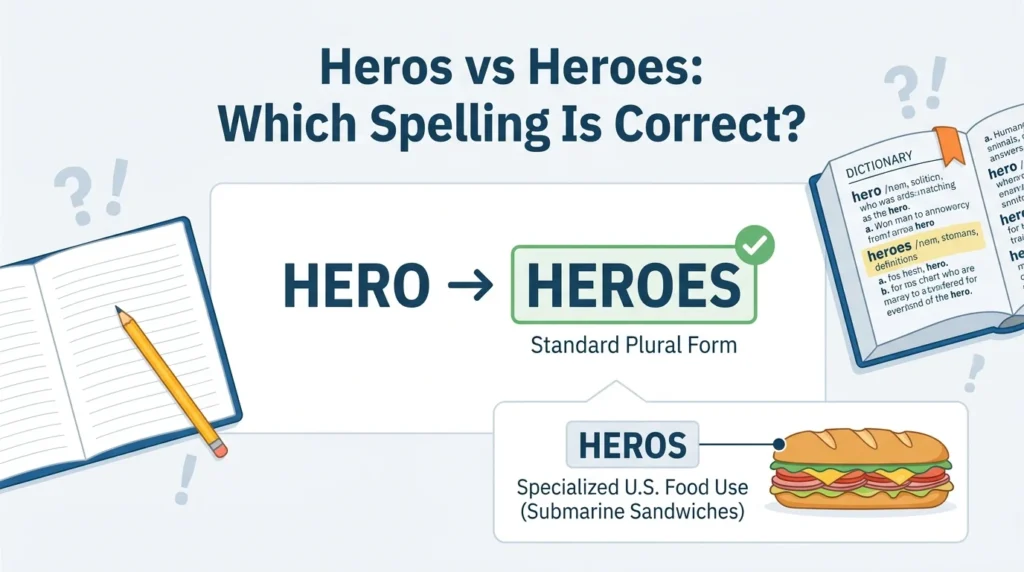

Heroes is the correct plural spelling of hero when you mean two or more brave, admired, or fictional people or characters. For example, “The firefighters were heroes.” Heros is not the standard plural for people. However, heros can appear in U.S. English as a specialized plural for a hero sandwich. So, for ordinary writing, remember: one hero, two heroes.
What Is the Difference Between Heros and Heroes?
The main difference is meaning and standard usage.
Hero is the singular form. It refers to one person or character who is admired for courage, achievement, good qualities, or an important role in a story.
Heroes is the standard plural form. It refers to two or more heroes.
For example:
- One firefighter was a hero.
- Several firefighters were heroes.
- The novel has one main hero.
- The film has several memorable heroes.
Heros is generally not the spelling you want when talking about heroic people or characters.
There is, however, one useful exception to know. In U.S. English, hero can also mean a type of long sandwich, and heros can be used as its plural. The spelling heroes is also used for the sandwich meaning, so the context matters.
For ordinary writing about people, characters, role models, or brave individuals, use heroes.
Why It Matters
A one-letter difference can change whether a sentence looks correct to the reader.
Consider:
The nurses were true heros.
The meaning is understandable, but heros is not the standard spelling for the plural of hero in this sense.
The standard version is:
The nurses were true heroes.
This matters especially in places where spelling creates a strong impression of accuracy:
- School assignments
- University essays
- Business emails
- Professional reports
- Articles and blog posts
- Social media captions
- Books and stories
- Speeches and presentations
- Resumes and personal statements
The mistake is easy to make because many English nouns form their plural simply by adding -s. But English nouns ending in -o do not all follow one universal plural rule.
The Core Rule
When you mean more than one hero, write heroes, not heros.
The basic pattern is:
hero → heroes
Not:
hero → heros
Examples:
- hero → heroes
- superhero → superheroes
- antihero → antiheroes
The extra e is part of the established spelling of the plural.
One important point is that you should not turn this into a universal rule saying that every English word ending in -o takes -es. English has several patterns.
For example:
- potato → potatoes
- tomato → tomatoes
- echo → echoes
But:
- photo → photos
- piano → pianos
- radio → radios
- studio → studios
So the safest approach is to learn the accepted plural form of each word rather than assume that every -o noun behaves identically.
For hero, the standard plural is heroes.
How to Use Hero and Heroes
Use “hero” for one person or character
Use hero when you are talking about a single person or character.
Examples:
The firefighter became a hero after rescuing the child.
She considers her father a hero.
The hero of the novel faces an impossible decision.
My childhood hero was a famous athlete.
The noun is singular, so singular grammar normally goes with it:
The hero is ready.
Not:
The hero are ready.
Use “heroes” for two or more
Use heroes when you are talking about more than one person or character.
Examples:
The firefighters were celebrated as heroes.
The children dressed as superheroes.
The story follows three unlikely heroes.
Nurses became everyday heroes during the crisis.
Because heroes is plural, it normally takes a plural verb:
The heroes are remembered.
Not:
The heroes is remembered.
Use “heroes” after plural words
Words such as many, several, these, those, our, their, and both can introduce a plural noun.
Examples:
Many heroes are never recognized.
Several heroes appear in the final chapter.
These heroes changed the course of the story.
Their heroes inspired them to work harder.
Correct Examples
Here are examples from different types of real writing.
Conversation
“Who are your heroes?” she asked.
We want to thank all the volunteers who became heroes to our community.
School Writing
The essay examines how national heroes are represented in history.
Academic Writing
Literary heroes often reflect the values of the societies in which their stories were created.
Workplace
The emergency response team were the heroes of the day.
News-Style Writing
The rescue workers were praised as heroes after the operation.
Social Media
Not all heroes wear uniforms.
Fiction
The two heroes entered the abandoned city before sunrise.
Sports Writing
The players became local heroes after winning the championship.
Everyday English
My parents have always been my heroes.
Notice that the spelling stays heroes even though the context changes.
Incorrect vs. Correct
| ❌ Incorrect | ✅ Correct | Why |
|---|---|---|
| The firefighters were heros. | The firefighters were heroes. | The standard plural of hero is heroes. |
| Children admire their heros. | Children admire their heroes. | Heroes is the standard plural when referring to admired people. |
| The movie has three heros. | The movie has three heroes. | The plural noun needs the established spelling heroes. |
| They became national heros. | They became national heroes. | More than one hero is heroes. |
| These are my childhood heros. | These are my childhood heroes. | The plural form requires -es. |
| The heros saved the town. | The heroes saved the town. | Heroes is the standard spelling for heroic characters. |
| Many heros appear in the story. | Many heroes appear in the story. | Many requires a plural noun, and the plural is heroes. |
| Our teachers are heros. | Our teachers are heroes. | The standard plural is heroes. |
| The comic book features several heros. | The comic book features several heroes. | Fictional heroes also use heroes. |
| The soldiers returned as heros. | The soldiers returned as heroes. | The word refers to multiple heroic people. |
Why People Make This Mistake
The spelling heros looks logical at first.
That is because one of the most common English plural patterns is simply adding -s:
- book → books
- car → cars
- student → students
- teacher → teachers
A writer may therefore see:
hero + s = heros
The problem is that English plural spelling is not completely predictable.
Read More: Flys vs Flies: Which Spelling Is Correct?
The spelling pattern creates confusion
Several familiar nouns ending in -o do take only -s:
- photo → photos
- piano → pianos
- radio → radios
That makes heros look reasonable.
But other nouns use -es:
- hero → heroes
- potato → potatoes
- tomato → tomatoes
- echo → echoes
So the writer cannot safely apply one rule to every noun ending in -o.
Pronunciation does not help much
In normal speech, heroes and the incorrectly written heros can sound extremely similar to a learner.
That means someone may know the word perfectly well when speaking but hesitate when writing it.
This is a spelling problem rather than a meaning problem.
Autocomplete can reinforce mistakes
Typing quickly on a phone can also create uncertainty.
If you have already typed hero, your brain may automatically expect the simplest plural ending:
hero + s
That does not mean the resulting spelling is standard.
Spellcheck can also be limited. A word may be recognized as a possible word in a specialized context even when it is not the form you intended.
Translation can interfere
Learners whose first language uses a different plural system may naturally expect a regular plural ending.
English has many irregular or historically established plural spellings, so translating the plural pattern directly from another language can produce forms that look logical but are not standard English.
Common Mistakes Checklist
1. Writing “heros” for people
Mistake:
The soldiers were heros.
Why it happens: The writer adds -s automatically.
Avoid it: Remember hero → heroes.
2. Writing “superheros”
Mistake:
The movie contains several superheros.
Correct:
The movie contains several superheroes.
The word superhero contains hero, so its standard plural is superheroes.
3. Confusing “heroes” with “hero’s”
These forms have different grammatical jobs.
Heroes = more than one hero.
The heroes arrived.
Hero’s = something belonging to one hero.
The hero’s shield was damaged.
4. Confusing “heroes” with “heroes’”
Heroes’ is the possessive form used when something belongs to multiple heroes.
The heroes’ journey was difficult.
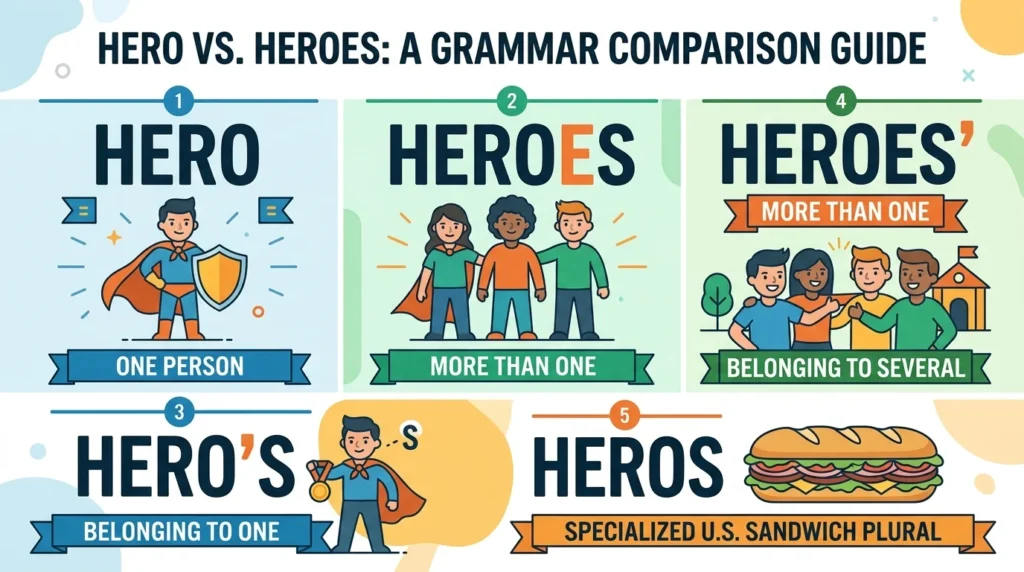
Compare:
- hero = one
- hero’s = belonging to one
- heroes = more than one
- heroes’ = belonging to more than one
5. Assuming every -o noun behaves the same way
Do not memorize a rule such as “all words ending in -o take -es.”
English does not work that neatly.
Instead, learn common plural forms individually.
Heros vs. Heroes in Real English
Heroes for people and characters
When English speakers use hero to mean a brave person, admired individual, role model, or principal character, the standard plural is heroes. This is the form you should use in everyday writing, schoolwork, professional communication, journalism, storytelling, and social media. For example, “The rescue workers were heroes” is standard natural English. Writing heros in this context is normally treated as a spelling error.
Heros in the sandwich sense
There is a specialized U.S. usage that makes heros more interesting. A hero can also mean a long sandwich, especially in American English. In this food sense, dictionaries record heros as a possible plural, alongside heroes. So “The deli sells Italian heros” can be legitimate American English when the writer is talking about sandwiches. The context tells you which meaning is intended.
Heroes can also refer to sandwiches
The spelling heroes is not limited to heroic people. A hero can refer to the sandwich, and heroes can therefore be used as its plural as well. This means the choice is not simply “heroes for people, heros for food.” Rather, heroes is the normal plural in general usage, while heros is a specialized U.S. plural associated with the sandwich meaning.
“Heros” for ordinary heroic people
If you write “The firefighters were heros,” most readers will understand what you mean, but the spelling is not the standard plural for the heroic-person sense. In a school essay, professional document, article, or formal message, use heroes. The specialized sandwich usage does not make heros an alternative spelling for heroic people.
American vs. British English
There is a genuine regional distinction worth knowing because of the sandwich meaning.
For the ordinary meaning of a brave or admired person:
American English: hero → heroes
British English: hero → heroes
There is no standard American/British spelling difference for this plural.
The distinction appears in the sandwich sense. Hero is used in North American English for a type of long sandwich, and specialized U.S. usage can use heros as its plural.
For ordinary writing about people or characters, however, the answer remains simple:
hero → heroes
Formal vs. Informal Usage
For people and fictional characters, heroes is appropriate in both formal and informal English.
You can use it in:
- Academic essays
- Business reports
- News writing
- Speeches
- Emails
- Conversations
- Social media
- Fiction
There is no need to replace heroes with another word simply because the writing is formal.
The specialized spelling heros is different. If it appears in American food-related writing, it refers to the sandwich sense. In formal writing about heroic people, heroes is the appropriate choice.
Hero, Heroes, Hero’s, and Heroes’ Compared
| Form | Meaning | Example |
|---|---|---|
| hero | One hero | He is a hero. |
| heroes | More than one hero | They are heroes. |
| hero’s | Belonging to one hero | The hero’s story was inspiring. |
| heroes’ | Belonging to multiple heroes | The heroes’ stories were inspiring. |
| heros | Specialized U.S. plural of hero in the sandwich sense | The restaurant sells Italian heros. |
The apostrophe forms are especially important because heroes and hero’s are not interchangeable.
Compare:
The heroes entered the building.
This means more than one hero entered.
The hero’s equipment was damaged.
This means the equipment belonged to one hero.
The heroes’ equipment was damaged.
This means the equipment belonged to multiple heroes.
Memory Trick
Use this simple pair:
One hero → two heroes
Think of the extra e as part of the plural:
hero + es = heroes
If you are talking about firefighters, soldiers, rescuers, athletes, fictional characters, role models, or admired people, choose heroes.
A second reminder can help:
The heroes have an E.
That is not a universal rule for every English word ending in -o, but it is an easy way to remember the spelling of hero.
Real-Life Situations
In an interview
“Who were your heroes when you were growing up?”
Here, heroes means the people the speaker admired.
In a meeting
“The support team were the heroes of yesterday’s launch.”
The word refers to multiple people.
In an email
“Thank you to everyone involved. You were all heroes.”
Again, the plural form is heroes.
In a text message
“Those volunteers are absolute heroes.”
Informal writing still uses the same spelling.
In an exam
The question asks you to discuss the heroes of the novel.
Because the sentence refers to more than one character, heroes is correct.
In a restaurant context
“We ordered two Italian heros.”
Here, heros can be legitimate U.S. usage because the word refers to sandwiches rather than heroic people.
The context completely changes the interpretation.
Read More: Smoky vs Smokey: Which Spelling Is Correct?
Mini Quiz
| # | Question | Answer | Explanation |
|---|---|---|---|
| 1 | Choose the correct plural: “The firefighters were ___.” A) heros B) heroes | B) heroes | Heroes is the standard plural when referring to brave people. |
| 2 | Fill in the blank: “The story has several ___.” | heroes | More than one hero requires the plural heroes. |
| 3 | Correct the sentence: “My parents are my heros.” | My parents are my heroes. | The standard plural of hero is heroes. |
| 4 | Which is correct? A) one hero B) one heroes | A) one hero | Hero is singular. |
| 5 | Which is correct? A) two hero B) two heroes | B) two heroes | Two requires a plural noun. |
| 6 | Fill in the blank: “The ___ shield was broken.” A) hero’s B) heroes | A) hero’s | The sentence describes something belonging to one hero. |
| 7 | Correct the sentence: “The heroes story was inspiring.” | The hero’s story was inspiring. | One hero owns the story, so the singular possessive hero’s is needed. |
| 8 | Choose the correct form: “The ___ stories were collected in one book.” A) heroes’ B) hero’s | A) heroes’ | The stories belong to multiple heroes. |
| 9 | In U.S. food-related usage, can “heros” be a valid word? | Yes. | Heros can be a specialized plural for the sandwich sense of hero. |
| 10 | Which spelling should you normally use for multiple heroic people? A) heros B) heroes | B) heroes | Heroes is the standard plural for people and characters. |
Expert Tips
Learn the whole pair
Do not memorize hero alone. Learn it as:
hero → heroes
This makes the plural easier to recall when writing quickly.
Watch compound words
The same spelling carries into compounds:
- superhero → superheroes
- antihero → antiheroes
So if you know hero → heroes, you already know an important part of several related words.
Do not rely only on the -o rule
There is no single rule that perfectly predicts every English plural ending in -o.
Compare:
- hero → heroes
- tomato → tomatoes
- potato → potatoes
- photo → photos
- piano → pianos
When you are uncertain, check the accepted form of the specific word.
Remember the apostrophe difference
Apostrophes can change the meaning:
heroes = more than one hero
hero’s = belonging to one hero
heroes’ = belonging to multiple heroes
This distinction is more important than simply remembering that one spelling contains an extra letter.
Do not “correct” a specialized word automatically
If you see heros in an American restaurant context, do not assume it must be a spelling mistake.
For example:
The deli makes excellent meatball heros.
In that context, heros can be a legitimate specialized plural referring to sandwiches.
The key is to identify the meaning before correcting the spelling.
FAQ
Is “heros” ever correct?
Yes, but only in a specialized context. In U.S. English, heros can be used as a plural of hero when hero means a type of long sandwich. It is not the standard plural for heroic people or characters.
Is “heroes” always the plural of hero?
Heroes is the standard plural in ordinary English and is used for heroic people, admired figures, and fictional characters. It can also be used for the sandwich sense of hero.
Why is the plural “heroes” instead of “heros”?
The established plural form of hero is heroes. English nouns ending in -o have different plural patterns, so there is no universal rule that makes every such noun behave identically.
Is “superheros” correct?
No, when you mean more than one superhero, the standard spelling is superheroes. The plural pattern of hero remains visible in the compound word.
Is “antiheros” correct?
No. The standard plural is antiheroes.
Is “hero’s” the plural of “hero”?
No. Hero’s is a possessive form meaning something belongs to one hero.
For example:
The hero’s costume was damaged.
The plural is:
heroes
What is the plural possessive of hero?
The plural possessive is heroes’.
For example:
The heroes’ costumes were damaged.
The apostrophe comes after the s because the noun is already plural.
Do American and British English spell “heroes” differently?
No. Both use heroes as the ordinary plural of hero. The specialized sandwich usage is more specifically associated with North American English.
Are “heroes” and “heros” pronounced differently?
They can sound very similar, which is one reason the spelling can be confusing. The important distinction is written rather than a reliable difference in ordinary pronunciation.
Is “hero” gender-neutral?
In modern English, hero can refer to a person regardless of gender, although some traditional uses distinguished hero and heroine. Current dictionaries document hero in broader uses, including people admired for achievements or qualities.
Can a fictional character be a hero?
Yes. Hero can refer to an important or principal character in a story, novel, film, or similar work. The plural is heroes.
Which should I use in an essay: “heros” or “heroes”?
Use heroes when referring to multiple heroic people or fictional characters. It is the standard form and is appropriate for academic and formal writing.
Quick Summary
Heroes is the standard plural of hero when you mean two or more brave, admired, or fictional people or characters. The correct spelling is hero → heroes, not hero → heros. This form is used in both American and British English. Heros does have a specialized use in U.S. English, where it can refer to multiple hero sandwiches, so it is not accurate to say that the spelling can never be a real English word. For normal writing, however, choose heroes. Also remember the related forms: hero for one, heroes for more than one, hero’s for one person’s possession, and heroes’ for possession by multiple heroes.