
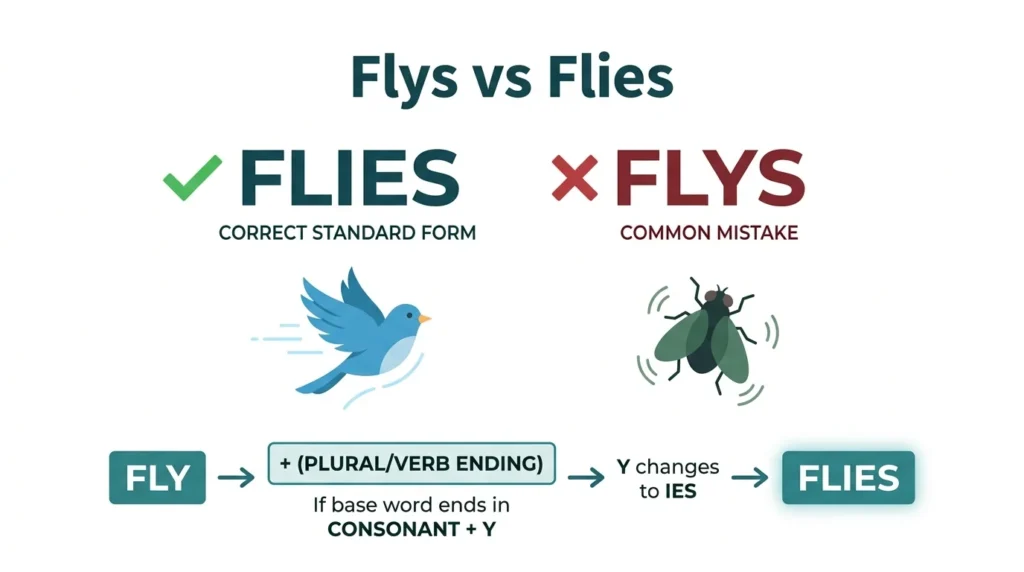

Flies is the standard spelling when you mean more than one fly, or when fly is used with he, she, or it in the present tense. For example, “There are several flies in the room” and “The bird flies over the lake” are correct. Flys is not the standard spelling for these everyday uses. In rare historical or specialized contexts, flys can appear, but ordinary writing should use flies.
What Is the Difference Between Flys and Flies?
The main difference is that flies is the normal standard form, while flys is generally not used for the ordinary plural noun or present-tense verb form.
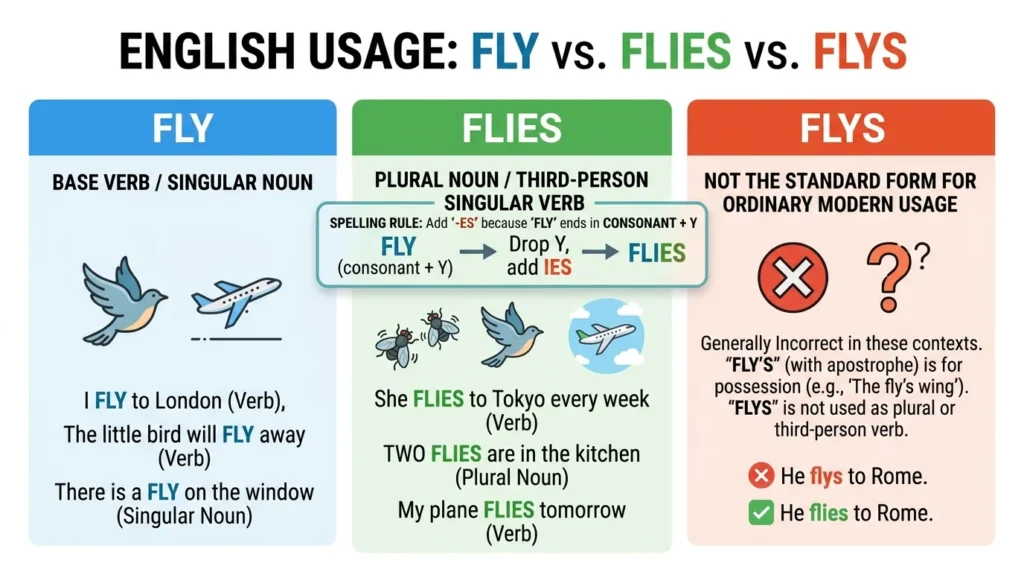
Flies has two especially common grammatical uses:
- It is the plural of the noun fly.
- It is the third-person singular present-tense form of the verb fly.
For example:
- One fly → two flies
- I fly → she flies
- Birds fly → the bird flies
Major learner dictionaries list flies as the plural of fly and give flies as the present-tense form used with he, she, and it.
The spelling flys is therefore not the form you should normally choose in an email, essay, article, school assignment, report, or everyday message.
Why Is Flies Correct?
The spelling flies follows a common English spelling pattern.
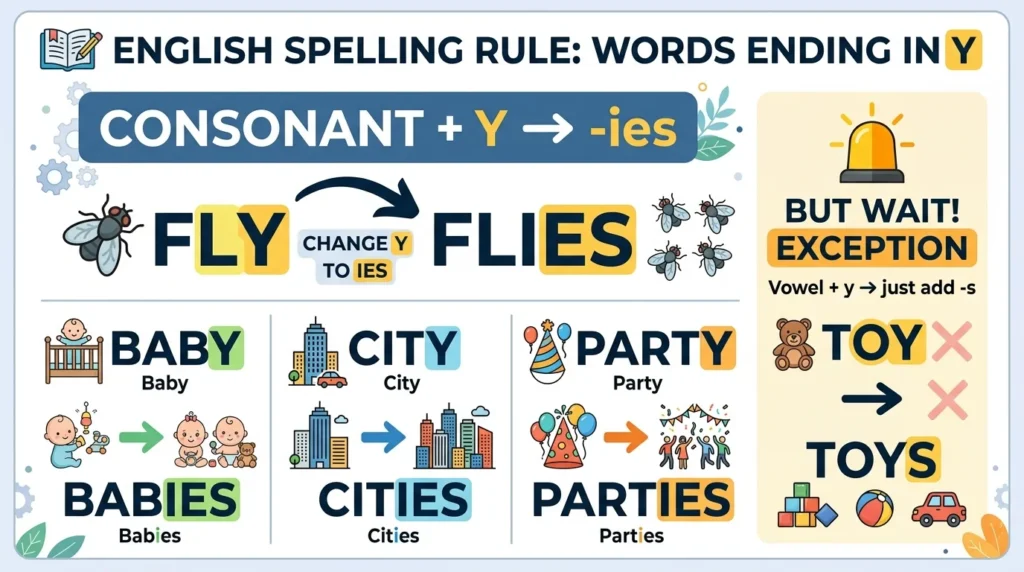
When a singular noun ends in a consonant + y, its regular plural is usually formed by changing the y to i and adding -es.
So:
fly → flies
The same pattern appears in words such as:
- baby → babies
- city → cities
- party → parties
- story → stories
- country → countries
- family → families
The important point is that the spelling depends on the letter immediately before the y.
In fly, the letter before y is l, a consonant. Therefore:
fly + plural ending → flies
By contrast, words ending in a vowel + y normally keep the y and simply take -s:
- boy → boys
- toy → toys
- day → days
- key → keys
- journey → journeys
This distinction explains why flys can look tempting even though it is not the standard plural of fly.
The Core Rule
When a word ends in consonant + y, change y to i and add -es to form the regular plural.
fly → flies
For the verb, fly also becomes flies when the subject is he, she, or it in the simple present.
As a noun
- one fly
- two flies
As a verb
- I fly.
- You fly.
- We fly.
- They fly.
- He flies.
- She flies.
- It flies.
This is why both of these sentences are correct:
Several flies landed on the window.
The bird flies across the garden.
The first flies is a plural noun. The second flies is a verb.
How to Use Flies
Flies as a plural noun
When fly means the insect, its plural is flies.
Examples:
- A fly landed on my desk.
- Two flies were near the window.
- The kitchen was full of flies.
- Several flies gathered around the food.
- The farmer noticed more flies around the animals.
The plural form is not flys.
Oxford lists fly as a countable noun with the plural flies, while Cambridge likewise identifies flies as the plural of fly.
Flies as a verb
Flies is also the simple present form of the verb fly when the subject is third-person singular.
Examples:
- The eagle flies high above the valley.
- She flies to London every summer.
- The plane flies from Dubai to Karachi.
- My brother flies for work every month.
- The butterfly flies from flower to flower.
Compare:
- I fly every month.
- We fly every month.
- They fly every month.
- He flies every month.
The change from fly to flies is a verb-form rule, not a plural noun rule.
Correct Examples
Here are examples from different types of writing and communication.
| Situation | Correct example |
|---|---|
| Conversation | “There are flies in the kitchen.” |
| Text message | “The bird flies really fast.” |
| “The aircraft flies twice a week.” | |
| Workplace | “The machine flies through the inspection process.” |
| School | “Several flies were visible near the window.” |
| Academic writing | “Some species of flies are associated with decaying organic matter.” |
| Social media | “Time flies when you’re having fun.” |
| Travel | “She flies to Istanbul tomorrow.” |
| News writing | “The airline flies to several international destinations.” |
| Creative writing | “A swarm of flies rose from the field.” |
| Everyday speech | “He flies home on Friday.” |
| Description | “The butterfly flies from one flower to another.” |
Notice that flies can represent either a plural noun or a verb. The surrounding sentence tells you which meaning applies.
Incorrect vs. Correct
| ❌ Incorrect | ✅ Correct | Why |
|---|---|---|
| There are three flys outside. | There are three flies outside. | Flies is the plural of fly. |
| The bird flys over the house. | The bird flies over the house. | Flies is the third-person singular form of fly. |
| She flys to Paris tomorrow. | She flies to Paris tomorrow. | The subject she requires flies in the simple present. |
| Time flys when you’re busy. | Time flies when you’re busy. | The subject time is singular, so the verb is flies. |
| Several flys landed on the food. | Several flies landed on the food. | The plural noun is flies. |
| The plane flys every morning. | The plane flies every morning. | A singular subject takes flies. |
| Two flys entered the room. | Two flies entered the room. | The plural of fly is flies. |
| He flys for work every week. | He flies for work every week. | He flies is the correct verb form. |
| I saw several flys near the door. | I saw several flies near the door. | The noun changes from fly to flies. |
| The eagle flys above the mountains. | The eagle flies above the mountains. | The singular subject requires flies. |
The explanation matters because simply memorizing “flys is wrong” does not teach you why the spelling changes.
Why People Make This Mistake
The simple plural rule seems to suggest “flys”
Many English nouns form their plural by adding -s:
- book → books
- car → cars
- house → houses
- toy → toys
A learner may therefore reason:
fly + s = flys
The problem is that English has a different spelling pattern for many words ending in consonant + y.
The word “toys” creates confusion
Compare:
- toy → toys
- boy → boys
- day → days
with:
- fly → flies
- baby → babies
- city → cities
The difference is the letter before y.
Vowel + y → usually add s
Consonant + y → usually change y to ies
Read More: Smoky vs Smokey: Which Spelling Is Correct?
Pronunciation does not solve the spelling
Flies and flys, when someone writes them as intended in the same pronunciation, do not give a learner a useful sound-based distinction.
That means you cannot reliably solve this problem by listening. You need to recognize the spelling pattern and the grammatical role.
Autocomplete can reinforce mistakes
Typing quickly on a phone or computer can create unusual spellings before you notice them. Spell-checking tools can help, but they should not replace understanding.
A useful habit is to stop for one second whenever you hesitate between flys and flies and ask:
Am I talking about more than one fly, or is my subject he, she, or it?
If so, flies is the standard form.
Translation can interfere
Learners whose first language forms plurals or verb endings differently may naturally transfer those patterns into English.
This is one reason apparently simple spelling questions can remain difficult even for advanced English learners.
Common Mistakes Checklist
Mistake 1: Writing “flys” as the plural
❌ “There are many flys in the room.”
✅ “There are many flies in the room.”
Why it happens: The writer applies the general “add s” rule.
How to avoid it: Remember consonant + y → ies.
Mistake 2: Writing “he flys”
❌ “He flys to New York every month.”
✅ “He flies to New York every month.”
Why it happens: The writer knows the base verb fly but forgets its third-person form.
How to avoid it: Learn the basic pattern:
I fly → he flies
Mistake 3: Assuming every word ending in y changes to ies
This is the opposite mistake.
❌ “She studie every night.”
Actually:
✅ “She studies every night.”
But:
✅ “She enjoys music.”
And:
✅ “The boy plays outside.”
Not every word ending in y follows exactly the same pattern. Check whether the letter before y is a vowel or consonant.
Mistake 4: Thinking “flies” only refers to insects
Flies can be a noun, but it can also be a verb.
- “The room has flies.” → noun
- “The bird flies.” → verb
Recognizing the grammatical role makes the word much easier to understand.
Flys vs. Flies in Real English
Grammatically correct and natural
Flies is completely natural when it is the plural of fly or the third-person singular form of fly.
For example, “The plane flies every morning” and “There are flies near the window” are ordinary English sentences. Native speakers do not need a special context to understand either use. These are standard forms in both American and British English.
Grammatically possible but specialized or unusual
The spelling flys can appear outside ordinary modern grammar, particularly in historical or specialized material. For example, historical sources can use flys as a plural of another sense of fly, such as a type of carriage, and specialized terminology can produce forms that are not part of everyday English.
That does not make flys an appropriate replacement for flies in ordinary sentences.
Natural everyday English
If you are writing a normal sentence about insects, flying, aircraft, birds, or the passage of time, use flies when the grammar requires it.
Natural:
- “Time flies.”
- “She flies home tomorrow.”
- “The bird flies over the lake.”
- “There are flies in the kitchen.”
Not natural standard usage:
- “Time flys.”
- “She flys home tomorrow.”
- “The bird flys over the lake.”
- “There are flys in the kitchen.”
This distinction is important because a word can exist in a specialized historical context without being the normal choice for today’s everyday writing.
American vs. British English
There is no meaningful American-versus-British spelling difference between “flys” and “flies” in the ordinary uses covered by this article.
Both varieties use:
- fly → flies for the plural noun
- fly → flies for the third-person singular present-tense verb
There are other meanings of fly where British and American English may differ in usage. For example, Oxford notes a British use of flies for the opening at the front of trousers, while American English commonly uses fly for that sense.
But this does not change the answer to the main spelling question:
Use flies, not flys, in ordinary English.
Read More: Treet vs Treat: Which Spelling Is Correct?
Formal vs. Informal Usage
The standard form flies works in both formal and informal English.
Formal writing
Use flies in:
- academic papers
- reports
- business documents
- professional emails
- school assignments
- examinations
Example:
The species of flies examined in the study were collected from several locations.
Informal writing
The same spelling applies in:
- text messages
- social media
- conversations
- personal emails
Example:
Time flies!
There is no need to switch to flys in informal writing. Informality does not change this spelling rule.
Comparison Table
| Feature | Fly | Flies | Flys |
|---|---|---|---|
| Singular noun meaning one insect | ✅ Yes | ❌ No | ❌ No |
| Plural noun meaning more than one insect | ❌ No | ✅ Yes | ❌ Standardly no |
| Base verb | ✅ Yes | ❌ No | ❌ No |
| Third-person singular verb | ❌ No | ✅ Yes | ❌ Standardly no |
| “I fly” | ✅ Yes | ❌ No | ❌ No |
| “She flies” | ❌ No | ✅ Yes | ❌ No |
| “Two flies” | ❌ No | ✅ Yes | ❌ No |
| Ordinary formal writing | ✅ Where grammatically appropriate | ✅ Where grammatically appropriate | ❌ Avoid |
| Ordinary informal writing | ✅ Where grammatically appropriate | ✅ Where grammatically appropriate | ❌ Avoid |
| Historical/specialized appearances | Possible | Yes | Possible in limited contexts |
The key distinction is that fly, flies, and flys should not be treated as three interchangeable spellings.
Fly, Flies, Flew, Flown, and Flying
Another source of confusion is the fact that the verb fly has several different forms.
| Form | Example |
|---|---|
| Base form | Birds fly south. |
| Third-person singular | The bird flies south. |
| Past tense | The bird flew south. |
| Past participle | The bird has flown south. |
| -ing form | The bird is flying south. |
The standard verb forms listed by Oxford are fly, flies, flew, flown, and flying.
So if you are looking for the present-tense form after he, she, or it, the answer is flies.
Memory Trick
Use the baby rule:
baby → babies
Now apply the same spelling pattern:
fly → flies
Think:
Baby changes y to ies. Fly does too.
You can also remember the shorter formula:
Consonant + Y → IES
So:
FLY → FLIES
Not:
FLY → FLYS
Real-Life Situations
In a meeting
“The company flies its sales team to the regional offices every month.”
Because company is singular, the verb is flies.
In an email
“She flies to Dubai on Thursday, so she will join the meeting remotely.”
Because she is singular, use flies.
In a text message
“Time flies! I can’t believe it’s already Friday.”
Here, flies is the verb.
In an exam
“The plural form of fly is flies.”
The spelling follows the consonant + y pattern.
In a school assignment
“Several flies were observed near the food.”
Here, flies is the plural noun.
In everyday conversation
“The bird flies across the garden every morning.”
Again, flies is the third-person singular verb.
Read More: Their vs Thier: Which Spelling Is Correct?
Expert Tips
Look at the subject before choosing the verb
If you are using fly as a verb, check the subject.
- I fly
- You fly
- We fly
- They fly
- He flies
- She flies
- It flies
This prevents the common mistake of writing he flys.
Look at the number before choosing the noun
If fly is a noun, ask whether you mean one or more than one.
- one fly
- several flies
Don’t rely only on “add s”
The “add s” rule works for many English words, but spelling rules interact with word endings.
For words such as fly, the correct plural is flies.
Don’t treat every unusual dictionary form as everyday English
English contains historical spellings, specialized terminology, proper names, and uncommon senses. A form appearing somewhere does not automatically make it the appropriate choice for ordinary writing.
That is particularly useful when deciding whether an unusual form such as flys should replace the familiar standard flies.
Remember that context determines the grammatical role
Compare:
“The flies are annoying.”
Here, flies is a plural noun.
“The bird flies every morning.”
Here, flies is a verb.
The spelling is identical, but the grammar is different.
Quick Summary
Flies is the standard spelling you normally need when writing about more than one fly or using fly as the present-tense verb with he, she, or it. The plural noun is fly → flies, while the verb changes from fly → flies in the third-person singular. The spelling follows the common consonant + y pattern, in which y changes to i before -es. Flys is not the standard form for these everyday uses, although it can appear in rare historical or specialized contexts. For schoolwork, professional writing, emails, articles, and everyday English, choose flies whenever the grammar calls for it.
FAQ
Is “flys” a correct word?
Not for the ordinary plural of fly or the third-person singular form of the verb fly. Flies is the standard form. Rare historical or specialized uses of flys can be found, so it is more accurate to call it nonstandard for ordinary modern usage rather than claiming that the letter sequence can never occur.
Is it “two flys” or “two flies”?
It is two flies. The plural of the noun fly is flies.
Is it “he flys” or “he flies”?
It is he flies. Flies is the third-person singular present-tense form of the verb fly.
Is it “she flys” or “she flies”?
It is she flies.
For example:
She flies to Karachi every Friday.
The subject she requires the third-person singular form flies.
Is “time flys” correct?
No. The standard expression is:
Time flies.
Here, time is a singular subject, so the verb takes the third-person singular form flies. The expression “time flies” is also an established English saying meaning that time seems to pass quickly.
Why does fly become flies?
Because fly ends in a consonant + y. In the regular plural pattern, the y changes to i and -es is added:
fly → flies
The same pattern appears in words such as baby → babies and city → cities.
What is the plural of fly?
The standard plural is flies.
one fly
two flies
Both Oxford and Cambridge list flies as the plural of fly.
What is the past tense of fly?
The usual past tense is flew.
The bird flew over the house.
The past participle is flown:
The bird has flown away.
Oxford lists flew and flown among the main forms of the verb fly.
Is “flies” only used for insects?
No. Flies can also be a verb.
The plane flies every morning.
It can also have other noun meanings in specific contexts. For example, dictionaries record flies in connection with the opening of trousers in British English and the space above a theatre stage.
Is there a difference between American and British spelling?
Not for the ordinary uses discussed here. Both American and British English use flies as the plural of fly and as the third-person singular form of the verb.
Can “flys” ever appear in English?
Yes, but this requires qualification. Historical sources include flys as a plural of a particular older sense of fly, and specialized or proper-name contexts can also produce unusual spellings. That does not make flys the standard spelling for ordinary modern sentences such as “two flies” or “she flies.”
Mini Quiz
| # | Question | Answer | Explanation |
|---|---|---|---|
| 1 | Choose the correct form: “There are three ___ on the wall.” A) flys B) flies | B) flies | Flies is the plural of fly. |
| 2 | Fill in the blank: “She ___ to London every month.” | flies | She is third-person singular, so the verb is flies. |
| 3 | Correct the sentence: “The bird flys over the lake.” | The bird flies over the lake. | A singular subject takes flies in the simple present. |
| 4 | Which is correct? A) two flys B) two flies | B) two flies | The plural noun is flies. |
| 5 | Fill in the blank: “I ___ to Islamabad tomorrow.” | fly | With I, use the base form fly, not flies. |
| 6 | Correct the sentence: “Time flys when you’re having fun.” | Time flies when you’re having fun. | Time is singular, so the verb is flies. |
| 7 | Which sentence is correct? A) He flys every Friday. B) He flies every Friday. | B) He flies every Friday. | He requires the third-person singular form flies. |
| 8 | Fill in the blank: “One fly, two ___.” | flies | The plural changes y to i and adds -es. |
| 9 | Is “flys” the standard plural of fly? | No | The standard plural is flies. |
| 10 | Which form is correct? “The eagle ___ above the mountains.” A) fly B) flies C) flys | B) flies | The eagle is singular, so the present-tense verb is flies. |