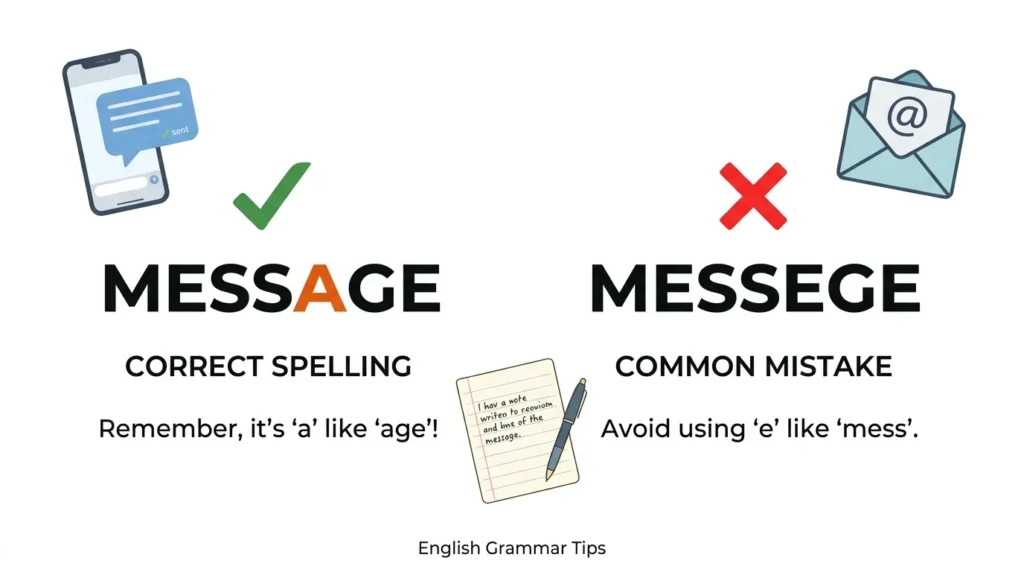

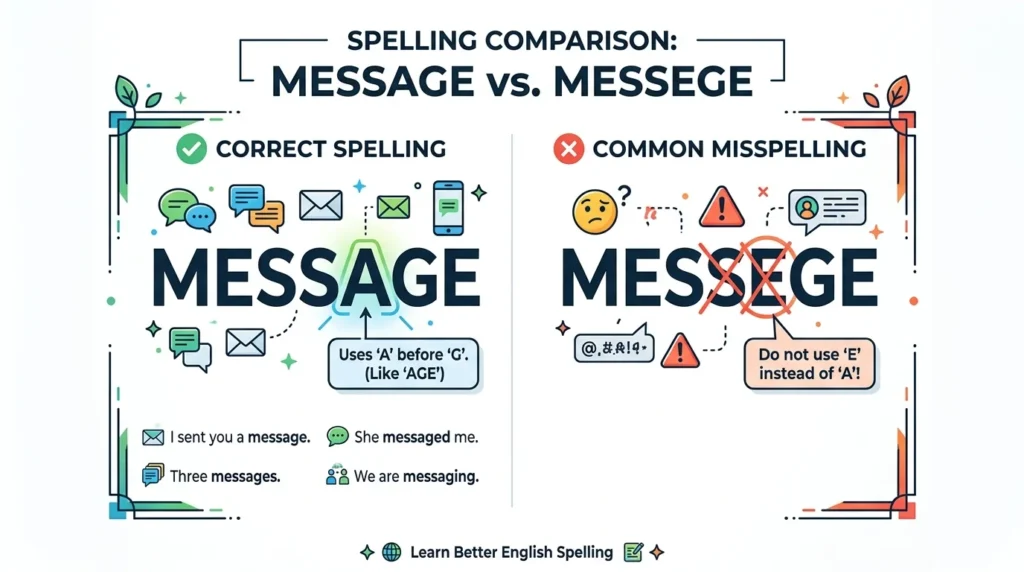
Message is the correct spelling. Messege is incorrect in standard English. If you mean a piece of information communicated to someone, always write message, with a before g: m-e-s-s-a-g-e. The confusion usually comes from pronunciation because the word does not sound exactly the way its letters look. The same spelling is used in standard American and British English.
What Is Message?
Message is a noun that commonly refers to information communicated from one person or group to another. It can be written, spoken, recorded, or sent electronically.
For example:
- “I received your message.”
- “She left a message on my phone.”
- “Please give him this message.”
- “I sent you a message yesterday.”
The word can also refer to the main idea that a book, movie, speech, advertisement, or other work communicates.
For example:
The main message of the book is that honesty matters.
In modern English, message can also be a verb. In that use, it means to send someone a message, especially electronically.
Message me when you arrive.
She messaged her manager about the meeting.
Cambridge Dictionary records both the noun and verb uses of message.
Why It Matters
A spelling mistake may seem minor when you are typing a quick text. However, message is used in almost every type of everyday writing.
You may need the word in:
- Emails
- School assignments
- Exams
- Business communication
- Job applications
- Social media posts
- Customer service messages
- Websites
- Reports
- Academic writing
If you write messege instead of message, readers will usually understand what you mean. The problem is that messege is not the standard spelling.
In casual texting, a single spelling error may pass unnoticed. In a professional email, application, report, or public-facing website, repeated spelling mistakes can make the writing look less carefully edited.
The important distinction is therefore simple: the meaning is usually clear, but the spelling is still incorrect.
Read More: Programming vs Programing: Which Spelling Is Correct?
The Core Rule
Use MESSAGE when you mean information that is communicated to someone. Never use MESSEGE as the standard spelling.
Remember the letters:
M-E-S-S-A-G-E
The important point of confusion is the A:
message ✅
messege ❌
There is no American-English or British-English spelling rule that changes message into messege. The standard spelling remains message.
How to Use Message
Message as a noun
When message refers to information or communication, it is a noun.
Examples:
I received your message.
She left a message for her brother.
The message was very clear.
We have three new messages.
The plural is messages, not messeges.
Message as a verb
Message can also describe the action of sending someone a message.
Examples:
Message me when you get home.
I messaged Sarah yesterday.
He is messaging his colleague now.
The standard forms are:
message → messaged → messaging
Cambridge Dictionary lists the electronic communication sense of the verb message.
Message as the main idea
The word can also describe the central idea communicated by something.
The message of the film is about forgiveness.
The speaker’s message was easy to understand.
The advertisement has a simple message.
This meaning is different from a text message, but the spelling is exactly the same.
Correct Examples
Here are examples from different types of everyday writing.
Conversation
Did you get my message?
This is a natural way to ask whether someone received information you sent or gave them.
Thank you for your message. I will review the document and reply tomorrow.
Here, message refers to the communication the writer received.
School
The teacher’s message was clear, so everyone understood the assignment.
Here, the word refers to information communicated by the teacher.
Workplace
I received your message about the client meeting.
This is suitable for professional communication.
Social media
Thanks for your message. I’ll get back to you soon.
The word works naturally in informal digital communication.
Academic writing
The central message of the novel is the importance of personal responsibility.
Here, message means the main idea communicated by the work.
Texting
Message me when you’re outside.
Here, message is a verb.
Customer service
We received your message and will respond shortly.
The word refers to communication received by the company.
Personal communication
Your message made my day.
Here, the word refers to something another person wrote or communicated.
Public communication
The campaign delivered a clear message to its audience.
Here, message means the main idea being communicated.
Incorrect vs. Correct
| ❌ Incorrect | ✅ Correct | Why |
|---|---|---|
| I sent you a messege. | I sent you a message. | Messege is a misspelling of the standard word message. |
| Did you get my messege? | Did you get my message? | The noun is spelled with a before g. |
| Please leave a messege. | Please leave a message. | The standard spelling is message. |
| She sent me two messeges. | She sent me two messages. | The plural is formed from message, giving messages. |
| He messeged me yesterday. | He messaged me yesterday. | The past-tense verb is messaged. |
| Please messege me later. | Please message me later. | Message can function as a verb. |
| I read your messege this morning. | I read your message this morning. | The communication itself is a message. |
| Your messege was helpful. | Your message was helpful. | The spelling does not change because the context is informal. |
| The story has an important messege. | The story has an important message. | Message can mean the central idea of a story. |
| We were messageing all evening. | We were messaging all evening. | The standard -ing form is messaging. |
Why People Make This Mistake
Phonetic similarity
One major reason is that people sometimes spell a word according to how they hear it.
The pronunciation of message does not clearly tell you that the written form contains a before g. Cambridge gives the pronunciation as approximately /ˈmes.ɪdʒ/ in both British and American English.
When people hear the ending, they may remember the sound but not the exact spelling.
That can lead to:
message → messege
The problem is not meaning. It is the connection between pronunciation and written form.
Spelling overlap
The two forms look extremely similar:
message
messege
Only one vowel changes.
Because the rest of the letters are identical, the incorrect version can look surprisingly familiar when you read it quickly.
Overgeneralisation
English spelling contains many patterns, but they do not always work consistently.
A learner may remember other words containing -ege or assume that an unstressed vowel can be written either way. That assumption does not apply here.
The standard spelling is fixed:
message
Autocomplete and spell-check limits
Spell-checking tools are useful, but they should not replace knowledge of common words.
Different keyboards, applications, dictionaries, and language settings can behave differently. A writer should still recognize the correct form independently.
If you know that the word is message, you can catch the error before sending the text.
Translation interference
English learners who think first in another language may sometimes transfer a familiar spelling or sound pattern into English.
This is especially common with words whose pronunciation does not make their spelling obvious.
The best solution is to learn the written English form as a complete unit:
message
rather than trying to reconstruct its spelling from pronunciation each time.
Read More: Receive vs Recieve: Correct Spelling and Examples.
Common Mistakes Checklist
Mistake 1: Writing “messege”
What happens: The writer replaces a with e.
Why: The pronunciation does not make the spelling obvious.
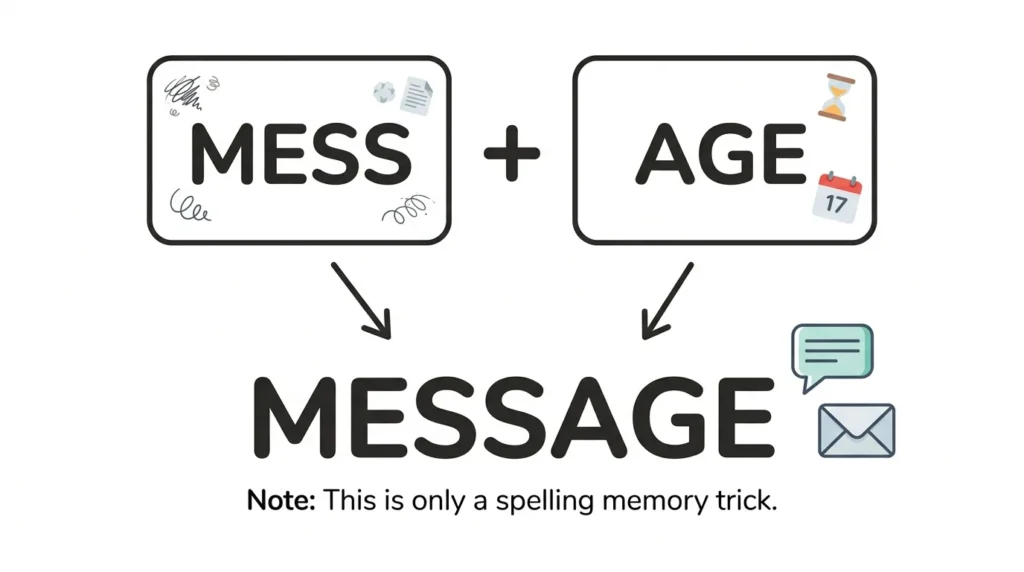
Avoid it: Memorize message as mess + age.
Mistake 2: Writing “messeges”
What happens: The spelling error is carried into the plural.
Why: The writer adds s to the already incorrect form.
Avoid it: Start from the correct singular:
message → messages
Mistake 3: Writing “messeged”
What happens: The incorrect spelling is used before -ed.
Why: The writer remembers the sound of the base word rather than its written form.
Avoid it: Remember:
message → messaged
Mistake 4: Writing “messageing”
What happens: The writer keeps the final e before adding -ing.
Why: The writer may apply a spelling pattern incorrectly.
Correct form: messaging
Mistake 5: Assuming “messege” is informal English
What happens: A writer believes that the spelling might be acceptable in texts or casual communication.
Why: Informal online writing contains many nonstandard spellings.
Avoid it: Informality can change vocabulary, tone, and sentence structure, but messege is still not the standard spelling of message.
Message in Real English
Grammatically correct
Message is grammatically correct as both a noun and a verb. As a noun, it can refer to information communicated to someone or to the central idea communicated by a work. As a verb, it can mean sending someone a message, especially through electronic communication. Examples such as “I received your message” and “Message me later” are both standard English constructions.
Grammatically possible but unnatural
The word message itself is not unnatural, but some sentences containing it may be less natural when another word gives the intended meaning more precisely. For example, “Send me a message by email” is understandable, but “Send me an email” may be more direct if the medium is the important point. Good English is not only about grammatical correctness; it is also about choosing the clearest word for the situation.
Natural everyday English
In everyday English, message is extremely flexible. People commonly talk about receiving, sending, reading, deleting, replying to, or responding to messages. The word also works naturally as a verb in digital communication: “Message me when you arrive.” The important point is that casual communication does not create an alternative spelling. Even in a quick text, the standard form remains message.
American vs. British English
There is no spelling difference between American and British English for this word.
Both use:
message
Both also use:
messages
messaged
messaging
Cambridge lists the pronunciation of message as /ˈmes.ɪdʒ/ for both UK and US English.
So you do not need to choose between message and messege based on location.
The answer is the same in both varieties:
message ✅
Formal vs. Informal Usage
Message works in both formal and informal English.
Informal
Message me when you get home.
I got your message.
Professional
Thank you for your message regarding the meeting.
We received your message and will respond within two business days.
Academic
The central message of the article concerns social responsibility.
The spelling never changes.
However, the verb use of message is especially common in modern digital communication and can sound more conversational than alternatives such as “contact” or “send a written communication.”
The issue is therefore not whether message is formal or informal. The issue is choosing the right meaning and register for your sentence.
Comparison Table
| Feature | Message | Messege |
|---|---|---|
| Standard English spelling | ✅ Yes | ❌ No |
| Standard dictionary word | ✅ Yes | ❌ No |
| Meaning | Communication or communicated idea | No standard meaning |
| Noun | ✅ Yes | ❌ No |
| Verb | ✅ Yes | ❌ No |
| Plural | Messages | — |
| Past-tense verb | Messaged | — |
| -ing form | Messaging | — |
| American English | Message | ❌ |
| British English | Message | ❌ |
| Formal writing | Appropriate | Incorrect |
| Informal writing | Appropriate | Incorrect |
| Academic writing | Appropriate | Incorrect |
Message vs. Other Related Words
The spelling problem becomes easier to understand when you separate message from similar communication words.
| Word | Typical meaning |
|---|---|
| Message | Information communicated to someone |
| Text | A written digital message, especially by phone |
| A message sent through email | |
| Notification | An alert telling you that something has happened |
| Announcement | Information made known to a group or the public |
| Statement | A particular expression of information, opinion, or position |
| Note | A short written communication |
For example, an email can contain a message, but the email itself is the medium through which that message is delivered.
Memory Trick
Use this simple visual trick:
MESS + AGE = MESSAGE
Look at the final four letters:
AGE
Now compare:
messAGE ✅
messeGE ❌
The phrase mess + age is only a spelling mnemonic. It is not meant to explain the word’s historical origin.
When you hesitate, write:
M-E-S-S-A-G-E
Then check for the A.
Real-Life Situations
In a job interview
“I received your message about the interview time.”
Here, message is a noun referring to information received from someone.
In a meeting
“Did anyone receive a message from the client?”
Again, message is a noun.
In an email
“Thank you for your message. I appreciate the update.”
This is a natural professional use.
In a text message
“Message me when you arrive.”
Here, message is a verb.
In an exam
“The main message of the poem is the importance of courage.”
Here, message refers to the central idea of the poem.
On social media
“Send me a message if you are interested.”
This is ordinary digital communication.
In customer service
“We have received your message and will contact you shortly.”
Here, the company is acknowledging a communication.
Read More: Rumor vs Rumour: Which Spelling Is Correct?
Expert Tips
Learn the word visually
Do not rely only on pronunciation. Store the complete spelling in your memory:
message
Learn the word family together
Instead of memorizing only one word, remember:
message → messages → messaged → messaging
This helps prevent the same spelling mistake from appearing in different forms.
Check the vowel before “g”
If you see:
messege
stop and check it.
The standard spelling is:
message
Do not assume informal writing changes the spelling
Texting may contain abbreviations and slang, but messege is not a standard informal alternative to message.
Read important writing once more before sending it
A five-second spelling check can catch mistakes that automatic correction misses.
Read More: Authorization vs Authorisation: Which Is Correct?
Learn meaning as well as spelling
Knowing what message means makes it easier to recognize the correct word in different contexts.
It can mean:
- Information communicated to someone.
- A digital or written communication.
- The central idea communicated by something.
- The act of sending a message when used as a verb.
Quick Summary
Message is the correct spelling, while messege is a misspelling. Use message when referring to information communicated through speech, writing, email, text, voicemail, or another medium. The word can also describe the central idea of a book, film, speech, or advertisement. In modern English, message works as both a noun and a verb: “I received your message” and “Message me later.” The spelling is the same in standard American and British English. A useful memory trick is mess + age = message. If you are unsure, focus on the a before g: message, never messege.
FAQ
Is “message” or “messege” correct?
Message is correct. Messege is a misspelling and should not be used as the standard spelling of the word.
What does “message” mean?
A message is information communicated from one person or group to another. It can also mean the main idea communicated by a book, film, speech, advertisement, or similar work.
Is “messege” a real English word?
No. Messege is not the standard spelling of the English word message. When you see messege, it normally represents a spelling mistake.
Why do people spell message as messege?
The main difficulty is that pronunciation does not make every letter obvious. The vowel in the written form is easy to misremember, especially when someone is writing quickly or spelling from sound.
Is “message” a noun or a verb?
It can be both. As a noun, it means a piece of communication or a communicated idea. As a verb, it means to send someone a message, especially electronically.
What is the plural of message?
The plural is messages.
Correct:
I have three messages.
Incorrect:
I have three messeges.
What is the past tense of message?
The past tense is messaged.
She messaged me yesterday.
Is “messaging” correct?
Yes. Messaging is the standard -ing form.
We were messaging all evening.
Cambridge also uses messaging for the process of sending messages through phones or computers.
Is message spelled differently in British English?
No. The standard spelling is message in both British and American English. Cambridge gives the same basic pronunciation for both varieties.
Can I use “message” in academic writing?
Yes. Message is appropriate in academic writing when you mean an idea or meaning communicated by a text, speech, study, or other work.
The article communicates an important message about social responsibility.
Is “message me” grammatically correct?
Yes. Message can be used as a verb.
Message me when you arrive.
This is particularly common in digital communication.
Mini Quiz
| # | Question | Answer | Explanation |
|---|---|---|---|
| 1 | Choose the correct spelling: “I received your ___.” A) messege B) message | B) message | Message is the standard spelling. |
| 2 | Fill in the blank: “Please send me a ___.” | message | The noun referring to the communication is message. |
| 3 | Correct the sentence: “She sent me a messege.” | She sent me a message. | Replace messege with message. |
| 4 | Which is correct? A) messages B) messeges | A) messages | The plural of message is messages. |
| 5 | Fill in the blank: “___ me when you get home.” | Message | Here message is being used as a verb. |
| 6 | Which is correct? A) messaged B) messeged | A) messaged | The past-tense form is messaged. |
| 7 | Correct the sentence: “We were messageing all night.” | We were messaging all night. | The standard -ing form is messaging. |
| 8 | Which spelling is used in both American and British English? A) message B) messege | A) message | There is no standard regional spelling change here. |
| 9 | Fill in the blank: “The novel has a powerful ___.” | message | Here message means the central idea communicated by the novel. |
| 10 | Correct the sentence: “Did you get my messege?” | Did you get my message? | Messege is a spelling error; message is correct. |
Final Takeaway
When you are choosing between message and messege, there is no difficult grammar rule to apply.
Just remember:
MESSAGE = correct
MESSEGE = incorrect
The letter that causes the confusion is A:
M-E-S-S-A-G-E
Once you learn that spelling, the related forms become easier:
message → messages → messaged → messaging
And the same standard spelling works whether you are writing a text, an email, a school assignment, a business report, or an academic paper.