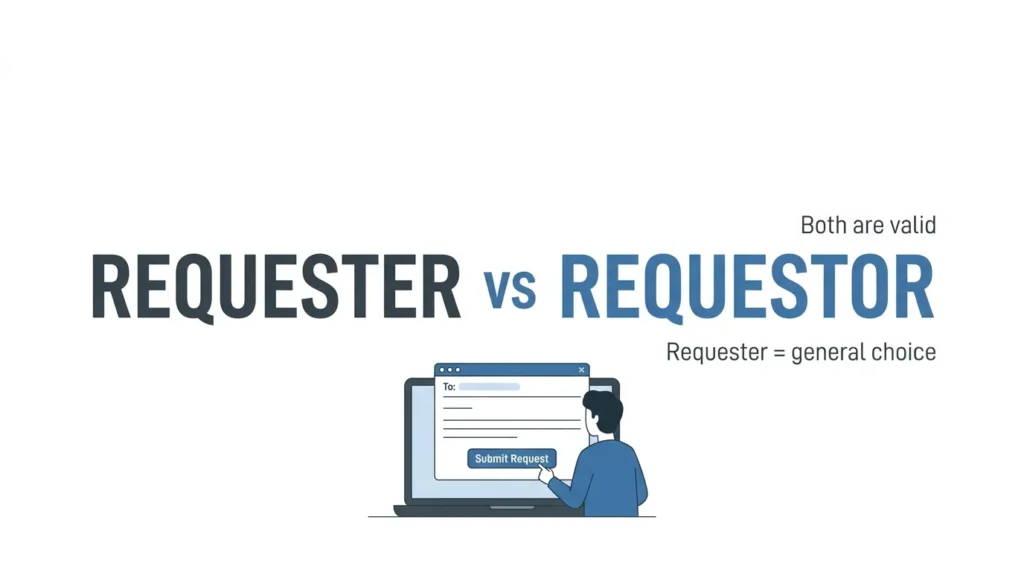

If you are unsure whether to write requester or requestor, the good news is that both are valid English words. Both refer to a person or entity that makes a request. Requester is the clearer general-purpose choice for most everyday, professional, and academic writing. Requestor is also established English, but it is less common and may appear in particular legal, administrative, or technical contexts.
What Is the Difference Between Requester and Requestor?
Requester and requestor are nouns formed from the verb request. They identify the person, organization, or other entity making a request.
For example:
The requester submitted the form yesterday.
You could also write:
The requestor submitted the form yesterday.
The basic meaning remains the same.
The main difference is usage and spelling preference, not a fundamental difference in meaning. Cambridge gives requestor as another form of requester, while Collins lists requestor as a rare spelling of requester. (Cambridge Dictionary)
So this is not a simple correct vs. incorrect spelling problem.
Requester
Requester means a person or entity that makes a request.
Examples include someone who asks for:
- information
- permission
- access
- assistance
- a document
- a service
- an explanation
- approval
Example:
The requester asked for access to the report.
Requestor
Requestor has essentially the same basic meaning.
Example:
The requestor must provide the required information.
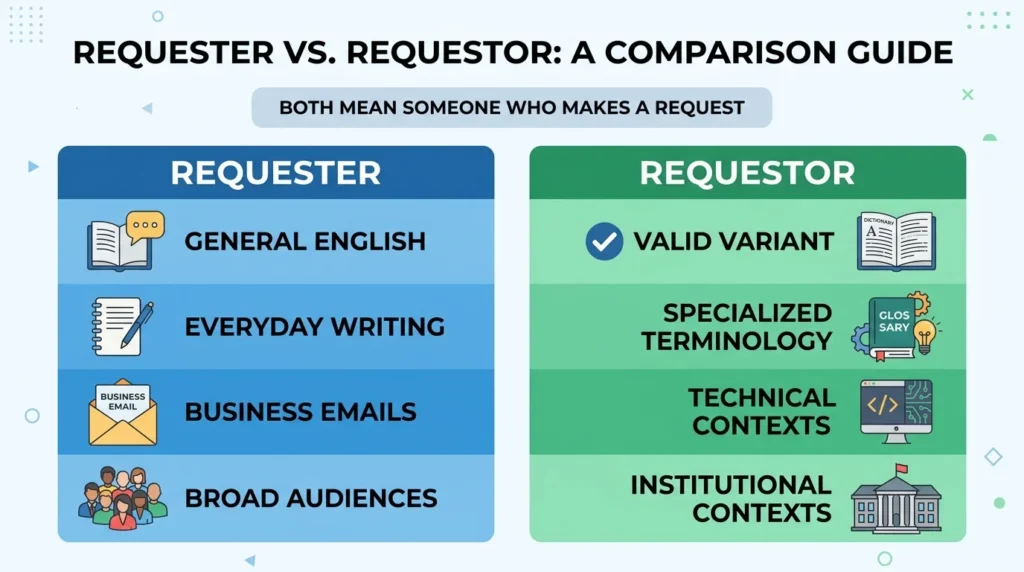
It is a legitimate English form, but it is less familiar to many general readers. It can also occur in specialized terminology, where an organization, legal document, software system, or technical process has adopted that spelling.
The important point is that the ending -or does not automatically give the word a different meaning.
Why It Matters
Choosing between these forms rarely changes the meaning of a sentence, but word choice still matters in professional writing.
A reader may encounter requestor in a technical system and understand it perfectly. In ordinary communication, however, requester may feel more familiar because it follows the common pattern of forming a noun with -er.
This matters when you are writing:
- a business email
- a website
- a customer-support message
- an academic paper
- an application
- a report
- instructions for general readers
- public-facing content
The goal is not to make requestor disappear. The goal is to understand when each form makes sense.
The Core Rule
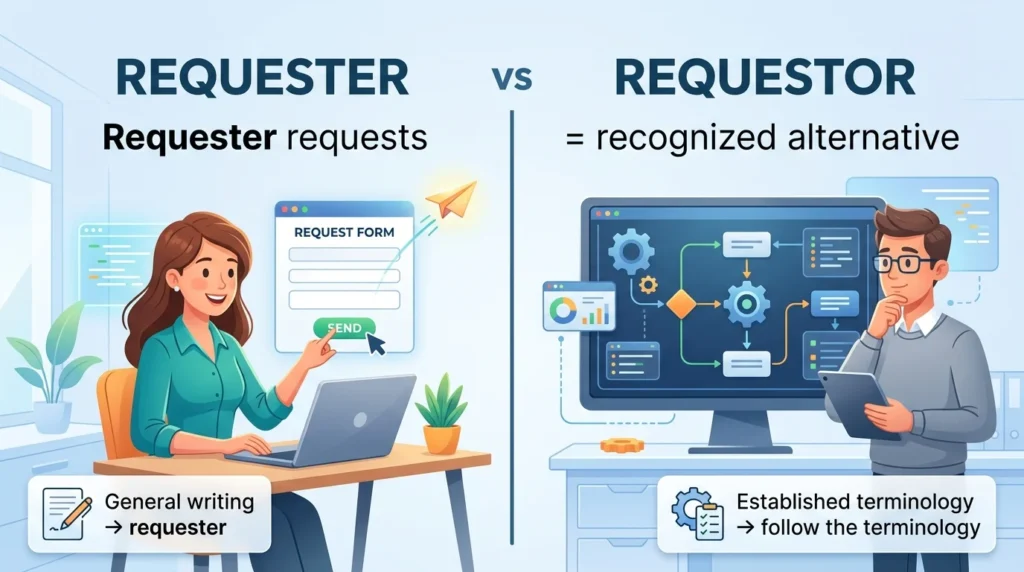
Use “requester” as your general-purpose spelling when you mean someone who makes a request. Use “requestor” when it is the established terminology of the context, organization, document, or system you are working with.
There is no general grammar rule saying that requestor is incorrect. Both forms are recognized in English.
If you are writing a normal email and have no reason to follow a specific terminology, requester is the straightforward choice.
If a software platform consistently labels a role Requestor, changing it to Requester may create unnecessary inconsistency.
How to Use Requester and Requestor
Use “requester” in general writing
When you are writing for a broad audience, requester is a clear and familiar choice.
The requester will receive an email confirmation.
Please contact the requester for additional information.
The requester asked for a copy of the contract.
We notified the requester about the delay.
This works naturally in business, education, customer service, and ordinary communication.
Use “requestor” when established terminology calls for it
Sometimes a particular organization or system already uses requestor.
For example, a software workflow might contain labels such as:
Requestor ID
Requestor Details
Requestor Approval
If those are the official labels in the system, preserving the existing terminology can be more useful than changing the spelling simply because requester is more familiar.
The same principle applies to a legal, administrative, technical, or institutional document: follow the terminology already established by the relevant system or organization when consistency matters.
Do not assume “-or” means more formal
English has many nouns ending in -or, such as creator, editor, and operator. It also has many nouns ending in -er, such as writer, teacher, and worker.
That does not create a universal rule that -or = formal and -er = informal.
Therefore, it would be misleading to say that requestor is automatically the “formal” version of requester.
Context determines register.
Correct Examples
Here are examples showing how the two forms work in real situations.
1. Workplace email
The requester has provided all the documents we need.
2. Customer service
We will contact the requester once the refund has been processed.
3. Business report
The requester submitted the application before the deadline.
4. Academic writing
The requester must provide sufficient evidence to support the claim.
5. School administration
The requester should complete the permission form.
6. Technical documentation
The system records the identity of the requestor for each transaction.
7. Software interface
The requestor must authenticate before accessing the service.
8. Formal administrative process
The requestor is responsible for supplying the required information.
9. Social media
The requester asked whether the company could share the full report.
10. Internal workflow
The system sends an automatic notification to the requester when the request is approved.
Notice that the meaning remains understandable in all these examples. The choice is primarily about usage, terminology, and consistency.
Incorrect vs. Correct
Because both spellings are legitimate, some “incorrect” examples need an important qualification: using requestor is not automatically a spelling error. The problem occurs when a writer treats one spelling as universally required or changes established terminology without a reason.
| ❌ Incorrect | ✅ Correct | Why |
|---|---|---|
| The requestor is always wrong. | The requestor is a valid variant of requester. | Both forms are recognized English words. |
| The requester is the only possible spelling. | The requester is the common general-purpose choice. | Requestor is also a recognized form. |
| Please use requestor because it is more formal. | Use requestor when it is appropriate to the established terminology. | The -or ending does not automatically make a word more formal. |
| Our system calls the role “Requester,” so we randomly changed it to “Requestor.” | Keep the system’s established spelling consistent. | Terminology should normally remain consistent. |
| Our software uses “Requestor,” so the word must be grammatically superior. | Our software uses “Requestor” as its terminology. | A system label does not make one spelling universally superior. |
| Requestor means the person receiving the request. | Requestor means the person or entity making the request. | Requester and requestor identify the maker of the request. |
| Requester and requestee mean exactly the same thing. | Requester/requestor and requestee can describe different roles. | The requester makes the request; requestee may refer to the party being asked. |
| Requester is American English, while requestor is British English. | Both forms occur in English; this is not a simple US-versus-UK spelling distinction. | Regional usage does not explain the difference by itself. |
| You must replace every requestor with requester. | Change the spelling only when there is a reason to do so. | Established terminology may need to remain unchanged. |
| Requestor is a misspelling of requester. | Requestor is a recognized variant spelling. | Dictionaries recognize the form. |
Why People Make This Mistake
The words sound almost identical
When two words have nearly the same pronunciation, writers naturally focus on the spelling.
Requester and requestor sound close enough that a writer may wonder whether one is a typo.
The problem becomes greater when spellcheck accepts one form but questions the other. A spelling checker is useful, but it does not determine every legitimate word choice.
The spelling pattern looks familiar
English uses both -er and -or to form nouns associated with actions.
Compare:
- teach → teacher
- write → writer
- drive → driver
- operate → operator
- create → creator
- edit → editor
Because both suffixes are common, writers cannot always predict the preferred form from a simple spelling rule.
People overgeneralize spelling rules
A writer may learn that some verbs form nouns ending in -or and then apply that idea too broadly.
That does not mean every verb should take -or.
Likewise, seeing requester frequently does not make requestor automatically wrong.
Autocomplete can reinforce confusion
Modern writing tools may suggest one form more often than another based on dictionaries, language models, software terminology, or usage patterns.
That can make writers assume:
“My software suggested this, so the other form must be incorrect.”
That conclusion is not reliable.
Translation can create another layer of confusion
English learners may encounter different translations or terminology in legal, technical, or administrative materials.
A translated document may use terminology that reflects the source language or a specific institutional convention.
The safest approach is to check the meaning and context rather than relying only on the spelling pattern.
Common Mistakes Checklist
Mistake 1: Calling “requestor” wrong
What happens: A writer sees requestor and assumes it is a spelling error.
Why it happens: Requester is more familiar in general English.
How to avoid it: Remember that requestor is a recognized variant.
Mistake 2: Treating the two forms as different in basic meaning
What happens: A writer assumes that requester and requestor describe different people.
Why it happens: The spelling difference looks meaningful.
How to avoid it: In ordinary usage, both refer to the person or entity making the request.
Mistake 3: Assuming “requestor” is always more formal
What happens: A writer deliberately chooses requestor to make an email sound more professional.
Why it happens: Many formal or specialized documents use words ending in -or.
How to avoid it: Choose based on context, not on the assumption that the suffix itself determines formality.
Mistake 4: Ignoring established terminology
What happens: Someone changes Requestor to Requester throughout a technical document without checking the terminology of the system.
Why it happens: They assume consistency with general English is more important than consistency with the system.
How to avoid it: Follow the official terminology when documenting a specific product, workflow, database, or organization.
Mistake 5: Mixing both forms without a reason
What happens: One paragraph uses requester, another uses requestor, and a third switches back again.
Why it happens: The writer treats the words as interchangeable without considering document consistency.
How to avoid it: Pick one form for a general document unless a specific technical or quoted term requires the other.
Requester and Requestor in Real English
Requester: natural general English
Requester is a natural choice when you are simply describing someone who makes a request. It fits ordinary workplace communication, customer service, educational writing, websites, and general professional prose. If your readers are not working within a specialized terminology system, requester is usually the clearest default. It communicates the intended meaning without asking the reader to interpret an industry-specific convention.
Requestor: possible, legitimate, but more context-dependent
Requestor is grammatically possible and genuinely used in English; it is not a fabricated or erroneous spelling. However, it is less familiar to many general readers and can be encountered in specialized terminology, including institutional, legal, administrative, and technical contexts. That does not mean requestor is inherently more formal or technically superior. Its suitability depends on the terminology of the document and audience.
Read More: Programming vs Programing: Which Spelling Is Correct?
American vs. British English
This is not a straightforward American-versus-British spelling difference.
You should not learn the rule as:
American English = requester
British English = requestor
That is too simplistic.
Cambridge recognizes requestor as another form of requester, and its dictionary entry does not present the two as a standard US/UK spelling pair.
Collins goes further by describing requestor as a rare spelling of requester in British English, which shows why it would be inaccurate to treat requestor as the normal British equivalent of requester.
So, for international English, the better question is not:
“Which country uses which spelling?”
Instead, ask:
“Which spelling is established in the context I am writing for?”
Formal vs. Informal Usage
Neither word is automatically informal or formal.
Requester can appear in highly formal writing:
The requester must submit the required documentation.
Requestor can also appear in formal institutional or technical language:
The requestor must authenticate before accessing the system.
The difference is therefore better understood as general usage versus established terminology, rather than simply informal versus formal.
If you are writing a general business email, requester is a clear choice.
If you are documenting a system that officially calls the initiating party a requestor, keep that terminology.
Requester vs Requestor: Comparison Table
| Feature | Requester | Requestor |
|---|---|---|
| Basic meaning | Someone who makes a request | Someone who makes a request |
| Valid English word? | Yes | Yes |
| General use | Common and straightforward | Less common |
| Basic role | Person/entity making a request | Person/entity making a request |
| Spelling | request + -er | request + -or |
| Everyday writing | Natural choice | Possible, but less familiar |
| Business writing | Common choice | Can be appropriate |
| Technical contexts | Used | Also used |
| Legal/administrative contexts | Used | Also used |
| British/US distinction | Not a simple regional split | Not a simple regional split |
| Best default for general readers | Yes | Usually not the first choice |
| If an organization has fixed terminology | Follow its terminology | Follow its terminology |
Requester vs. Requestor vs. Requestee
A third word can make this topic even more confusing: requestee.
The basic distinction is:
- Requester = the person or entity making the request
- Requestor = another spelling for the person or entity making the request
- Requestee = the person or entity being asked, where this term is used
For example:
Maria asked David for access to the report.
Here, Maria is the requester.
David is the person being asked.
In ordinary English, however, you would often simply say the person asked, recipient, or another more precise description rather than using requestee.
Memory Trick
Remember:
Requester requests.
The familiar -er ending works like:
- teach → teacher
- write → writer
- drive → driver
- request → requester
For the second spelling, remember:
Requestor is a recognized alternative, not a spelling error.
So your two-part memory rule is:
General writing → requester
Established terminology → follow the terminology
Real-Life Situations
In an interview
If you are describing someone who asks an interview question:
The requester asked the company to explain its policy.
If there is no specialized terminology involved, requester is straightforward.
In a meeting
The requester asked for an additional five minutes to present the proposal.
There is no need to choose requestor simply because the meeting is professional.
In an email
Please contact the requester if any additional information is required.
This is a natural general-business use.
In a technical system
Suppose your company’s software uses a field called Requestor ID.
In documentation, you might write:
The Requestor ID identifies the user who initiated the workflow.
Here, maintaining the system’s established terminology is sensible.
In an exam
If a question asks:
What do you call a person who makes a request?
Requester is a clear answer.
But if the question is specifically about terminology used by a particular system or document, the answer may follow that system’s established wording.
Mini Quiz
| # | Question | Answer | Explanation |
|---|---|---|---|
| 1 | Which spelling is a valid English word: requester or requestor? | Both | Both forms are recognized English words. |
| 2 | The ___ submitted a request for access. | requester | Requester is a clear general-purpose choice. |
| 3 | True or false: “Requestor” is always incorrect. | False | Requestor is a recognized variant of requester. |
| 4 | Which spelling should you normally choose for general readers? | Requester | It is the straightforward general-purpose form. |
| 5 | A software system officially labels a field “Requestor ID.” Should you automatically rename it “Requester ID”? | No | Established system terminology should normally remain consistent. |
| 6 | Complete the sentence: “Please contact the ___ for clarification.” | requester | The person who made the request is the requester. |
| 7 | True or false: Requestor is simply the British spelling of requester. | False | The distinction is not a simple US-versus-UK spelling rule. |
| 8 | Correct this sentence: “The requestor is always a spelling mistake.” | The requestor is not necessarily a spelling mistake. | Requestor is a recognized variant. |
| 9 | Which word describes the person making the request: requester or requestee? | Requester | Requester identifies the maker of the request. |
| 10 | A company consistently uses “requestor” in its official workflow. Which form should its documentation normally use? | Requestor | Following established terminology improves consistency. |
Expert Tips
1. Do not turn a usage preference into a grammar rule
The most important lesson is that both forms exist.
If someone tells you that requestor is never correct, that claim is too broad.
Read More: Receive vs Recieve: Correct Spelling and Examples.
2. Let the audience guide you
For a general audience, requester is usually easier and more familiar.
For a specialized audience, check the terminology they already use.
3. Follow product terminology
If you are writing software documentation, do not casually rename system roles.
If the interface says Requestor, document it as Requestor.
4. Do not confuse familiarity with correctness
A word can be less common without being wrong.
That distinction is especially important for English learners.
5. Keep one document consistent
If you choose requester for general prose, do not switch randomly to requestor halfway through the document.
Consistency makes professional writing easier to read.
6. Do not invent a suffix rule
There is no reliable rule saying:
“Words ending in -or are formal, while words ending in -er are informal.”
English word formation is more complicated than that.
7. Consider rewriting when precision matters
Sometimes applicant, customer, submitter, user, or recipient may describe the role more precisely than either requester or requestor.
For example:
The applicant submitted the application.
may be clearer than:
The requester submitted the application.
if the person is specifically applying for something.
Read More: Rumor vs Rumour: Which Spelling Is Correct?
FAQ
Is “requester” or “requestor” correct?
Both are correct. Requester is the straightforward general-purpose choice, while requestor is a recognized variant that can occur in specialized terminology. Cambridge lists requestor as another form of requester.
Is “requestor” a real word?
Yes. Requestor is a real English word, not merely a common typo. Dictionaries recognize it as a variant of requester.
Which is more common, requester or requestor?
Requester is generally the more familiar general-English form. Requestor is less common and may be encountered in particular institutional or specialized contexts.
Should I use requester in a business email?
Usually, yes. If you are writing a normal professional email for a broad audience, requester is a clear and natural choice.
Is requestor more formal than requester?
Not automatically. A document may feel formal because of its context, terminology, or subject matter, but the -or ending itself does not make requestor a more formal version of requester.
Is requestor British English?
Not as a simple rule. British English does use requestor, but it should not be treated as the standard British equivalent of requester. Collins describes it as a rare British spelling.
What is the plural of requester?
The plural is requesters.
Several requesters asked for access.
What is the plural of requestor?
The plural is requestors.
The system records all requestors.
What is the difference between requester and requestee?
A requester is the person or entity making the request. Requestee can refer to the person or party being asked, although requestee is much less common in ordinary English.
Can a company use requestor instead of requester?
Yes. A company can use requestor as its chosen terminology, particularly if that spelling is built into its forms, software, procedures, or documentation. The key is to use the terminology consistently.
Should I change requestor to requester in every document?
No. If requestor is part of an established name, field, role, legal term, or technical system, changing it may be unnecessary. For newly written general-purpose content, requester is usually the clearer default.
Quick Summary
Requester and requestor are both valid English forms for someone who makes a request. The difference is mainly one of spelling, usage, and context rather than basic meaning. Requester is the clearest general-purpose choice for everyday, business, academic, and public-facing writing. Requestor is also legitimate and may appear in specialized legal, administrative, institutional, or technical terminology. It should not automatically be labeled incorrect or assumed to be more formal. If a specific organization or software system already uses requestor, follow its established terminology. When you are writing for a general audience and have no special terminology to follow, requester is the simplest choice.