
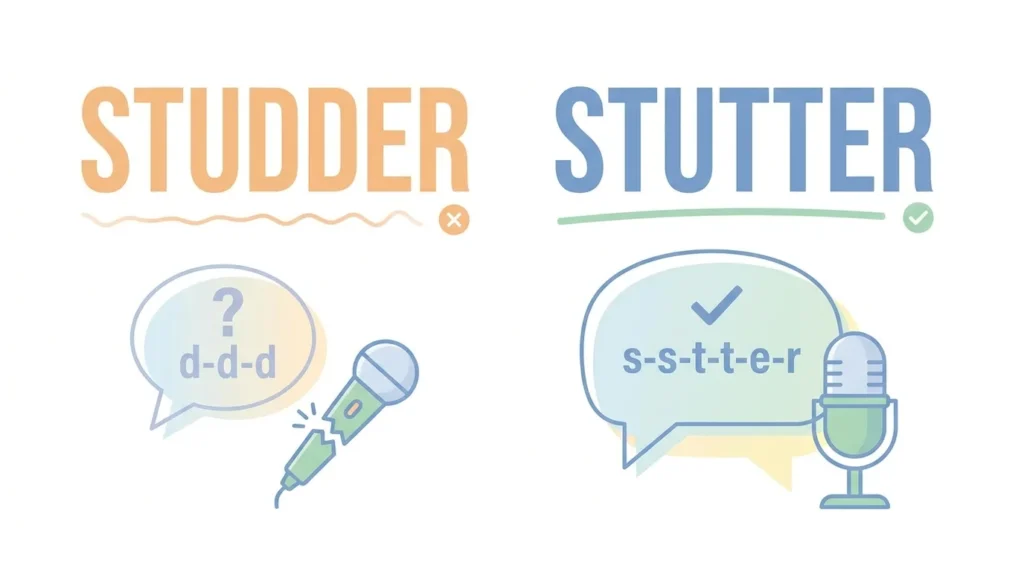

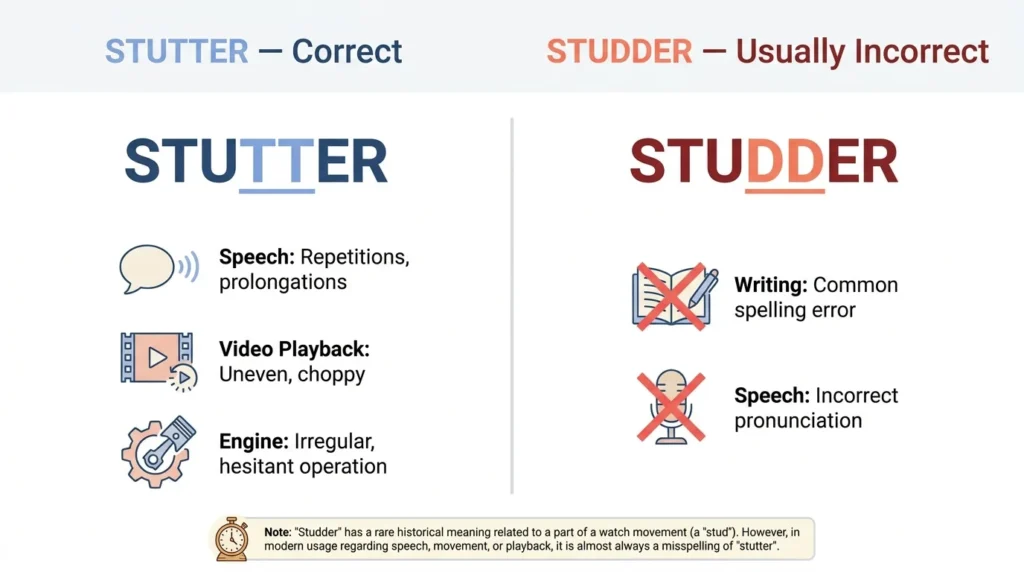
Stutter is the correct spelling when you mean speaking with repeated sounds, prolonged sounds, pauses, or blocks. Studder is normally a misspelling of stutter. However, studder does exist as a very rare historical occupational noun referring to a worker involved in watchmaking. In ordinary English, including speech, writing, and descriptions of machines or video playback, use stutter.
What Is the Difference Between Studder and Stutter?
The main difference is simple: stutter is the standard word you want in normal English; studder is usually a spelling mistake.
Stutter can be used as both a verb and a noun.
As a verb, stutter means to speak with repeated sounds, syllables, or interruptions.
She began to stutter when she became nervous.
As a noun, stutter refers to the speech pattern or interruption itself.
He has a noticeable stutter.
The word can also be used outside speech. For example, an engine, video, game, or computer can stutter when its operation becomes uneven or repeatedly stops and starts.
By contrast, studder is not the spelling you should use for these meanings. In modern everyday writing, it normally represents a misspelling of stutter. A dictionary search does reveal a rare historical noun studder associated with watchmaking, but that specialized meaning is unrelated to speech.
Why It Matters
A single letter can change whether a word looks correct to a reader.
Writing studder instead of stutter can create problems in:
- School assignments
- Job applications
- Professional emails
- Articles and reports
- Medical or educational writing
- Social media posts
- Website content
- English-language exams
The mistake is especially easy to make because stutter does not sound exactly as its spelling might suggest to every listener. In some accents and speaking situations, the middle consonant can sound closer to a d, which can encourage the spelling studder.
That does not make studder the correct spelling for the ordinary meaning.
The Core Rule
Use STUTTER when you mean repeated, blocked, interrupted, or uneven speech—or something else that repeatedly stops and starts.
Remember the middle of the word:
S-T-U-T-T-E-R
The two T’s belong in stutter, not two D’s.
The simplest rule
- stutter = correct for ordinary English
- studder = usually a misspelling
- studder = also a very rare historical watchmaking noun
For everyday writing, choose stutter.
Read More: Well Deserved vs. Well-Deserved: Which Is Correct?
How to Use Stutter
Stutter as a verb
Use stutter when describing the act of speaking with repetitions, pauses, blocks, or other interruptions.
I sometimes stutter when I speak in front of a large audience.
He started to stutter during the interview.
She did not stutter when she gave her presentation.
The verb changes normally according to tense.
| Form | Example |
|---|---|
| Base form | stutter |
| Third-person singular | stutters |
| Present participle | stuttering |
| Past tense | stuttered |
| Past participle | stuttered |
Notice that the spelling remains based on stutter, not studder.
Stutter as a noun
Use stutter as a noun when referring to the speech difficulty or pattern itself.
He has a stutter.
Her stutter became more noticeable when she was tired.
The speaker talked openly about his stutter.
The noun and verb are spelled the same.
Stutter outside speech
English also uses stutter metaphorically or technically for things that operate unevenly.
For example:
The engine began to stutter.
The video stuttered during playback.
The game keeps stuttering whenever the graphics become demanding.
This broader meaning is important because stutter is not limited to human speech.
Correct Examples
Here are examples showing how stutter works in different situations.
- Conversation:
“I sometimes stutter when I have to introduce myself to strangers.” - Interview:
“He was worried that he would stutter during the job interview.” - Email:
“I may stutter slightly when speaking publicly, but I am comfortable presenting the material.” - School:
“The student explained that he sometimes stutters when answering questions aloud.” - Workplace:
“She continued with the presentation even though she began to stutter.” - Social media:
“I used to worry about stuttering when speaking on camera.” - Academic writing:
“The researchers examined factors associated with speech fluency and stuttering.” - Technology:
“The video began to stutter after the connection became unstable.” - Automotive context:
“The engine started to stutter when the driver accelerated.” - Everyday conversation:
“He tends to stutter when he is extremely excited.”
Incorrect vs. Correct
| ❌ Incorrect | ✅ Correct | Why |
|---|---|---|
| I studder when I am nervous. | I stutter when I am nervous. | Stutter is the standard spelling for interrupted or repeated speech. |
| She has a studder. | She has a stutter. | The noun is spelled stutter. |
| He studders during presentations. | He stutters during presentations. | The third-person verb comes from stutter. |
| She was studdering while answering. | She was stuttering while answering. | The present participle is stuttering. |
| The engine studdered at the traffic light. | The engine stuttered at the traffic light. | Stutter can describe uneven mechanical operation. |
| The video keeps studdering. | The video keeps stuttering. | The technology-related meaning also uses stutter. |
| He began to studder during the speech. | He began to stutter during the speech. | Studder is not the standard spelling for this meaning. |
| My computer studders when I open the game. | My computer stutters when I open the game. | The accepted verb is stutter. |
| Her studder made her anxious. | Her stutter made her anxious. | The noun is stutter. |
| The audio studdered for a moment. | The audio stuttered for a moment. | Uneven or interrupted playback is described as stuttering. |
Why Do People Make This Mistake?
The confusion between studder and stutter is understandable.
1. Pronunciation can mislead you
English spelling does not always give learners a perfect guide to pronunciation.
When stutter is spoken quickly, the middle consonant may not sound as clearly like a strong t as a learner expects. Depending on accent and speech context, it can be perceived as closer to d.
Someone who learns the word mainly by hearing it may therefore write:
studder
instead of:
stutter
2. The spelling looks familiar
English contains many words with -dd-:
- ladder
- sudden
- middle
- hidden
- better? No—this one uses tt
When people hear a soft middle consonant, they may unconsciously choose a spelling pattern they already know.
Read More: Training vs Trainning: Which Spelling Is Correct?
3. People often spell from sound
This is a common problem for English learners.
If you know a word only through conversation, you may try to reconstruct its spelling from pronunciation. That strategy works sometimes, but English has many words whose spelling cannot be predicted perfectly from sound.
4. Autocorrect does not replace knowledge
Spellcheck can help identify studder, but relying on automatic correction has limits.
A better approach is to remember the correct spelling yourself:
STUTTER = S-T-U-T-T-E-R
5. Translation can interfere
Learners who think first in another language may map an English sound onto a familiar spelling pattern from their first language. That can make studder seem reasonable even though stutter is the standard English spelling for the intended meaning.
Common Mistakes Checklist
Mistake 1: Writing “studder” for speech
What happens:
You write studder when describing someone who repeats or gets stuck on sounds.
Why:
The middle sound may be heard as a d.
How to avoid it:
Remember stutter = double T.
Mistake 2: Writing “studdering”
The correct form is:
stuttering
Not:
studdering
If you need the continuous form, start with the correct base word stutter.
Mistake 3: Writing “studdered”
The past tense is:
stuttered
Not:
studdered
Mistake 4: Assuming “studder” is the British spelling
It is not. British English uses stutter for the standard word. British speakers may also use stammer, but studder is not the British spelling of stutter.
Mistake 5: Thinking every online occurrence proves a word is correct
Search engines can find misspellings, usernames, names, historical references, and specialized vocabulary.
Seeing studder online does not mean it is an accepted alternative spelling for stutter.
Studder vs. Stutter in Real English
1. “I stutter when I speak in public.”
This is natural and standard English. The speaker is using stutter as a verb to describe interruptions or repetitions in speech. There is no need to replace it with another spelling simply because the middle consonant may sound softer in rapid speech. Studder would be a spelling error in this context.
2. “He has a stutter.”
This is natural everyday English. Here, stutter functions as a noun. The sentence identifies the speech pattern without requiring a more complicated construction. The spelling remains stutter, with two T’s. Writing studder would not create a different meaning; it would normally be understood as a misspelling.
3. “The video keeps stuttering.”
This is also natural English, even though no person is speaking. English extends stutter to situations where sound, movement, or output repeatedly stops or becomes uneven. Gamers, computer users, and technology writers commonly use the word this way. The spelling remains stuttering, not studdering.
4. “The engine stuttered.”
This is grammatically correct and natural when an engine runs unevenly or hesitates. The meaning is related to the general idea of interrupted or irregular operation. You do not need to reserve stutter only for speech. In this context, stuttered is the standard spelling.
5. “Studder” as an ordinary spelling of “stutter”
This is not standard everyday English. If your sentence concerns speech, a machine, audio, video, or another form of interrupted operation, use stutter. There is a rare dictionary meaning of studder connected with watchmaking, but that specialized historical sense is unrelated to the ordinary word most people mean.
Read More: Onethird vs One Third: Which Is Correct?
American vs. British English
There is no American-versus-British spelling difference between stutter and studder.
Both American and British English use:
stutter
British English also commonly uses stammer for the same general speech phenomenon. That does not make studder an alternative British spelling.
| English variety | Standard word | Not the standard spelling |
|---|---|---|
| American English | stutter | studder |
| British English | stutter / stammer | studder |
| International English | stutter | studder |
The pronunciation can vary by accent, but the spelling stutter remains the safe standard form.
Formal vs. Informal Usage
Stutter works in both formal and informal English.
Formal
The study examined patterns of stuttering among young speakers.
The presentation addressed misconceptions about people who stutter.
Informal
I sometimes stutter when I’m tired.
My game keeps stuttering.
There is no need to replace stutter with a more formal spelling. The same word works across registers.
In sensitive contexts involving people who stutter, it is also better to describe the person respectfully rather than treating the speech pattern as a joke or defining the person by it.
Comparison Table
| Feature | Stutter | Studder |
|---|---|---|
| Standard everyday spelling | ✅ Yes | ❌ No |
| Used for interrupted speech | ✅ Yes | ❌ No |
| Used as a noun | ✅ Yes | ❌ No |
| Used as a verb | ✅ Yes | ❌ No |
| Used for uneven video/audio | ✅ Yes | ❌ No |
| Used for uneven engine operation | ✅ Yes | ❌ No |
| American English | ✅ Yes | ❌ No |
| British English | ✅ Yes | ❌ No |
| Common spelling mistake | No | ✅ Yes |
| Rare historical meaning | No | ✅ Yes, in watchmaking |
The key point is that stutter is the word you want for ordinary modern usage. Studder has a specialized historical dictionary sense, but it is not an alternative spelling for the common word.
How to Remember the Correct Spelling
Use this mnemonic:
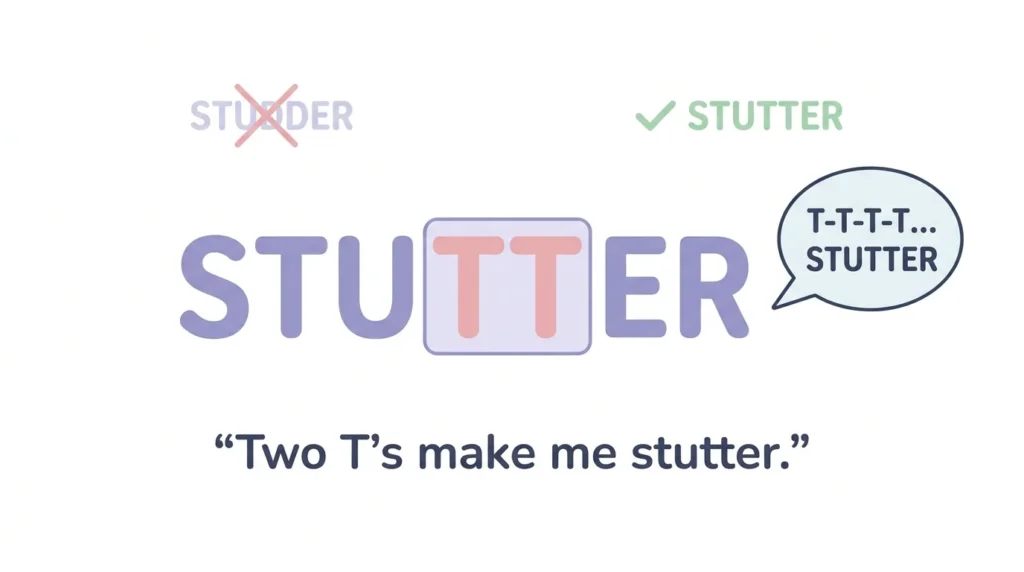
STUTTER has two T’s because the word itself “repeats” the T.
Break it into parts:
STU + TT + ER
Or remember:
“Two T’s make me stutter.”
When you are unsure between studder and stutter, look at the middle:
❌ STUDDER
✅ STUTTER
The correct word has TT, not DD.
Real-Life Situations
Job Interview
“I sometimes stutter when I’m nervous, but I know the material well.”
The speaker is using stutter correctly as a verb.
Workplace Meeting
“The video began to stutter during the presentation.”
Here, stutter describes uneven video playback.
Text Message
“Sorry, I stutter when I’m put on the spot.”
This is natural informal English.
School Assignment
“The research examines factors associated with childhood stuttering.”
This is appropriate formal or academic usage.
Technical Support
“The game starts to stutter whenever the frame rate drops.”
Again, stutter is being used for uneven performance rather than speech.
Read More: Goodmorning vs Good Morning: Which One Is Correct?
Expert Tips
Tip 1: Learn the whole word, not just the sound
Instead of memorizing the pronunciation and guessing the spelling, memorize:
stutter = STUT + TER
That makes the double T easier to recall.
Tip 2: Learn the word family
Once you know stutter, connect the related forms:
- stutter
- stutters
- stuttered
- stuttering
- stutterer
This reduces the temptation to create forms such as studdering or studdered.
Tip 3: Don’t confuse pronunciation with spelling
A sound that resembles d does not automatically require the letter d.
English spelling frequently preserves conventional forms that cannot be predicted from pronunciation alone.
Tip 4: Remember the wider meaning
If you already know that a video can stutter, it becomes easier to recognize stutter as a general word for interrupted or uneven performance—not only a speech term.
Tip 5: Treat “studder” as a warning signal
When you type studder, stop and check it.
In ordinary English, the word you probably want is:
stutter
FAQ
Is “studder” or “stutter” correct?
Stutter is correct for the ordinary meaning involving interrupted or repeated speech, and it is also used for uneven operation such as video or engine performance. Studder is normally a misspelling in these contexts.
Is “studder” ever a real word?
Yes, but only in a very rare historical sense. Merriam-Webster defines studder as a worker who inserts watch hairsprings into studs. This specialized meaning is unrelated to speech.
Is “studder” the British spelling of “stutter”?
No. British English uses stutter. The British word stammer is also commonly used for speech disfluency, but studder is not a British spelling variant.
Is “stuttering” spelled with two T’s?
Yes.
Correct: stuttering
Incorrect: studdering
The form comes from stutter.
Is “stuttered” spelled with two T’s?
Yes.
Correct: stuttered
Incorrect: studdered
Can “stutter” describe a computer or video?
Yes. A video, game, computer, audio stream, or other system can be described as stuttering when its output becomes uneven or repeatedly pauses.
Can “stutter” be a noun and a verb?
Yes.
Verb: “I sometimes stutter.”
Noun: “He has a stutter.”
Is “stammer” the same as “stutter”?
In ordinary discussion of speech, the terms can refer to the same general phenomenon, although terminology and usage vary by region and context. Stammer is particularly common in British English.
Why does “stutter” sound like “studder” sometimes?
The middle consonant can sound softer in connected or rapid speech, and accent can affect how listeners perceive it. That can lead someone to reconstruct the spelling with d instead of tt. The standard spelling remains stutter.
How do I remember how to spell stutter?
Remember:
STUTTER = two T’s
You can also use the mnemonic:
“Two T’s make me stutter.”
What is the easiest way to check the spelling?
Look at the middle of the word.
STU + TT + ER
If you have written DD, change it to TT for the ordinary meaning.
Mini Quiz
| # | Question | Answer | Explanation |
|---|---|---|---|
| 1 | Which spelling is correct: “studder” or “stutter”? | Stutter | Stutter is the standard spelling for interrupted or repeated speech. |
| 2 | Fill in the blank: “He began to ___ during the interview.” | stutter | The verb describing interrupted speech is stutter. |
| 3 | Choose the correct sentence: A) She has a studder. B) She has a stutter. | B | Stutter is the correct noun. |
| 4 | Fill in the blank: “The video kept ___.” | stuttering | The word can describe uneven video playback. |
| 5 | Correct this sentence: “I studder when I am nervous.” | I stutter when I am nervous. | Studder is normally a misspelling here. |
| 6 | Which word has the correct double consonant: A) studder B) stutter? | B) stutter | The standard word contains tt. |
| 7 | Fill in the blank: “The engine ___ before stopping.” | stuttered | Stuttered can describe uneven engine operation. |
| 8 | Is studder the British spelling of stutter? | No | British English uses stutter; stammer is also common. |
| 9 | Which is correct: “stuttering” or “studdering”? | stuttering | The present participle is formed from stutter. |
| 10 | Correct this sentence: “My computer studders when I open the game.” | My computer stutters when I open the game. | Stutters is the correct verb for uneven computer performance. |
Quick Summary
Stutter is the correct spelling for the common English word meaning to speak with repeated sounds, pauses, prolonged sounds, or blocks. It can also describe something that operates unevenly, such as a video, engine, or computer. Studder is normally a misspelling of stutter, although it has a very rare historical meaning connected with watchmaking. The easiest way to remember the standard spelling is to focus on the middle: STUTTER contains two T’s. American and British English both use stutter; British English may also use stammer. Whenever you mean interrupted speech or uneven operation, choose stutter, stutters, stuttered, or stuttering—not studder, studdered, or studdering.