
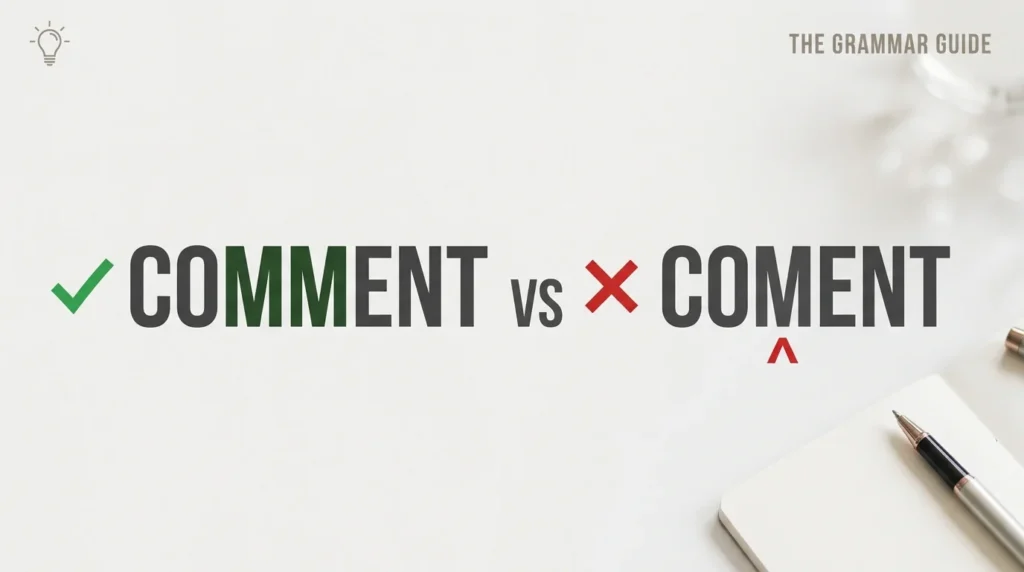

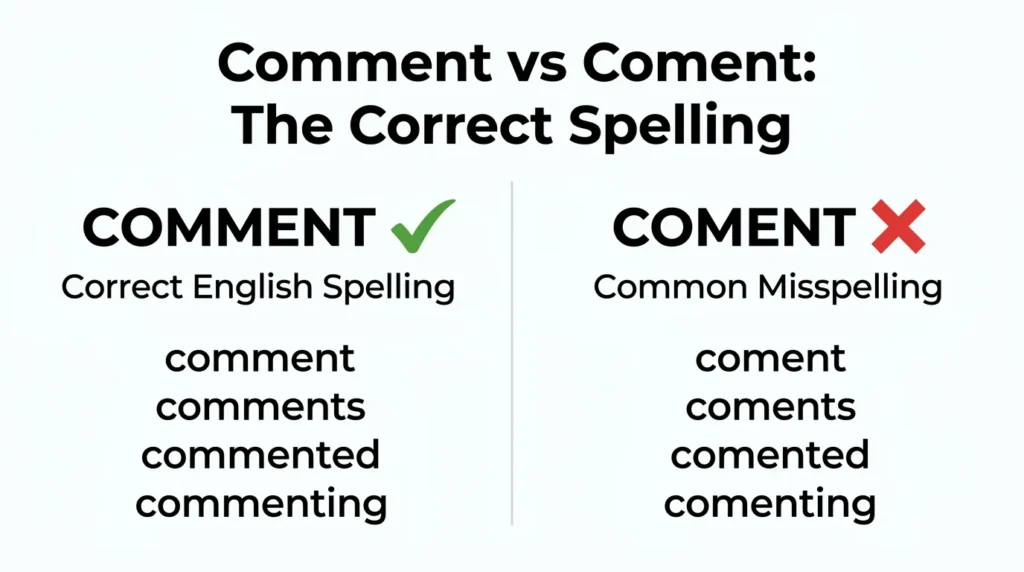
Comment is the correct spelling in standard modern English. Coment is normally a misspelling caused by leaving out one of the two m letters. Write comment when you mean a spoken or written remark, opinion, observation, or the act of expressing one. The correct related forms are comments, commented, and commenting.
Correct: comment
Incorrect: coment
The easiest rule is simple: comment always has two m’s.
What Is Comment?
Comment can function as both a noun and a verb.
As a noun, it refers to something someone says or writes to express an opinion, reaction, observation, explanation, or criticism.
Her comment helped us understand the problem.
As a verb, comment means to express an opinion or make a remark about something.
The manager commented on the proposal.
Standard reference sources recognize both noun and verb uses.
Coment, by contrast, is not the standard modern English spelling when you mean comment. In ordinary English writing, it should be corrected to comment.
Why Correct Spelling Matters
Writing coment instead of comment usually will not make your sentence impossible to understand. Readers can often guess what you mean. However, the error becomes more noticeable in situations where careful writing matters.
Correct spelling is especially important in:
- professional emails
- job applications
- reports and proposals
- academic assignments
- exams
- business websites
- customer support messages
- published articles
- social media content for a brand
- presentations and official documents
A spelling error can distract readers from your message. In professional or academic writing, repeated errors may also make your work appear less carefully edited.
The Core Rule
RULE: Write COMMENT with two m’s.
comment ✅
coment ❌The same double m remains in related forms:
comments
commented
commenting
There is no situation in normal modern English where you should deliberately remove one m from comment simply because of pronunciation.
Read More: Nonresponsive vs Unresponsive: Both Are Correct; Context Decides
How to Use Comment Correctly
Comment as a Noun
Use comment as a noun when referring to a remark, opinion, reaction, or observation.
Examples:
- I have one comment about your presentation.
- Her comment surprised everyone.
- Please leave a comment below the video.
- The editor added a helpful comment to the document.
- He made no comment about the decision.
The plural is simply comments.
We received several positive comments.
Comment as a Verb
Use comment as a verb when someone expresses an opinion or observation.
Examples:
- She commented on the new design.
- Would you like to comment on the proposal?
- Several readers commented on the article.
- He commented that the room looked much brighter.
A very common construction is:
comment on + topic
The director declined to comment on the report.
Another standard construction places a clause after comment:
comment + that-clause
She commented that the results were encouraging.
Both patterns are established in standard English usage.
Comment, Comments, Commented, and Commenting
Keep the double m in every common form:
| Form | Function | Example |
|---|---|---|
| comment | Singular noun / base verb | I have a comment. |
| comments | Plural noun / verb | She comments regularly. |
| commented | Past tense | He commented yesterday. |
| commenting | -ing form | They are commenting on the issue. |
Do not write coments, comented, or comenting when you mean these English forms.
Correct Examples of Comment
The following examples show how comment appears naturally in different situations.
Conversation
- “That was an interesting comment about the movie.”
- “I didn’t mean my comment to sound rude.”
- “Please review the attached draft and send me your comments by Friday.”
- “I would like to comment on one point from your previous email.”
School
- “The teacher wrote a helpful comment at the bottom of my essay.”
- “Several students commented on the main character’s decision.”
Workplace
- “The manager asked the team to comment on the proposed schedule.”
- “Her comments helped us improve the final presentation.”
Social Media
- “Someone left a funny comment under my photo.”
- “Hundreds of viewers commented on the announcement.”
Academic Writing
- “The researcher comments on the limitations of the earlier study.”
- “The author’s final comment raises an important question about the evidence.”
Incorrect vs. Correct
| ❌ Incorrect | ✅ Correct | Why |
|---|---|---|
| Please leave a coment below. | Please leave a comment below. | The English word comment requires two m’s. |
| She made a useful coment. | She made a useful comment. | Coment is missing the second m. |
| I read all the coments. | I read all the comments. | The plural keeps both m’s and adds -s. |
| He comented on my photo. | He commented on my photo. | The base word is comment, so the past form begins with comment-. |
| They are comenting on the story. | They are commenting on the story. | Adding -ing does not remove an m from the base word. |
| Can you coment on this idea? | Can you comment on this idea? | The verb is spelled comment. |
| Her coment sounded negative. | Her comment sounded negative. | The noun needs the double m. |
| The professor comented that more research was needed. | The professor commented that more research was needed. | The correct past-tense spelling is commented. |
| We received several coments from customers. | We received several comments from customers. | The standard plural is comments. |
| Stop comenting before you read the full report. | Stop commenting before you read the full report. | The correct participle is commenting, with two m’s. |
Why People Write Coment Instead of Comment
The Double Letter Is Easy to Miss
When two identical consonants appear together, fast typists may accidentally press the letter only once.
That turns:
comment
into:
coment
The result looks close enough to the intended word that the writer may overlook it during proofreading.
Pronunciation Does Not Clearly Reveal Two M’s
A double consonant in English spelling does not mean that speakers normally pronounce two completely separate consonant sounds.
The spoken form of comment therefore does not provide an obvious warning that the written word contains mm. Both British and American pronunciations have two syllables, but hearing the word alone may not help a learner decide whether one or two m’s belong in the spelling.
Spelling by Sound
English learners sometimes write an unfamiliar word according to how it sounds.
If a learner hears something like:
COM-ent
writing coment may seem reasonable.
However, English spelling cannot always be reconstructed reliably from pronunciation. The written form has to be learned as comment.
Spelling Overlap With Other Words
Writers may also confuse the visual pattern with words containing only one consonant in a similar position.
The best solution is not to invent a complicated spelling rule. Memorize comment as one complete spelling pattern.
Autocomplete and Spellcheck Have Limits
Digital tools can catch many misspellings, but writers should not depend on them completely.
A keyboard suggestion may change what you intended to type, and proofreading tools can behave differently depending on language settings, proper names, or surrounding text.
Learn the spelling first; use technology as a backup.
Translation Interference
Learners sometimes transfer spelling patterns from another language into English. Similar-looking words across languages may use different consonant patterns.
When writing standard English, treat comment as a fixed English spelling rather than trying to build it from a translated equivalent.
Common Mistakes Checklist
- Writing “coment.”
You have dropped the second m. Replace it with comment. - Writing “coments.”
The correct plural is comments. - Writing “comented.”
Begin with the full base word comment, then add -ed: commented. - Writing “comenting.”
The correct form is commenting. - Assuming pronunciation tells you the spelling.
The spoken word does not make the double m obvious. - Confusing comment with commend.
Comment means to make a remark or express an opinion. Commend usually means to praise or recommend someone or something as worthy. - Using the wrong verb pattern.
For a topic, comment on something is a standard and natural construction. - Trusting autocorrect without proofreading.
Always reread important writing before sending or publishing it.
Comment vs Coment in Real English
Grammatically Correct
Comment is the standard spelling whether the word functions as a noun or verb. Sentences such as “I have a comment,” “She commented on the report,” and “They are commenting on the results” are grammatically standard. The spelling remains consistent across its common forms: comment, comments, commented, and commenting.
Possible but Unnatural
A sentence can contain correctly spelled words yet still sound awkward. For example, “I wish to make commentary regarding your photograph” may be grammatical in the right context, but it sounds unnecessarily formal when someone simply wants to react to an online photo. In everyday communication, English speakers normally choose the simpler noun or verb comment when that meaning fits.
Natural Everyday English
Natural choices include “Leave a comment,” “Can I comment on that?” “She commented on my post,” and “I read your comments.” These patterns work well because they use comment directly instead of replacing it with longer expressions. In professional contexts, phrases such as “We welcome your comments” and “The company declined to comment” are also normal and concise.
Read More: Scoup vs Scoop: Which Spelling Is Correct?
American vs. British English
There is no British-versus-American spelling difference here. Both varieties write:
comment
The main difference is pronunciation rather than spelling. A standard British pronunciation is represented as /ˈkɒm.ent/, while a standard American pronunciation is represented as /ˈkɑː.ment/ in one major learner reference.
So whether you write in American or British English:
comment ✅
coment ❌
Formal vs. Informal Usage
The spelling does not change according to formality, but the way comment appears in a sentence can vary.
Informal
- Leave a comment!
- I saw your comment.
- Why did you comment on that post?
- Thanks for commenting.
These are common in conversation and online communication.
Formal and Professional
- We welcome your comments on the proposal.
- The organization declined to comment on the matter.
- Please provide comments before the final review.
- The author comments on several limitations of the study.
In formal writing, choose a construction that clearly identifies what the comment concerns.
Comment vs Coment Comparison Table
| Feature | Comment | Coment |
|---|---|---|
| Correct standard English spelling | Yes | No, when intended to mean comment |
| Number of m’s | Two | One |
| Can be a noun | Yes | Not as the standard English spelling |
| Can be a verb | Yes | Not as the standard English spelling |
| Correct plural | comments | coments ❌ |
| Correct past form | commented | comented ❌ |
| Correct -ing form | commenting | comenting ❌ |
| Used in professional English | Yes | Should be corrected |
| Used in academic English | Yes | Should be corrected |
| Used in social media English | Yes | Common typo |
| American spelling | comment | coment ❌ |
| British spelling | comment | coment ❌ |
Comment vs Commend
Another word worth separating from comment is commend.
They look similar, but their meanings are different.
Comment = express an opinion or make a remark.
The reviewer commented on the design.
Commend = praise, approve of, or recommend as worthy.
I commend the team for its excellent work.
Major dictionaries treat commend as a separate verb with meanings related to praise, recommendation, or entrusting something to someone’s care.
Read More: Naive vs Nieve: Which Spelling Is Correct?
Memory Trick
Use this sentence:
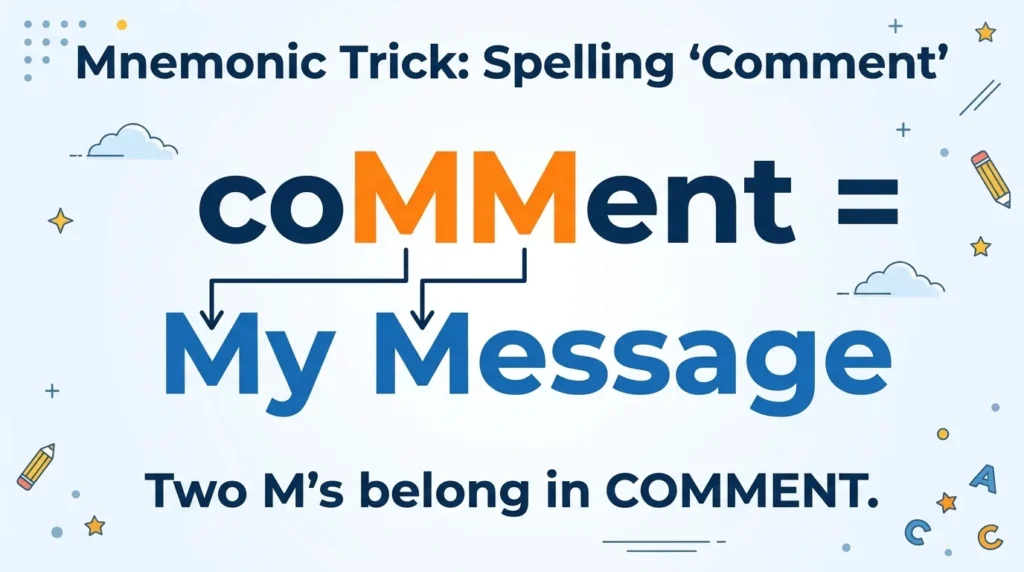
My Message Makes a COMMENT.
The two words My Message begin with M + M.
Think:
MM = coMMent
Whenever you write the word, look for the pair:
coMMent
If you see only one m, one member of the pair is missing.
Real-Life Situations
Interview
The interviewer asks:
“Would you like to comment on your previous experience?”
Correct response:
“Yes, I’d like to comment on what I learned from my previous role.”
Meeting
Your manager says:
“Does anyone have a comment about the revised schedule?”
You might answer:
“I have one comment about the deadline.”
You are reviewing a document:
“I’ve added my comments to the attached draft.”
This is concise and professional.
Text Message
A friend sends you a video:
“I saw your comment. 😂”
Even in casual writing, the spelling remains comment.
Exam
You see:
Please coment on the writer’s argument.
The spelling should be corrected to:
Please comment on the writer’s argument.
Expert Tips
1. Learn the Whole Word, Not Just the Rule
There is little benefit in creating an elaborate rule for one spelling. Store comment visually as:
co + mm + ent
2. Check the Base Word Before Adding Endings
If you forget whether to write commented or comented, return to the base form:
comment
Then add the ending:
comment + ed = commented
comment + ing = commenting
3. Learn Common Word Partnerships
Memorizing frequent combinations makes both spelling and usage easier:
- make a comment
- leave a comment
- post a comment
- comments on something
- comment on an issue
- comment that…
- decline to comment
- no comment
- public comment
- helpful comments
4. Do Not Treat Every Search Result as Proof of Correctness
A misspelling can appear online thousands of times simply because thousands of people can make the same typo.
Frequency on informal websites does not automatically make a spelling standard.
5. Be Careful With Names and Historical Forms
You may occasionally encounter Coment as part of a name, product, specialized label, or historical material. Historical sources also show older spellings related to the development of comment. That does not make coment an interchangeable spelling in present-day standard English. Modern English uses comment for the ordinary noun and verb.
6. Use “Comment on” When You Need a Safe Verb Pattern
When comment is followed by a topic, comment on is one of the safest and most widely useful patterns:
- Identify the person making the remark.
- Use the correct form of comment.
- Add on.
- Name the topic.
Example:
The analyst commented on the new figures.
Quick Summary
Comment is the correct spelling in standard modern English; coment is normally a misspelling. Always keep both m’s in comment and in related forms such as comments, commented, and commenting. The word works as both a noun, meaning a remark or opinion, and a verb, meaning to express one. A common verb pattern is comment on + topic, as in “She commented on the report.” American and British English use the same spelling, although pronunciation differs slightly. To remember the spelling, focus on the MM in coMMent. In emails, schoolwork, professional documents, academic writing, and social media, use comment, never coment, unless the latter is intentionally part of a name or historical material.
FAQ
Is comment or coment correct?
Comment is correct in standard modern English. Coment is normally a misspelling caused by omitting one m.
Is coment an English word?
Not as the standard modern English spelling of the noun or verb comment. It may occasionally appear in names, historical material, or other specialized contexts, but you should not use it as an alternative spelling of comment in normal English writing.
How do you spell comment correctly?
Spell it:
C-O-M-M-E-N-T
The important feature is the double m.
Why does comment have two m’s?
The modern standard spelling is historically established as comment. The word has a long history through Middle English and Latin-derived forms, and modern spelling preserves the double m. Its pronunciation alone does not reliably tell a learner that two m’s are present.
Is it comments or coments?
The correct plural is comments.
One comment → two comments
Do not remove an m when adding -s.
Is it commented or comented?
The correct past tense and past participle are commented.
She commented on the article yesterday.
Is it commenting or comenting?
The correct -ing form is commenting.
People are commenting on the announcement.
Is comment a noun or a verb?
It can be both.
Noun:
Your comment was helpful.
Verb:
She commented on my draft.
Both uses are standard.
Should I say comment on or comment about?
Both on and about can occur with the noun comment, depending on the sentence. With the verb, comment on + topic is an especially common and useful construction.
She commented on the proposal.
He made a comment about the delay.
Reference examples and collocation evidence support both kinds of patterns.
Is comment spelled differently in British English?
No. British and American English both spell the word comment. There is a pronunciation difference between common British and American forms, but not a spelling difference.
What is the difference between comment and commend?
Comment means to make a remark or express an opinion.
Commend usually means to praise someone or something or recommend it as worthy.
I commented on her work.
I commended her excellent work.
Can comment mean something other than an online reply?
Yes. Online messages are only one use. Comment can refer broadly to spoken or written opinions, remarks, explanatory notes, criticisms, observations, and other expressions of viewpoint.
Mini Quiz
| # | Question | Answer | Explanation |
|---|---|---|---|
| 1 | Which is correct? A) coment B) comment | B) comment | Standard English spells the word with two m’s. |
| 2 | Fill in the blank: “Please leave a ___ below the video.” | comment | A written reaction or opinion is a comment. |
| 3 | Correct the sentence: “She comented on my presentation.” | She commented on my presentation. | The past form keeps both m’s from comment. |
| 4 | Which plural is correct? A) coments B) comments | B) comments | Add -s to the complete base word comment. |
| 5 | Fill in the blank: “The company declined to ___ on the report.” | comment | The base verb is comment. |
| 6 | Correct the sentence: “People are comenting on the news.” | People are commenting on the news. | The correct -ing form is commenting. |
| 7 | Which sentence uses the natural verb pattern? A) She commented on the proposal. B) She coment the proposal. | A | Comment on + topic is a standard construction. |
| 8 | Is comment a noun, verb, or both? | Both | It can name a remark or describe the act of making one. |
| 9 | Choose the correct word: “I ___ the team for its excellent work.” A) comment B) commend | B) commend | Commend means praise; comment means make a remark or express an opinion. |
| 10 | Correct the sentence: “I read every coment before replying.” | I read every comment before replying. | The singular noun requires two m’s. |