

Transferred is the correct standard spelling. Transfered with one r is a spelling error in standard English. Transferred is both the simple past tense and the past participle of the verb transfer. The same double r appears in transferring. Write “I transferred the money,” not “I transfered the money.”
What Does “Transferred” Mean?
Transferred is the past-tense and past-participle form of transfer, a verb that generally means moving, sending, changing, or passing someone or something from one place, person, position, system, or owner to another.
You can transfer many different things:
- money between bank accounts
- files between computers
- an employee to another department
- a patient to another hospital
- ownership of property
- a telephone call to another person
- a student to another school
- responsibility from one team to another
When the action happened in the past, the standard form is transferred.
Present: I transfer the files every Friday.
Past: I transferred the files yesterday.
Past participle: The files have been transferred.
-ing form: I am transferring the files now.
Why the Correct Spelling Matters
A missing r rarely prevents someone from understanding your sentence, but spelling still affects how polished your writing appears.
The difference matters especially in:
- Job applications: “I was transfered to the sales department” contains an obvious spelling error.
- Business emails: A message about transferred funds or transferred accounts should look professional.
- School assignments: Teachers may mark transfered as incorrect spelling.
- Academic writing: Consistent standard spelling improves clarity and credibility.
- Financial communication: Words such as transferred payment or transferred funds often appear in formal records.
In a casual text, a reader will probably understand transfered. In professional, educational, or published writing, however, use transferred.
The Core Rule
Rule: Write transferred, with two r’s, when forming the simple past or past participle of transfer. Write transferring, also with two r’s, when adding -ing.
The standard verb forms are:
| Verb Form | Correct Spelling |
|---|---|
| Base form | transfer |
| Third-person singular | transfers |
| Simple past | transferred |
| Past participle | transferred |
| Present participle / gerund | transferring |
Standard dictionaries list transferred and transferring as the inflected forms of transfer.
Read More: Commit vs Comit: Which Spelling Is Correct?
Why Does “Transferred” Have Two R’s?
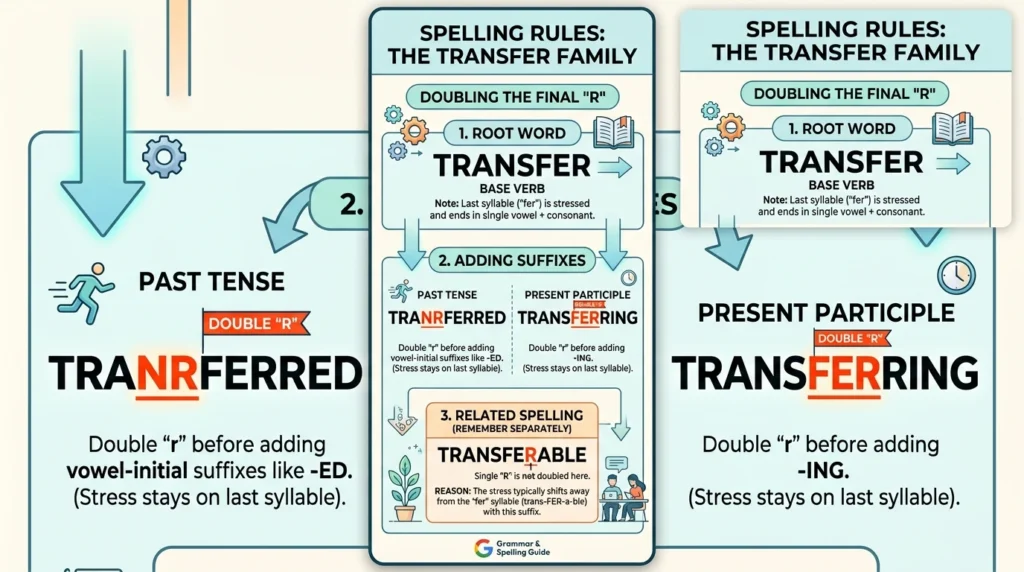
English often doubles a final consonant before adding a suffix that begins with a vowel, such as -ed or -ing. This pattern can be seen in verbs such as refer → referred and prefer → preferred. Standard spelling applies the same double r in transferred and transferring.
You may see the rule explained only in terms of word stress. Stress is useful when learning many consonant-doubling patterns, but it should not be treated as a perfect pronunciation test for transfer. Pronunciation and stress can vary by accent, while the spelling transferred remains established.
For practical writing, remember the word family instead:
- refer → referred → referring
- prefer → preferred → preferring
- transfer → transferred → transferring
That pattern is more reliable than stopping to analyze your pronunciation every time you write the word.
How to Use “Transferred”
Use “Transferred” for a Completed Past Action
Use the simple past when the transfer happened at a known or understood time in the past.
Example:
She transferred the payment yesterday.
The action is complete, so transferred is the simple past verb.
Use “Transferred” as a Past Participle
The past participle appears with auxiliary verbs such as have, has, and had.
Examples:
- We have transferred the documents.
- He has transferred to another university.
- They had already transferred the funds.
It also appears in passive constructions:
- The patient was transferred overnight.
- Your call has been transferred.
- Ownership was transferred to the buyer.
Use “Transferring” for an Ongoing Action
When you add -ing to transfer, keep the double r:
Correct: transferring
Incorrect: transfering
Example:
I am transferring the photos to my new phone.
Do Not Apply the Double-R Pattern Blindly to Every Related Word
One useful spelling trap is transferable.
The commonly preferred spelling is transferable, with one r after transfe-; transferrable also exists as a less common accepted variant in some dictionaries. This means you should not assume that every suffix added to transfer automatically produces rr.
Compare:
transferred
transferring
transferable
Learning the actual word forms is safer than trying to extend one spelling rule to every suffix.
Correct Examples of “Transferred”
Here are original examples from everyday and professional contexts.
Conversation
- “I transferred the photos to my new phone last night.”
- “They transferred me to another representative after I called support.”
- “I have transferred the requested documents to the shared folder.”
- “The payment was transferred successfully this morning.”
School
- “Maya transferred to our school at the beginning of the semester.”
- “The teacher transferred the final grades into the new system.”
Workplace
- “The company transferred Daniel from marketing to operations.”
- “Responsibility for the project was transferred to the regional team.”
Social Media and Technology
- “Finally transferred all my vacation videos without losing a single file.”
- “My account information was automatically transferred to the new app.”
Academic Writing
- “The collected samples were transferred to sterile containers for analysis.”
- “Thermal energy was transferred from the warmer material to the cooler surface.”
These examples show that transferred works across casual, professional, technical, and academic contexts.
Incorrect vs. Correct Examples
| ❌ Incorrect | ✅ Correct | Why |
|---|---|---|
| I transfered the money yesterday. | I transferred the money yesterday. | The simple past of transfer is transferred with two r’s. |
| She was transfered to another department. | She was transferred to another department. | The passive construction requires the past participle transferred. |
| We have transfered your files. | We have transferred your files. | After have, use the past participle, spelled transferred. |
| He transfered schools last year. | He transferred schools last year. | The completed past action requires transferred. |
| The payment has been transfered. | The payment has been transferred. | Has been is followed here by the past participle transferred. |
| They are transfering the data now. | They are transferring the data now. | The -ing form also doubles the final r. |
| I am transfering my contacts. | I am transferring my contacts. | Transfering is not the standard spelling of the present participle. |
| The patient had been transfered earlier. | The patient had been transferred earlier. | The past participle remains transferred after had been. |
| Ownership was transfered in May. | Ownership was transferred in May. | The passive verb needs the standard double-r form. |
| Your call is being transfered. | Your call is being transferred. | After being, use the past participle transferred. |
Why People Write “Transfered”
Several factors make this mistake easy to understand.
Adding “-ed” Too Mechanically
Many English verbs simply take -ed:
- walk → walked
- clean → cleaned
- open → opened
A learner may therefore apply the same visible process:
transfer + ed → transfered
The problem is that transfer belongs to a spelling pattern in which the standard past form has a doubled r.
Read More: Pentoxide vs Pentaoxide: Which Spelling Is Correct in Chemistry?
The Pronunciation Does Not Clearly Reveal the Extra Letter
You do not pronounce two separate r sounds in transferred. The second r is mainly a spelling feature, so hearing the word alone may not tell a learner how many r’s to write.
Similar-Looking Words Cause Overgeneralization
Words such as offered contain only one final r before -ed.
A learner may unconsciously think:
offer → offered
therefore
transfer → transfered
English spelling does not allow that simple analogy here.
Autocomplete Can Encourage Careless Typing
Spellcheckers usually identify common misspellings, but writers should not depend entirely on software. A typo may survive in a name, search query, draft, username, imported text, or system that has limited language checking.
Translation Interference
Learners whose first language forms past tense without consonant doubling may naturally expect the English verb to remain unchanged before the ending.
That makes transfer + ed = transfered look logical even though standard English uses transferred.
Common Mistakes Checklist
Use this checklist whenever transfer appears in your writing:
- Writing “transfered.” Add the second r: transferred.
- Writing “transfering.” The correct -ing form is transferring.
- Assuming every verb simply adds -ed. English sometimes changes the spelling of the base before adding a suffix.
- Treating pronunciation as the only guide. English spelling and pronunciation do not always match letter for sound.
- Assuming British and American spelling differ here. Standard usage uses transferred in both varieties.
- Doubling the r in every related word automatically. The usual spelling of the adjective is transferable.
- Confusing tense with spelling. Transferred can be either simple past or past participle; the surrounding grammar tells you which function it has.
- Trusting autocorrect without checking context. Software can help, but it cannot replace proofreading.
“Transferred” in Real English
Natural Everyday English
Transferred is completely natural in everyday English when something moves from one person, place, system, account, school, job, or device to another. Sentences such as “I transferred the money,” “They transferred my call,” and “She transferred to another school” sound normal and direct. The word is not unusually formal, so speakers use it comfortably in both conversation and writing.
Grammatically Correct but Context-Dependent English
Some sentences with transferred are grammatically correct but can sound vague without enough context. For example, “She was transferred” is structurally correct, but the listener may naturally wonder where or to what. In real communication, speakers often add information: “She was transferred to another branch.” Correct grammar does not automatically make a sentence complete or informative for a particular situation.
Grammatically Possible but Less Natural Wording
A sentence can contain transferred correctly while another verb would sound more natural. For instance, “I transferred myself from the kitchen to the bedroom” is understandable but unusually formal for an ordinary movement; “I went to the bedroom” is more natural. Use transfer when there is a meaningful change of location, responsibility, ownership, system, institution, account, transport, or control—not simply any physical movement.
Formal vs. Informal Usage
Transferred is register-neutral: the spelling does not change between formal and informal English.
In casual conversation:
They transferred me to another agent.
In professional writing:
The employee was transferred to the regional office effective Monday.
In technical writing:
The data were transferred to the secure server.
In banking:
The funds have been transferred to the recipient’s account.
More specialized contexts may use alternatives such as reassigned, relocated, conveyed, or remitted, but those words have narrower meanings. Do not replace transferred merely to make a sentence sound more formal.
Read More: Preform vs Perform: Difference, Meaning, and Examples
Transferred vs. Transfered Comparison Table
| Feature | Transferred | Transfered |
|---|---|---|
| Standard English spelling | Yes | No |
| Number of r’s before -ed | Two | One |
| Simple past of transfer | Yes | No |
| Past participle of transfer | Yes | No |
| Suitable for formal writing | Yes | No |
| Suitable for academic writing | Yes | No |
| Suitable for business writing | Yes | No |
| Used in American English | Yes | Not as standard spelling |
| Used in British English | Yes | Not as standard spelling |
| Example | “She transferred the funds.” | “She transfered the funds.” ❌ |
Both major dictionary traditions record transferred as the standard form.
Similar Forms You Should Know
| Form | Status | Example |
|---|---|---|
| transfer | Correct | Please transfer the file. |
| transfers | Correct | She transfers the reports every week. |
| transferred | Correct | She transferred them yesterday. |
| transfered | Incorrect in standard English | She transfered them. ❌ |
| transferring | Correct | She is transferring them now. |
| transfering | Incorrect in standard English | She is transfering them. ❌ |
| transferable | Standard and common | These skills are transferable. |
| transferrable | Accepted variant, less common in some dictionaries | The ticket may be transferrable. |
The important point is that the spelling of transferred does not automatically predict the spelling of every related word.

Memory Trick
Think:
A TRANSFER needs an extra R before it is finishED.
Break the word visually:
transfe + rr + ed
Or remember the short family:
refer → referred
prefer → preferred
transfer → transferred
If the past-tense word looks like transfered, ask yourself:
“Where did the second R get transferred to?”
Put it back:
transferred.
Real-Life Situations
Interview
Interviewer: Why did your responsibilities change last year?
You: “I was transferred to the operations team and given responsibility for two additional accounts.”
Using the correct spelling matters especially if the same information appears on your résumé or written application.
Meeting
“The client files were transferred to the new database over the weekend.”
Here, transferred clearly describes a completed movement of data.
“Your request has been transferred to our billing department for review.”
The past participle follows has been.
Text Message
“I transferred you the money. Check your account.”
The word works naturally even in informal communication.
Exam
Question: Complete the sentence: “The student _____ to another university last semester.”
Answer: transferred
Because the action happened in the past, use the simple past form with two r’s.
Expert Tips
Learn Word Families Instead of Isolated Rules
English spelling rules are useful, but individual word families are often easier to remember.
Learn these together:
transfer – transferred – transferring
Then learn:
refer – referred – referring
and:
prefer – preferred – preferring
Patterns become easier to recognize when you see related examples together.
Do Not Confuse Spelling Rules With Pronunciation Rules
A common explanation says the r doubles because the last syllable is stressed. Stress-based doubling is an important English spelling principle, but pronunciation of transfer is not identical across every accent. Standard references nevertheless agree on transferred and transferring.
For learners, memorizing the established forms is more reliable than trying to judge the spelling entirely by ear.
Check the Base Word When Proofreading
If you see:
transfered
mentally separate it:
transfer + ed
Then recall the standard past form:
transferred
This quick visual check catches the mistake faster than rereading the entire sentence.
Watch for the Same Error in “Transferring”
Someone who writes transfered may also write transfering.
Always check both:
❌ transfered
✅ transferred
❌ transfering
✅ transferring
Keep “Transferable” Separate
Do not assume the spelling must be transferrable simply because transferred contains rr.
The common standard adjective is transferable, while transferrable is also recorded as a less common variant.
This is a useful reminder that English suffix spelling cannot always be predicted from one related form.
Quick Summary
Transferred is the correct standard spelling; transfered is a misspelling. Transferred functions as both the simple past and past participle of transfer, as in “I transferred the money” and “The money has been transferred.” The -ing form is transferring, also with two r’s. English consonant-doubling patterns help explain the spelling, but learners should avoid relying only on pronunciation because stress can vary across accents. The easiest approach is to memorize the family transfer → transferred → transferring. The related adjective is usually spelled transferable, so do not double the r automatically before every suffix. For school, business, academic, technical, and everyday writing, choose transferred every time.
FAQ
Is “transfered” ever correct?
Not as the standard past-tense or past-participle spelling of transfer. For ordinary English writing, use transferred.
How do you spell the past tense of “transfer”?
The past tense is transferred:
Yesterday, I transferred the payment.
Is it “transferred” or “transfered” in American English?
Use transferred in standard American English. Major American reference dictionaries list transferred as the past and past-participle form.
Is it “transferred” or “transfered” in British English?
Use transferred in standard British English as well. British reference material also gives the past tense and past participle as transferred.
Is “transfering” or “transferring” correct?
Transferring is correct.
Example:
We are transferring the files now.
The standard -ing form contains two r’s.
Is “has transferred” correct?
Yes.
Has transferred is a present-perfect construction:
The bank has transferred the funds.
Here, transferred is the past participle.
Is “has been transferred” correct?
Yes.
Your application has been transferred to another department.
This is a present-perfect passive construction. The subject receives the action rather than performing it.
What is the difference between “was transferred” and “has been transferred”?
Both can be correct, but they present time differently.
Was transferred usually places the action in a completed past situation:
“She was transferred last May.”
Has been transferred connects the completed action with the present:
“Your case has been transferred to our legal team.”
Why is “offered” not spelled “offerred” if “transferred” has two r’s?
English consonant doubling depends on established spelling patterns and, in many words, syllable stress. You cannot determine every verb simply by noticing that both base words end in r.
That is why the correct forms are:
offered
preferred
referred
transferred
Learning these common families separately prevents overgeneralization.
Is “transferrable” wrong because “transferable” has one r?
Not necessarily. Transferable is the common spelling, while transferrable is also recorded as a less common variant in some dictionaries.
This exception is another reason not to assume that every suffix added to transfer follows exactly the same spelling pattern.
Mini Quiz
| # | Question | Answer | Explanation |
|---|---|---|---|
| 1 | Choose the correct spelling: transferred / transfered | transferred | The standard past tense and past participle contain two r’s. |
| 2 | Fill in the blank: “I _____ the files yesterday.” | transferred | Yesterday signals a completed past action. |
| 3 | Correct the sentence: “She transfered to another school.” | She transferred to another school. | The simple past of transfer is transferred. |
| 4 | Choose the correct form: “The money has been _____.” A) transfered B) transferred | B) transferred | The passive construction requires the past participle transferred. |
| 5 | Fill in the blank: “We are _____ the database now.” | transferring | The -ing form doubles the r. |
| 6 | Correct the spelling: “The call is being transfered.” | The call is being transferred. | Being is followed here by the past participle transferred. |
| 7 | Which is the usual adjective? A) transferable B) transferedable | A) transferable | Transferable means capable of being transferred. |
| 8 | True or false: “Transfered” is the standard British spelling. | False | Standard British English also uses transferred. |
| 9 | Fill in the blank: “The company has _____ three employees to the new office.” | transferred | Has requires the past participle. |
| 10 | Which sentence is correct? A) “I am transfering the photos.” B) “I am transferring the photos.” | B | The standard present participle is transferring. |