

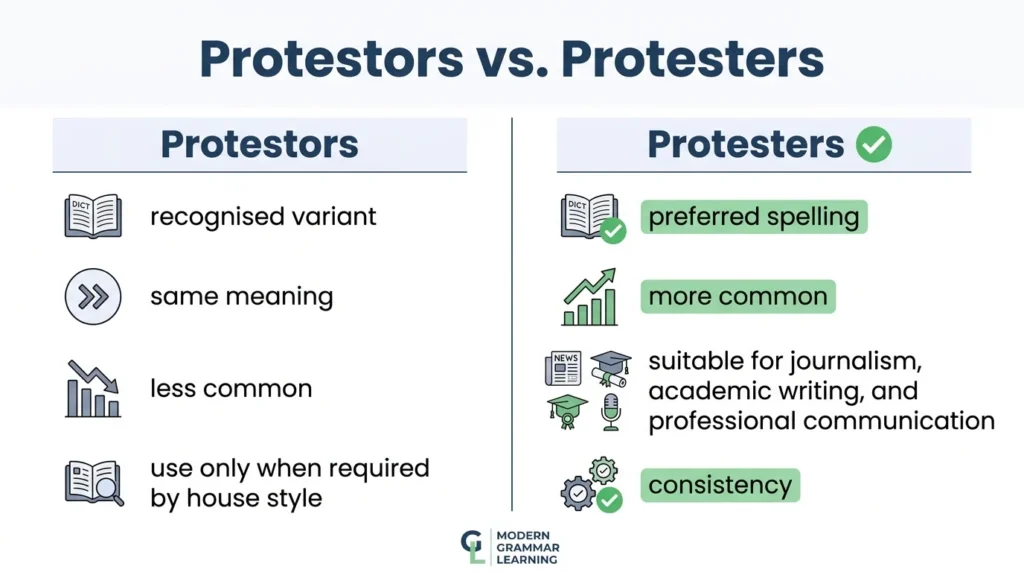
Both protesters and protestors are recognised spellings for people who publicly express disagreement. However, protesters is much more common and is the preferred form in most edited, academic, professional, and journalistic writing. Use protesters unless your organisation’s style guide specifically requires protestors. Whichever form you choose, use it consistently throughout the document.
What Do Protesters and Protestors Mean?
A protester or protestor is a person who publicly expresses disagreement, objection, or opposition.
That person may participate in a march, demonstration, rally, sit-in, strike, boycott, or another organised form of public protest.
Hundreds of protesters gathered outside the building.
Both spellings refer to the same type of person. There is no established difference in meaning between a protester and a protestor.
The plural forms are:
- protester → protesters
- protestor → protestors
Modern dictionaries recognise both forms, although they commonly present protester as the main entry or primary spelling. tor a Real Word?
Yes. Protestor is a real and recognised variant of protester.
It should not be treated as a meaningless invention or an automatic spelling error. However, it is less common and may conflict with the editorial rules used by a newspaper, university, publisher, government department, or company.
Therefore, the most accurate answer is:
Protestor is acceptable, but protester is generally preferred.
What Part of Speech Are These Words?
Both protester and protestor are countable nouns.
A countable noun names something that can be counted:
- one protester
- two protesters
- several protesters
- a group of protesters
The words are known as agent nouns. An agent noun identifies the person or thing performing an action.
In this case:
- protest is the action.
- A protester is the person performing that action.
Why the Spelling Choice Matters
Using protestors instead of protesters will not normally change the meaning of a sentence. Readers will understand both forms.
The choice still matters in edited writing because consistency affects credibility.
A report that uses protesters in one paragraph and protestors in the next can appear careless. The inconsistency may distract an editor, client, teacher, or attentive reader even though neither form is inherently meaningless.
The issue is especially relevant in:
- newspaper reporting
- academic assignments
- political analysis
- legal commentary
- public policy documents
- professional emails
- website content
- press releases
- historical writing
Writers must also choose related labels carefully. A protester is not automatically a rioter, and an activist does not need to be participating in a public protest at that moment. Precise wording prevents a spelling discussion from becoming a factual or tonal mistake.
Also Read: Dysregulated vs Disregulated: Which Word Is Correct?
The Core Rule
Use protesters as your default spelling. Use protestors only when it is required by an established house style or when you are preserving the spelling in a quotation, title, or proper name.
Follow this three-step rule:
- Choose protesters when no style guide is available.
- Check the required style when writing for an organisation or publication.
- Keep the selected spelling consistent throughout your document.
Why Protesters Is Usually Preferred
English commonly forms nouns for people performing actions by adding -er to a verb.
For example:
- teach → teacher
- work → worker
- march → marcher
- speak → speaker
- campaign → campaigner
- protest → protester
This pattern makes protester feel natural and predictable.
English also has many agent nouns ending in -or, including actor, director, editor, inventor, and supervisor. Those familiar words help explain why protestor looks reasonable and has remained in use.
The existence of the -or ending does not make every agent noun interchangeable. English spelling develops through usage and convention rather than one perfectly consistent suffix rule.
How to Use Protesters and Protestors
Use Protesters in General Writing
Use protesters in ordinary essays, articles, reports, emails, and social media posts.
Peaceful protesters assembled near the town hall.
The protesters carried signs calling for policy changes.
Police redirected traffic while the protesters crossed the road.
This is the safest spelling because it is widely recognised and preferred by influential editorial style guides. stors When a Style Requires It
You may use protestors when an employer, publisher, client, teacher, or organisation has selected that form.
The report referred to the demonstrators as protestors throughout.
Consistency is more important than changing forms based on personal preference halfway through a document.
Preserve the Original Spelling in Direct Quotations
Do not silently change protestors to protesters when reproducing an exact quotation unless your editing rules permit such changes.
Original quotation:
“The protestors remained outside until midnight.”
When exact wording matters, preserve the source’s spelling. You may use [sic] only when necessary and appropriate, but it would usually be excessive here because protestors is an accepted variant.
Also Read: Unenroll vs Disenroll: Meaning and Key Difference
Use the Correct Singular or Plural Form
Use protester for one person:
One protester spoke to the reporter.
Use protesters for two or more people:
Several protesters spoke to the reporter.
The same number rule applies to the alternative spelling:
One protestor addressed the crowd.
Several protestors addressed the crowd.
Form the Possessive Correctly
For one person, add an apostrophe and s:
the protester’s sign
This phrase means the sign belongs to one protester.
For multiple protesters, place the apostrophe after the plural s:
the protesters’ signs
This phrase means the signs belong to several protesters.
Use Counter-Protester for an Opposing Participant
A person participating in a protest against another protest may be called a counter-protester.
Both closed and hyphenated forms can appear:
- counterprotester
- counter-protester
The plural forms are:
- counterprotesters
- counter-protesters
Dictionaries recognise these forms, but a publication may choose one as its house style. ion of Protester and Protestor
The change from -er to -or does not normally create a difference in pronunciation. A speaker is unlikely to reveal which spelling they have in mind.
Pronunciation varies by accent. Common forms include:
British English: pruh-TEST-uh
American English: PROH-tes-ter or pruh-TEST-er
IPA forms may include:
- UK: /prəˈtes.tə(r)/
- US: /ˈproʊ.tes.tɚ/
Stress patterns vary, and dictionaries record more than one accepted pronunciation. The spelling question matters primarily in writing, not speech. amples
| Context | Correct example |
|---|---|
| Conversation | Several protesters were standing near the station this morning. |
| Please inform the security team that protesters may gather outside the entrance. | |
| School | The student interviewed two protesters for her history project. |
| Workplace | Employees were advised to use the rear entrance during the protest. |
| Journalism | Peaceful protesters marched through the city centre on Saturday. |
| Social media | Local protesters are collecting food for families affected by the closures. |
| Academic writing | The study examined how news reports described protesters during periods of social unrest. |
| Public announcement | Drivers should expect delays while protesters move along the planned route. |
| Meeting | The committee discussed how officials had responded to the protesters’ demands. |
| Legal context | Lawyers argued that the protesters had remained within the designated area. |
| Historical writing | Protesters gathered to oppose the proposed legislation. |
| Alternative spelling | The editor retained protestors because the client’s style guide required that form. |
Incorrect vs. Correct Examples
The following table treats an example as incorrect when it breaks grammar, spelling consistency, punctuation, number agreement, or the required editorial style. It does not suggest that protestor is always an invalid word.
| ❌ Incorrect | ✅ Correct | Why |
| A group of protester gathered outside. | A group of protesters gathered outside. | The sentence refers to multiple people, so the plural noun is required. |
| One protesters approached the gate. | One protester approached the gate. | One requires the singular form protester. |
| The protesters was carrying banners. | The protesters were carrying banners. | A plural subject takes the plural verb were. |
| The protester’s marched peacefully. | The protesters marched peacefully. | No possession is involved, so an apostrophe should not be used. |
| The protesters signs filled the square. | The protesters’ signs filled the square. | The signs belong to multiple protesters, so the apostrophe follows the plural s. |
| A protester signs was damaged. | A protester’s sign was damaged. | The sign belongs to one protester, requiring the singular possessive form. |
| Protesters arrived first, but the protestors left early. | Protesters arrived first, but the protesters left early. | Both spellings are recognised, but switching forms without a reason creates inconsistency. |
| The newspaper’s required style says “protester,” but the report uses “protestor.” | The newspaper’s required style says “protester,” and the report uses “protester.” | Writers should follow the publication’s established house style. |
| The anti war protesters crossed the bridge. | The anti-war protesters crossed the bridge. | Anti-war is a compound modifier placed before a noun, so the hyphen improves clarity. |
| Hundreds of peaceful protester attended. | Hundreds of peaceful protesters attended. | Hundreds of requires a plural noun. |
| Every protesters received a leaflet. | Every protester received a leaflet. | Every is followed by a singular countable noun. |
| All protesters is expected to leave by nine. | All protesters are expected to leave by nine. | The plural subject protesters requires are. |
| The reporter described every participant as a rioter. | The reporter distinguished peaceful protesters from people involved in violence. | Protester and rioter describe different conduct and should not be treated as automatic synonyms. |
Also Read: Conex or Connex: What Is the Difference?
Why People Confuse Protestors and Protesters
The Pronunciation Is the Same
Most speakers pronounce protester and protestor identically.
Because the endings sound alike in unstressed speech, pronunciation offers little help when choosing the written form.
Both Agent-Noun Endings Exist
English uses both -er and -or to create nouns for people or things that perform actions.
Words ending in -er include:
- teacher
- runner
- speaker
- worker
Words ending in -or include:
- actor
- editor
- conductor
- inventor
Since both endings are familiar, writers may select either one by analogy.
Both Spellings Appear in Dictionaries
Spellcheckers may accept protestor because it is a recognised word.
This can confuse writers who expect software to identify one form as completely wrong. A spelling checker tests whether a word exists; it may not know which version your teacher, employer, client, or publication prefers.
Search Results Contain Both Forms
Online articles, legal documents, social media posts, books, comments, and news reports contain both spellings.
A search engine displays real usage rather than enforcing one universal editorial rule. Finding examples of protestors therefore proves that the variant is used, but it does not show that it is the preferred form for your document.
Writers Overgeneralise the -or Ending
A writer may connect protestor with words such as demonstrator, objector, agitator, or oppressor.
The analogy is understandable, but English word formation is not completely uniform. The more established general spelling remains protester.
Also Read: Emersion vs Immersion: Difference and Which One Is Correct?
Translation Can Affect Word Formation
English learners may be influenced by an equivalent word in another language or by familiar English words ending in -or.
The easiest solution is not to build the spelling from pronunciation each time. Learn protester as the default complete form.
Common Mistakes Checklist
Treating Protestor as Meaningless
The mistake: Claiming that protestor is never a real word.
Why it happens: Many style guides strongly prefer protester, leading writers to confuse a style preference with an absolute spelling rule.
How to avoid it: Explain that both forms are recognised but that protester is preferred.
Assuming Protestor Is American English
The mistake: Presenting protestor as the standard American spelling and protester as the British spelling.
Why it happens: Several familiar American words use -or, and online explanations sometimes turn a usage preference into a regional rule.
How to avoid it: Remember that protester is widely used in both American and British English.
Switching Spellings Midway
The mistake: Using protesters in one section and protestors in another.
Why it happens: Both pass many spelling checks, so the inconsistency may be missed.
How to avoid it: Search the completed document for both forms before publishing.
Adding an Unnecessary Apostrophe
The mistake: Writing protester’s when you mean more than one protester.
Why it happens: The writer uses an apostrophe to form a plural.
How to avoid it: Use protesters for a plural and protester’s only for singular possession.
Confusing Protesters With Activists
The mistake: Assuming every activist is currently a protester.
Why it happens: Activism and public protest often overlap.
How to avoid it: Use protester for someone participating in or making a protest. Use activist for someone who actively campaigns for political or social change, which may involve many activities beyond protests.
Confusing Protesters With Rioters
The mistake: Calling all participants in a protest rioters.
Why it happens: News coverage may focus on conflict, property damage, or confrontations.
How to avoid it: Describe observed conduct precisely. A protester expresses opposition; a rioter participates in violent public disorder. A person may fit both descriptions in a particular situation, but the terms are not automatically interchangeable.
Using the Wrong Singular Form After Every
The mistake: Writing every protesters.
Why it happens: The writer thinks about the whole group rather than the grammar of every.
How to avoid it: Use a singular noun after every: every protester.
Protestors or Protesters in Real English
Grammatically Correct English
Both protester and protestor function as standard countable nouns. Each can have a singular, plural, and possessive form. A sentence such as “The protestors gathered outside” is grammatically complete. However, grammatical correctness does not automatically settle an editorial choice. A publication can recognise both forms while still requiring one spelling for consistency. ally Possible but Unnatural English
Using protestors is not inherently unnatural, but switching repeatedly between protestors and protesters within one article can look unpolished. Similarly, “the protesting protesters protested” is grammatically possible but stylistically awkward because it repeats the same word family. A more natural version might be, “The demonstrators continued their protest outside the building.”
Natural Everyday English
In everyday edited English, protesters is the most natural default. It appears comfortably in news reports, conversations, essays, emails, and captions. The spelling difference disappears in speech because both forms are pronounced alike. Most people will understand protestors, but some readers may see it as unusual or assume it conflicts with their preferred style guide.
American vs. British English
There is no dependable rule stating that Americans must write protestors while British writers must write protesters.
Dictionaries covering both varieties recognise the forms, and protester is widely preferred in edited writing on both sides of the Atlantic. A prominent British editorial style guide explicitly recommends protester, while American journalistic style also commonly prefers the -er form. tion may differ by accent:
- British speakers often stress the second syllable: pruh-TEST-uh.
- American speakers may stress the first syllable: PROH-tes-ter.
These pronunciation tendencies do not create different spelling rules.
Formal vs. Informal Usage
Formal Usage
Use protesters in formal writing unless an organisation’s style guide directs otherwise.
It is suitable for:
- academic papers
- news reports
- government documents
- professional correspondence
- policy analysis
- business reports
- legal commentary
Formal writing should remain consistent and use precise labels for participants and their conduct.
Informal Usage
Either spelling may appear in text messages, comments, personal posts, and informal discussions.
Protesters are already gathering near the park.
I saw a group of protestors outside the venue.
Both sentences will be understood. Even in informal writing, protesters remains the safest default.
Protestors vs. Protesters Comparison Table
| Feature | Protestors | Protesters |
| Meaning | People who protest | People who protest |
| Part of speech | Countable noun | Countable noun |
| Singular form | Protestor | Protester |
| Plural form | Protestors | Protesters |
| Dictionary status | Recognised variant | Primary or preferred form |
| General frequency | Less common | More common |
| Meaning difference | None | None |
| Pronunciation difference | Usually none | Usually none |
| American English | Recognised but less preferred | Widely used and preferred |
| British English | Recognised in some dictionaries | Widely used and preferred |
| Journalistic writing | May conflict with house style | Usually the safer form |
| Academic writing | Acceptable if permitted and consistent | Recommended default |
| Professional writing | Understandable but less conventional | Recommended default |
| Best choice without guidance | Usually avoid | Use this form |
| Example | The protestors carried banners. | The protesters carried banners. |
Protester, Demonstrator, Activist, and Rioter
These words overlap, but they do not mean exactly the same thing.
| Word | Basic meaning | Appropriate use |
| Protester | A person publicly expressing objection or opposition | Someone participating in a protest |
| Demonstrator | A participant in a public demonstration | A close synonym for protester |
| Activist | A person actively campaigning for political or social change | Someone engaged in sustained advocacy |
| Marcher | A person participating in an organised march | When movement in a march is relevant |
| Picketer | A person protesting outside a workplace or location, often with signs | Labour disputes and organised picketing |
| Dissenter | A person who openly disagrees with an official or widely accepted position | Religious, political, legal, or intellectual disagreement |
| Rioter | A participant in violent public disorder | Only when violent disorder is involved |
| Counter-protester | A person protesting against another protest or its message | Opposing demonstrations |
Memory Trick
Remember this sentence:
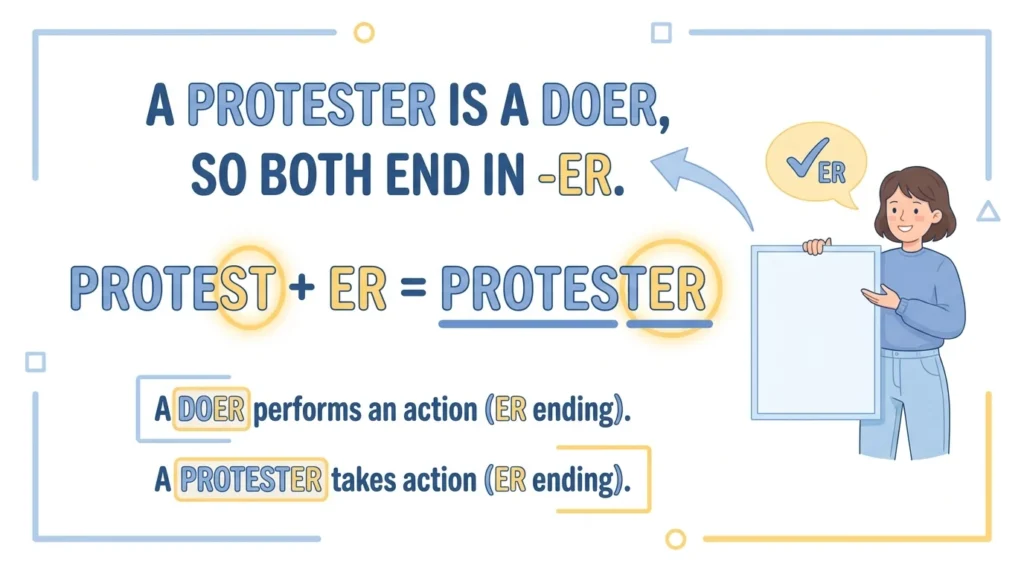
A protester is a doer, so both end in -er.
A protester does the action of protesting. Connecting protester with doer helps you remember the preferred ending.
You can also break the word into two parts:
protest + er = protester
Also Read: Kinesthesiology vs Kinesiology: What’s the Difference?
Real-Life Situations
Job Interview
Interviewer: Tell me about a challenging assignment you completed.
Candidate: I coordinated building access while protesters gathered outside our main office.
The candidate uses the preferred spelling in a professional context.
Workplace Meeting
Manager: Which entrance will remain open during the demonstration?
Security officer: The eastern entrance will remain open, and barriers will separate protesters from arriving vehicles.
The noun clearly identifies people taking part in the demonstration.
Professional Email
Staff should expect travel delays because protesters plan to march along Central Avenue between noon and 2 p.m.
This spelling is appropriate for a clear workplace announcement.
Text Message
There are protesters near the station, so my bus is taking another route.
The sentence uses the natural everyday spelling.
Academic Assignment
The researchers examined whether news reports portrayed peaceful protesters and violent participants differently.
The writer distinguishes people by their conduct rather than using one broad label inaccurately.
Newsroom
Reporter: Should I use protestors or protesters?
Editor: Our style guide uses protesters. Please apply that spelling throughout the article.
The decision reflects house style rather than a difference in meaning.
Examination
Question: Choose the preferred spelling for formal writing: protestors or protesters.
Answer: Protesters
Both forms may be recognised, but protesters is the safer formal choice.
Also Read: Emaculate vs Immaculate: Correct Spelling & Meaning
Expert Tips
Separate Correctness From Preference
A word can be accepted by dictionaries while remaining less common or unsuitable under a particular style guide.
Describe protestor as a recognised variant, not as pure nonsense. Describe protester as the preferred default, not as the only form ever used.
Follow House Style Before Personal Preference
An organisation may make editorial decisions for consistency rather than because every alternative is grammatically incorrect.
When writing for a client or publisher, its established style takes priority.
Run a Consistency Search
Before publishing, search the document for:
- protester
- protestor
- protesters
- protestors
- protester’s
- protesters’
This quick check catches spelling switches and apostrophe mistakes.
Use Labels That Match Conduct
Do not replace protester with rioter, extremist, agitator, or mob member merely to avoid repetition. These words can carry different factual meanings and emotional implications.
When possible, describe what the people did:
Protesters blocked the road for twenty minutes.
This sentence is more informative than using an emotionally loaded label without evidence.
Distinguish Identity From Temporary Action
A person who attends one demonstration can be described as a protester in that context. The word does not necessarily define the person’s permanent identity, profession, or complete political position.
Check Singular and Plural Possessives
Use these patterns:
- one protester
- several protesters
- one protester’s sign
- several protesters’ signs
Possessive punctuation often causes more serious errors than the -er/-or spelling choice.
Quick Summary
Both protesters and protestors describe people who publicly express disagreement, and both forms are recognised. However, protesters is more common and is the preferred spelling in most professional, academic, journalistic, and edited writing. Also you can visit Worddifferences. The difference is not a reliable American-versus-British distinction, and the two forms are normally pronounced alike. Use protesters when no style guide has been provided. Use protestors only when required by house style or when preserving original wording. Most importantly, do not switch between the spellings within one document. Remember the preferred form with the sentence: “A protester is a doer, so both end in -er.”
Frequently Asked Questions
Is protestor a spelling mistake?
Not necessarily. Protestor is a recognised alternative spelling of protester. However, many editors and style guides prefer protester, so protestor may be corrected when it conflicts with an organisation’s required style.
Which spelling should I use in an academic paper?
Use protester unless your university, journal, teacher, or required style guide specifies another form. The -er spelling is the safer and more conventional academic choice.
Which spelling should journalists use?
Journalists should follow their publication’s house style. Major journalistic style guidance generally favours protester, making it the safest choice for news writing. protesters and protestors in the same article?
Avoid switching between them unless you are reproducing direct quotations or discussing the spellings themselves. Using one form consistently creates a more polished article.
Is protestor more formal than protester?
No. The -or ending may appear formal because it resembles words such as director and supervisor, but protestor is not inherently more formal. Protester is usually preferred in formal writing.
Do protester and protestor have different meanings?
No established modern meaning separates them. Both describe a person who protests or participates in a public protest.
What is the plural of protester?
The plural is protesters.
One protester spoke while the other protesters listened.
How do I write the possessive form of protesters?
For one person, write protester’s:
the protester’s banner
For several people, write protesters’:
the protesters’ banners
Is a protester the same as an activist?
Not always. A protester participates in or makes a protest. An activist campaigns actively for political or social change through protests, organising, education, fundraising, lobbying, or other activities.
Is every protester a rioter?
No. A protester expresses disagreement or opposition. A rioter participates in violent public disorder. A person’s conduct may justify both descriptions in a specific case, but the words are not synonyms.
Should counter-protester have a hyphen?
Both counter-protester and counterprotester appear in standard usage. Follow your organisation’s style and remain consistent.
Why does my spellchecker accept protestor?
Spellcheckers often accept recognised dictionary variants. They cannot always determine which spelling your publication, employer, teacher, or client prefers.
Mini Quiz
| No. | Question | Answer | Explanation |
| 1 | Which is the preferred general spelling: protesters or protestors? | Protesters | Both are recognised, but protesters is more common and widely preferred. |
| 2 | True or false: Protestor has no recognised English usage. | False | It is an accepted variant, although it is less common. |
| 3 | Fill in the blank: “One _____ spoke to the journalist.” | protester | One requires the singular form. |
| 4 | Fill in the blank: “Several _____ marched through the city.” | protesters | Several requires a plural noun. |
| 5 | Correct the sentence: “The protesters was carrying signs.” | The protesters were carrying signs. | The plural subject requires the plural verb were. |
| 6 | Choose the correct possessive: “The _____ sign was damaged.” A) protesters B) protester’s | B) protester’s | The sign belongs to one protester, so the singular possessive is required. |
| 7 | Choose the correct plural possessive: “The _____ banners were displayed.” A) protesters’ B) protester’s | A) protesters’ | The banners belong to multiple protesters. |
| 8 | Correct the inconsistency: “The protesters arrived, and the protestors began chanting.” | The protesters arrived, and the protesters began chanting. | Use one spelling consistently unless there is a specific reason to switch. |
| 9 | Are protester and rioter exact synonyms? | No | A protester expresses opposition, while a rioter participates in violent public disorder. |
| 10 | Which sentence is best for formal writing? A) Protestors gathered outside. B) Protesters gathered outside. | B | Both can be understood, but protesters is the recommended formal default. |