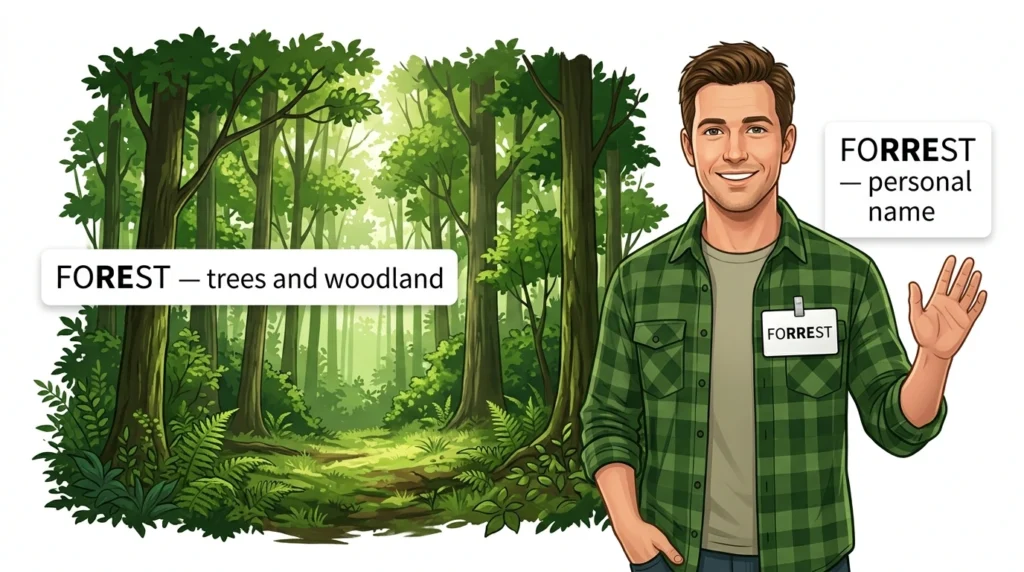

Forest is the standard English word for an area of land covered with trees. Forrest is generally used as a personal name or surname, not as the ordinary word for woodland. So, if you are writing about trees, wildlife, nature, or a wooded area, use forest. If you are writing someone’s name, keep the official spelling Forrest.
What Is Forest vs Forrest?
Forest and Forrest look almost identical, but they normally serve different purposes.
Forest is a common noun. It refers to a large area of land covered with trees and plants. It can be used in everyday English, academic writing, environmental writing, news reports, and many other contexts.
Forrest, with two r’s, is most commonly encountered as a proper name, such as a person’s first name or surname. Because names can have spellings that differ from ordinary words, Forrest can be correct when it is someone’s actual name.
Compare:
- We walked through the forest. → trees and woodland
- Forrest called me yesterday. → a person’s name
The important point is that Forrest is not the normal spelling of the word for a wooded area.
Why It Matters
A single extra letter can change what your reader understands.
Writing about a national park, wildlife, environmental research, hiking, forestry, or nature requires forest, not forrest.
For example:
We spent three hours hiking through the forrest.
The meaning is easy to understand, but the spelling is incorrect for the intended noun.
The correct version is:
We spent three hours hiking through the forest.
The difference also matters when writing about someone’s name. If a person’s official name is Forrest, changing it to Forest can create a different name and therefore a different identity.
This is particularly important in:
- School assignments
- University papers
- Emails
- Business documents
- Articles and websites
- Resumes and biographies
- Addresses and records
- Names of people, companies, or organizations
The Core Rule
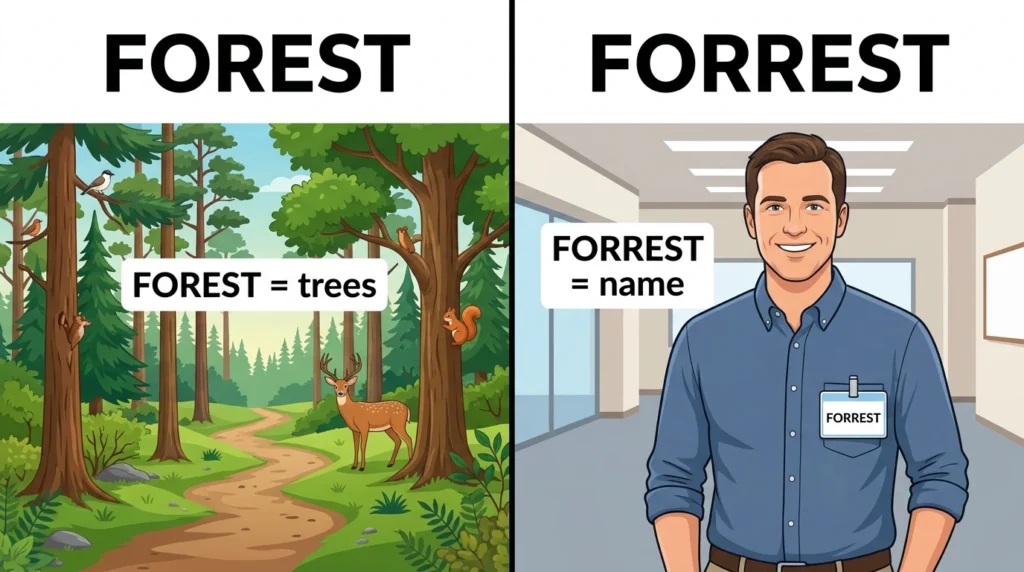
Forest = an area covered with trees.
Forrest = usually a personal name or surname.
When you mean woodland, use forest.
When you mean a person whose name is Forrest, preserve the spelling Forrest.
There is no general English spelling rule that changes forest into forrest when you mean a particularly large, dense, or beautiful woodland.
The One-Second Test
Ask yourself:
“Am I talking about trees or a person?”
- Trees or woodland → forest
- A person named Forrest → Forrest
For example:
The forest was covered in mist. ✅
Forrest was waiting outside. ✅
But:
The forrest was covered in mist. ❌
The extra r does not make the noun more correct.
How to Use Forest
Use forest when referring to a wooded area, forests generally, or something associated with forests.
Talking About a Particular Forest
Use forest with an article when referring to a specific forest.
We entered the forest before sunset.
The forest was unusually quiet.
They built a road through the forest.
Talking About Forests in General
You can also use forest as an uncountable noun or forests as a plural countable noun, depending on the meaning.
Much of the region is covered in forest.
Tropical forests contain enormous biological diversity.
Forests provide habitats for many species.
Both singular and plural forms are normal; the choice depends on whether you mean forest as a general land cover or individual forests.
Forest in Compound Expressions
Forest appears naturally in many common combinations:
- forest floor
- forest fire
- forest management
- forest ranger
- forest habitat
- forest ecosystem
- forest conservation
- forest land
- forest wildlife
- forest restoration
- tropical forest
- pine forest
- dense forest
For example:
The researchers studied the forest ecosystem.
Not:
The researchers studied the forrest ecosystem.
How to Use Forrest
Use Forrest when it is part of a person’s official name or another proper name that uses that spelling.
For example:
Forrest will join us after lunch.
I sent the document to Mr. Forrest.
The character’s name is Forrest.
In these sentences, Forrest identifies a particular person rather than describing a landscape.
Capitalization Matters
There is another useful visual clue.
forest is normally lowercase because it is a common noun:
We walked through the forest.
Forrest is normally capitalized when it is a person’s name:
Forrest walked into the room.
However, capitalization alone should not be treated as the entire rule. A common noun can begin with a capital letter at the beginning of a sentence, and Forest can also occur as part of an official name.
The meaning and context determine the correct form.
Correct Examples
Here are original examples showing how forest and Forrest work in different situations.
- Conversation:
“We got lost in the forest for almost an hour.” - Email:
“The team will meet near the forest entrance at 9 a.m.” - School writing:
“The forest provides shelter for many species of birds.” - Academic writing:
“The study examines changes in forest cover over several decades.” - Workplace report:
“The project may affect the surrounding forest ecosystem.” - Social media:
“Nothing beats an early-morning walk through the forest.” - Travel writing:
“Our guide took us deep into the forest before sunrise.” - Personal message:
“Forrest said he would call you later.” - Biography:
“Forrest began his career in the early 1990s.” - Dialogue:
“Forrest, are you coming with us?” - Environmental writing:
“The government introduced measures to protect the remaining forest.” - Creative writing:
“Moonlight filtered through the silent forest.”
Notice that the choice depends on meaning, not on how many trees are being discussed.
Read More: Fliers vs Flyers: Which Spelling Is Correct?
Incorrect vs. Correct
| ❌ Incorrect | ✅ Correct | Why |
|---|---|---|
| We walked through the forrest. | We walked through the forest. | Forest is the standard noun for a wooded area. |
| The forrest was very dense. | The forest was very dense. | The extra r is not part of the ordinary spelling. |
| Many animals live in the forrest. | Many animals live in the forest. | The sentence refers to woodland, not a person’s name. |
| They are protecting the forrest. | They are protecting the forest. | Environmental contexts use forest. |
| We camped beside the forrest. | We camped beside the forest. | Forest is the correct common noun. |
| The forrest floor was wet. | The forest floor was wet. | The established compound is forest floor. |
| Forrest covers most of the mountain. | Forest covers most of the mountain. | The sentence describes land covered with trees. |
| I met Forest yesterday. | I met Forrest yesterday. | If the person’s actual name is Forrest, the official spelling should be preserved. |
| Forrest is my colleague. | Forrest is my colleague. | Here the double-r form is correct because it is a person’s name. |
| The Forest was dark and quiet. | The forest was dark and quiet. | A common noun normally remains lowercase unless another capitalization rule applies. |
The last example illustrates an important point: Forest is not automatically wrong simply because it begins with a capital letter. If it starts a sentence, for example, capitalization is required:
Forest fires can spread rapidly.
The spelling problem is the extra r, not capitalization by itself.
Why People Make This Mistake
The confusion is understandable because forest and Forrest are visually similar and can sound the same in English.
Phonetic Similarity
When people hear a word rather than see it written, pronunciation does not always reveal its spelling.
A listener may hear:
“forest”
and later wonder whether it should be written forest or forrest.
English contains many spelling patterns that cannot be predicted perfectly from pronunciation, so sound alone is not a reliable spelling guide.
Cambridge gives pronunciations for forest in both British and American English, and the written form remains forest.
Familiarity With Names
Many English speakers have encountered Forrest as a personal name.
That makes the spelling visually familiar.
When someone already knows a person named Forrest, it is easy for the brain to transfer that spelling to the ordinary noun forest.
Overgeneralisation
English has many words containing doubled consonants:
- address
- different
- necessary
- occasion
- successful
Learners may unconsciously assume that another r makes forrest look more like a conventional English spelling.
But spelling patterns cannot always be applied mechanically.
Autocomplete and Spellcheck
Modern typing tools can reduce some mistakes, but they do not eliminate the need to understand the distinction.
A spellchecker may recognize Forrest as a legitimate name. That does not mean Forrest is appropriate whenever you mean woodland.
Names create a particular problem because software may not know the intended context.
Translation Interference
Learners who think first in another language may sometimes map a familiar translated word to an English spelling based on sound or visual memory.
This is especially common when learning vocabulary through listening rather than reading.
The safest approach is to learn the English word together with its written form:
forest = woodland
rather than trying to reconstruct its spelling from pronunciation.
Common Mistakes Checklist
Mistake 1: Adding a second “r”
Problem: Writing forrest when talking about trees.
Why it happens: The spelling resembles familiar double-letter patterns and the name Forrest is also familiar.
Fix: Remember:
Forest has one r.
Mistake 2: Treating Forrest as an alternative spelling of forest
Problem: Assuming both forms are interchangeable.
Why it happens: The two forms are visually close.
Fix: Separate their normal roles:
- forest → woodland
- Forrest → personal name or surname
Mistake 3: Changing someone’s name
Problem: Writing Forest when someone’s actual name is Forrest.
Why it happens: The writer recognizes the word as the ordinary noun and automatically corrects it.
Fix: Names must retain their established spelling.
Mistake 4: Trusting pronunciation alone
Problem: Choosing spelling based only on what you hear.
Why it happens: Spoken English does not always reveal spelling.
Fix: When uncertain, check the written form rather than guessing from sound.
Mistake 5: Assuming a capital letter makes “Forrest” correct
Problem: Writing Forrest simply because the word is being used as a noun.
Why it happens: Learners sometimes associate capital letters with important nouns.
Fix: Capitalization follows grammatical and naming rules. Forest remains the normal common noun.
Forest in Real English
Grammatically Correct and Natural
“We walked through the forest.”
This is ordinary, natural English. Forest is the standard noun for a large area of land covered with trees and plants. Dictionaries also show common combinations such as forest floor, forest fire, and forest management. The word is used naturally in conversation, education, journalism, environmental writing, and academic contexts.
Grammatically Possible but Context-Dependent
“The forest is valuable.”
This sentence is grammatically correct, but its exact meaning depends on context. A forest might be valuable for ecological, economic, cultural, recreational, or other reasons. The word forest itself does not specify which value is intended. Good writing adds the missing information when the reader needs it: “The forest is valuable because it provides habitat for several endangered species.”
Natural Everyday English
“I love walking in the forest.”
This sounds straightforward and natural when talking about outdoor activities. Other common patterns include in the forest, through the forest, forest floor, forest fire, and forest path. Oxford’s usage information similarly shows patterns such as “in a/the forest,” “through a/the forest,” and “the edge of the forest.”
A Name Requires the Name’s Spelling
“Forrest emailed me this morning.”
Here Forrest is natural if that is the person’s name. Replacing it with Forest would not be a spelling correction; it would change the name.
This distinction is important because proper names do not have to follow the spelling of similarly shaped common nouns.
American vs. British English
There is no meaningful American-versus-British spelling difference between forest and Forrest for this particular question.
Both varieties use forest for the wooded area.
The pronunciation can differ between British and American English, but that does not create an alternative spelling with two r’s. Cambridge lists British and American pronunciations for forest, while the written word remains forest.
There is, however, a related vocabulary difference worth knowing: the idiom “not see the forest for the trees” is identified as North American English, while British English commonly uses “not see the wood for the trees.” That is a vocabulary choice involving forest/wood, not a spelling change from forest to forrest.
Formal vs. Informal Usage
The spelling rule does not change between formal and informal English.
Use forest when referring to woodland in:
- Academic papers
- Business reports
- School assignments
- Government documents
- News articles
- Emails
- Text messages
- Social media
Use Forrest when that is the established spelling of a person’s name or another proper name.
For example:
Formal:
The report examines forest conservation in the region.
Informal:
We spent all afternoon in the forest.
The register changes, but the spelling of the woodland noun does not.
Comparison Table
| Feature | Forest | Forrest |
|---|---|---|
| Spelling | F-O-R-E-S-T | F-O-R-R-E-S-T |
| Main use | Common English noun | Usually a proper name |
| Meaning | An area covered with trees | Usually a person’s name or surname |
| Refers to woodland? | Yes | No, not as the standard modern common noun |
| Refers to a person? | Not normally | Yes, when it is the person’s name |
| Capitalization | Usually lowercase | Usually capitalized as a personal name |
| Example | “The forest was quiet.” | “Forrest was quiet.” |
| Common mistake | Adding an extra r | Using it as the noun for woodland |
| American/British spelling | Same | Same when it is a name |
| Everyday nature writing | Correct | Incorrect for this meaning |
Memory Trick
Use this simple mnemonic:
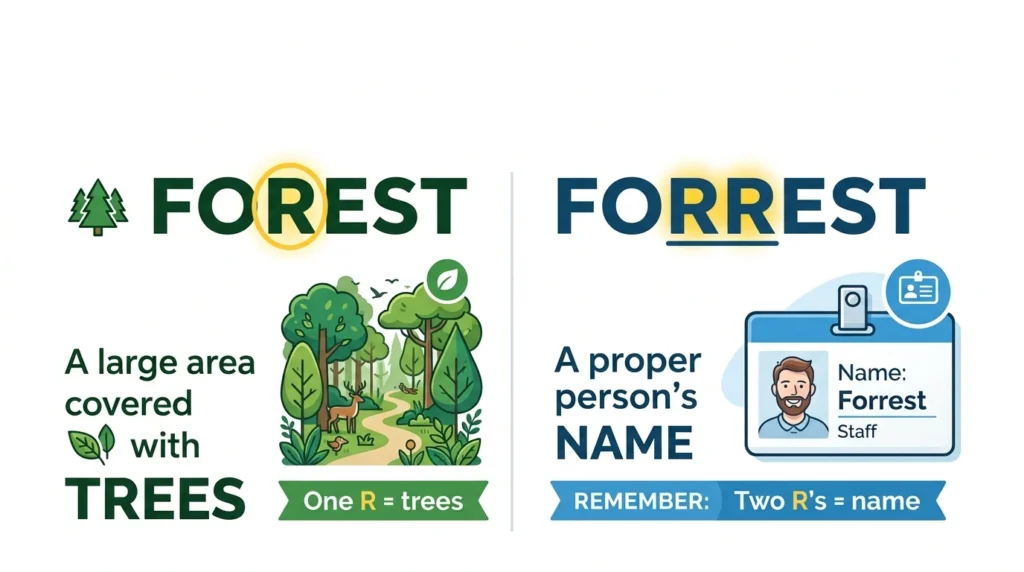
One R for trees: foRest.
Two R’s for a name: FoRRest.
Think of the extra R in Forrest as belonging to the person’s name, not to the trees.
Another quick test:
Can you replace the word with “woodland”?
- “We walked through the forest.” → Yes.
- “We walked through the Forrest.” → No, unless Forrest is the name of a person or named place.
So:
Forest = woodland
Forrest = name
Real-Life Situations
In an Interview
Interviewer: Where did you grow up?
Candidate: Near a large forest outside the city.
The candidate is talking about a wooded area, so forest is correct.
In a Meeting
“The proposed road would pass close to the forest.”
A workplace or planning discussion still uses the ordinary spelling forest.
In an Email
“Please find attached the report on forest conservation.”
The formal setting does not change the spelling.
In a Text Message
“We’re going into the forest tomorrow.”
Informal communication still uses forest.
In an Exam
“Several species depend on the forest for food and shelter.”
Writing forrest here would be a spelling error because the sentence refers to woodland.
When Writing a Person’s Name
“Please send the invoice to Forrest.”
If the customer’s official name is Forrest, the double r must be retained.
In a Biography
“Forrest was born in the United States.”
Here the word is functioning as a person’s name, so Forrest is appropriate if that is the documented spelling.
Read More: Affend vs Offend: Which Spelling Is Correct?
Mini Quiz
| # | Question | Answer | Explanation |
|---|---|---|---|
| 1 | We walked through the ___ before sunset. A) forest B) forrest | A) forest | Forest is the standard noun for a wooded area. |
| 2 | My colleague’s name is ___. A) Forest B) Forrest | B) Forrest | Use the person’s official spelling. |
| 3 | Correct the sentence: “The animals live in the forrest.” | The animals live in the forest. | The sentence refers to woodland, so forest is required. |
| 4 | Which is correct? A) forest floor B) forrest floor | A) forest floor | Forest floor is the standard expression for the ground beneath a forest. |
| 5 | Fill in the blank: “___ sent me the report yesterday.” The person’s name is Forrest. | Forrest | A person’s name keeps its official spelling. |
| 6 | Which sentence is correct? A) The forrest was quiet. B) The forest was quiet. | B) The forest was quiet. | The sentence describes a wooded area. |
| 7 | Correct the sentence: “Forrest is covered with trees.” You mean a wooded area, not a person’s name. | The forest is covered with trees. | Forest is the common noun for the wooded area. |
| 8 | Which spelling belongs in “___ conservation”? A) forest B) forrest | A) forest | The phrase concerns the protection and management of forests. |
| 9 | Choose the correct sentence: A) I spoke with Mr. Forest. B) I spoke with Mr. Forrest. The person’s surname is Forrest. | B) I spoke with Mr. Forrest. | Proper names should be written as officially established. |
| 10 | Fill in the blank: “The researchers studied the ___ ecosystem.” A) forest B) forrest | A) forest | Forest ecosystem refers to an ecosystem associated with woodland. |
Expert Tips
1. Learn the word visually
If spelling is your main difficulty, memorize:
F-O-R-E-S-T
rather than trying to construct the spelling from pronunciation.
2. Do not treat every familiar-looking form as a spelling variant
A word can look legitimate and still have a different grammatical or naming function.
Forrest is a good example.
3. Check names separately
If you are writing about a person, organization, place, or brand, do not automatically “correct” its spelling to the common noun you know.
The official name takes priority.
4. Pay attention to compounds
If you see expressions such as:
- forest floor
- forest fire
- forest management
- forest ecosystem
- forest conservation
the standard spelling is forest.
5. Use context, not just spellcheck
A spellchecker may recognize both forest and Forrest because both can occur legitimately in English. Your job is to decide which one matches the intended meaning.
6. Remember that pronunciation cannot always settle spelling
Two forms can sound alike while having different written functions. When writing matters, verify the spelling rather than relying only on sound.
FAQ
Is forest or forrest correct?
Forest is correct when you mean a large area of land covered with trees. Forrest is generally used as a personal name or surname. Therefore, “We walked through the forest” is correct, while “We walked through the forrest” is not standard spelling for woodland.
Is “forrest” a word?
Forrest is used legitimately as a proper name, including as a given name or surname. Lowercase forrest has also existed historically as an obsolete spelling of forest, but that does not make it the standard modern spelling for woodland. In present-day standard English, use forest for the natural area.
Why do people spell forest with two r’s?
The confusion is partly visual and partly phonetic. Forrest is a familiar personal name, while forest and Forrest can sound very similar or identical in ordinary speech. That makes it easy to transfer the double-r spelling from the name to the common noun.
Is Forrest a name?
Yes. Forrest is used as a personal name and surname. If someone’s documented name is Forrest, that spelling should be preserved rather than changed to Forest.
Is forest a noun?
Yes. Forest is primarily a noun when it refers to an area of land covered with trees. It can also occur in other grammatical uses and related forms. Major learner dictionaries classify the ordinary woodland sense as a noun.
Can forest be used as a verb?
Yes, although the verb use is much less common in everyday English than the noun. Related forms such as forested, afforestation, and reforestation are also common in environmental and forestry contexts. Cambridge, for example, defines forested as meaning covered by forest.
Are forest and Forrest pronounced the same?
They can be pronounced the same in ordinary English, which is one reason the spelling confusion occurs. The exact pronunciation of forest varies between English varieties; Cambridge gives separate British and American pronunciations.
Should I write “Forest” or “Forrest” in an essay?
If your essay is about trees, woodland, wildlife, or an ecosystem, write forest. If your essay mentions a person whose name is Forrest, write Forrest because it is that person’s proper name.
Is “forest” always lowercase?
No. Forest is normally lowercase when it is a common noun, but it can be capitalized at the beginning of a sentence or when it forms part of a proper name. The important distinction is not simply uppercase versus lowercase; it is the word’s function and meaning.
Which is correct: “forest fire” or “forrest fire”?
Forest fire is correct. The phrase refers to a fire burning in an area with many trees. Standard dictionaries list forest fire as the established expression.
What is the easiest way to remember forest vs. Forrest?
Remember:
Forest has one R for trees. Forrest has two R’s when it is a name.
Then ask yourself whether you are describing woodland or identifying a person.
Quick Summary
Forest and Forrest are not interchangeable spellings. Forest is the standard English noun for a large area of land covered with trees and plants, and it is the form you need for nature, wildlife, woodland, forestry, and environmental writing. Forrest is most commonly a personal name or surname, so it is correct when it is someone’s established name. The confusion often comes from their similar appearance and pronunciation, especially because Forrest is a familiar name. American and British English do not use different spellings for the woodland noun. The easiest memory trick is simple: forest = trees; Forrest = name. When in doubt, check the meaning before choosing the spelling.