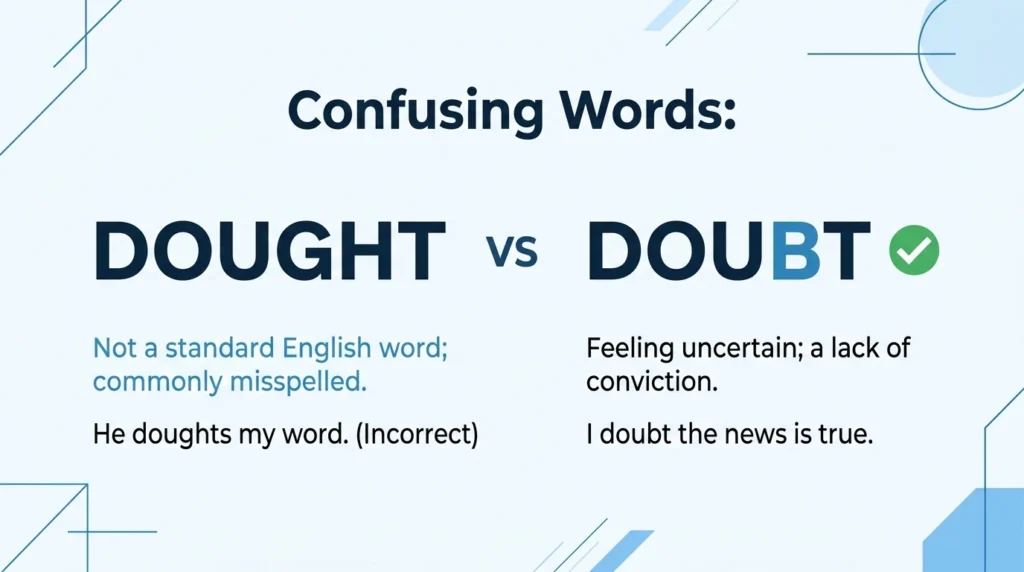

For normal modern English, doubt is the correct word when you mean uncertainty, disbelief, hesitation, or lack of confidence. Dought should not replace doubt in everyday, academic, or professional writing. However, dought is not completely invented: it exists as a rare historical or regional form connected with the Scots and Northern English verb dow, meaning “to be able” or “be capable.”
If your sentence means “I am not sure”, “I question this”, or “there is uncertainty,” use doubt.
What Is the Difference Between Dought and Doubt?
Doubt is a common modern English noun and verb. As a noun, it describes uncertainty or lack of confidence. As a verb, it means to feel uncertain about something, question whether it is true, or consider something unlikely.
Examples:
- I have doubt about the claim.
- I doubt the claim is accurate.
- She never doubted his ability.
- There is no doubt that we need more information.
Dought, by contrast, is not the standard spelling of doubt. It appears historically and regionally as a past-tense form of dow, a verb associated mainly with Scots and Northern English and meaning “to be able” or “be capable.”
For most writers, that historical meaning will never be needed.
Why the Difference Matters
Writing dought when you mean doubt can make an otherwise clear sentence look like a spelling error.
That matters in situations where small mistakes affect credibility, including:
- job applications and résumés
- business emails
- academic assignments
- exams
- client proposals
- reports
- website content
- professional social media posts
A reader may still understand what you mean, but correct spelling keeps attention on your message instead of the mistake.
The Core Rule
Rule: If you mean uncertainty, hesitation, disbelief, suspicion, or lack of confidence, write doubt, not dought.
Use dought only when you are deliberately discussing its rare historical or regional meaning.
A fast test is to replace the word with uncertainty or question.
If the meaning still works, you almost certainly need doubt.
Example:
“She had some ___ about the plan.”
“She had some uncertainty about the plan.”
Therefore:
✅ She had some doubt about the plan.
Read More: Bachelor vs Batchelor: Which Spelling Is Correct?
How to Use Doubt Correctly
Doubt can function as both a noun and a verb. A noun names something, while a verb describes an action or state.
Doubt as a Noun
As a noun, doubt refers to uncertainty, hesitation, or lack of confidence.
- I have doubts about the proposal.
- His explanation left me with some doubt.
- The result is still in doubt.
- There is little doubt that she understands the issue.
The plural doubts is common when referring to particular concerns or reservations.
Doubt as a Verb
As a verb, doubt means that you are uncertain about something, question it, or think it may not be true or likely.
- I doubt that he knows the answer.
- She doubted the accuracy of the figures.
- We never doubted her commitment.
- They are doubting whether the plan will work.
The normal verb forms are:
| Form | Word |
|---|---|
| Base form | doubt |
| Third-person singular | doubts |
| Past tense | doubted |
| Past participle | doubted |
| -ing form | doubting |
Common Expressions With Doubt
English also uses doubt in several established expressions.
Without a doubt means certainly.
She is, without a doubt, qualified for the role.
In doubt means uncertain or unresolved.
The final result remains in doubt.
No doubt can express certainty or strong probability.
He will no doubt ask for more information.
Give someone the benefit of the doubt means choosing to believe or trust someone despite some uncertainty.
I decided to give her the benefit of the doubt.
A Simple Three-Step Check
- Ask whether the sentence involves uncertainty, belief, trust, probability, or hesitation.
- If yes, choose doubt.
- Keep the b in writing, even though you do not pronounce it.
Why Is the B Silent in Doubt?
Doubt is pronounced approximately like “dout,” rhyming with out. The b is silent in standard pronunciation.
That silent letter is one reason people write dought or other phonetic spellings.
The spelling has a historical explanation. English acquired earlier forms of the word through French without the b. Later writers added a b to reflect the word’s relationship with Latin forms such as dubitare. The spelling changed, but the established pronunciation did not add a /b/ sound.
So:
Written: doubt
Pronounced: /daʊt/
Not: “dubt”
Correct Examples of Doubt
These examples show how doubt works across everyday and professional situations.
Conversation
- I doubt he will arrive before noon.
- There is no doubt that Maya enjoyed the trip.
Text Message
- I doubt I’ll be able to come tonight, but I’ll let you know.
Social Media
- If you’re in doubt about the information, check the original source before sharing it.
School
- The student expressed doubt about the answer and checked her calculations again.
- I have no doubt that regular practice will improve your spelling.
Workplace
- The new figures cast doubt on our original forecast.
- I doubt the team can finish the entire project by Friday without additional help.
- If you have any doubt about the instructions, please contact me before submitting the form.
- We do not doubt your ability to complete the work successfully.
Academic Writing
- The new evidence raises doubt about the earlier interpretation.
- The results give researchers reason to doubt the original assumption.
Read More: Signer vs Signor Difference: Meanings and Correct Usage
Dought vs Doubt: Incorrect and Correct Examples
| ❌ Incorrect | ✅ Correct | Why |
|---|---|---|
| I dought he will come. | I doubt he will come. | The sentence expresses uncertainty, so doubt is required. |
| There is no dought about it. | There is no doubt about it. | No doubt is the standard expression. |
| She doughted his story. | She doubted his story. | The past tense of doubt is doubted. |
| I have some doughts about the plan. | I have some doubts about the plan. | Particular concerns or uncertainties are doubts. |
| Without a dought, she was the best candidate. | Without a doubt, she was the best candidate. | The fixed phrase is without a doubt. |
| His answer created dought. | His answer created doubt. | The noun meaning uncertainty is doubt. |
| I dought your numbers are correct. | I doubt your numbers are correct. | The verb meaning “consider unlikely” is doubt. |
| The outcome remains in dought. | The outcome remains in doubt. | In doubt means unresolved or uncertain. |
| Never dought yourself. | Never doubt yourself. | Doubt yourself means lack confidence in yourself. |
| The evidence cast dought on the claim. | The evidence cast doubt on the claim. | The established phrase is cast doubt on. |
| We are doughting the decision. | We are doubting the decision. | The -ing form is doubting. |
| She had self-dought after the interview. | She had self-doubt after the interview. | Self-doubt is written with doubt and normally hyphenated. |
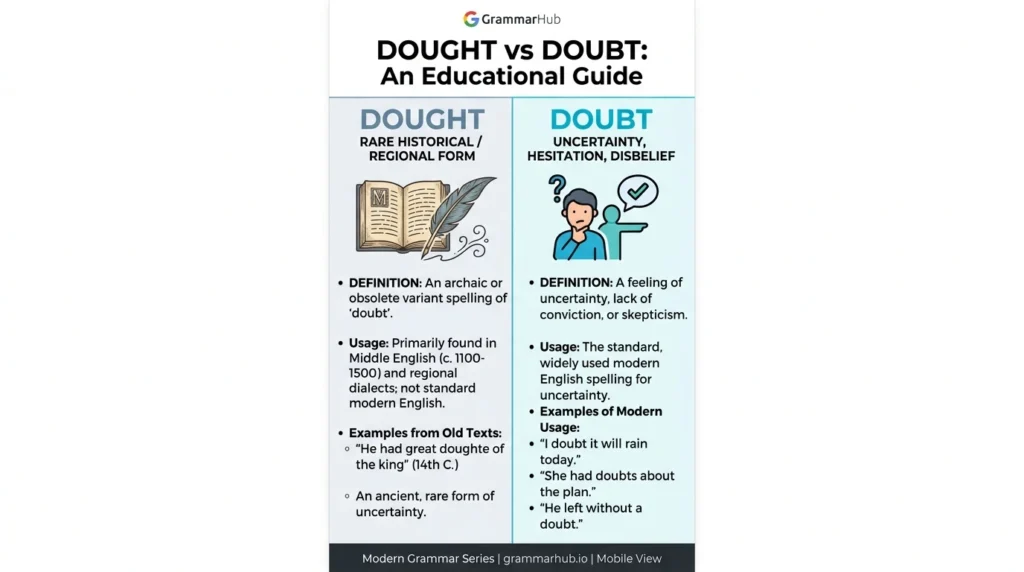
Is Dought a Real Word?
Yes, but this needs an important qualification.
Dought exists in historical and regional English. It has been recorded as a past form of dow, meaning roughly “to be able” or “be capable,” particularly in Scots and Northern English usage. Historical Scots records also contain forms such as docht, doucht, and dought.
That does not make dought an alternative modern spelling of doubt.
In normal contemporary writing:
❌ I dought your explanation.
is incorrect if you mean:
✅ I doubt your explanation.
This distinction is worth making because saying “dought is not a word” is too broad. Saying “dought is not the correct modern spelling of doubt” is more accurate.
Dought vs Doubt Comparison Table
| Feature | Dought | Doubt |
|---|---|---|
| Standard modern word for uncertainty? | No | Yes |
| Common in everyday English? | No | Yes |
| Can be a noun meaning uncertainty? | Not in standard modern usage | Yes |
| Can be a verb meaning to question or feel uncertain? | No | Yes |
| Historical/regional use? | Yes | Yes, but also fully modern |
| Common pronunciation | Rare/regional; historically similar forms exist | /daʊt/ |
| Silent b? | No b present | Yes |
| Example | Rare historical/regional contexts | “I doubt the claim.” |
| Recommended for business or academic writing? | Not when you mean uncertainty | Yes |
Why People Confuse Dought and Doubt
The B in Doubt Is Silent
The most obvious problem is pronunciation.
People hear doubt as /daʊt/, so the written b provides no sound clue. A learner who spells words mainly by sound may therefore omit or replace letters.
Dought Looks Like Other English -ought Words
English contains familiar words such as:
- thought
- bought
- brought
- fought
- sought
Because these words end in -ought, dought can look visually plausible.
However, English spelling patterns are not interchangeable. The fact that thought and bought use -ought does not mean doubt follows the same spelling pattern.
Doubt and Dought Can Sound Alike
In contexts where historical or regional dought occurs, its form may sound like doubt. That makes visual spelling, rather than pronunciation alone, important.
For modern learners, context is the simplest guide: if you mean uncertainty, use doubt.
Writers Overgeneralize Familiar Spelling Patterns
Once learners notice a pattern, they naturally try to apply it elsewhere.
For example:
thought → bought → brought → dought
The first three forms are real and familiar, so the fourth can feel reasonable even when the intended word is actually doubt.
Autocorrect and Spellcheck Are Not Perfect
A spelling checker can identify many mistakes, but it cannot always determine what you intended.
This matters especially when the accidental spelling is also a documented rare word, proper noun, name, or specialist term. Context still matters.
Do not depend entirely on software to choose between confusing words.
Translation Can Encourage Sound-Based Spelling
English learners whose first language has more predictable spelling may expect written letters to closely match pronunciation.
English often does not work that way. In doubt, the silent b must be remembered even though it is not heard.
Common Mistakes Checklist
- Writing by sound alone: You hear /daʊt/ and write dout or dought. Avoid this by memorizing the complete spelling d-o-u-b-t.
- Copying the -ought pattern: Words such as thought and bought make dought look natural. Check the meaning instead of relying on visual similarity.
- Pronouncing the b: The b belongs in the spelling, but standard pronunciation does not normally include a /b/ sound.
- Using dought as a normal alternative: Its rare historical existence does not make it interchangeable with doubt.
- Writing “doughted”: When you need the past tense of doubt, write doubted.
- Writing “doughts” for uncertainties: The correct plural is doubts.
- Misspelling self-doubt: The standard form is self-doubt, not self-dought.
- Trusting autocorrect without checking meaning: A tool may not always understand your intended sentence. Read the full sentence after correcting it.
Dought vs Doubt in Real English
Grammatically Correct English
In modern standard English, sentences such as “I doubt the claim,” “She has doubts about the plan,” and “The outcome is in doubt” are fully normal. Doubt works as either a verb or noun depending on the sentence. It can express uncertainty about facts, people, decisions, predictions, ability, or outcomes without requiring unusual grammar.
Grammatically Possible but Unnatural English
A sentence can be technically understandable while still sounding heavier than everyday English. For example, “I possess doubt regarding his statement” communicates uncertainty, but most speakers would simply say “I doubt his statement” or “I have doubts about his statement.” Good writing is not only about avoiding errors. It also means choosing structures that fit how English is normally used.
Natural Everyday English
In conversation, people often use short structures such as “I doubt it,” “I doubt he’ll come,” “I have my doubts,” and “No doubt.” The exact choice depends on meaning. “I doubt it” usually signals that you think something is unlikely or untrue, while “I have my doubts” expresses reservations without necessarily rejecting the idea completely.
Formal vs Informal Usage
Doubt works naturally in both formal and informal English. The difference usually comes from the surrounding phrase, not from the word itself.
Informal
Common conversational forms include:
- I doubt it.
- I doubt she’ll come.
- I’ve got my doubts.
- Don’t doubt yourself.
These are suitable for normal conversation, texts, and many everyday emails.
Formal
More formal writing may use structures such as:
- The evidence raises doubt about the original conclusion.
- There is reason to doubt the accuracy of the report.
- The findings cast doubt on the earlier assumption.
- The matter remains in doubt.
Legal English also uses expressions such as beyond a reasonable doubt, where doubt refers to uncertainty about whether a proposition has been established.
Memory Trick for Dought vs Doubt
Remember:
When you doubt a BELIEF, keep the B.
The B in douBt can remind you of belief.
If you are uncertain about what you believe, you have doubt.
You do not pronounce that B, but you still write it.

Real-Life Situations
Job Interview
You want to express confidence:
“I have no doubt that my experience would help me contribute to the team.”
Not:
“I have no dought…”
Business Meeting
A forecast seems too optimistic:
“I doubt we can reach that target without increasing the budget.”
The verb shows that you consider the outcome uncertain or unlikely.
Professional Email
You want the recipient to ask for clarification:
“If you are in doubt about any part of the process, please contact me.”
Text Message
A friend asks whether the restaurant is still open:
“I doubt it. It’s already pretty late.”
This is natural conversational English.
Exam
The sentence is:
“There is no ___ that water is essential for life.”
Choose:
doubt
The fixed expression is there is no doubt that…
Read More: What Is the Difference Between Prooving or Proving?
Similar Words You Should Not Confuse With Doubt
Doubt vs Drought
Doubt means uncertainty.
Drought means a long period of unusually dry conditions or, figuratively, an extended shortage of something.
I doubt it will rain today.
The region is experiencing a severe drought.
Doubt vs Dough
Dough usually refers to a mixture used for making bread, pastry, or similar foods.
I doubt we have enough time.
Leave the dough to rise.
Doubt vs Doughty
Doughty is a different word meaning brave, determined, or resolute.
The doughty campaigner refused to give up.
Do not assume that doughty means “full of doubt.” It does not.
Doubt vs Doubtful
Doubtful is an adjective.
I am doubtful that the project will finish today.
The result is doubtful.
Use doubt when you need the noun or verb and doubtful when you need an adjective describing uncertainty.
Expert Tips
Learn the Whole Word, Not Just the Sound
Store doubt visually as a five-letter unit: D-O-U-B-T.
Trying to rebuild the spelling from pronunciation each time makes the silent b easier to forget.
Learn Common Word Families Together
Practice related forms as a group:
- doubt
- doubts
- doubted
- doubting
- doubtful
- doubtfully
- doubtless
- self-doubt
Seeing the b repeated across the family makes the spelling easier to remember.
Learn Phrases Instead of Isolated Vocabulary
Useful chunks include:
- no doubt
- without a doubt
- in doubt
- have doubts about
- cast doubt on
- doubt whether
- doubt that
- benefit of the doubt
Learning these as complete expressions improves both spelling and natural usage.
Do Not Treat Every -ought Word as a Pattern
English has thought, bought, brought, and fought, but that does not create a universal spelling rule.
Always check the actual word you need.
Use Meaning as Your Final Check
If your sentence involves uncertainty, questioning, lack of confidence, or believing something may be unlikely, doubt is normally the word you want.
FAQ
Is dought the correct spelling of doubt?
No. If you mean uncertainty, hesitation, disbelief, or lack of confidence in modern standard English, the correct spelling is doubt.
Is dought actually a word?
Yes, in a limited historical and regional sense. It has been recorded as a past form of the Scots and Northern English verb dow, meaning “to be able” or “be capable.” It is not a normal alternative spelling of doubt.
How do you spell doubt correctly?
Spell it D-O-U-B-T. Remember to include the silent b.
How is doubt pronounced?
Doubt is pronounced /daʊt/, approximately like “dout,” and rhymes with out. The b is silent.
Why does doubt have a silent b?
The b reflects the word’s historical relationship with Latin. It was introduced into the spelling after earlier English forms had existed without it, while the established pronunciation continued without a /b/ sound.
Is “I dought it” correct?
No. Write:
I doubt it.
The phrase means that you think something is unlikely or untrue.
Is it “without a dought” or “without a doubt”?
The correct expression is without a doubt, meaning certainly or unquestionably.
What is the plural of doubt?
The plural is doubts.
I still have several doubts about the proposal.
What is the past tense of doubt?
The past tense is doubted.
She doubted the accuracy of the report.
Is self-doubt one word?
Self-doubt is normally written with a hyphen. It refers to uncertainty or lack of confidence in yourself or your abilities.
Can doubt mean that I think something is false?
Yes. As a verb, doubt can indicate that you consider a statement, event, or possibility unlikely or questionable.
I doubt his explanation is accurate.
Is “no doubt” the same as “I doubt it”?
No. They can express nearly opposite attitudes.
No doubt can indicate strong certainty or probability.
I doubt it indicates disbelief or that you think something is unlikely.
Mini Quiz
| # | Question | Answer | Explanation |
|---|---|---|---|
| 1 | Choose the correct word: “I ___ that the meeting will finish by noon.” A) dought B) doubt | B) doubt | The sentence expresses uncertainty about a future event. |
| 2 | Fill in the blank: “There is no ___ that she is qualified.” | doubt | There is no doubt that… is a standard expression. |
| 3 | Correct the sentence: “I dought his explanation.” | I doubt his explanation. | Use doubt when you question whether something is true. |
| 4 | Which spelling is standard for uncertainty? A) dout B) dought C) doubt | C) doubt | Doubt is the standard modern spelling. |
| 5 | Fill in the blank: “The new evidence cast ___ on the original claim.” | doubt | The established expression is cast doubt on. |
| 6 | Correct the sentence: “She doughted whether the plan would work.” | She doubted whether the plan would work. | The past tense of doubt is doubted. |
| 7 | Choose the natural sentence: A) I doubt it. B) I dought it. | A) I doubt it. | I doubt it is the standard expression of disbelief or uncertainty. |
| 8 | Fill in the blank: “If in ___, ask your instructor.” | doubt | If in doubt means if you are uncertain. |
| 9 | True or false: “Dought has never existed in English in any form.” | False | Rare historical and regional uses of dought are documented, but it is not the standard spelling of doubt. |
| 10 | Correct the sentence: “Without a dought, this is her strongest performance.” | Without a doubt, this is her strongest performance. | The fixed expression uses doubt. |
Quick Summary
Doubt is the correct modern English word when you mean uncertainty, hesitation, disbelief, suspicion, or lack of confidence. It can function as both a noun and a verb, as in “I have doubts” and “I doubt the claim.” The b in doubt is silent, which helps explain why people sometimes misspell the word as dought. However, dought is not entirely fictional: rare historical and regional uses exist, particularly as a form connected with Scots and Northern English dow, meaning “to be able.” For everyday, academic, and professional writing, remember one simple rule: if the meaning involves uncertainty, choose doubt. A useful memory trick is: when you doubt a belief, keep the B