
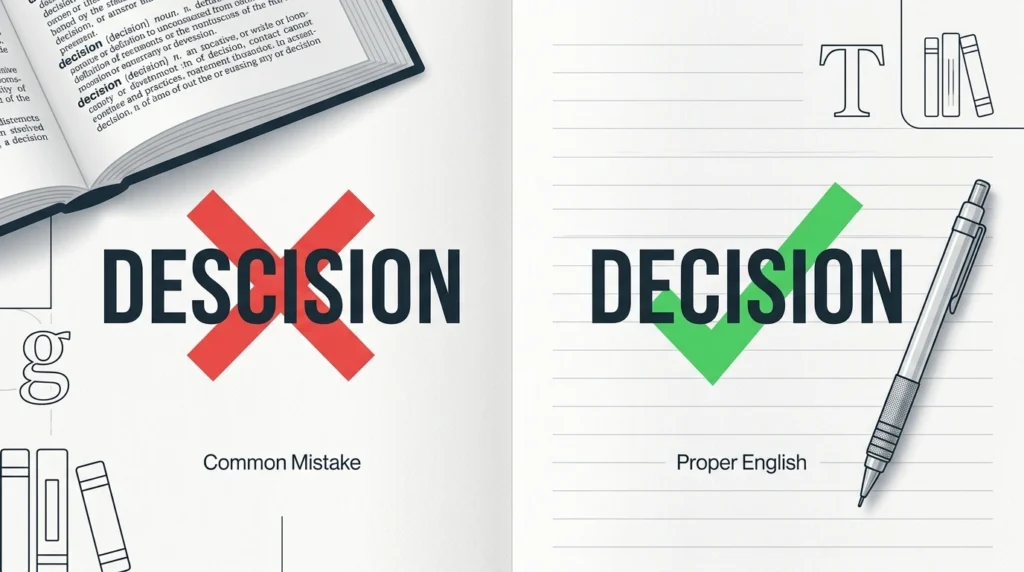

Decision is the correct spelling. Descision is a misspelling and should not be used in standard English. Decision is a noun meaning a choice, judgment, or conclusion reached after considering different possibilities. An easy way to remember the spelling is to connect it with decide: both words begin with deci-.
Correct: decision
Incorrect: descision
Spelling: D-E-C-I-S-I-O-N
If you are writing an email, assignment, report, social media post, application, or professional document, always use decision.
What Is a Decision?
A decision is a choice or conclusion reached after thinking about what to do.
You make a decision when you consider two or more possibilities and select one. The word can describe everyday choices, major personal choices, business judgments, official rulings, and other conclusions.
For example:
“I made the decision to accept the job.”
Here, decision names the choice that the speaker made.
Grammatically, decision is primarily a noun. A noun is a word that names a person, place, thing, idea, event, or—in this case—a choice or judgment.
The related verb is decide:
- Verb: decide
- Noun: decision
- Adjective: decisive
- Opposite noun: indecision
That word-family connection is also one of the easiest ways to remember the correct spelling.
Why Correct Spelling Matters
Writing descision instead of decision usually does not prevent someone from understanding your message. However, spelling becomes more important when your writing represents your ability, business, schoolwork, or professional reputation.
A misspelling may stand out in situations such as:
- A résumé or job application
- A university assignment or exam
- A client proposal
- A business email
- A presentation
- A professional report
- A published article
- A company website
In a casual text message, a typing mistake may matter very little. In polished writing, however, spelling decision correctly helps your work look careful and credible.
The Core Rule
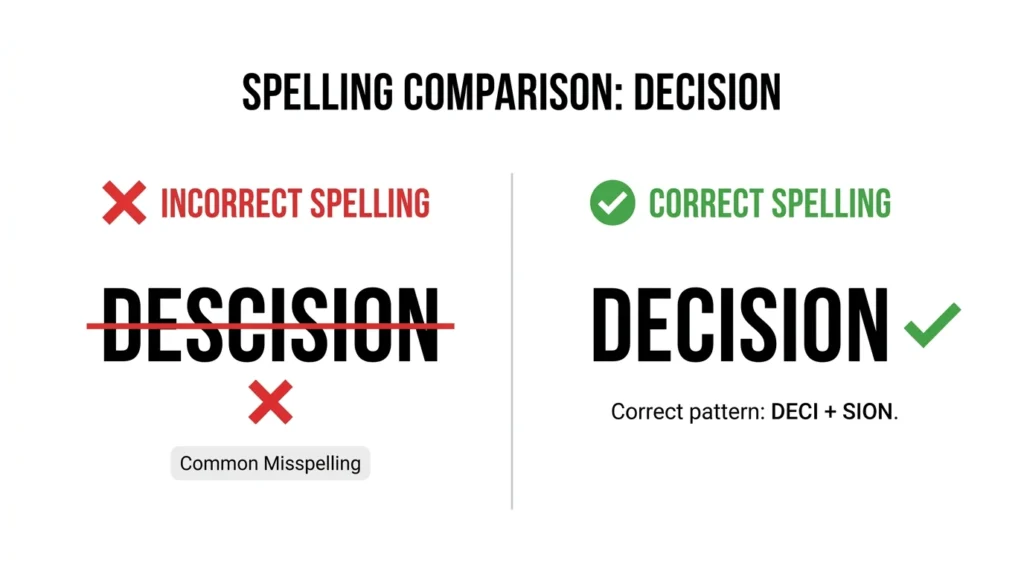
RULE: Write decision, never descision, when you mean a choice, judgment, conclusion, or act of deciding.
There is no standard spelling choice between the two words.
Decision is correct.
Descision is a spelling error.
You can remember the structure like this:
DECI + SION = DECISION
The important detail is that the word begins deci-, not desci-.
Read More: Stich vs Stitch: Which Spelling Is Correct?
How to Spell Decision Correctly
The correct spelling is:
D-E-C-I-S-I-O-N
Break it visually into two parts:
DECI + SION
This is useful because learners sometimes try to spell the word entirely from its pronunciation. English spelling does not always match sound letter by letter, so remembering the written pattern is more reliable.
Decision Pronunciation
Decision is commonly pronounced approximately:
dih-SIZH-uhn
The middle sound is similar to the sound in words such as vision.
The stress falls on the second syllable:
de-CI-sion
Do not assume that every sound you hear must correspond to an obvious letter. The c in decision has a soft sound rather than the hard /k/ sound heard in words such as cat.
How to Use Decision
Decision normally functions as a noun.
Common sentence patterns include:
make a decision
“I need to make a decision today.”
reach a decision
“The committee reached a decision after the meeting.”
come to a decision
“We finally came to a decision.”
decision to + verb
“Her decision to study abroad surprised everyone.”
decision about + noun/topic
“We discussed the decision about the new schedule.”
decision on + issue/topic
“The board will announce its decision on the proposal.”
Decision vs Decide
Do not confuse the noun decision with the verb decide.
Decide describes the action.
“I need to decide where to go.”
Decision names the resulting choice or judgment.
“I need to make a decision about where to go.”
Compare:
| Function | Decide | Decision |
|---|---|---|
| Part of speech | Verb | Noun |
| Meaning | To choose or reach a conclusion | A choice or conclusion |
| Example | We decided to leave. | We made a decision to leave. |
| Correct form | decide | decision |
| Incorrect confusion | make a decide | to decision something |
Correct Examples of Decision
Here are original examples showing how decision works across different situations.
- Conversation: “Have you made a decision about dinner yet?”
- Text message: “I think staying home tonight is the right decision.”
- School: “The student explained the reason for her decision in the final paragraph.”
- Exam: “His decision to check the calculation again helped him find the mistake.”
- Email: “Please let me know your final decision by Friday.”
- Workplace: “The manager made a decision after reviewing the team’s feedback.”
- Meeting: “We cannot reach a final decision until everyone has seen the revised budget.”
- Job application: “Moving into digital marketing was an important career decision for me.”
- Social media: “Deleting the post was probably the best decision.”
- Academic writing: “The final decision depended on the evidence collected during the study.”
- Customer service: “We respect your decision to cancel the subscription.”
- Business: “The company postponed its decision until the financial report was complete.”
The spelling remains decision in every example regardless of the context.
Descision vs Decision: Incorrect vs Correct Examples
| ❌ Incorrect | ✅ Correct | Why |
| I made a difficult descision. | I made a difficult decision. | Descision contains an unnecessary s. The standard spelling is decision. |
| It was her descision to leave. | It was her decision to leave. | The noun formed in this word family is decision, not descision. |
| Have you made your descision? | Have you made your decision? | A choice or conclusion is called a decision. |
| The final descision is yours. | The final decision is yours. | The correct spelling begins deci-, not desci-. |
| That was a smart descision. | That was a smart decision. | Descision is not an alternative spelling. |
| We reached a descision yesterday. | We reached a decision yesterday. | The correct collocation is reach a decision. |
| His descision surprised the team. | His decision surprised the team. | Use decision whenever the word functions as the noun meaning “choice” or “judgment.” |
| I respect your descision. | I respect your decision. | Pronunciation can make the spelling confusing, but the written form remains decision. |
| She explained her descision clearly. | She explained her decision clearly. | Adding s after de produces the incorrect spelling. |
| The hiring descision will be announced tomorrow. | The hiring decision will be announced tomorrow. | Decision is also correct when another noun, such as hiring, modifies it. |
| This was not an easy decission. | This was not an easy decision. | Decision contains one s in the -sion sequence, not -ssion. |
| They made a dicision quickly. | They made a decision quickly. | The word begins deci-, not dici-. |
Why Do People Spell Decision as Descision?
The mistake makes more sense when you look at how English spelling and pronunciation interact.
1. The C Does Not Sound Like a Hard C
Learners often associate c with the /k/ sound in words such as car or cold.
In decision, however, the c is part of a sequence that does not sound the way a beginner may expect from looking at the spelling.
That can make sound-based spelling unreliable.
2. The Word Contains Several Similar-Looking Letters
Decision contains the sequence:
c-i-s-i
When typing quickly, it is easy to lose track of where the s belongs.
That can produce forms such as:
- descision
- decission
- dicision
- decidion
- decisoin
3. Similar Word Patterns Can Interfere
English contains many words beginning with combinations such as des-, dis-, and dec-.
A writer who remembers the sound but not the exact visual form may unconsciously combine familiar spelling patterns and create descision.
4. Pronunciation Does Not Reveal Every Letter Clearly
Decision is pronounced roughly dih-SIZH-uhn.
You do not hear a separate sound that clearly tells you, “Put the letter c here.”
That makes memorizing the written form useful.
5. Learners May Overgeneralize -sion and -ssion Patterns
English contains words ending in forms such as:
mission, discussion, permission, decision, vision, conclusion
These endings do not all follow one simple spelling pattern.
A learner who remembers discussion or permission may incorrectly assume that decision also needs an extra s.
6. Spellcheck Does Not Replace Learning the Pattern
Modern spellcheckers will often identify descision, but they cannot prevent every typo in every environment.
A misspelling may remain in filenames, usernames, graphics, handwritten work, image text, or systems where automatic correction is unavailable.
Learning DECI + SION means you are not completely dependent on software.
Read More: Tapping vs Taping: What’s the Difference?
7. First-Language Spelling Habits Can Affect English
People learning English often bring spelling expectations from languages with more predictable sound-to-letter relationships.
Because English spelling is less phonetic in many words, learners may try to reproduce what they hear rather than remembering the conventional written form.
For decision, visual memory is often more helpful than phonetic guessing.
Common Mistakes Checklist
Use this checklist when proofreading the word.
- Writing descision: Remove the extra s after de. Write decision.
- Writing decission: Do not double the s. The correct form is decision.
- Writing dicision: Remember that the first two letters are de, not di.
- Writing decidion: The noun is not formed by simply replacing the final e in decide with ion.
- Writing decisoin: Watch the final letter order. It is -sion, not -soin.
- Using decision as the normal verb: Say “I decided,” not “I decisioned,” in ordinary contexts.
- Saying do a decision: Standard everyday English normally uses make a decision.
- Forgetting an article: Say “I made a decision” when referring to one unspecified decision.
- Confusing decide and decision: Decide is the verb; decision is the noun.
- Misspelling decision-making: The compound adjective or noun is normally written decision-making with a hyphen.
Descision vs Decision in Real English
Grammatically Correct and Natural
Decision is completely normal in everyday and formal English. Common combinations include make a decision, reach a decision, final decision, difficult decision, business decision, and decision to do something. For example, “I made the decision to leave” is both grammatically correct and natural. The word appears comfortably in conversation, emails, academic work, business writing, journalism, and official communication.
Grammatically Possible but Less Natural
A sentence can sometimes be grammatically possible without being the wording most speakers would normally choose. For example, a very formal sentence such as “A decision concerning the implementation of the policy was reached” is correct but heavier than everyday speech requires. In conversation, someone would be more likely to say, “We decided how to implement the policy” or “We made a decision about the policy.”
Natural Everyday English
In everyday conversation, English speakers often choose the verb decide when a longer noun phrase adds no useful meaning. Instead of saying, “I made the decision to stay home,” someone may simply say, “I decided to stay home.” Both are natural. The noun version can place slightly more attention on the choice itself, while the verb version is often shorter and more direct.
American vs British English
There is no spelling difference between American and British English here.
Both use:
decision
Not:
descision
The pronunciation is also broadly represented by the same standard phonemic form.
There is, however, a small usage difference worth knowing.
Make a Decision
Make a decision is natural in both American and British English and is the safest choice for international writing.
Examples:
“Have you made a decision?”
“We need to make a decision today.”
Take a Decision
Take a decision can occur in British and especially formal or institutional English. It is much less typical in everyday American English.
For an international audience, make a decision is therefore the easiest and most universally natural choice.
Formal vs Informal Usage
The spelling decision never changes according to formality, but sentence style can.
Formal
“The committee reached a unanimous decision after reviewing the evidence.”
“The organization will announce its final decision next week.”
“The decision to revise the policy followed an internal review.”
These structures fit reports, official announcements, academic writing, legal contexts, and professional communication.
Informal
“I finally made a decision.”
“Have you decided yet?”
“That was probably the right decision.”
“I can’t decide what to order.”
Informal English often prefers the shorter verb decide when there is no reason to emphasize the decision as a separate thing.
Read More: Stich vs Stitch: Which Spelling Is Correct?
Descision vs Decision Comparison Table
| Feature | Descision | Decision |
| Standard spelling? | ❌ No | ✅ Yes |
| Use in edited English | Avoid | Correct |
| Part of speech | Not a standard form | Primarily a noun |
| Meaning | Usually a misspelling of “decision” | A choice, judgment, or conclusion |
| Correct beginning | — | deci- |
| Ending | — | -sion |
| Pronunciation | No separate standard pronunciation needed | roughly dih-SIZH-uhn |
| Related verb | — | decide |
| Example | ❌ My descision is final. | ✅ My decision is final. |
| AmE/BrE spelling | Incorrect in both | Correct in both |
Decision and Other Common Misspellings
| Spelling | Status | What Went Wrong |
| decision | ✅ Correct | Standard spelling |
| descision | ❌ Incorrect | Extra s after de |
| decission | ❌ Incorrect | Extra s |
| dicision | ❌ Incorrect | Wrong first vowel |
| decidion | ❌ Incorrect | Incorrect noun formation |
| decisoin | ❌ Incorrect | Letters reversed near the ending |
| decison | ❌ Incorrect | Missing i |
| desicion | ❌ Incorrect | s incorrectly replaces c |
Memory Trick for Decision
Remember this simple pattern:
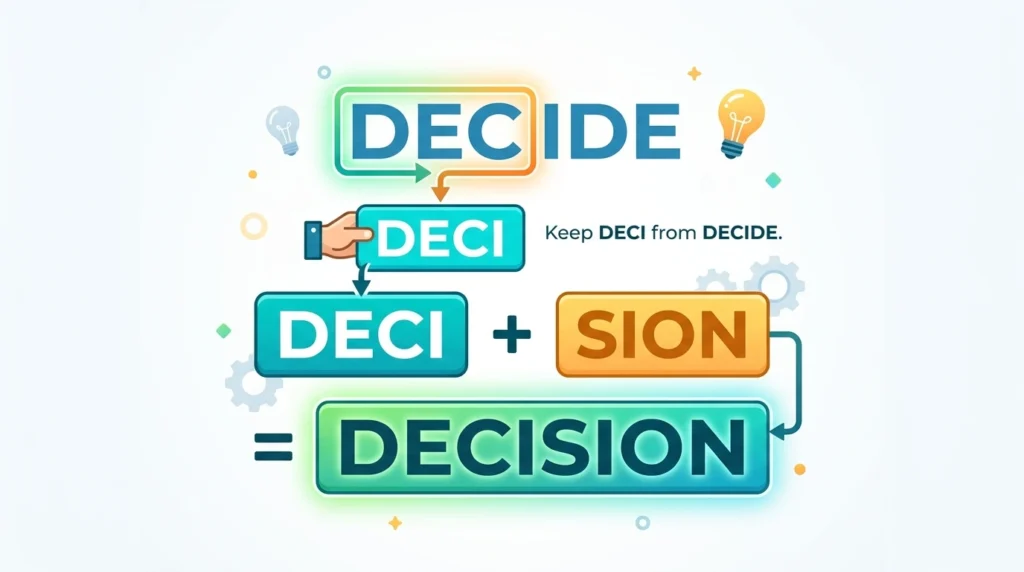
A DECISION keeps the DECI from DECIDE.
Take the beginning of decide:
DECI
Then remember the ending:
SION
Put them together:
DECI + SION = DECISION
If you find yourself writing descision, stop after the first three letters:
D-E-C
The c should come before the first i.
Another quick visual check is:
DECIsion
If you can see DECI at the beginning, you are on the right track.
Real-Life Situations
Interview
Interviewer: Why did you leave your previous position?
Candidate: “It was a difficult decision, but I wanted a role with more opportunities to develop my skills.”
Using the correct spelling matters especially in written interview responses, applications, and follow-up emails.
Read More:Developed vs Developped: Which Spelling Is Correct?
Meeting
“We need to make a decision before the supplier’s deadline.”
Here, make a decision is clear, natural, and professional.
“Thank you for reviewing the proposal. Please let me know your final decision by Thursday.”
This is a natural business use of the noun.
Text Message
“I made a decision. I’m going with the blue one.”
Even in casual communication, the spelling remains decision.
Exam
Incorrect:
“The government’s descision affected the economy.”
Correct:
“The government’s decision affected the economy.”
A spelling error may reduce the polish of an otherwise strong answer, so proofreading important recurring words is worthwhile.
Expert Tips for Remembering and Using Decision
Learn the Word Family Together
Do not memorize decision in isolation.
Learn:
decide → decision → decisive → indecision
Seeing the related forms repeatedly makes the correct spelling easier to recognize.
Memorize Collocations, Not Just Definitions
A collocation is a group of words that naturally occur together.
Instead of memorizing only “decision = choice,” learn:
- make a decision
- reach a decision
- final decision
- difficult decision
- informed decision
- decision about
- decision on
- decision to
This helps both vocabulary and grammar.
Use Decide When the Noun Sounds Heavy
Compare:
“The committee made a decision to postpone the event.”
“The committee decided to postpone the event.”
Both can be correct, but the second is shorter and often more direct.
Good writing is not only about grammatical correctness. It is also about choosing the clearest natural structure.
Proofread the Middle of the Word
Most mistakes happen around:
-cisi-
When proofreading, do not only glance at the first and last letters.
Check that you have:
d e c i s i o n
Do Not Trust Sound Alone
English spelling often preserves letter patterns that are not completely obvious from pronunciation.
If you are unsure, recall the visual form:
DECISION
rather than trying to rebuild the spelling only from what you hear.
Frequently Asked Questions
Is descision a word?
Descision is not the standard English spelling of the noun meaning a choice or judgment. If you mean the result or act of deciding, write decision.
Which is correct: decision or descision?
Decision is correct. Descision is a misspelling.
How do you spell decision?
Spell it:
D-E-C-I-S-I-O-N
A useful pattern is:
DECI + SION = DECISION
Why is decision spelled with a c?
The c is part of the established spelling and word history of decision and its relationship with decide. The sound of the word does not make every letter obvious, which is why sound-based spelling can cause mistakes.
Is decission correct?
No. Decission incorrectly doubles the s.
Write:
decision
not:
decission
Is desicion correct?
No. Desicion is another misspelling. The correct sequence at the beginning is:
deci-
Is decision a noun or verb?
Decision is primarily a noun.
Example:
“That was a difficult decision.”
The related verb is decide:
“We decided to leave.”
What is the plural of decision?
The plural is decisions.
Example:
“Managers sometimes have to make difficult decisions.”
Is decision spelled differently in British English?
No. Both British and American English use decision.
There is no accepted British spelling descision.
Should I say make a decision or do a decision?
Say make a decision.
“Do a decision” is not the normal English collocation.
Correct:
“We need to make a decision.”
What is the difference between decide and decision?
Decide is normally a verb describing the action of choosing.
Decision is a noun naming the choice.
Compare:
“I decided to apply.”
“I made the decision to apply.”
What is an easy way to remember decision?
Remember:
DECI + SION
The word begins with the same four-letter sequence you see at the beginning of decide:
DECIde → DECIsion
Read More: Comprable vs Comparable: Which Spelling Is Correct?
Mini Quiz: Descision vs Decision
| # | Question | Answer | Explanation |
| 1 | Multiple choice: Which spelling is correct? A) descision B) decision C) decission | B) decision | Decision is the standard spelling. |
| 2 | Fill in the blank: I need to make a ______ before Friday. | decision | The noun after make a is decision. |
| 3 | Correct the sentence: Her descision surprised everyone. | Her decision surprised everyone. | Remove the unnecessary s after de. |
| 4 | Multiple choice: Which is the verb? A) decision B) decide C) decisive | B) decide | Decide describes the action. Decision is the noun. |
| 5 | Fill in the blank: The committee reached a final ______. | decision | Reach a decision is a standard English collocation. |
| 6 | Correct the sentence: We need to do a decision today. | We need to make a decision today. | English normally uses make a decision, not do a decision. |
| 7 | Multiple choice: Which form is incorrect? A) decision B) decisions C) descision | C) descision | Descision is a misspelling. |
| 8 | Fill in the blank: She ______ to wait until Monday. | decided | A verb is required, so use the past tense of decide. |
| 9 | Correct the sentence: It was an important career decission. | It was an important career decision. | Decision has one s in the -sion sequence. |
| 10 | Multiple choice: Which sentence is most natural in international English? A) We did a decision. B) We made a decision. C) We performed a decision. | B) We made a decision. | Make a decision is the standard widely understood collocation. |
Quick Summary
Decision is the correct spelling, while descision is a common spelling error. Decision is primarily a noun meaning a choice, judgment, or conclusion reached after considering different possibilities. The related verb is decide, which gives you an easy memory clue: keep DECI from decide and remember DECI + SION = DECISION. Common phrases include make a decision, reach a decision, final decision, and decision to do something. American and British English both spell the word decision, although take a decision occurs more often in some British and formal contexts. For everyday international English, make a decision is the safest expression.