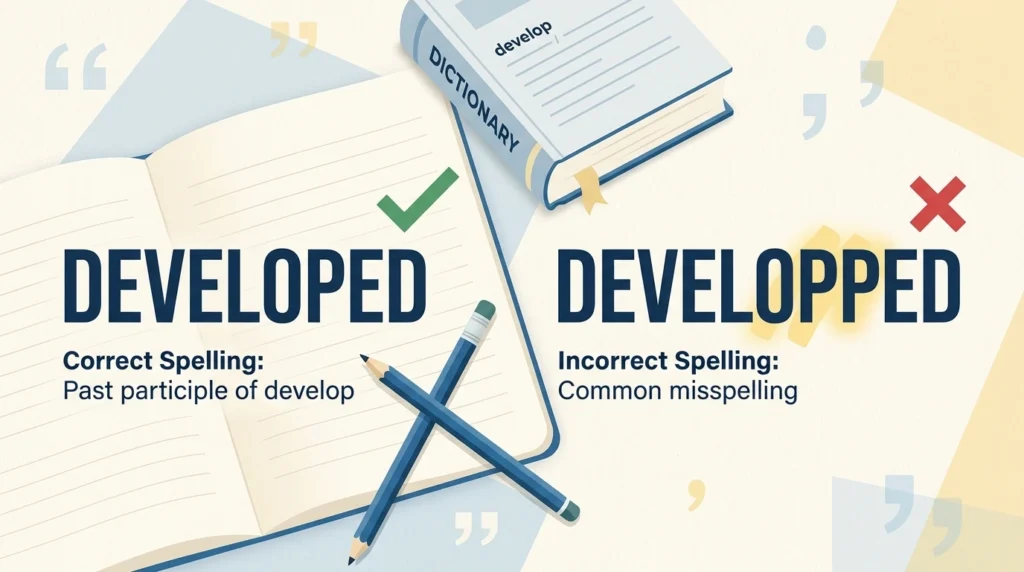

Developed is the correct spelling in standard English. Developped is a misspelling. The verb develop forms its past tense and past participle by adding -ed without doubling the final p: develop → developed. This spelling is correct in both American and British English because the final syllable of develop is not stressed.
What Is Developed vs Developped?
Developed is the standard English form created from the verb develop. It can function as the simple past tense, a past participle, or an adjective.
For example:
- We developed a new marketing strategy.
- Scientists have developed a faster testing method.
- The software is highly developed.
Developped, with two p’s before -ed, is not the standard English spelling of this word.
The confusion is understandable because English sometimes doubles a final consonant before adding endings such as -ed or -ing. However, develop does not meet the usual stress condition that causes this doubling.
Why It Matters
A single extra letter may seem minor, but spelling affects how readers judge your writing.
Writing developped in an application, academic paper, client email, report, résumé, or business proposal can make otherwise strong writing appear less carefully edited.
The mistake is especially noticeable because developed is a common word in professional and academic English. Knowing the rule also helps with related forms such as developing, which likewise keeps a single p.
The Core Rule
Rule: Write developed, not developped. Add -ed directly to develop without doubling the final p.
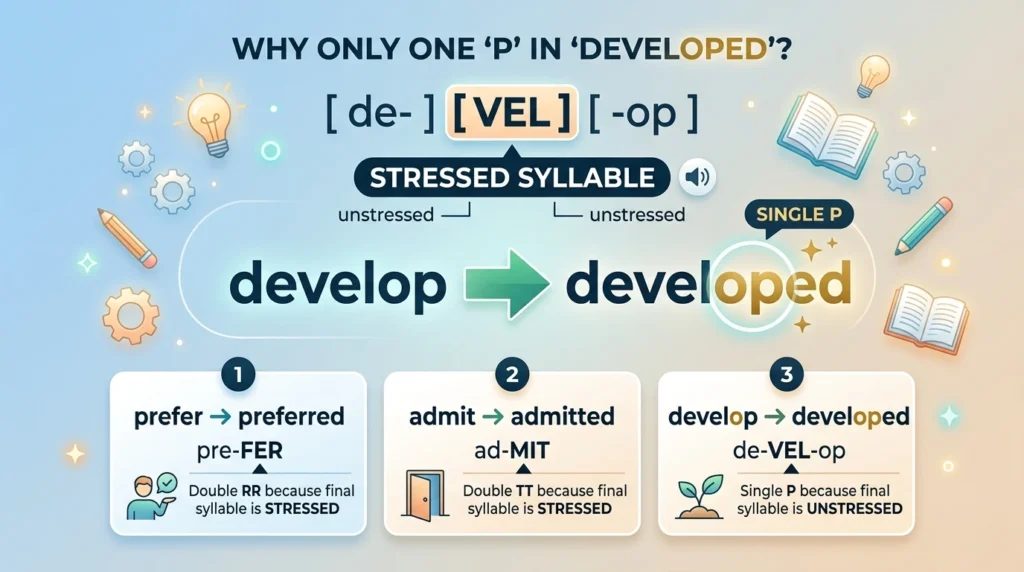
The reason involves word stress, meaning the syllable pronounced with the strongest emphasis.
The verb is pronounced roughly:
de-VEL-op
The stress falls on VEL, not on the final syllable op.
With many multisyllable English verbs, the final consonant is doubled before -ed when the last syllable is stressed and ends in a single vowel followed by a single consonant.
Read More: Comprable vs Comparable: Which Spelling Is Correct?
Compare:
| Base Verb | Stress | Past Form | Final Consonant |
|---|---|---|---|
| admit | ad-MIT | admitted | doubled |
| occur | oc-CUR | occurred | doubled |
| prefer | pre-FER | preferred | doubled |
| develop | de-VEL-op | developed | not doubled |
Therefore:
develop + ed = developed
Not:
develop + p + ed = developped
How to Use Developed Correctly
Developed has several common grammatical functions.
1. Use Developed for the Simple Past
Use developed when something happened or changed in the past.
The company developed the application last year.
The action is completed, so developed functions as the simple past form of develop.
2. Use Developed as a Past Participle
The past participle also has the form developed.
It commonly appears after has, have, had, is, was, were, and similar helping verbs.
The research team has developed a new method.
The system was developed for small businesses.
3. Use Developed as an Adjective
Developed can describe something that has reached a particular stage of growth, complexity, maturity, or advancement.
She presented a well-developed argument.
The area has a highly developed transport network.
In these examples, developed describes a quality rather than simply reporting a past action.
4. Keep One P in Related Forms
The same spelling principle applies to other forms of develop:
- develop
- develops
- developed
- developing
- developer
- development
Neither developped nor developping is the standard spelling of the English verb forms.
Correct Examples of Developed
Here are original examples showing how developed appears across everyday and professional situations.
- Conversation: I developed an interest in photography during college.
- Email: We developed a revised schedule based on your feedback.
- School: Maya developed her argument carefully in the final paragraph.
- Workplace: The engineering team developed a solution before the deadline.
- Social media: I finally developed a routine that helps me stay productive.
- Academic writing: Researchers developed a model to examine changes in consumer behavior.
- Business: The company developed a training program for new employees.
- Technology: Our developers developed a feature that reduces loading time.
- Personal growth: He developed stronger communication skills through regular practice.
- Healthcare context: The laboratory developed a more efficient testing procedure.
- Creative writing: The author developed the main character gradually throughout the novel.
- Project management: We developed the initial prototype after reviewing the requirements.
Every sentence uses developed with one p before -ed.
Incorrect vs. Correct
| ❌ Incorrect | ✅ Correct | Why |
|---|---|---|
| We developped a new plan. | We developed a new plan. | Develop does not double its final p before -ed. |
| She developped strong leadership skills. | She developed strong leadership skills. | The standard past tense is developed. |
| They have developped an online platform. | They have developed an online platform. | The past participle also uses one p. |
| The software was developped internally. | The software was developed internally. | Passive constructions still require developed. |
| He developped an interest in history. | He developed an interest in history. | The spelling does not change according to meaning. |
| Researchers developped a new theory. | Researchers developed a new theory. | Academic English uses the standard developed form. |
| We developped the project together. | We developed the project together. | Adding -ed does not create a second p. |
| The neighborhood has developped rapidly. | The neighborhood has developed rapidly. | Developed can describe gradual growth or change. |
| Our team developped three prototypes. | Our team developed three prototypes. | The verb remains a regular verb with one final p. |
| She had developped the idea earlier. | She had developed the idea earlier. | The past perfect uses had + developed. |
| The country developped its infrastructure. | The country developed its infrastructure. | Regional English varieties do not require a second p here. |
| The character is well developped. | The character is well developed. | The adjective form is also spelled developed. |
Why People Make This Mistake
Several different spelling patterns can push writers toward developped.
Phonetic Similarity
You cannot reliably hear whether a written consonant should be doubled in this word.
Both imagined spellings would be pronounced essentially the same way, so pronunciation alone does not tell a learner how many p’s to write.
Overgeneralizing the Double-Consonant Rule
Learners often notice forms such as:
- stop → stopped
- plan → planned
- admit → admitted
- prefer → preferred
They may then assume:
develop → developped
The problem is that consonant doubling does not apply to every verb ending in a vowel and consonant. Stress matters in multisyllable words.
Spelling Overlap
The base word develop already ends in -op. Adding -ed creates developed, and the cluster around the final letters can make a second p look visually plausible.
That visual familiarity can be misleading.
Translation Interference
Another language can sometimes influence English spelling.
French is a particularly useful example because the related French verb is développer, which contains two p’s. A bilingual writer familiar with that spelling may accidentally transfer the doubled consonant into English and write developped.
English does not retain that doubled p in developed.
Read More: Shinny vs Shiny: What Is the Difference?
Autocomplete and Spellcheck Limitations
Most modern spelling tools can identify many common misspellings, but they should not replace understanding the rule.
Language settings, custom dictionaries, names, copied text, specialized software, or simple oversight can allow an incorrect spelling to remain. Learning develop → developed makes you less dependent on automatic correction.
Common Mistakes Checklist
Use this checklist when proofreading.
- Adding an unnecessary second p: Writers produce developped because doubled consonants appear in words such as stopped. Remember that develop has stress before its final syllable, so keep one p.
- Writing developping: The same mistake can appear before -ing. Write developing, not developping.
- Assuming British English uses developped: It does not. Standard American and British English both use developed.
- Changing spelling according to meaning: Whether something grew, was created, became stronger, or reached an advanced stage, the spelling remains developed.
- Trusting pronunciation alone: The spoken form does not tell you whether a consonant is doubled. Check the base word and spelling rule instead.
- Copying the spelling from another language: Similar-looking words in another language may follow different spelling conventions. English uses developed.
Developed vs Developped in Real English
Grammatically Correct and Standard
Developed is the form you should use in edited English. It works naturally as a past-tense verb, past participle, and adjective: we developed the idea, the team has developed a prototype, and a well-developed plan. The spelling does not depend on whether your writing is conversational, academic, technical, or professional.
Grammatically Possible but Unnatural Constructions
A sentence can contain developed correctly but still sound unnecessarily awkward. For example, The new strategy was developed by me yesterday is grammatical, but in normal circumstances I developed the new strategy yesterday sounds clearer and more direct. Likewise, context often determines whether developed, created, built, grew, or improved expresses the intended meaning most naturally.
Natural Everyday English
Native speakers use developed in many ordinary combinations: developed a habit, developed an idea, developed feelings, developed skills, developed a product, and developed over time. In everyday conversation, another verb may sometimes sound simpler. Someone might say I got better at it instead of I developed greater proficiency, even though both can be grammatically correct.
Formal vs. Informal Usage
Developed itself is neutral rather than strongly formal or informal. You can use it comfortably in everyday conversation, workplace communication, academic writing, reports, and professional emails.
The surrounding vocabulary changes with the register.
Informal:
I developed a habit of checking my phone too often.
More formal:
The organization developed a comprehensive risk-management framework.
The spelling remains developed in both cases.
Developed vs Developped Comparison Table
| Feature | Developed | Developped |
|---|---|---|
| Standard English spelling | Yes | No |
| Number of p’s before -ed | One | Two |
| Past tense of develop | Yes | No |
| Past participle of develop | Yes | No |
| Can function as an adjective | Yes | No |
| Used in American English | Yes | No as a standard variant |
| Used in British English | Yes | No as a standard variant |
| Suitable for academic writing | Yes | No |
| Suitable for professional writing | Yes | No |
| Related -ing form | developing | not developping |
| Example | We developed the product. | We developped the product. ❌ |
Memory Trick
Remember:
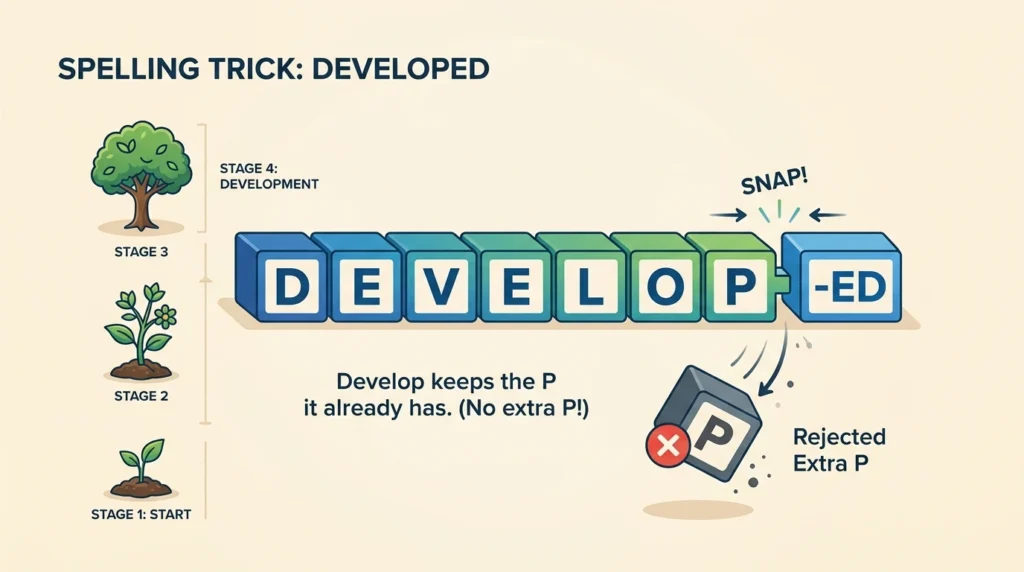
Develop keeps the P it already has.
Start with:
develoP
Then simply add:
-ed
Result:
develoP + ed = developed
There is no need to give develop an extra p.
Another visual shortcut is:
One P develops. Two P’s don’t.
Read More: Crier vs Cryer: The Correct Usage Explained
Real-Life Situations
Interview
An interviewer asks how you improved your leadership abilities.
Correct:
I developed stronger leadership skills while managing a five-person team.
Meeting
You explain how your department solved a problem.
Correct:
We developed a simpler process for reviewing customer requests.
Professional Email
You update a client about a project.
Correct:
Our team has developed the first version of the proposed dashboard.
Text Message
You talk about a new personal habit.
Correct:
I developed a taste for black coffee after working early shifts.
Exam
You describe changes in a fictional character.
Correct:
The protagonist developed greater confidence as the story progressed.
Expert Tips
Look at Stress Before Doubling
When a multisyllable verb ends in a single vowel followed by a consonant, ask where the stress falls.
Compare:
pre-FER → preferred
but:
de-VEL-op → developed
This is more useful than memorizing random lists.
Learn Word Families Together
Instead of memorizing developed alone, learn the whole family:
develop → develops → developed → developing → development → developer
Seeing the forms together reinforces the single p pattern.
Do Not Treat Every Double Consonant the Same Way
English consonant doubling depends on several spelling patterns. A rule that explains stopped cannot automatically be applied to every verb.
Check syllable stress when working with longer words.
Separate Spelling From Meaning
The spelling developed stays the same across many meanings:
developed a product
developed a friendship
developed a skill
developed a theory
developed rapidly
Context changes the meaning, not the spelling.
Notice the Pronunciation of -ed
The -ed ending in developed is normally pronounced like /t/ because the base verb ends with the voiceless /p/ sound.
It therefore sounds roughly like:
de-VEL-uhpt
The -ed does not normally create a separate extra syllable.
FAQ
Is developped ever correct in standard English?
No. When you mean the past tense or past participle of the English verb develop, write developed.
Occurrences of developped in informal or published material should not be treated as evidence of a standard alternative. Spelling mistakes can appear in any kind of text.
Is developed a verb or an adjective?
It can be both.
In They developed the software, it is a past-tense verb.
In a highly developed system, it functions as an adjective describing something advanced or elaborated.
Is develop a regular or irregular verb?
Develop is a regular verb because its past tense and past participle are formed with the regular -ed ending:
develop → developed → developed
The spelling rule simply determines whether the final consonant is doubled.
Why doesn’t developed have two p’s?
The final syllable of develop is unstressed. In the common consonant-doubling pattern for multisyllable verbs, the last consonant is typically doubled when the final syllable carries the stress.
Compare prefer → preferred with develop → developed.
Is it developing or developping?
Developing is correct.
Write:
develop + ing = developing
Do not double the p.
Is developed spelled differently in British English?
No. Developed is standard in both British and American English.
This word does not follow the type of regional spelling difference seen in pairs such as color/colour.
What is the noun form of develop?
The most common noun is development.
For example:
The development of the new system took six months.
A person or company that develops something can also be called a developer.
Can developed mean created?
Yes, depending on context.
Engineers developed a new engine.
Here developed can mean designed, created, or brought into existence through a process.
In other contexts it can mean grew, acquired, improved, or became more advanced.
Is well-developed hyphenated?
It is commonly written well-developed when functioning as a compound adjective, especially before a noun:
a well-developed argument
a well-developed strategy
The important point for this spelling question is that developed still contains only one p.
Is developpé the same as developed?
No.
Developpé, usually written with an accented final é, can appear as a ballet term referring to a movement in which the working leg unfolds or extends.
It should not be confused with developed, the English past tense and past participle of develop.
Read More: Convertor vs Converter: Which Spelling Is Correct?
Mini Quiz
| # | Question | Answer | Explanation |
|---|---|---|---|
| 1 | Choose the correct spelling: developed / developped | developed | Standard English uses one p before -ed. |
| 2 | Fill in the blank: The company ___ a new mobile app last year. | developed | The sentence requires the simple past of develop. |
| 3 | Correct the sentence: She developped excellent communication skills. | She developed excellent communication skills. | The final p is not doubled. |
| 4 | Which is correct: developing / developping? | developing | Develop also keeps one p before -ing. |
| 5 | Fill in the blank: Researchers have ___ a faster method. | developed | After have, use the past participle developed. |
| 6 | True or false: Developped is the normal British spelling. | False | British and American English both use developed. |
| 7 | Correct the sentence: The software was developped for hospitals. | The software was developed for hospitals. | Passive voice requires the past participle developed. |
| 8 | Which word receives the main stress: de-VEL-op or de-vel-OP? | de-VEL-op | The final syllable is unstressed, helping explain why the final p is not doubled. |
| 9 | Fill in the blank: Over several years, the town ___ into a major tourist destination. | developed | Here developed means gradually changed or grew. |
| 10 | Which sentence is correct? A) We developped the proposal. B) We developed the proposal. | B | Developed is the standard past-tense spelling. |
Quick Summary
Developed is the correct spelling of the past tense and past participle of develop, while developped is a misspelling in standard English. The final p is not doubled because the stress in develop falls on the middle syllable: de-VEL-op. The same pattern gives us developing, not developping. Developed can describe something that was created, grew, improved, or reached a more advanced stage, and it can also function as an adjective. American and British English use the same spelling. To remember it, keep the p already present in develop and simply add -ed: develop + ed = developed.