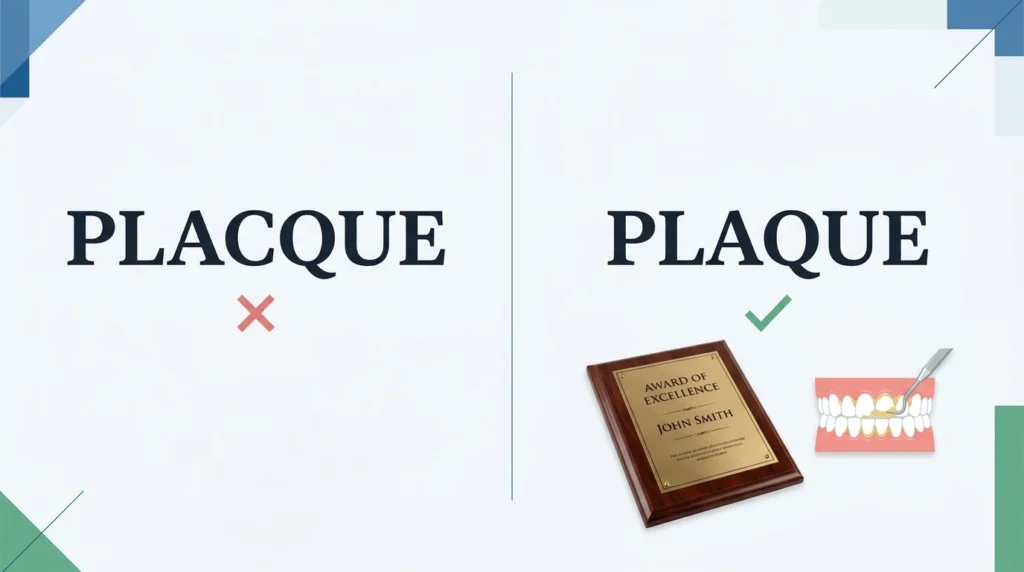

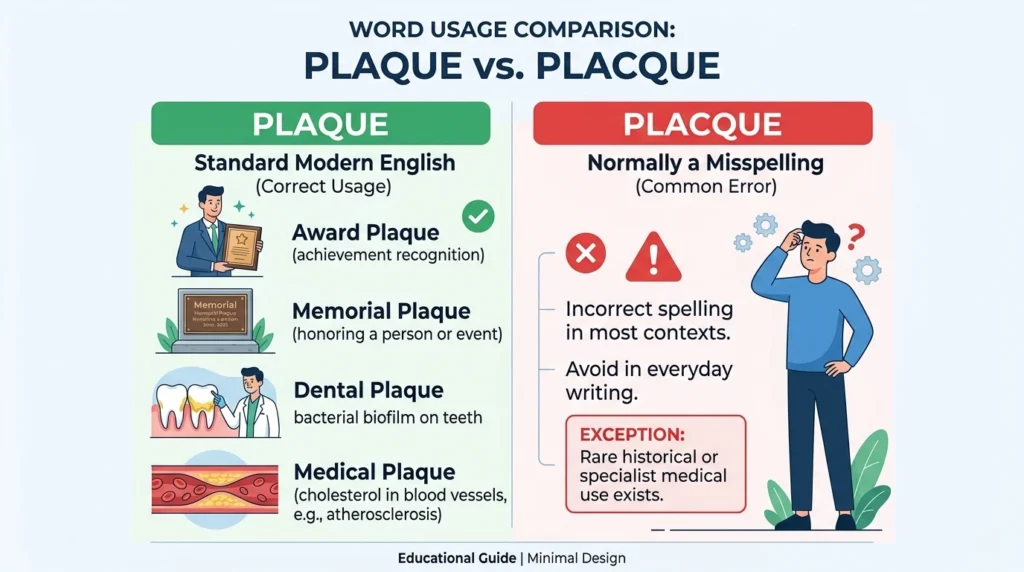
Plaque is the correct spelling in standard modern English. Placque is usually a misspelling. A plaque can be an inscribed flat plate, dental buildup, or a medical deposit or lesion. Rare specialist and historical medical uses of placque do exist, but for school, business, websites, dentistry, everyday communication, and modern professional writing, plaque is the spelling you should normally use.
What Is Plaque?
Plaque is a noun with several meanings depending on context.
Most people encounter it in one of three ways:
- A flat plate or tablet displaying a name, message, achievement, or memorial
- The sticky bacterial film that forms on teeth
- A medical deposit, patch, or lesion that develops in or on part of the body
For example:
The school placed a plaque beside the entrance to honor its founder.
In dentistry:
Brushing and flossing help remove plaque from the teeth.
In medical writing:
The scan showed plaque buildup in the artery.
The spelling stays plaque in all these common situations.
Why Does the Correct Spelling Matter?
Confusing placque vs plaque may look like a small spelling problem, but it becomes noticeable in professional writing.
Imagine submitting a résumé that says:
Received an employee achievement placque.
The reader can still understand the sentence, but the spelling error may make the document look less polished.
Accuracy matters especially in:
- Résumés and job applications
- Business emails
- Academic assignments
- Medical or dental content
- Award descriptions
- Historical signs and memorial information
- Product listings for engraved plaques
- Professional website content
Using plaque consistently removes unnecessary doubt and makes the writing look more reliable.
The Core Rule for Placque vs Plaque
RULE: Use “plaque” in normal modern English. Do not add an extra “c” before the “q.”
Correct:
plaque
Normally incorrect:
placque
Think of the spelling as:
P + L + A + Q + U + E
There is only one c sound when the word is spoken, but the written word does not contain the letter c at all.
That unusual relationship between spelling and pronunciation is one reason people mistype the word.
How to Use Plaque Correctly
Use Plaque for an Award or Recognition
A plaque can be a decorative object given to recognize an achievement, contribution, or milestone.
Maria received a plaque for twenty years of service.
The championship plaque was displayed in the school office.
Use Plaque for a Memorial or Marker
A plaque may also contain information about a person, building, event, or historic location.
A bronze plaque marks the birthplace of the writer.
Visitors stopped to read the memorial plaque.
Use Plaque for Dental Buildup
In dental contexts, plaque usually refers to the film containing bacteria that develops on teeth.
Plaque tends to collect around areas that are difficult to clean.
Notice that dental plaque is often treated as an uncountable substance.
Natural:
There is plaque on my teeth.
Less natural in an ordinary dental conversation:
There is a plaque on my teeth.
The second sentence can suggest a distinct patch or lesion rather than ordinary dental buildup.
Use Plaque in Medical Contexts
Medical writers also use plaque for certain deposits, lesions, or abnormal areas.
Common combinations include:
- arterial plaque
- plaque buildup
- atherosclerotic plaque
- psoriatic plaque
- amyloid plaque
- plaque formation
The exact meaning depends on the medical context.
Read More: Cheer vs Chear: Which Spelling Is Correct?
Use Plaques as the Plural
When plaque refers to countable objects or individual medical formations, its regular plural is:
plaque → plaques
For example:
Three commemorative plaques were installed outside the building.
Researchers examined the plaques visible in the tissue samples.
Do not write placques as the normal plural of plaque.
Correct Examples of Plaque
Here are original examples showing how plaque appears in different types of English.
Conversation
- “Did you see the plaque beside the library entrance?”
- “The dentist said I need to pay more attention to plaque around my back teeth.”
- “We have approved the wording for the commemorative plaque.”
- “Please confirm whether the award plaque should include her job title.”
School
- “Our class designed a plaque honoring the school’s first principal.”
- “The report explains how dental plaque develops on tooth surfaces.”
Workplace
- “The company presented him with a plaque for outstanding service.”
- “Please check the spelling of every name before the plaque is engraved.”
Social Media
- “So proud to receive this plaque after five years with the organization!”
- “I finally found the small historical plaque everyone was talking about.”
Academic and Professional Writing
- “The memorial plaque identifies the year in which the building was completed.”
- “The researchers measured changes in plaque formation during the study.”
Placque vs Plaque: Incorrect and Correct Examples
| ❌ Incorrect | ✅ Correct | Why? |
|---|---|---|
| She received a placque for excellence. | She received a plaque for excellence. | An award or recognition tablet is normally spelled plaque. |
| The dentist removed the placque. | The dentist removed the plaque. | Dental buildup uses the standard spelling plaque. |
| A bronze placque hangs near the entrance. | A bronze plaque hangs near the entrance. | A commemorative plate is a plaque, not a placque. |
| We ordered three placques for the winners. | We ordered three plaques for the winners. | The standard plural of plaque is plaques. |
| Please clean the placque from your teeth. | Please clean the plaque from your teeth. | Dental plaque does not gain an extra c. |
| His name appears on a memorial placque. | His name appears on a memorial plaque. | Memorial markers use plaque. |
| The doctor discussed arterial placque buildup. | The doctor discussed arterial plaque buildup. | Modern general medical writing normally uses plaque. |
| The museum unveiled a new placque yesterday. | The museum unveiled a new plaque yesterday. | The object being unveiled is a plaque. |
| I received an achievement placque at work. | I received an achievement plaque at work. | Recognition awards use the standard spelling. |
| The building has several historical placques. | The building has several historical plaques. | Plaques is the correct standard plural. |
Why Do People Confuse Placque and Plaque?
The mistake makes more sense once you examine how the word looks and sounds.
Phonetic Similarity
Plaque is generally pronounced as a single syllable.
The spelling does not closely match what an English learner might expect from the pronunciation.
Someone who hears the word before seeing it written may try spellings such as:
- plac
- plack
- placque
- plak
That happens because English does not always use predictable sound-to-letter relationships.
The Unusual “-que” Ending
The ending -que appears in several words borrowed or influenced by French spelling patterns.
Examples include:
- unique
- antique
- technique
- boutique
However, those words do not all pronounce -que in exactly the same way.
With plaque, the final letters produce a simple /k/ sound rather than another syllable.
That makes the spelling easier to forget.
Spelling Overgeneralization
A writer may know that a hard k sound can sometimes be represented by c, k, ck, or qu.
They may unconsciously combine these possibilities and create placque.
In other words, the writer adds a letter that feels as though it “should” be there.
Autocomplete and Spellcheck Limitations
Spellcheck is helpful but should not replace spelling knowledge.
Depending on the software, dictionary, language setting, specialist vocabulary, or surrounding text, an unusual form may not always be corrected immediately.
Autocomplete can also preserve previous typing habits.
If you regularly type placque, your keyboard may eventually begin suggesting it.
Translation Interference
People who use more than one language sometimes transfer familiar spelling patterns from one language into another.
Because plaque entered English through French, learners familiar with related European words may recognize the sound or meaning while remembering a slightly different spelling pattern.
The safest solution is simple:
When writing normal English, memorize plaque as one complete word rather than trying to reconstruct it from pronunciation.
Common Mistakes Checklist
Before publishing or submitting your writing, check for these common problems:
- Adding an extra c: Write plaque, not placque, in normal modern English.
- Writing plack: The pronunciation may sound like “plack,” but that is not the normal spelling of the word.
- Forgetting the final e: Write plaque, not plaqu.
- Using placques as the plural: The standard plural is plaques.
- Treating dental plaque like an ordinary countable object: Usually write “some plaque” or “plaque buildup,” not “a plaque,” when discussing normal dental buildup.
- Assuming every medical use has the same meaning: Plaque can describe different deposits or lesions depending on the medical field.
- Using plaque and plate as exact synonyms: A plaque may be plate-like, but the two nouns are not interchangeable in every situation.
- Trusting pronunciation alone: The word does not sound exactly as an unfamiliar reader might expect from its spelling.
Placque vs Plaque in Real English
Grammatically Correct English
Plaque behaves primarily as a noun. You can write a plaque when referring to a countable object such as a memorial or award and plaques when referring to several of them. Dental plaque is commonly treated as an uncountable substance, so phrases such as plaque buildup, remove plaque, and plaque on the teeth are normal. Medical contexts can also use countable plaques when discussing individual lesions or deposits.
Grammatically Possible but Unnatural English
A sentence can follow basic grammar rules and still sound unusual because the noun is being used in an uncommon way. For example, “I have a plaque on my teeth” is structurally grammatical, but an ordinary speaker discussing general dental buildup would more naturally say “I have plaque on my teeth.” Likewise, saying “They gave me the plaque” without previous context may sound incomplete because listeners do not know which plaque you mean.
Natural Everyday English
Natural usage depends on context. At the dentist, people commonly talk about plaque, plaque buildup, or removing plaque. At an awards ceremony, they may say someone received a plaque. At a historical building, visitors may read the plaque or notice a plaque on the wall. Native-style usage is less about complicated grammar and more about choosing countable or uncountable wording that matches the meaning.
American vs British English
There is no standard spelling difference between American and British English.
Both use:
plaque
However, pronunciation can vary.
| Feature | American English | British English |
| Standard spelling | plaque | plaque |
| Common pronunciation | /plæk/ | /plæk/ or /plɑːk/ |
| Plural | plaques | plaques |
| Dental spelling | plaque | plaque |
| Award spelling | plaque | plaque |
So, unlike words such as color/colour, you do not need to change the spelling based on whether you are writing for an American or British audience.
Placque vs Plaque Comparison Table
| Feature | Plaque | Placque |
| Standard modern English spelling | ✅ Yes | ❌ Normally no |
| Common general-English word | ✅ Yes | ❌ No |
| Award meaning | ✅ Yes | ❌ Not recommended |
| Memorial meaning | ✅ Yes | ❌ Not recommended |
| Dental meaning | ✅ Yes | ❌ Not recommended |
| Modern general medical writing | ✅ Preferred | ⚠️ Rare specialist/historical variant |
| Normal plural | plaques | Not the standard form |
| Pronounced with one syllable | ✅ Yes | Not normally treated as a separate everyday word |
| Suitable for school writing | ✅ Yes | ❌ No |
| Suitable for business writing | ✅ Yes | ❌ No |
Read More: Trauma vs Trama Difference: Which Spelling Is Correct?
Is Placque Ever Correct?
This is where a precise answer is better than saying that placque has never existed.
In ordinary modern English, placque should normally be treated as a misspelling of plaque.
However, the spelling has appeared as a medical variant in specialist references and older medical literature. Historical texts also contain examples of placque where modern writing would normally use plaque.
That distinction matters because it explains why someone might occasionally encounter the spelling in an old book, archive, medical paper, or specialist dictionary.
For practical writing today, the rule remains straightforward:
Unless you are reproducing a historical spelling or working with terminology that specifically requires the variant, write “plaque.”
Students, content writers, businesses, journalists, bloggers, dental professionals, and general medical writers should normally choose plaque.
What Does Plaque Mean in Different Contexts?
Award Plaque
An award plaque is a decorative object presented in recognition of an achievement or contribution.
The volunteers received plaques for their community service.
Memorial Plaque
A memorial plaque records or commemorates a person, place, or event.
A plaque outside the theater remembers its original architect.
Dental Plaque
Dental plaque refers to the film containing bacteria that can develop on teeth.
The hygienist explained where plaque was collecting.
Arterial Plaque
In cardiovascular contexts, plaque can refer to material that accumulates within artery walls.
The report described plaque in the coronary arteries.
Skin or Tissue Plaque
In some medical contexts, plaque describes a raised, abnormal, or clearly defined area of tissue.
The exact definition depends on the condition being discussed, so medical meaning should always be interpreted from context.
Plaque, Plate, Placard, and Plaquette: What Is the Difference?
These related-looking words should not automatically be treated as synonyms.
| Word | Basic Meaning | Example |
| Plaque | An inscribed object, dental buildup, or certain medical deposits/lesions | A memorial plaque |
| Plate | A broad term for a flat object or dish | A metal plate |
| Placard | A sign or notice intended for display | A protest placard |
| Plaquette | A small plaque | A decorative plaquette |
For example, a memorial plaque may physically resemble a metal plate, but calling every plate a plaque would be inaccurate.
How Do You Pronounce Plaque?
Plaque has one syllable.
In American English, it is commonly pronounced:
/plæk/
A useful approximation is:
“plack”
The written -que does not create an extra syllable.
Avoid pronunciations such as:
❌ “plack-you”
❌ “play-kway”
❌ “plah-kwee”
British pronunciation has more variation, with both a short and a broader vowel heard in standard usage.
The key point for spelling is that pronunciation does not tell you to add another c.
Memory Trick for Plaque
Use this mnemonic:
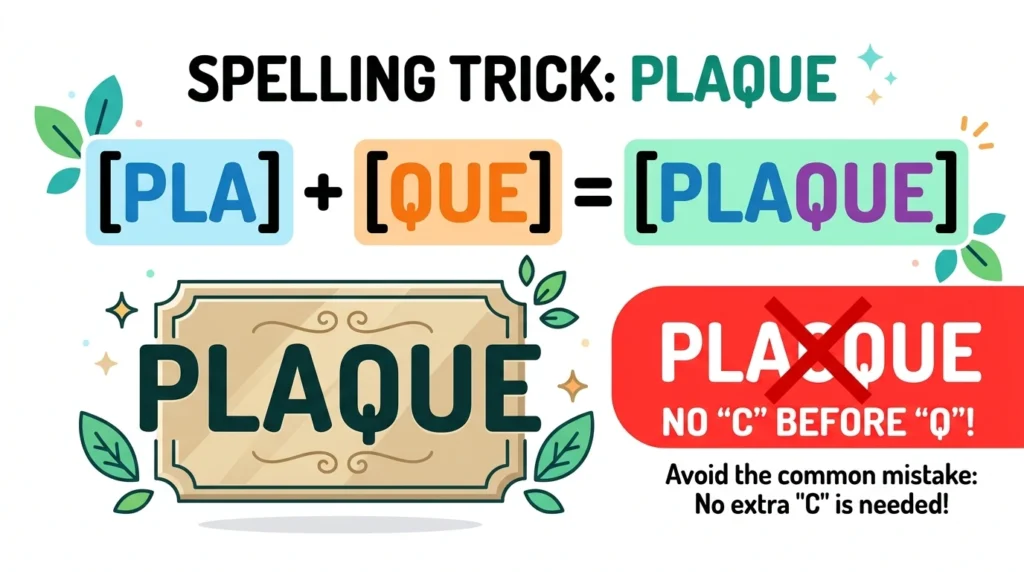
A plaque is flat, so keep its spelling flat: P-L-A-Q-U-E. Don’t put an extra C bump before the Q.
You can also remember the last three letters:
QUE
Then build backward:
PLA + QUE = PLAQUE
Not:
PLAC + QUE = PLACQUE
Real-Life Situations
Job Interview
You are describing an achievement from a previous company.
Correct:
“I received a plaque for leading the highest-performing sales team.”
Writing placque on your résumé would be unnecessary spelling risk.
Business Meeting
Your company is preparing employee awards.
Natural:
“We need twelve engraved plaques before Friday.”
The plural is plaques.
Professional Email
You need to approve an inscription.
Natural:
“Please send the final plaque design before production begins.”
There is no reason to use placque.
Text Message
A friend asks what you received at an event.
Natural:
“They gave me a plaque for volunteering.”
Casual English does not change the spelling.
Exam
The sentence asks you to correct:
The dentist explained how placque forms.
Correct version:
The dentist explained how plaque forms.
Expert Tips for Remembering Plaque
Learn the Whole Word
Do not try to spell plaque by sounding out each letter.
English contains many borrowed words whose spelling is not completely predictable from pronunciation.
Memorizing the full visual form is faster:
PLAQUE
Associate It With a Picture
Imagine a rectangular award with the word PLAQUE engraved across it.
Visual memory can be especially helpful for irregular spellings.
Watch the Q
Once you remember that the word contains q, the spelling becomes easier.
The sequence is:
a + q + u + e
not:
a + c + q + u + e
Check the Noun Type
Ask what plaque means in your sentence.
If it means an award:
a plaque
If it means several awards:
plaques
If it means ordinary dental buildup:
plaque
This prevents both spelling and grammar errors at the same time.
Be Careful With Old Sources
If you encounter placque in historical or specialist writing, do not automatically assume the original author made a simple keyboard error.
Older spelling conventions and specialist variants can survive in archives.
However, that does not make placque the preferred spelling for your own modern writing.
Read More: Seal vs Seel: Which Is Correct and What Is the Difference?
Frequently Asked Questions
Is it placque or plaque?
Plaque is the standard spelling in modern English. Use it for awards, memorials, dental buildup, and ordinary modern medical writing.
Is placque a real word?
In everyday modern English, placque is normally treated as a misspelling of plaque. However, the spelling has appeared as a rare specialist medical variant and in older medical literature. That historical or specialist use does not make it the preferred spelling for general writing today.
How do you spell plaque on your teeth?
The correct standard spelling is plaque.
Example:
Plaque can collect between the teeth.
Do not normally write placque when discussing dental hygiene.
How do you spell plaque as in an award?
Use plaque.
Example:
She received a plaque for outstanding leadership.
The plural is plaques.
What is the plural of plaque?
The plural of plaque is plaques.
Singular:
one plaque
Plural:
three plaques
Does plaque have a silent letter?
The spelling contains letters that are not pronounced individually in the way an English learner might expect. The ending -que contributes to the final /k/ sound rather than being pronounced as a separate syllable.
Does plaque rhyme with black?
In common American pronunciation, plaque and black have the same vowel and final consonant sound, so they rhyme.
British pronunciation varies more, so the rhyme may depend on the speaker.
Is plaque a noun?
Yes. Plaque is primarily used as a noun.
It can refer to a physical award or memorial tablet, a substance on teeth, or certain medical lesions and deposits.
Is dental plaque countable or uncountable?
When referring generally to the bacterial film on teeth, plaque is usually uncountable.
Natural:
The dentist found plaque near the gumline.
Individual medical lesions or formations may be discussed as countable plaques in specialist contexts.
Are plaque and placard the same thing?
No.
A plaque is often a permanent plate or tablet containing an inscription.
A placard is generally a displayed sign or notice and may be temporary.
Is plaque spelled differently in American and British English?
No. Both varieties use plaque.
The main difference is pronunciation, not spelling.
Why is plaque so difficult to spell?
The spelling reflects the word’s linguistic history and does not correspond perfectly to what many learners expect from its modern pronunciation. The -que ending is particularly easy to misremember, which encourages forms such as placque and plack.
Mini Quiz: Placque vs Plaque
| Question | Answer | Explanation |
| 1. Choose the correct spelling: She received a (plaque / placque) for her service. | Plaque | A recognition award uses the standard spelling plaque. |
| 2. Fill in the blank: The dentist noticed ______ near the gumline. | plaque | Dental buildup is spelled plaque and is normally uncountable here. |
| 3. Correct the sentence: “Three placques were displayed in the hallway.” | Three plaques were displayed in the hallway. | The plural of plaque is plaques. |
| 4. Which is the normal modern spelling? A) Placque B) Plaque C) Plaqu | B) Plaque | Plaque is the standard form. |
| 5. Fill in the blank: A bronze ______ marked the historical site. | plaque | A permanent inscribed marker can be called a plaque. |
| 6. Correct the sentence: “Plaque are hanging on the office wall.” | Plaques are hanging on the office wall. | Several physical plaques require the plural plaques and plural verb are. |
| 7. Which sounds more natural for ordinary dental buildup? A) I have plaque on my teeth. B) I have a plaque on my teeth. | A | General dental plaque is normally treated as an uncountable substance. |
| 8. True or false: American and British English require different spellings of plaque. | False | Both normally spell the word plaque. |
| 9. Fill in the blank: The organization ordered five engraved ______. | plaques | Five requires the plural form. |
| 10. True or false: Placque has never appeared in English under any circumstances. | False | Rare specialist and historical medical uses exist, although plaque is the standard spelling for modern general writing. |
Quick Summary
Plaque is the standard spelling you should use in modern English. Placque is normally a misspelling, although rare specialist and historical medical uses of the variant can be found. Plaque may refer to an award or memorial plate, dental buildup, or certain medical deposits and lesions. The standard plural is plaques. Dental plaque is usually treated as an uncountable substance, while awards and individual medical plaques can be countable. American English commonly pronounces plaque as /plæk/, while British English allows some pronunciation variation. The easiest memory trick is to learn PLA + QUE = PLAQUE and remember that no extra c belongs before the q.