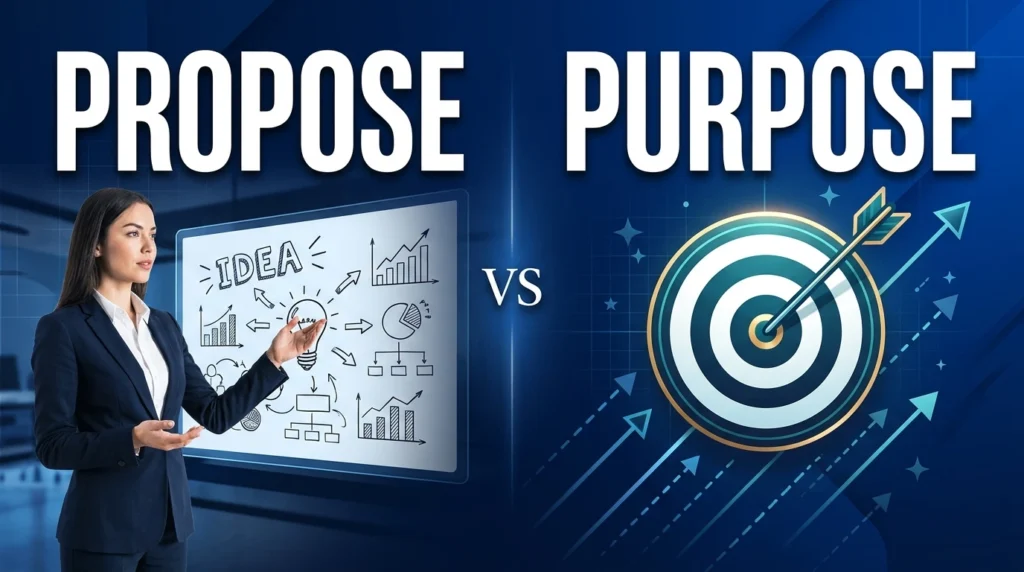

The words propose and purpose look similar, but they have different meanings and grammatical functions. Propose is primarily a verb meaning to suggest a plan, idea, or action for consideration. Purpose is primarily a noun meaning the reason for doing something or the goal you want to achieve. For example, you can propose a plan because you have a purpose in mind.
What Is the Difference Between Propose and Purpose?
The main difference between propose and purpose is that propose describes an action, while purpose usually identifies a reason, intention, or goal.
- Propose (verb): To suggest an idea, plan, solution, or course of action for others to consider.
- Purpose (noun): The reason something exists or is done, or the goal someone wants to achieve.
- Purpose (verb): A less common, formal use meaning to intend or resolve to do something.
Examples:
- The manager will propose a new marketing strategy at tomorrow’s meeting.
- The purpose of the marketing strategy is to attract more customers.
Remember: You propose something, but you usually do something for a purpose.
What Does Propose Mean?
Propose is a verb that means to put forward an idea, suggestion, plan, or action for someone to consider. It is commonly used in business meetings, academic discussions, formal writing, negotiations, and everyday conversations.
When you propose something, you are not necessarily making a final decision. You are presenting an idea that someone else may accept, reject, or discuss.
Different Meanings of Propose
The verb propose has several established meanings.
1. To suggest an idea or plan
This is its most common meaning.
- She proposed a better way to manage the project.
- The committee proposed changes to the existing policy.
2. To intend to do something
In more formal English, propose can mean to intend or plan to do something.
- We propose to complete the work before December.
- What do you propose to do about the problem?
3. To ask someone to marry you
Propose can also mean to ask someone to marry you.
- He proposed to his girlfriend during their holiday.
- She was delighted when he proposed.
4. To nominate someone for a position
In formal meetings and organizations, propose can mean to recommend someone for a position or membership.
- I would like to propose Ahmed for the position of chairman.
- She was proposed as the new team leader.
5. To suggest something formally at a meeting
- The chairman proposed a motion to reduce unnecessary expenses.
- A new resolution was proposed during the conference.
What Does Purpose Mean?
Purpose is primarily a noun that means the reason for doing something, the intention behind an action, or the goal someone wants to achieve.
It answers an important question: Why is something being done?
For example:
- The purpose of this meeting is to discuss the new business strategy.
- Her purpose in learning English is to communicate confidently.
- The main purpose of the research is to identify possible solutions.
Purpose can describe both practical objectives and deeper personal reasons.
Different Meanings of Purpose
1. A reason for doing something
This is the most common meaning of purpose.
- The purpose of this exercise is to improve your writing.
- What is the purpose of this document?
2. A goal or objective
Purpose can describe something a person or organization wants to achieve.
- Our company has a clear purpose.
- His main purpose is to help young entrepreneurs.
3. A sense of direction or meaning in life
Purpose can also describe a person’s deeper sense of meaning or direction.
- She found a new purpose after starting her business.
- Having a purpose gives him the motivation to keep moving forward.
4. A specific intention or use
- This room serves a practical purpose.
- The equipment was designed for a particular purpose.
5. A less common verb meaning to intend
Purpose can also be used as a verb, although this use is much less common than its use as a noun.
- She purposed to complete the project within a year.
- He purposed to dedicate his life to education.
In modern everyday English, intended or planned would usually sound more natural in these sentences.
Read More: Its Called vs. It Called: Which Is Correct?
Why Does the Difference Between Propose and Purpose Matter?
Confusing these words can change the meaning of a sentence and make your writing unclear.
The difference is particularly important in professional communication, academic writing, business proposals, and everyday conversations.
Consider these situations:
- Business: A manager proposes a new strategy. The purpose of that strategy is to increase sales.
- Education: A teacher proposes a new teaching method. Its purpose is to help students understand difficult topics.
- Research: A researcher proposes a theory. The purpose of the research is to test that theory.
- Personal development: A person proposes a plan for improvement. The purpose is to achieve a specific goal.
Using the correct word helps readers understand whether you are talking about a suggestion or the reason behind an action.
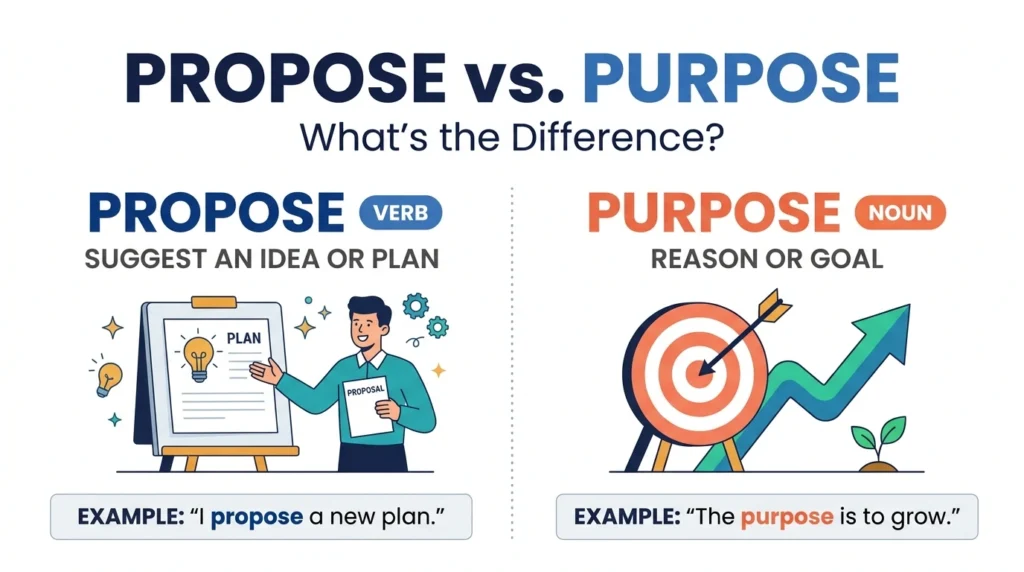
The Core Rule: When to Use Propose vs Purpose
PROPOSE
Suggest or put forward
Use it when someone presents an idea, plan, solution, or recommendation.
Example: I propose a new strategy.
PURPOSE
Reason or goal
Use it when explaining why something is done or what someone wants to achieve.
Example: The purpose is to increase sales.
The easiest rule to remember: Propose is something you do; purpose is usually the reason why you do it.
How to Use Propose and Purpose Correctly
Understanding their grammatical roles makes choosing the right word much easier.
How to Use Propose in a Sentence
Propose is a verb. It describes an action, so it normally appears with a subject and an appropriate object or clause.
Here are the common sentence patterns.
1. Propose + noun
Use this structure when suggesting a particular idea, plan, change, or solution.
- I propose a new business model.
- The committee proposed several changes.
- They proposed a different approach.
2. Propose + doing something (-ing form)
Use a verb ending in -ing when suggesting an activity or action.
- She proposed launching a new website.
- We proposed reducing unnecessary expenses.
- He proposed hiring additional employees.
3. Propose + that + subject + verb
Use this structure when suggesting that someone should do something.
- I propose that we review the agreement.
- She proposed that the meeting be postponed.
- The director proposed that every department submit a report.
In formal English, the verb after that can use the base form, even with a singular subject. This is called the subjunctive mood. It is a grammatical form used for suggestions, demands, and recommendations.
For example:
- Correct: I propose that he attend the meeting.
- Also correct: I propose that he should attend the meeting.
The second pattern is especially common in British English.
4. Propose + to + base verb
Use this pattern when propose means intend or plan to do something.
- We propose to expand our operations.
- I propose to finish the assignment today.
- The company proposes to introduce a new service.
5. Propose to + person
Use this pattern when asking someone to marry you.
- He proposed to her on their anniversary.
- She finally proposed to him.
Be careful: propose to someone has a different meaning from propose something to someone.
- He proposed to Sarah. (He asked her to marry him.)
- He proposed a new idea to Sarah. (He suggested an idea to her.)
How to Use Purpose in a Sentence
Purpose is usually a noun. It identifies the reason, intention, or objective behind an action.
Here are the most useful patterns.
1. The purpose of + noun
Use this structure to explain why something exists or is done.
- The purpose of this course is to teach practical skills.
- The purpose of the meeting is to discuss the budget.
- The purpose of the campaign is to increase brand awareness.
2. Purpose + of + -ing form
Use this structure to describe the reason behind an activity.
- The purpose of learning English is to communicate effectively.
- The purpose of exercising regularly is to improve fitness.
- The purpose of saving money is to prepare for future needs.
3. For the purpose of + noun or -ing form
This is a more formal expression used to explain the intended reason for an action.
- The information was collected for the purpose of research.
- The building was designed for the purpose of education.
- We organized the event for the purpose of raising funds.
4. With the purpose of + -ing form
Use this structure to describe the intention behind an action.
- The organization was established with the purpose of helping children.
- She joined the course with the purpose of improving her communication skills.
5. On purpose
This is a common expression meaning intentionally or deliberately.
- I did not break the glass on purpose.
- He ignored my message on purpose.
- She arrived early on purpose.
Remember that on purpose does not mean the same as for a purpose.
- I did it on purpose. (I did it intentionally.)
- I did it for a purpose. (I had a reason for doing it.)
6. A sense of purpose
Use this expression to describe having a meaningful goal or direction in life.
- Helping others gives her a sense of purpose.
- He started his business with a strong sense of purpose.
7. Serve a purpose
Use this expression when something has a particular use or function.
- Every section of the report serves a purpose.
- This small tool serves a useful purpose.
Read More: Envolved vs. Involved: Which Spelling Is Correct?
Correct Examples of Propose and Purpose
The following examples show how both words work in everyday communication, education, business, and professional writing.
Propose: 10 Correct Examples
| Situation | Correct example |
|---|---|
| Everyday conversation | I propose that we go out for dinner tonight. |
| Business meeting | The manager proposed a new sales strategy. |
| Professional email | I would like to propose a meeting next Monday. |
| Academic writing | The researcher proposes a new explanation for the results. |
| School assignment | Our teacher proposed a different topic for the project. |
| Workplace discussion | She proposed hiring two additional employees. |
| Social media | I propose we make this year about personal growth. |
| Marriage | He proposed to his partner during their trip. |
| Formal meeting | The chairman proposed a motion to change the policy. |
| Project planning | We propose to complete the first phase by March. |
Purpose: 10 Correct Examples
| Situation | Correct example |
|---|---|
| Everyday conversation | What is the purpose of your visit? |
| Business meeting | The purpose of this meeting is to review our progress. |
| Professional email | I am writing for the purpose of confirming our appointment. |
| Academic writing | The purpose of this study is to examine student performance. |
| School assignment | The purpose of the experiment is to test the hypothesis. |
| Workplace discussion | Every employee should understand the purpose of this project. |
| Social media | Find your purpose and work towards your dreams. |
| Personal development | Helping people gives her a sense of purpose. |
| Research | The research was conducted for educational purposes. |
| Daily activities | I bought this notebook for a specific purpose. |
Incorrect vs Correct: Propose vs Purpose
The following examples highlight common errors and explain why one word works better than the other.
| ❌ Incorrect | ✅ Correct | Why |
|---|---|---|
| I purpose a new business idea. | I propose a new business idea. | You suggest an idea; you do not normally purpose one. |
| What is the propose of this meeting? | What is the purpose of this meeting? | You are asking about the reason for the meeting. |
| The purpose is to propose a solution. | The purpose is to propose a solution. | This sentence is already correct: the goal is to suggest a solution. |
| She proposed of helping students. | She proposed helping students. | Propose takes an -ing form when suggesting an activity. |
| I want to propose my purpose. | I want to explain my purpose. | Explain is the natural verb when communicating your reason or goal. |
| The propose of education is learning. | The purpose of education is learning. | Purpose is the noun needed to identify a reason. |
| Our purpose a new strategy yesterday. | We proposed a new strategy yesterday. | Proposed is the past-tense verb needed to describe the suggestion. |
| He proposed to his manager a new policy. | He proposed a new policy to his manager. | When suggesting a policy, place the suggested thing after propose. |
| What do you purpose to do next? | What do you propose to do next? | Propose is the natural choice when asking someone about their intended course of action. |
| The propose of this campaign is brand awareness. | The purpose of this campaign is brand awareness. | The sentence needs a noun identifying the campaign’s objective. |
| She proposed that he to attend the meeting. | She proposed that he attend the meeting. | The verb after this formal that-clause does not take an additional to. |
| The purpose of the committee is proposed a change. | The purpose of the committee is to propose a change. | The infinitive form is needed to explain the committee’s intended action. |
Why People Confuse Propose and Purpose
Although the words have different meanings, several factors can make them confusing, particularly for English learners.
1. Similar Spelling
Both words contain seven letters and share most of their spelling pattern. Their visual similarity can cause writers to select the wrong word when typing quickly.
However, their endings are different:
- Propose ends in -pose.
- Purpose ends in -pose, but has a different vowel pattern earlier in the word.
Looking carefully at the middle letters can help prevent spelling mistakes.
2. Similar Word Origins
The words have related historical backgrounds. Their development is connected to the idea of putting something forward or setting something before someone.
However, their modern meanings and grammatical roles have developed differently. Their related origins do not make them interchangeable.
3. Overgeneralization
Some learners assume that words with similar spelling must have similar grammatical functions.
For example, someone may know that propose means to put forward an idea and incorrectly use purpose in the same position.
The solution is to learn each word through its sentence patterns, not spelling alone.
4. Autocorrect and Spellcheck
Spellcheck software may accept both words because they are correctly spelled English words.
If you type:
– What is the propose of this project?
A basic spelling checker may not identify the problem because propose is a valid word.
This is a context error, not necessarily a spelling error.
5. Translation Interference
Some learners translate both words into a single word in their first language because both can relate to ideas such as intention, planning, or objectives.
But English distinguishes between suggesting an action and explaining the reason behind it.
Learning the English sentence patterns directly is more reliable than translating each word individually.
Common Mistakes Checklist
Use this checklist to identify and correct the most frequent errors.
- Using propose instead of purpose: Remember that a reason or objective is normally a purpose. Ask yourself whether you are explaining why something happens.
- Using purpose instead of propose: When presenting an idea for consideration, use propose. Ask yourself whether someone is suggesting something.
- Using the wrong verb form: Write proposed for the past tense and proposing for the -ing form.
- Using propose with an incorrect infinitive structure: Avoid I propose him to attend. Use I propose that he attend or I propose his attending where appropriate.
- Confusing marriage proposals with suggestions: Use propose to someone when asking for marriage. Use propose something to someone when suggesting an idea.
- Misusing on purpose: This expression means deliberately, not simply having a goal.
- Forgetting the noun structure: Use the purpose of the project, not the propose of the project.
- Using the rare verb purpose unnecessarily: In everyday writing, prefer intend, plan, or aim when you mean to have a goal.
Propose vs Purpose in Real English
Understanding dictionary definitions is useful, but knowing how people actually use words in everyday English is equally important.
Propose: Grammatically Correct and Natural
Grammatically correct: “I propose that we change the schedule.”
Natural everyday English: “I suggest we change the schedule.”
Both sentences are correct. Propose is particularly suitable for formal discussions, meetings, recommendations, and situations where an idea is presented for consideration. In casual conversation, suggest may sound more relaxed. However, propose is not restricted to formal writing; it is also natural when discussing plans or marriage.
Purpose: Grammatically Correct and Natural
Grammatically correct: “The purpose of this meeting is to discuss our progress.”
Natural everyday English: “We’re meeting to discuss our progress.”
Both sentences are natural. Purpose is commonly used in professional communication, education, research, and everyday discussions about goals. It is not an unusually formal word. Expressions such as on purpose, a sense of purpose, and for this purpose are also established parts of ordinary English.
Purpose as a Verb: Grammatically Possible but Uncommon
Grammatically possible: “He purposed to establish a new organization.”
More natural everyday English: “He intended to establish a new organization.”
Purpose can function as a verb meaning to intend, resolve, or set something as an aim. This usage is established English, not a spelling mistake. However, it is uncommon in contemporary everyday conversation. Most writers and speakers prefer intend, plan, or aim because these words communicate the meaning more directly.
American vs British English: Propose vs Purpose
There is no significant difference in the core meanings or ordinary spelling of propose and purpose between American and British English.
Both varieties use:
- Propose to suggest an idea or plan.
- Purpose to identify a reason, aim, or objective.
- On purpose to mean intentionally.
The main differences are in pronunciation.
| Word | American English | British English |
|---|---|---|
| Propose | /prəˈpoʊz/ | /prəˈpəʊz/ |
| Purpose | /ˈpɝːpəs/ | /ˈpɜːpəs/ |
These are pronunciation differences, not differences in meaning or spelling.
Formal vs Informal Usage
Both words work in formal and informal English, but their common expressions differ depending on the situation.
| Situation | More formal | More conversational |
|---|---|---|
| Suggesting an idea | I propose a new approach. | I suggest we try something different. |
| Explaining a goal | The purpose is to improve performance. | We’re doing this to improve performance. |
| Explaining an intention | I propose to complete the project. | I plan to finish the project. |
| Explaining a reason | This was created for the purpose of research. | This was created for research. |
Important: Propose is not always formal, and purpose is not always formal. The sentence and situation determine the level of formality.
Comparison Table: Propose vs Purpose
| Feature | Propose | Purpose |
|---|---|---|
| Main part of speech | Verb | Noun |
| Secondary part of speech | — | Verb (less common) |
| Main meaning | Suggest an idea or plan | Reason, aim, or objective |
| Main function | Describes an action | Identifies a reason or goal |
| Common question | What do you propose? | What is the purpose? |
| Present tense | Propose | Purpose |
| Past tense | Proposed | Purposed (rare verb use) |
| -ing form | Proposing | Purposing (rare verb use) |
| Common expression | Propose a solution | Have a purpose |
| Business usage | Propose a strategy | Define a business purpose |
| Academic usage | Propose a theory | Explain the purpose of research |
| Marriage usage | Propose to someone | No equivalent marriage meaning |
| Everyday usage | Suggest or recommend | Reason or intention |
| Example | I propose a new plan. | The purpose is to succeed. |
Related Words You Should Know
Some other English words are closely related to propose and purpose. Understanding their differences can make your writing more precise.
| Word | Meaning | Example |
|---|---|---|
| Suggest | To put forward an idea | I suggest changing the schedule. |
| Proposal | A formal suggestion or plan | She submitted a business proposal. |
| Purposeful | Having a clear intention | He took purposeful steps towards success. |
| Purposefully | In a deliberate or intentional way | She purposefully avoided the discussion. |
| Intention | Something you plan or want to do | My intention is to finish the project. |
| Objective | A specific result you want to achieve | Our objective is to increase sales. |
| Proposer | Someone who puts forward a suggestion | The proposer explained the new motion. |
Memory Trick: How to Remember Propose vs Purpose
Here is a simple way to remember the difference:
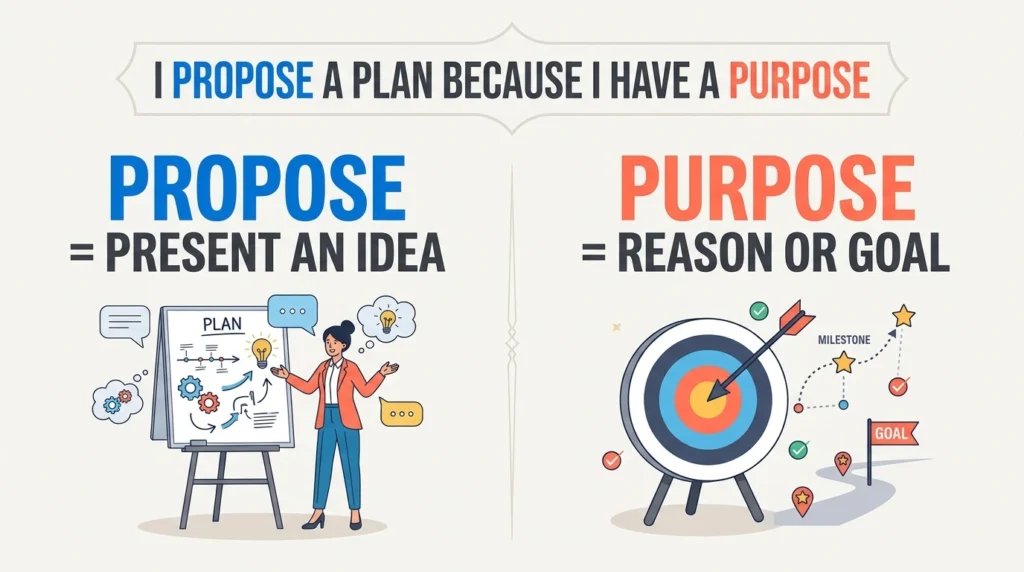
PROPOSE = PRESENT AN IDEA
Think of the word propose as presenting something to another person.
You propose:
- A plan.
- A solution.
- A business strategy.
- A suggestion.
- A marriage.
PURPOSE = WHY YOU DO IT
Think of purpose as the reason behind your actions.
You have:
- A purpose in life.
- A purpose for learning.
- A purpose for working.
- A purpose for starting a business.
- A purpose for making a decision.
Read More: Tieing vs Tying: Which Spelling Is Correct?
Remember this sentence
I propose a plan because I have a purpose.
Propose = the suggestion. Purpose = the reason behind it.
Propose vs Purpose in Real-Life Situations
The following scenarios demonstrate how to choose the correct word in practical situations.
1. During a Job Interview
Interviewer: What would you suggest to improve our company’s performance?
Candidate: I would propose a new customer retention strategy. The purpose would be to increase customer loyalty and long-term revenue.
Here, propose introduces the suggested strategy, while purpose explains its objective.
2. During a Business Meeting
Manager: We need to reduce our operating costs.
Employee: I propose reviewing our monthly expenses and removing unnecessary spending.
Manager: Good idea. What would be the purpose of this exercise?
Employee: The purpose would be to improve profitability without affecting service quality.
3. In a Professional Email
Subject: Proposal for a New Marketing Strategy
Dear Team,
I would like to propose a new marketing strategy for the next quarter. The main purpose of this strategy is to increase brand awareness and generate more qualified leads.
Please review the idea before our next meeting.
Best regards,
Ahmed
4. In an Academic Assignment
Student: My research paper proposes a new approach to understanding online learning.
Teacher: What is the purpose of your research?
Student: The purpose is to examine how digital tools affect student engagement.
5. In an Everyday Conversation
Friend 1: What should we do this weekend?
Friend 2: I propose visiting the mountains.
Friend 1: What’s the purpose of the trip?
Friend 2: To relax, enjoy nature, and spend time together.
Quick Summary: Propose vs Purpose
Propose and purpose are similar-looking words with different meanings and grammatical functions. Propose is primarily a verb meaning to suggest or present an idea, plan, or action for consideration. It can also mean to intend to do something or ask someone to marry you. Purpose is primarily a noun describing the reason, intention, or goal behind an action. Although purpose can also function as a verb, this usage is uncommon in everyday English. Remember the simple distinction: you propose a plan, but you have a purpose for making that plan. Choosing the correct word makes your communication clearer and more professional.
Frequently Asked Questions (FAQ)
1. What is the main difference between propose and purpose?
Propose is primarily a verb meaning to suggest an idea, plan, or action. Purpose is primarily a noun meaning the reason or goal behind something. For example, you propose a business strategy because your purpose is to increase sales.
2. Can propose and purpose be used interchangeably?
No. They have different meanings and grammatical functions. Propose describes suggesting something, while purpose identifies why something is done. Replacing one with the other usually changes the sentence or makes it grammatically incorrect.
3. Is purpose a noun or a verb?
Purpose is primarily a noun, but it can also function as a verb meaning to intend, plan, or resolve to do something. The verb form is much less common in modern everyday English.
4. What is the past tense of propose?
The past tense of propose is proposed. For example: “The manager proposed a new strategy yesterday.”
5. What is the past tense of purpose?
When purpose is used as a verb, its past tense is purposed. However, this form is uncommon. In ordinary writing, intended or planned is usually more natural.
6. Can I say “I propose a purpose”?
Yes, the sentence can be grammatically correct in a suitable context, but it may sound unusual without further explanation. For example, “I propose a clear purpose for the project” means that you are suggesting an objective for it. More commonly, you might say, “I propose a new goal for the project.”
7. What does “on purpose” mean?
“On purpose” means intentionally or deliberately. It describes an action that someone does knowingly rather than by accident. For example: “She deleted the file on purpose.”
8. What is the difference between propose and suggest?
Both words can mean putting forward an idea for consideration. Suggest is generally more conversational and flexible, while propose often sounds more formal or structured. For example, “I suggest taking a break” and “I propose taking a break” are both correct.
9. Is “purpose” used in academic writing?
Yes. Purpose is frequently used in academic writing to explain the aim of research, experiments, studies, and investigations. For example: “The purpose of this study is to examine the effects of social media on learning.”
10. How can I remember the difference between propose and purpose?
Remember this simple sentence: “I propose a plan because I have a purpose.” Propose means presenting an idea, while purpose means the reason or goal behind an action.
11. Is there a spelling difference between American and British English?
No. Both American and British English use the spellings propose and purpose. Their pronunciations differ slightly, but their standard meanings remain the same.
12. Which word should I use when explaining why I started a business?
Use purpose because you are explaining your reason or objective. For example: “The purpose of starting my business was to provide affordable services to small companies.”
Mini Quiz: Test Your Understanding of Propose vs Purpose
Choose the correct word or sentence in each question. Answers and explanations are included so you can learn from your mistakes.
| No. | Question | Answer | Explanation |
|---|---|---|---|
| 1 | The main _____ of this meeting is to discuss our plans. (propose / purpose) | Purpose | Purpose identifies the reason for the meeting. |
| 2 | The manager will _____ a new marketing strategy. (propose / purpose) | Propose | Propose means to suggest a strategy. |
| 3 | What is the _____ of learning a foreign language? (propose / purpose) | Purpose | Purpose refers to the reason for learning. |
| 4 | She _____ introducing a new training programme. (proposed / purposed) | Proposed | Proposed is the past tense of propose. |
| 5 | Correct this sentence: “I purpose a better solution.” | I propose a better solution. | Propose is the appropriate verb for suggesting a solution. |
| 6 | He deleted the document on _____. (propose / purpose) | Purpose | On purpose means intentionally. |
| 7 | Complete the sentence: “The researcher proposed _____ the results again.” (checking / to checking) | Checking | Propose can be followed by a gerund when suggesting an activity. |
| 8 | Which sentence is correct? A. The propose of this project is education. B. The purpose of this project is education. | B | Purpose is the noun needed to describe the project’s objective. |
| 9 | Complete the sentence: “I propose that he _____ the meeting.” (attend / to attend) | Attend | The base form is used in this formal subjunctive construction. |
| 10 | Choose the natural sentence: A. My propose is to help people. B. My purpose is to help people. | B | Purpose is the correct noun for describing a personal goal or intention. |
Quiz Score Guide
- 9–10 correct: Excellent! You understand the difference.
- 7–8 correct: Good work! Review the sentence patterns.
- 5–6 correct: You’re making progress. Practise using both words in sentences.
- 0–4 correct: Revisit the core rule and examples before trying again.