


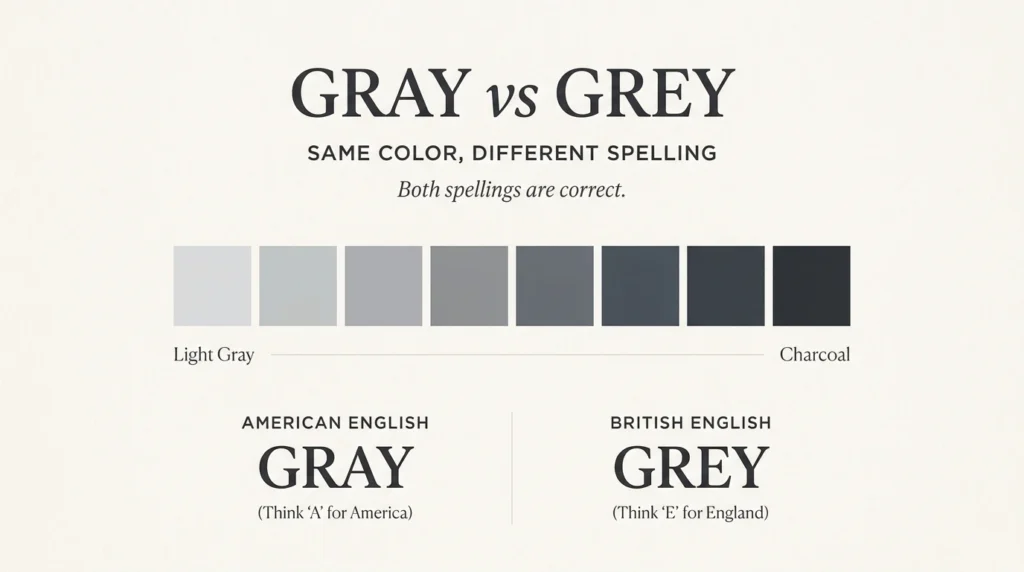
Both gray and grey are correct spellings of the same color. The difference is mainly regional: American English uses gray, while British English generally uses grey. They have the same pronunciation, meaning, and grammatical functions. Neither spelling describes a different shade. Choose the version that matches your audience, keep it consistent, and remember that certain proper names and fixed terms have their own established spellings.
What Is the Difference Between Gray and Grey?
Gray and grey refer to the neutral color between black and white. The two spellings have the same meaning and pronunciation. The difference comes from regional spelling conventions rather than grammar.
- Gray: The standard spelling in American English.
- Grey: The standard and more common spelling in British English.
For example:
- American English: The walls of my bedroom are light gray.
- British English: The walls of my bedroom are light grey.
Both sentences are correct. The spelling changes, but the meaning remains exactly the same.
The distinction also applies when the word describes someone’s hair, a cloudy sky, clothing, furniture, or an unclear situation.
Why Does the Difference Matter?
Choosing between gray and grey may seem like a small spelling decision, but consistency matters in professional and academic writing.
Imagine preparing an American business report using words such as color, favorite, and organize. If you suddenly write grey, your spelling becomes inconsistent with the American English convention.
The same applies to British English. A document using colour, favourite, and organise will generally look more consistent with grey than gray.
This matters in several situations:
- Professional writing: Consistent spelling makes business documents look carefully edited.
- Academic writing: Universities and publications may require a particular English variant.
- Website content: A consistent language style creates a more professional reading experience.
- Editing and proofreading: Knowing both forms prevents you from correcting an acceptable regional spelling unnecessarily.
- International communication: Choosing the audience’s preferred spelling makes your writing easier to follow.
The goal is not to memorize one spelling as universally correct. It is to understand where each spelling belongs.
The Core Rule
Use gray in American English and grey in British English. Both spellings are correct, and neither changes the meaning of the word.
A simple comparison:
| English Variant | Preferred Spelling | Example |
|---|---|---|
| American English | Gray | A gray jacket |
| British English | Grey | A grey jacket |
If you are unsure which spelling to choose, identify your target audience first.
How to Use Gray and Grey
Both spellings perform the same grammatical functions. They can be used as adjectives, nouns, and verbs.
1. Gray or Grey as an Adjective
An adjective describes a person, place, object, or situation.
Use gray or grey when describing something that has this color.
Examples:
- She bought a gray dress. (American English)
- She bought a grey dress. (British English)
- The old building has gray walls.
- The old building has grey walls.
- He wore a dark gray suit to the interview.
- He wore a dark grey suit to the interview.
The spelling depends on the English variant you are following.
2. Gray or Grey as a Noun
A noun names something. Gray or grey can refer to the color itself or different shades of that color.
Examples:
- Gray is a popular choice for modern office interiors.
- Grey is often used in minimalist home designs.
- The artist mixed several shades of gray.
- The designer selected three shades of grey for the collection.
Both spellings work in the same way.
3. Gray or Grey as a Verb
A verb describes an action or state. Gray or grey can also mean to become gray, particularly when discussing hair.
Examples:
- His hair began to gray in his early thirties.
- Her hair started to grey after years of stress.
- The photograph has grayed with age.
- The old photograph has greyed over time.
The regional spelling convention continues in the verb forms.
| American English | British English |
|---|---|
| Gray | Grey |
| Grayed | Greyed |
| Graying | Greying |
| Grayish | Greyish |
| Grayness | Greyness |
4. Gray Area or Grey Area
Both expressions describe a situation that is unclear, uncertain, or not easily classified as right or wrong.
American English generally uses gray area, while British English generally uses grey area.
Examples:
- The contract contains a gray area that needs clarification.
- The contract contains a grey area that needs clarification.
- The legal status of this arrangement is still a gray area.
- The legal status of this arrangement is still a grey area.
Neither expression refers to a physical color in this context. It is a figurative expression describing uncertainty.
5. Gray Hair or Grey Hair
Both expressions describe hair that has lost some or most of its natural color.
Examples:
- My father started getting gray hair at an early age.
- My father started getting grey hair at an early age.
- She noticed a few gray hairs near her temples.
- She noticed a few grey hairs near her temples.
The same regional spelling rule applies.
Correct Examples of Gray and Grey in Sentences
Here are 12 original examples showing how both spellings work in everyday and professional communication.
| Situation | American English (Gray) | British English (Grey) |
|---|---|---|
| Everyday conversation | I think the gray shirt looks better. | I think the grey shirt looks better. |
| Please send me the gray version of the design. | Please send me the grey version of the design. | |
| School | The student used gray pencils for the drawing. | The student used grey pencils for the drawing. |
| Workplace | Our office will have gray furniture. | Our office will have grey furniture. |
| Social media | Gray outfits never go out of style. | Grey outfits never go out of style. |
| Academic writing | The study examined gray matter in the brain. | The study examined grey matter in the brain. |
| Fashion | A gray coat looks elegant in winter. | A grey coat looks elegant in winter. |
| Weather | Dark gray clouds covered the sky. | Dark grey clouds covered the sky. |
| Interior design | We selected a light gray wall color. | We selected a light grey wall colour. |
| Photography | The photographer converted the image to grayscale. | The photographer converted the image to greyscale. |
| Personal description | His beard is turning gray. | His beard is turning grey. |
| Business discussion | This policy creates a gray area. | This policy creates a grey area. |
These examples demonstrate that the spelling changes according to the regional convention, not the meaning.
Incorrect vs. Correct: Gray vs Grey
There is an important distinction here: neither spelling is universally incorrect. An otherwise correct spelling may be inconsistent with a particular style guide.
The following examples identify errors in regional consistency, fixed spelling, or actual spelling.
| Incorrect or Inconsistent | Correct | Why |
|---|---|---|
| The sky is grey. (In a document strictly following American English.) | The sky is gray. | American English generally prefers gray. |
| The sky is gray. (In a document strictly following British English.) | The sky is grey. | British English generally prefers grey. |
| I bought a greay jacket. | I bought a gray jacket. / I bought a grey jacket. | Greay is a misspelling of both accepted forms. |
| His hair is turning greyy. | His hair is turning grey. | Greyy contains an unnecessary extra letter. |
| She drinks Earl Gray tea. | She drinks Earl Grey tea. | Earl Grey is the established name of the tea. |
| I adopted a greyhound, spelled grayhound. | I adopted a greyhound. | Greyhound has a fixed spelling. |
| The book is titled Grey’s Anatomy, but I wrote Gray’s Anatomy when referring to that title. | Gray’s Anatomy. | The established title uses Gray. |
| The report uses color, favorite, and grey throughout. (For consistent American English.) | The report uses color, favorite, and gray throughout. | The spelling should follow the selected regional convention. |
| The report uses colour, favourite, and gray throughout. (For consistent British English.) | The report uses colour, favourite, and grey throughout. | Gray is inconsistent with the selected British spelling style. |
| Her hair is graying. (In a document strictly following British English.) | Her hair is greying. | The British spelling convention carries through to the verb form. |
| His hair is greying. (In a document strictly following American English.) | His hair is graying. | American English generally uses graying. |
| The artist preferred grayish tones. (In a document strictly following British English.) | The artist preferred greyish tones. | Greyish follows the British spelling convention. |
Important: The first, second, and final regional examples are style inconsistencies, not universal grammar errors. If a writer uses the other regional spelling in an otherwise correct sentence, the meaning remains clear.
Why Do People Make This Mistake?
Gray and grey create confusion because English allows two established spellings for the same word.
Several factors contribute to this uncertainty.
1. Both Spellings Sound Exactly the Same
Gray and grey are pronounced /ɡreɪ/. They rhyme with words such as day, say, and way.
When people hear the word, they cannot determine which spelling the speaker intends.
This is why the confusion often appears in writing rather than conversation.
2. English Uses Different Regional Spelling Systems
American and British English have several spelling differences.
For example:
- Color (American) / Colour (British)
- Favorite (American) / Favourite (British)
- Center (American) / Centre (British)
- Gray (American) / Grey (British)
People who regularly read both varieties may naturally become familiar with both forms.
3. Both Spellings Look Correct
Unlike a clear spelling mistake, gray and grey are both accepted English words.
Spellcheckers may accept both forms because neither is inherently incorrect. A spelling tool may not identify whether the chosen form matches the language setting or style guide of your document.
4. Translation Can Influence Spelling
English learners may learn vocabulary from textbooks, online courses, films, or teachers who use different regional varieties.
A learner familiar with British English may write grey, while someone trained primarily in American English may choose gray.
Neither learner has necessarily misunderstood the word.
5. People Assume Different Spellings Mean Different Shades
Some writers believe gray describes a darker or warmer shade, while grey describes a lighter or cooler shade.
Historical writers have sometimes suggested distinctions between the two forms. However, modern everyday English does not maintain a standard difference in shade.
For ordinary writing, both spellings describe the same color.
Read More: Propose vs Purpose: Meaning, Differences & 20+ Examples.
Common Mistakes Checklist
Before publishing your writing, check these common problems.
- Treating one spelling as universally wrong: Both forms are correct. Choose the one that matches your English variant.
- Mixing American and British spelling: Using gray in a British document filled with British spellings may create inconsistency. Follow one style throughout.
- Changing proper names: Do not change the spelling of a person’s name, book title, product, or established name to match your preferred regional spelling.
- Assuming the words describe different colors: They have the same ordinary meaning. Do not use them to distinguish two shades unless a specific brand or technical color system defines them differently.
- Ignoring related word forms: Remember that grayed and graying are American forms, while greyed and greying are British forms.
- Trusting spellcheck without checking language settings: A spellchecker may accept both spellings without considering your intended audience.
- Correcting someone else’s regional spelling unnecessarily: Before editing a document, find out which English variant the writer is using.
Gray vs Grey in Real English
Understanding the difference between what is grammatically correct and what is natural in everyday English helps you avoid unnecessary corrections.
Grammatically Correct
Both gray and grey are grammatically correct. You can use either spelling as an adjective, noun, or verb. For example, “The sky is gray” and “The sky is grey” are both correct sentences. The difference is regional spelling preference, not sentence structure or grammar. Both forms are understood by English speakers.
Grammatically Possible but Inconsistent
A sentence can be grammatically correct while using a spelling that does not match the document’s chosen English variant. For example, “The colour of the wall is gray” combines a British spelling of colour with the American spelling gray. The sentence is understandable and grammatically sound, but a British English editor would normally change gray to grey for consistency.
Natural, Everyday English
Both spellings are completely natural in everyday English when they match the speaker’s or writer’s regional convention. An American might naturally say, “I like your gray jacket,” while a British speaker might say, “I like your grey jacket.” Neither sounds unnatural. The important point is to use the form expected by your audience, rather than trying to make a distinction between shades.
American vs. British English
This is the main distinction between gray and grey.
American English
American English generally uses gray.
Examples:
- The gray clouds look heavy.
- I bought a gray sweater.
- His hair is turning gray.
- The issue remains a gray area.
- The building has gray walls.
Related spellings include:
- Gray
- Grayed
- Graying
- Grayish
- Grayness
- Grayscale
British English
British English generally uses grey.
Examples:
- The grey clouds look heavy.
- I bought a grey sweater.
- His hair is turning grey.
- The issue remains a grey area.
- The building has grey walls.
Related spellings include:
- Grey
- Greyed
- Greying
- Greyish
- Greyness
- Greyscale
Read More: Its Called vs. It Called: Which Is Correct?
What About Other English-Speaking Countries?
British-style spelling is generally preferred in countries such as the United Kingdom, Australia, New Zealand, and Ireland. Canada commonly prefers grey, although gray is also accepted.
However, national preferences are not absolute. Individual publishers, organizations, and style guides may establish their own spelling rules.
For international writing, follow the style guide or spelling convention required by your organization.
Formal vs. Informal Usage
There is no formal-versus-informal distinction between gray and grey.
Both spellings are suitable for:
- Academic essays
- Business reports
- Professional emails
- News articles
- Casual conversations
- Social media posts
- Creative writing
- Product descriptions
The choice depends on regional spelling conventions rather than the level of formality.
For example, a formal American business report would normally use gray, while a formal British business report would normally use grey.
Neither spelling is more professional than the other.
Gray vs Grey: Comparison Table
| Feature | Gray | Grey |
|---|---|---|
| Meaning | Color between black and white | Same color |
| Pronunciation | /ɡreɪ/ | /ɡreɪ/ |
| American English | Standard | Less common |
| British English | Less common | Standard |
| Part of speech | Noun, adjective, verb | Noun, adjective, verb |
| Verb form | Grayed | Greyed |
| Present participle | Graying | Greying |
| Related adjective | Grayish | Greyish |
| Figurative expression | Gray area | Grey area |
| Grammatical correctness | Correct | Correct |
| Formal writing | Accepted | Accepted |
| Meaning difference | None in ordinary use | None in ordinary use |
The comparison makes one point clear: the spelling changes, but the ordinary meaning and grammatical function do not.
Memory Trick: How to Remember Gray vs Grey
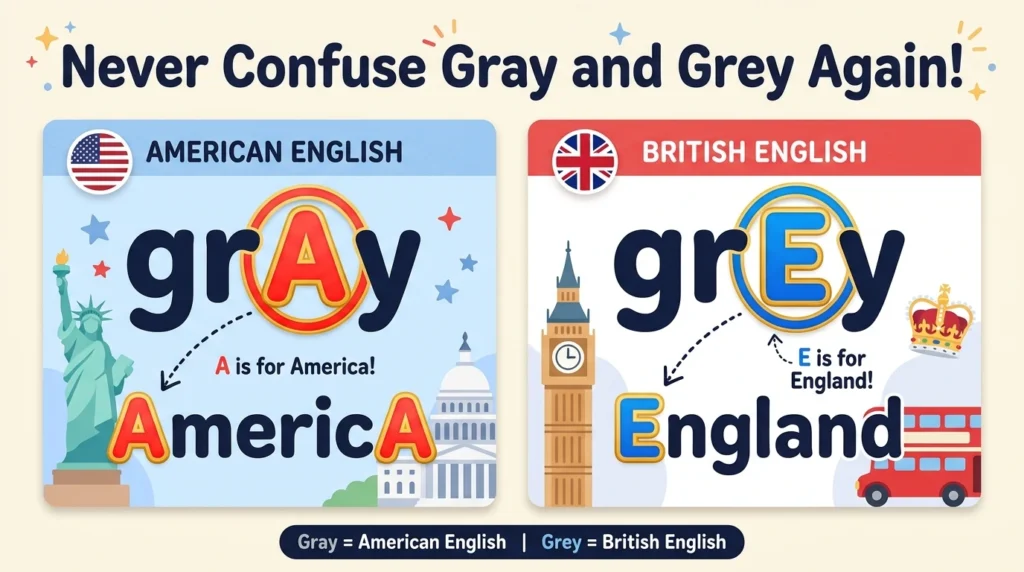
Use the first letter of the regional name to remember the spelling:
- A = America = Gray
- E = England = Grey
Think of the word as having a regional spelling clue:
GrAy = AmericA
GrEy = England
This is a simple way to remember which spelling is preferred in American and British English.
Another useful trick is to remember that both words rhyme with day. Their pronunciation is identical, so the vowel is the only spelling difference you need to remember.
Read More: Envolved vs. Involved: Which Spelling Is Correct?
Real-Life Situations: Gray or Grey?
Here are five practical situations showing how to select the correct spelling.
1. During a Job Interview
You are describing your professional clothing to an American employer.
Natural American English:
“I usually wear a gray suit for important business meetings.”
For a British employer:
“I usually wear a grey suit for important business meetings.”
2. Writing a Business Email
You are asking a designer to change a product’s color.
American English:
“Please change the background to a darker shade of gray.”
British English:
“Please change the background to a darker shade of grey.”
3. Writing an Academic Assignment
You are discussing the brain in a research paper.
Both gray matter and grey matter are acceptable expressions. Follow the spelling convention required by your institution or publication.
4. Sending a Text Message
Your friend asks which jacket you prefer.
American English:
“I like the gray one. It looks better.”
British English:
“I like the grey one. It looks better.”
5. Taking an English Examination
Your examination follows British English conventions.
You should normally write grey, not gray, to maintain consistency with the required variety.
If the examination specifies American English, choose gray instead.
The key is to understand the expected English variant before writing.
Frequently Asked Questions
1. Is gray or grey correct?
Both are correct. Gray is the standard American English spelling, while grey is the standard British English spelling. They have the same meaning and pronunciation.
2. Is grey British and gray American?
Yes. Grey is generally preferred in British English, while gray is standard in American English. Other English-speaking countries may follow either convention, depending on their publishing standards.
3. Do gray and grey mean different colors?
No. In ordinary modern English, both words describe the same color between black and white. Neither spelling refers to a specific shade.
4. Is gray acceptable in British English?
Yes. British readers understand gray, and it is an accepted alternative spelling. However, grey is the more conventional choice in British English publications.
5. Is grey acceptable in American English?
Yes. American readers understand grey, and it is not an inherently incorrect spelling. However, gray is the standard American form.
6. Should I write gray hair or grey hair?
Use gray hair in American English and grey hair in British English. Both expressions describe hair that has lost some of its natural color.
7. Is it grayish or greyish?
Both are correct. Grayish is the American spelling, while greyish is generally preferred in British English.
8. Is it graying or greying?
Both forms are correct. American English generally uses graying, while British English generally uses greying. Both describe the process of becoming gray or grey.
9. Is Earl Grey tea spelled with an A or an E?
It is always spelled Earl Grey tea. Grey is part of the established name, so you should not change it to Earl Gray, even when writing in American English.
10. Why is Greyhound spelled with an E?
Greyhound is the established spelling of the dog breed and is not an alternative spelling of the color word. Its spelling should remain unchanged regardless of whether you use American or British English.
11. Which spelling should I use for an international audience?
Choose one English variant and use it consistently. If your organization has a style guide, follow it. Otherwise, consider the main location of your readers and the spelling convention they are most familiar with.
12. Is gray or grey more professional?
Neither is more professional. Both are accepted in formal and informal writing. Professionalism comes from using the correct spelling convention consistently, not from choosing one vowel over the other.
Mini Quiz: Gray vs Grey
Test your understanding with these 10 questions. The quiz includes multiple-choice questions, fill-in-the-blanks, and sentence corrections.
| No. | Question | Answer | Explanation |
|---|---|---|---|
| 1 | Which spelling is standard in American English? A) Grey B) Gray C) Greay | B) Gray | American English generally uses gray. |
| 2 | Which spelling is preferred in British English? A) Gray B) Grey C) Graey | B) Grey | British English generally prefers grey. |
| 3 | Complete the sentence using American English: “The sky looks dark and ____ today.” | Gray | Gray is the standard American spelling. |
| 4 | Complete the sentence using British English: “She bought a beautiful ____ coat.” | Grey | Grey is the standard British spelling. |
| 5 | True or False: Gray and grey have different meanings. | False | Both spellings have the same ordinary meaning. |
| 6 | Correct this sentence for American English: “My hair is turning grey.” | My hair is turning gray. | Gray is the preferred American spelling. |
| 7 | Correct this sentence: “I enjoy drinking Earl Gray tea.” | I enjoy drinking Earl Grey tea. | Earl Grey is the established name. |
| 8 | Which is the correct British English spelling? A) Greyed B) Grayed C) Grayd | A) Greyed | Greyed is the British form of the verb. |
| 9 | Complete the sentence using American English: “The designer selected a ____ish shade for the walls.” | Grayish | Grayish follows the American spelling convention. |
| 10 | Correct this sentence for British English: “The legal issue is still a gray area.” | The legal issue is still a grey area. | Grey area is the conventional British spelling. |
Your score:
- 9–10 correct: Excellent! You understand the difference.
- 7–8 correct: Good work! Review the regional spelling rules.
- 5–6 correct: You are getting there. Practise with the examples.
- 0–4 correct: Revisit the core rule and try again.
Quick Summary: Gray vs Grey
Gray and grey are two correct spellings of the same color. The difference is regional, not grammatical. American English generally prefers gray, while British English generally prefers grey. Both words have the same pronunciation, meaning, and grammatical functions. They can be used as nouns, adjectives, and verbs. Their related forms also follow regional conventions: grayed and graying in American English, and greyed and greying in British English. Remember the simple trick: A in America goes with grAy, while E in England goes with grEy. Also, preserve fixed spellings in established names such as Earl Grey tea and Greyhound. Above all, choose one spelling convention and use it consistently.