


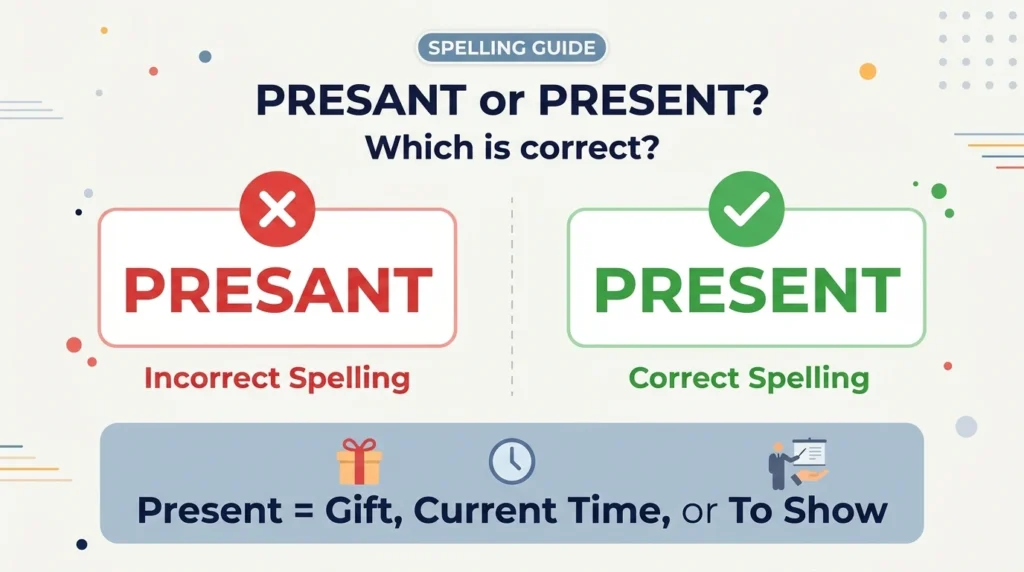
The correct spelling is present, not presant. The word presant is a common spelling mistake and is not a standard English word. Present can function as a noun meaning a gift, an adjective meaning current or physically there, and a verb meaning to show, give, or introduce something. If you are writing an email, completing an assignment, or preparing a presentation, always use present.
What Is the Difference Between Presant and Present?
The difference between presant and present is simple: present is the correct English spelling, while presant is a misspelling.
Present is a versatile English word with several meanings. Its meaning depends on how it is used in a sentence.
For example:
- Noun: I bought a birthday present for my sister.
- Adjective: All the students were present in class.
- Verb: She will present her research tomorrow.
On the other hand, presant has no accepted meaning or grammatical function in standard English. You should not use it in formal writing, professional communication, academic assignments, or everyday messages.
The confusion usually happens because some learners hear the word and assume that its second vowel should be an “a” rather than an “e.” However, the correct spelling always uses e: present.
Why Does the Correct Spelling Matter?
Spelling is an important part of clear communication. Even a small spelling mistake can affect how readers understand and evaluate your writing.
Using presant instead of present may seem like a minor error, but it can create an unprofessional impression, especially in situations where accuracy matters.
Consider these situations:
- Job applications: A spelling mistake in a cover letter can make your application look less carefully prepared.
- Academic assignments: Incorrect spelling can reduce the overall quality of an otherwise strong piece of writing.
- Business emails: Professional communication requires accurate spelling and clear language.
- Presentations: When preparing slides, reports, or meeting documents, correct spelling helps maintain credibility.
- Social media: Spelling errors can distract readers from your message.
- Examinations: Using the correct spelling is essential when demonstrating your English language skills.
Remember that spellcheck tools do not always identify every mistake. Developing a habit of recognizing correct spellings is more reliable than depending entirely on automatic corrections.
Read More: Payed vs Paid: Which Spelling Is Correct?
The Core Rule: Presant or Present?
PRESENT
Correct spelling
Present is the only correct standard English spelling for the word discussed in this comparison.
PRESANT
Incorrect spelling
Presant is a spelling error. Do not use it as a replacement for present.
The easiest rule to remember is:
Always write PRESENT with an E in the second syllable, never PRESANT with an A.
This rule applies whether you are using present as a noun, adjective, or verb.
How to Use Present Correctly
The word present has several grammatical functions. Understanding them will help you use it correctly in different situations.
1. Present as a Noun
A noun is a word that names a person, place, thing, or idea.
As a noun, present commonly means a gift given to someone, usually on a special occasion.
Examples:
- My parents gave me a beautiful birthday present.
- She received a special present on her graduation day.
- I wrapped the present before leaving home.
- The children were excited to open their presents.
Present can also refer to the current period of time.
Examples:
- We should focus on the present rather than worry about the past.
- The story moves between the past and the present.
- Living in the present can help you appreciate everyday experiences.
2. Present as an Adjective
An adjective describes a person, place, or thing.
Present has two particularly common adjective meanings.
Meaning 1: Being in a particular place
Examples:
- Every employee was present at the meeting.
- My teacher was present during the examination.
- Only three members were present at the discussion.
Meaning 2: Existing or happening now
Examples:
- My present job gives me valuable experience.
- The present situation requires careful planning.
- We need to improve our present system.
Notice the difference between these two expressions:
- The people present at the meeting = the people who attended.
- The present employees = the employees currently working there.
The position of the adjective helps determine its meaning.
3. Present as a Verb
A verb describes an action, event, or state.
As a verb, present can mean to show, introduce, deliver, offer, or formally give something.
Examples:
- I will present my business plan tomorrow.
- The manager will present the new strategy.
- She presented her research to the university.
- The principal will present awards to the students.
- Let me present our new marketing director.
The verb also appears in different grammatical forms:
| Verb form | Example |
|---|---|
| Present | I present my ideas clearly. |
| Presents | She presents the report. |
| Presented | He presented his proposal yesterday. |
| Presenting | They are presenting their findings. |
Remember that the spelling remains based on present. You do not change it to presant when changing the tense.
Correct Examples of Present in Everyday English
Here are 12 original examples showing how to use present naturally in different situations.
- Conversation: What present did you buy for your mother?
- Birthday: My brother surprised me with an expensive present.
- Email: I am writing to present our updated project proposal.
- School: All students must be present before the examination begins.
- University: The professor asked us to present our research findings.
- Workplace: Our team will present the quarterly results on Monday.
- Business: I want to present a new growth strategy to our partners.
- Social media: Sometimes, the best way to enjoy life is to appreciate the present.
- Academic writing: The study presents evidence supporting the proposed theory.
- Meeting: Please make sure that all department heads are present.
- Family: We bought a special present for our grandparents.
- Professional introduction: It is my pleasure to present our guest speaker.
Each sentence uses the standard spelling present, but the meaning changes according to its grammatical role and context.
Incorrect vs. Correct: Presant vs Present
The following table demonstrates common spelling mistakes and their corrections.
| ❌ Incorrect | ✅ Correct | Why |
|---|---|---|
| I bought a presant. | I bought a present. | Present is the correct spelling for a gift. |
| She gave me a presant. | She gave me a present. | The noun must be spelled present. |
| I will presant my idea. | I will present my idea. | Present is the correct verb. |
| Everyone was presant. | Everyone was present. | Present describes attendance. |
| This is my presant job. | This is my present job. | Present means current here. |
| He received a presant. | He received a present. | Presant is not standard English. |
| Please presant your report. | Please present your report. | The verb requires the correct spelling. |
| She is presant today. | She is present today. | Present means physically there. |
| The teacher will presant the award. | The teacher will present the award. | Present means formally give here. |
| I live in the presant. | I live in the present. | Present refers to the current time. |
| They were not presant. | They were not present. | The adjective is spelled present. |
| He wrapped the presant carefully. | He wrapped the present carefully. | Present is the correct noun. |
The important point is that none of these sentences requires a different English word. They all require the same correct spelling: present.
Why Do People Confuse Presant and Present?
There are several reasons why English learners and even experienced writers sometimes type presant instead of present.
1. Pronunciation Confusion
The pronunciation of a word does not always reveal its exact spelling.
Present is generally pronounced with a short vowel sound in its first syllable when used as a noun or adjective. The second syllable contains a reduced vowel sound, which can make the spelling less obvious to learners.
When people write words according to how they hear them, they may choose the wrong vowel.
2. Spelling by Sound
Some learners assume that English spelling follows pronunciation consistently.
However, English has many words whose sounds and written forms do not match perfectly.
For example:
- Different
- Excellent
- President
- Present
- Pleasant
A person who relies only on pronunciation may struggle to remember which vowel belongs in a particular word.
3. Overgeneralisation
Overgeneralisation happens when someone applies a spelling pattern they have learned to a word where it does not belong.
For example, a learner may become accustomed to writing words with an “a” sound and incorrectly apply that pattern to present.
The solution is to learn the complete spelling of frequently used words rather than guessing individual letters.
4. Autocorrect and Spellcheck Limitations
Modern keyboards and writing applications can correct many spelling mistakes. However, they are not perfect.
Some tools may suggest corrections based on sentence context, while others may fail to recognize an unusual typing error.
Never assume that a sentence is correct simply because your device has not underlined a word.
5. Translation Interference
People learning English through another language sometimes transfer spelling or pronunciation patterns from their first language.
This can create confusion when English uses a different vowel or spelling pattern.
The best approach is to learn present through its meaning, pronunciation, and repeated use in complete sentences.
Read More: Straight vs. Strait: Meaning, Difference & Examples Explained.
Common Mistakes Checklist
Avoid these mistakes when writing the word present.
- Writing presant instead of present: This is the main spelling error. Remember that the correct word contains an E in the second syllable.
- Using presant in professional emails: Always check the spelling before sending business communication.
- Assuming present has only one meaning: It can refer to a gift, the current time, attendance, or an action.
- Confusing the noun and verb pronunciation: The noun and adjective are stressed on the first syllable, while the verb is stressed on the second.
- Using present in the wrong position: When present means physically there, it commonly follows the noun it describes or a linking verb.
- Depending completely on autocorrect: Learn the spelling yourself instead of trusting every automatic suggestion.
- Forgetting the spelling in different verb forms: Presented and presenting are also spelled with the same root letters.
A useful proofreading habit is to search for presant in your document before publishing or submitting it.
Presant vs Present in Real English
Understanding how a word works in real English involves more than identifying the correct spelling. You should also understand whether a form is accepted, whether a sentence is grammatically possible, and whether the expression sounds natural.
Grammatically Correct
Present is the grammatically correct standard English word. It can function as a noun, adjective, or verb depending on the sentence. For example, “I received a present,” “She was present at the meeting,” and “I will present my findings” are all grammatically correct. Its spelling does not change to presant when its grammatical function changes.
Grammatically Possible but Unnatural
A sentence containing present can be grammatically possible but sound unnatural because of its word order or context. For example, “The present people attended the meeting” may be understood, but it is not the natural way to say that people were physically there. “The people present attended the meeting” is clearer when referring to those who were in attendance.
Natural, Everyday English
In everyday English, people commonly use present in expressions such as “birthday present,” “at present,” “the present moment,” and “everyone present.” The verb is also natural in professional situations, such as “present your findings” or “present a proposal.” Choosing the appropriate meaning and sentence structure makes your writing clear. There is no everyday situation in standard English where presant is the correct replacement.
American vs. British English: Is There Any Difference?
There is no spelling difference between American and British English for this word.
Both varieties use present, not presant.
| Feature | American English | British English |
|---|---|---|
| Correct spelling | Present | Present |
| Incorrect spelling | Presant | Presant |
| Gift meaning | Present | Present |
| Current time meaning | Present | Present |
| Attendance meaning | Present | Present |
| Verb meaning | Present | Present |
Both varieties use the same spelling and broadly the same meanings.
There may be minor differences in accent and pronunciation between individual speakers, but these do not change the standard spelling.
Formal vs. Informal Usage
The word present is suitable for both formal and informal communication.
Its level of formality depends on the meaning and sentence in which it appears.
| Situation | Example | Usage |
|---|---|---|
| Casual conversation | I bought you a present. | Informal and natural |
| Family discussion | Where is my birthday present? | Informal and natural |
| Business meeting | I will present our new strategy. | Professional and formal |
| Academic writing | This paper presents the research findings. | Formal and academic |
| Workplace email | Please be present at the scheduled meeting. | Professional |
| Social media | Enjoy the present moment. | Neutral and conversational |
You do not need a different spelling for formal or informal writing. Present remains correct in every register.
Presant vs Present: Comparison Table
This table summarizes the most important differences.
| Feature | Presant | Present |
|---|---|---|
| Correct spelling | No | Yes |
| Standard English word | No | Yes |
| Meaning | No accepted standard meaning | Gift, current time, attendance, or show/give |
| Part of speech | None in standard English | Noun, adjective, verb |
| Suitable for emails | No | Yes |
| Suitable for academic writing | No | Yes |
| Suitable for conversation | No | Yes |
| American English | Incorrect | Correct |
| British English | Incorrect | Correct |
| Example | I bought a presant. | I bought a present. |
The conclusion is straightforward: presant is a spelling mistake, while present is the correct English word.
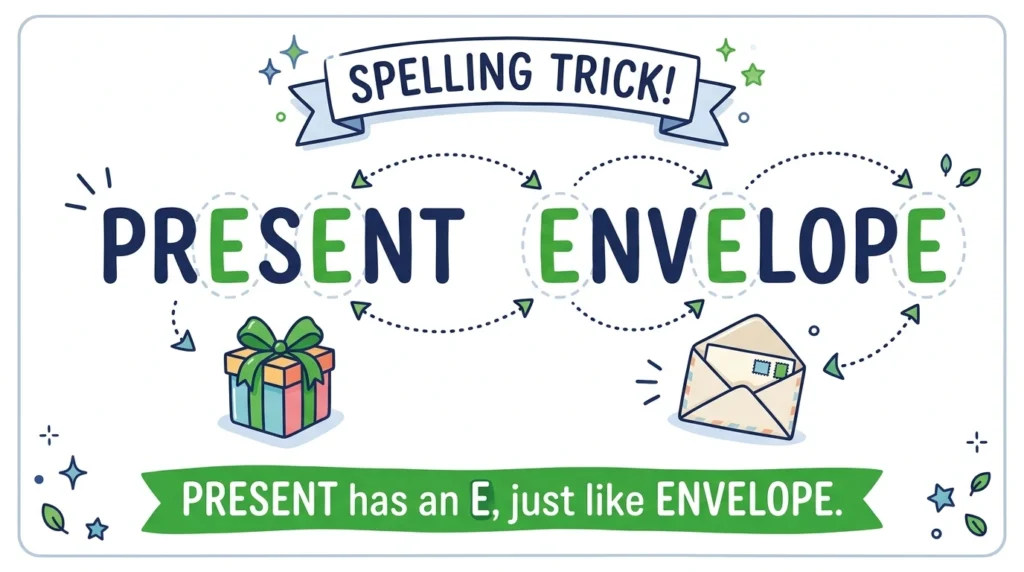
Memory Trick: How to Remember Present
Remember this simple trick:
A PRESENT has an E, just like an ENVELOPE.
Think about receiving an envelope containing a special message or gift. Both words contain the letter E.
You can also remember the spelling by breaking it into three parts:
PRE + S + ENT = PRESENT
Whenever you are unsure whether to write presant or present, remember the E in the second syllable.
Another helpful technique is to write the correct spelling three times:
- Present
- Present
- Present
Then use it in a complete sentence:
“I bought a present for my friend.”
Repeated practice makes the correct spelling easier to recall.
Real-Life Situations: Present in Context
Here are five practical situations showing how to use present correctly.
1. During a Job Interview
Interviewer: Can you present your previous work experience?
Candidate: Certainly. I would like to present my professional background and explain how my experience matches this position.
Here, present means to explain or show information.
Read More: Mobil vs Mobile: Which Spelling Is Correct?
2. During a Business Meeting
Manager: Who will present the new marketing strategy?
Employee: I will present it to the management team tomorrow.
The word is used as a verb because the employee will explain or show a strategy.
3. In a Professional Email
Incorrect: I would like to presant our proposal for your consideration.
Correct: I would like to present our proposal for your consideration.
The correct spelling makes the message suitable for professional communication.
4. In a Text Message
Friend A: Did you buy anything for your sister?
Friend B: Yes! I bought her a beautiful birthday present.
Here, present is a noun referring to a gift.
5. During a School Examination
Teacher: Were all students present during the examination?
Student: Yes, all registered students were present.
Here, present is an adjective describing attendance.
These situations demonstrate why understanding the different meanings of present is just as important as remembering its spelling.
Expert Tips to Improve Your Spelling
If you frequently confuse presant and present, use these practical techniques.
1. Learn Words Through Sentences
Do not memorize spelling in isolation. Learn the word in a complete sentence.
For example:
- I received a present.
- I am present today.
- I will present my project.
This connects the spelling with its different meanings.
2. Understand the Three Grammatical Roles
Remember that present can be a noun, adjective, or verb.
Recognizing its grammatical role helps you understand how the word functions in a sentence.
3. Read English Regularly
Reading books, newspapers, articles, and well-written online content exposes you to correct spelling repeatedly.
The more frequently you encounter present, the easier it becomes to recognize its correct form.
4. Practice Writing Without Autocorrect
Try writing short paragraphs without relying on automatic spelling corrections.
After finishing, review your work and identify your mistakes.
This helps develop independent spelling skills.
5. Proofread Important Documents
Before submitting an assignment, sending an email, or publishing an article, check commonly confused words.
A quick review can prevent avoidable errors.
6. Practice the Pronunciation
Listen to the pronunciation of present in both its noun/adjective and verb forms.
Understanding its different stress patterns can improve your speaking and listening skills.
7. Create a Personal Spelling List
Whenever you make a spelling mistake, add the word to a personal practice list.
For example:
| Incorrect spelling | Correct spelling |
|---|---|
| Presant | Present |
| Definately | Definitely |
| Seperate | Separate |
| Recieve | Receive |
| Untill | Until |
Review the list regularly to avoid repeating the same mistakes.
Read More: Copyright vs Copywrite: Which Is Correct?
Quick Summary
The correct spelling is present, while presant is an incorrect spelling that should not be used in standard English. Present has several meanings: it can refer to a gift, the current time, someone being physically somewhere, or the act of showing or introducing something. It works as a noun, adjective, and verb. Both American and British English use the same spelling. To remember it, associate PRESENT with ENVELOPE because both contain the letter E. Whether you are writing a birthday message, academic assignment, business email, or professional presentation, always use present. Remembering this simple rule will help you avoid a common spelling mistake.
Frequently Asked Questions (FAQ)
1. Is presant or present the correct spelling?
Present is the correct spelling. Presant is a misspelling and is not accepted as a standard English word.
2. Is presant a real English word?
No. Presant has no recognized standard meaning or grammatical function in English. It is generally a spelling error for present.
3. What does the word present mean?
Present has several meanings. It can mean a gift, the current time, being physically somewhere, or showing and introducing something to others.
4. Why do people spell present as presant?
People often make this mistake because they rely on pronunciation rather than remembering the correct written form. Typing errors and unfamiliarity with English spelling patterns can also contribute.
5. Is present a noun or a verb?
Present can be both. As a noun, it means a gift or the current time. As a verb, it means to show, introduce, offer, or formally give something.
6. What is the plural of present?
The plural form of the noun present, meaning a gift, is presents.
Example: The children received several presents on their birthdays.
7. Is present spelled differently in American and British English?
No. Both American and British English use the spelling present. There is no standard regional spelling difference.
8. How do you pronounce present?
When used as a noun or adjective, it is pronounced approximately PREZ-uhnt, with stress on the first syllable. When used as a verb, it is pronounced pri-ZENT, with stress on the second syllable.
9. Can I use present in a professional email?
Yes. Present is perfectly suitable for professional communication. For example: “I would like to present our proposed business strategy for your consideration.”
10. What is the easiest way to remember the spelling of present?
Remember that PRESENT contains an E, just like ENVELOPE. Practice writing the word in different sentences to reinforce its correct spelling.
Mini Quiz: Test Your Understanding of Presant vs Present
Test your knowledge with these 10 questions. Each question includes its correct answer and an explanation.
| No. | Question | Answer | Explanation |
|---|---|---|---|
| 1 | Which spelling is correct: Presant or Present? | Present | Present is the recognized English spelling. |
| 2 | I bought a birthday ______ for my brother. (presant/present) | Present | Present is a noun meaning a gift. |
| 3 | Correct the sentence: She will presant her project tomorrow. | She will present her project tomorrow. | Present is the correct verb spelling. |
| 4 | Is presant an accepted standard English word? (Yes/No) | No | It is a misspelling, not a standard English word. |
| 5 | Everyone was ______ at the meeting. (presant/present) | Present | Present means physically there. |
| 6 | What is the plural of present when it means a gift? | Presents | Add an S to form the plural. |
| 7 | Correct the sentence: I want to enjoy the presant moment. | I want to enjoy the present moment. | Present refers to the current time. |
| 8 | Which sentence is correct? A. He received a presant. B. He received a present. | B. He received a present. | Present is the correct spelling. |
| 9 | Complete the sentence: The manager will ______ the new business plan. | Present | Here, present is a verb meaning to show or explain. |
| 10 | Does American English use presant instead of present? | No | Both American and British English use present. |
Your score:
- 9–10 correct: Excellent! You understand the difference.
- 7–8 correct: Good work! Review the examples once more.
- 5–6 correct: Keep practicing.
- Below 5: Read the core rule and try again.


