


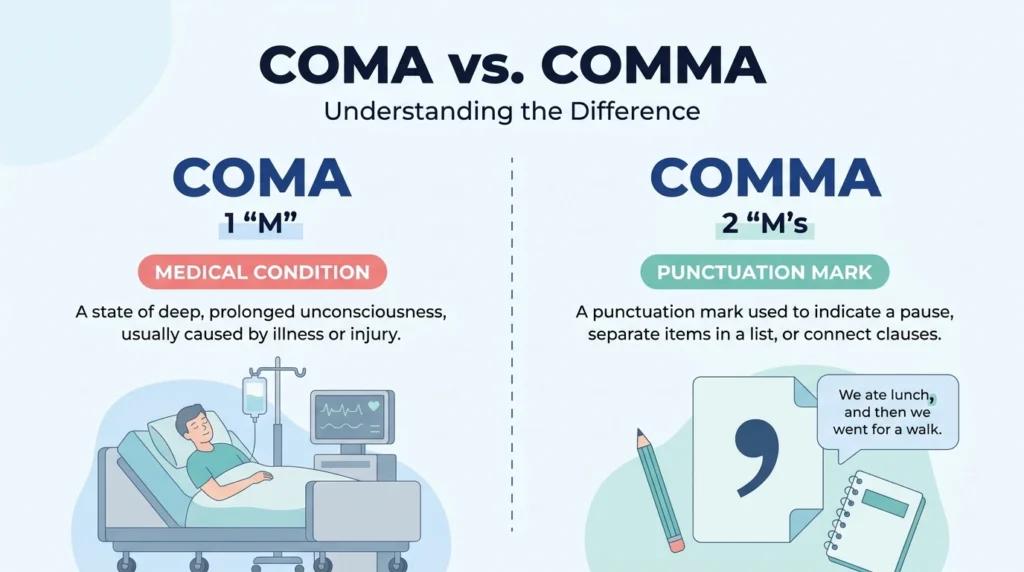
Coma and comma are two different English words with completely different meanings. A coma is a prolonged state of unconsciousness in which a person cannot be awakened, while a comma is a punctuation mark (,) used to separate words, phrases, and clauses in a sentence. Remember: a coma is a medical condition; a comma is a writing symbol.
What Is the Difference Between Coma and Comma?
The difference between coma and comma is their meaning, spelling, and use.
- Coma: A medical condition involving prolonged unconsciousness. It is a noun.
- Comma: A punctuation mark used to organize written sentences and make their meaning clearer. It is also a noun.
Both words are pronounced similarly, but their spelling and meanings are not interchangeable.
For example:
- The patient remained in a coma for several days.
- Add a comma after the introductory phrase.
Using one instead of the other can completely change the meaning of a sentence.
What Does Coma Mean?
A coma is a prolonged state of deep unconsciousness in which a person cannot be awakened and does not respond normally to their surroundings.
It is a serious medical condition that can result from brain injury, stroke, infection, poisoning, or other medical problems.
Coma is a medical term, not a punctuation or writing term.
Examples of Coma in Sentences
- The accident left the driver in a coma.
- Doctors monitored the patient while he remained in a coma.
- She was relieved when her brother finally woke up from his coma.
- The severe head injury caused him to fall into a coma.
- The family waited anxiously for news about the patient’s condition.
- He spent two weeks in a coma after the accident.
- Medical specialists carefully examined the unconscious patient.
- The doctor explained the possible causes of a coma.
- The patient gradually recovered after leaving the coma.
- The news report described how the athlete survived a coma following a serious injury.
What Does Comma Mean?
A comma is a punctuation mark (,) used to separate elements in a sentence, including items in a list, introductory expressions, and certain clauses.
It helps readers understand how different parts of a sentence are connected.
Without commas, some sentences can become confusing or difficult to read.
Examples of Comma in Sentences
- I bought apples, oranges, bananas, and grapes.
- After finishing her homework, Sara watched television.
- My brother, who lives in London, is visiting us next week.
- Yes, I would love to join the meeting.
- We visited Paris, France, during our summer holiday.
- Before you leave, please turn off the lights.
- The presentation was informative, engaging, and practical.
- Unfortunately, the train arrived late.
- I wanted to attend the conference, but I had another commitment.
- Dear John, thank you for your thoughtful message.
The Core Rule: Coma vs Comma
COMA
One M
A medical condition involving prolonged unconsciousness.
Example: The patient was in a coma.
COMMA
Two Ms
A punctuation mark used in writing.
Example: Put a comma between the items.
The easiest rule: Coma relates to a medical condition; comma relates to punctuation and writing.
How to Use Coma and Comma Correctly
The easiest way to choose between these words is to identify what you are describing.
When to Use Coma
Use coma when discussing:
- A person’s prolonged state of unconsciousness.
- A serious medical condition following an injury or illness.
- A medically induced state of unconsciousness.
- A patient’s recovery from unconsciousness.
Common expressions include:
- Fall into a coma
- Go into a coma
- Be in a coma
- Come out of a coma
- Recover from a coma
- Medically induced coma
Examples:
- The football player fell into a coma after the accident.
- The doctors decided to induce a coma as part of his treatment.
- Her father came out of a coma after several weeks.
When to Use Comma
Use comma when discussing punctuation or written communication.
Common situations include:
- Separating items in a list: I need a notebook, a pen, and a folder.
- Introducing a sentence with an introductory phrase: After the meeting, we went for lunch.
- Separating an introductory word: However, the results were different.
- Setting off additional information: My uncle, who lives in Canada, is visiting us.
- Separating independent clauses joined by a coordinating conjunction: I wanted to travel, but I had no time.
- Addressing someone directly: Sarah, please check your email.
- Separating elements in dates and locations: Faisalabad, Pakistan, is a major industrial city.
Remember that a comma does not belong wherever you naturally pause while speaking. Its placement depends on sentence structure and meaning.
Correct Examples: Coma vs Comma
Here are 12 practical examples showing how both words work in everyday English.
| Context | Correct sentence |
|---|---|
| Conversation | Did you hear that the injured man was in a coma? |
| Hospital report | The patient remained in a coma under medical supervision. |
| News | The young athlete recovered after spending ten days in a coma. |
| Family discussion | We prayed for his recovery while he was in a coma. |
| Please add a comma after the greeting in your email. | |
| School | Our English teacher explained how to use a comma correctly. |
| Workplace | The editor removed an unnecessary comma from the report. |
| Social media | A single comma can sometimes change the meaning of a sentence. |
| Academic writing | The researcher used a comma to separate introductory information. |
| Business communication | Please insert a comma between the company name and its location. |
| Journalism | The article described the patient’s recovery from a coma. |
| Editing | Check whether the comma separates the introductory clause correctly. |
Incorrect vs. Correct: Coma vs Comma
Confusing these words can produce sentences that are grammatically incorrect or communicate an entirely different meaning.
The following examples show the correct spelling and explain why the alternatives fail.
| ❌ Incorrect | ✅ Correct | Why |
|---|---|---|
| The patient was in a comma. | The patient was in a coma. | A coma is a medical condition, not a punctuation mark. |
| Please add a coma after my name. | Please add a comma after my name. | A comma is the punctuation mark needed in writing. |
| He fell into a comma after the accident. | He fell into a coma after the accident. | The sentence describes unconsciousness. |
| Put a coma between these words. | Put a comma between these words. | The instruction concerns punctuation. |
| She woke up from her comma. | She woke up from her coma. | A person may regain consciousness after a coma. |
| Remove the extra coma from this paragraph. | Remove the extra comma from this paragraph. | The writer is discussing an unnecessary punctuation mark. |
| The doctor explained the comma to the family. | The doctor explained the coma to the family. | The intended subject is a medical condition. |
| I forgot to use a coma in the list. | I forgot to use a comma in the list. | Items in a written list may need commas. |
| The injured man remained unconscious in a comma. | The injured man remained unconscious in a coma. | Coma describes the patient’s condition. |
| There should be a coma before the word however. | There should be a comma before the word however. | The sentence requires punctuation, not a medical term. |
Why People Confuse Coma and Comma
Although their meanings are completely different, several factors make these words easy to mix up.
1. Similar Pronunciation
Both words have two syllables and end with the same unstressed sound, /mə/. Their first vowel sounds are different in standard English pronunciation, but the difference may be difficult for some learners to hear.
2. Similar Spelling
The words share four letters in the same order: c, o, m, and a. The only difference is that comma contains an additional m.
When typing quickly, writers may accidentally omit or add the letter.
3. Overgeneralisation
English learners sometimes assume that similar-looking words belong to the same category or have related meanings.
However, coma and comma are independent words. The additional m is not a grammatical variation; it creates a different word.
4. Autocorrect and Spellcheck Limitations
Both spellings are legitimate English words. Therefore, a spelling checker may accept either one even when the writer has selected the wrong word for the sentence.
For example, both of these sentences contain correctly spelled words:
- The patient remained in a coma.
- Please insert a comma.
A spellchecker cannot always determine which meaning you intended.
5. Translation Interference
Learners who translate directly from another language may remember the general meaning but confuse the English spelling. This is especially possible when the two English words have similar sounds or are learned together.
The best solution is to learn each word through its meaning and a complete example rather than memorising spelling alone.
Read More: Payed vs Paid: Which Spelling Is Correct?
Common Mistakes Checklist
Use this checklist when proofreading your writing.
- Using coma for punctuation: Remember that coma refers to unconsciousness. Use comma when discussing writing marks.
- Using comma for a medical condition: A patient can be in a coma, not in a comma.
- Forgetting the second m: Comma always has two consecutive m letters.
- Trusting spellcheck completely: Both words are correctly spelled, so check the meaning yourself.
- Choosing by sound alone: Listen carefully, but use the sentence context to decide.
- Assuming a comma always represents a spoken pause: Comma placement follows grammatical structure and clarity, not every pause in speech.
- Using the wrong word in professional documents: Proofread medical reports, emails, academic papers, and business documents carefully.
Coma vs Comma in Real English
Grammatically Correct
Both words are grammatically correct English nouns. Coma describes a state of unconsciousness, while comma identifies a punctuation mark. The correct choice depends entirely on the intended meaning. For example, “The patient was in a coma” and “The editor added a comma” are both natural, correctly constructed sentences. Neither spelling is a variant of the other.
Grammatically Possible but Unnatural
A sentence can contain a correctly spelled word but still sound unnatural because that word does not fit the intended meaning. For example, “The writer fell into a comma” is grammatically structured, but it is not a natural way to describe someone becoming unconscious. Likewise, “The patient needed a coma in the sentence” does not communicate the intended punctuation instruction.
Natural, Everyday English
In everyday English, people commonly say that someone is “in a coma” or “fell into a coma.” When discussing writing, they naturally say “add a comma,” “remove the comma,” or “put a comma after the word.” These word combinations are established expressions. Learning them as complete phrases makes it easier to choose the correct spelling without repeatedly thinking about the additional letter.
American vs. British English
There is no spelling difference between coma and comma in American and British English.
Both varieties use:
- Coma for the medical condition.
- Comma for the punctuation mark.
However, their pronunciation differs slightly across accents.
| Word | American English | British English |
|---|---|---|
| Coma | /ˈkoʊ.mə/ | /ˈkəʊ.mə/ |
| Comma | /ˈkɑː.mə/ | /ˈkɒm.ə/ |
There is also a punctuation convention worth knowing: American English generally uses the serial comma (Oxford comma) before the final “and” in a list, while British English often omits it unless needed for clarity.
- American: We invited Ali, Sara, and Ahmed.
- British: We invited Ali, Sara and Ahmed.
This is a difference in punctuation style, not a difference in the spelling or meaning of coma and comma.
Formal vs. Informal Usage
Both words are suitable for formal and informal communication, but their contexts differ.
| Word | Formal usage | Informal usage |
|---|---|---|
| Coma | The patient entered a medically induced coma. | He was in a coma after the accident. |
| Comma | The editor inserted a comma to improve clarity. | You forgot a comma here. |
Coma is commonly used in medical reports, news articles, conversations, and family discussions.
Comma is used in academic writing, business communication, editing, text messages, and everyday discussions about grammar.
An informal expression worth knowing is food coma. It describes feeling very sleepy or sluggish after eating a large meal. It is humorous and figurative, not a medical diagnosis of actual coma.
Comparison Table: Coma vs Comma
| Feature | Coma | Comma |
|---|---|---|
| Spelling | Coma | Comma |
| Number of Ms | One | Two |
| Part of speech | Noun | Noun |
| Main meaning | State of unconsciousness | Punctuation mark |
| Symbol | No punctuation symbol | , |
| Main context | Medicine and health | Writing and grammar |
| Pronunciation (AmE) | /ˈkoʊ.mə/ | /ˈkɑː.mə/ |
| Plural | Comas | Commas |
| Common expression | In a coma | Add a comma |
| Example | He fell into a coma. | Add a comma after the introduction. |
Memory Trick: How to Remember Coma vs Comma
Here is a simple trick to remember the difference:
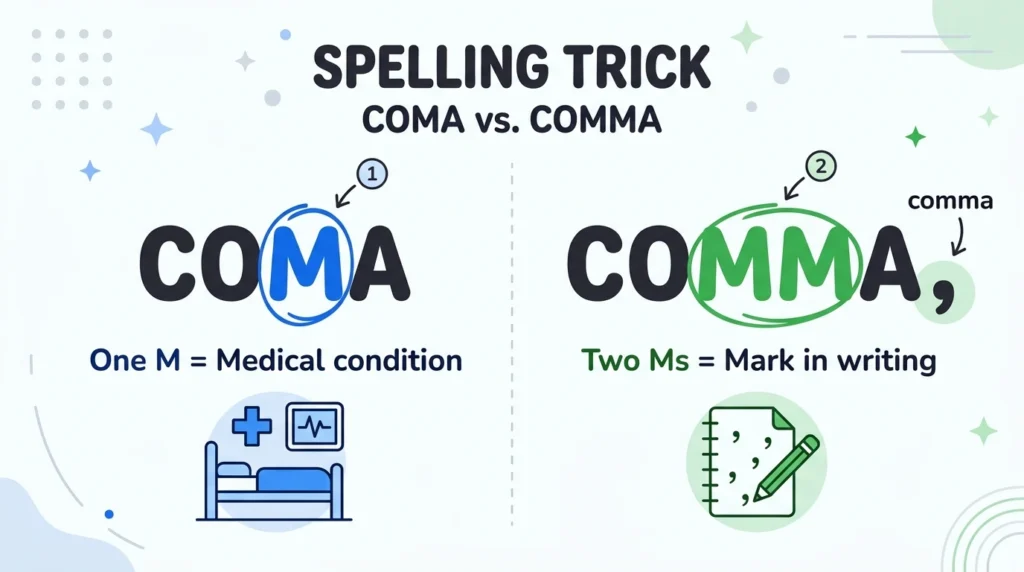
M
COMA = Medical
One M for the medical condition.
MM
COMMA = Mark
Two Ms for the punctuation mark.
Think of it this way:
- Coma has one M because it is a medical term.
- Comma has two Ms because it is a mark used in writing.
Another easy way to remember it is to look at the symbol itself: ,. Whenever you are discussing this small punctuation mark, you need the longer spelling: comma.
Read More: Straight vs. Strait: Meaning, Difference & Examples Explained.
Real-Life Situations: Coma vs Comma
Situation 1: Hospital Conversation
A person asks about an injured relative.
Incorrect: “I heard your brother is in a comma.”
Correct: “I heard your brother is in a coma.”
The conversation concerns a medical condition, so coma is correct.
Situation 2: English Classroom
A teacher explains punctuation to students.
Incorrect: “You need to put a coma after the introductory phrase.”
Correct: “You need to put a comma after the introductory phrase.”
The teacher is discussing sentence structure, so comma is required.
Situation 3: Workplace Email
A manager reviews an employee’s report.
Incorrect: “Please remove the unnecessary coma from the second paragraph.”
Correct: “Please remove the unnecessary comma from the second paragraph.”
The manager is requesting an editing correction.
Situation 4: Job Interview
An interviewer asks a candidate about writing skills.
Incorrect: “I know how to use a coma correctly in professional reports.”
Correct: “I know how to use a comma correctly in professional reports.”
The candidate is talking about punctuation.
Situation 5: News Report
A journalist reports on an accident victim.
Incorrect: “The injured passenger remained in a comma for several days.”
Correct: “The injured passenger remained in a coma for several days.”
The report describes a person’s medical condition.
Expert Tips: Coma vs Comma
These practical tips can help you avoid the mistake even when writing quickly.
- Learn the words in context: Memorise “in a coma” and “add a comma” rather than studying the spellings separately.
- Check the subject of your sentence: If you are discussing a patient, coma may be appropriate. If you are editing text, comma is probably the intended word.
- Do not depend entirely on pronunciation: Regional accents affect vowel sounds. Spelling and context are more reliable.
- Use the symbol test: If you can replace the word with the symbol (,), you need comma.
- Proofread professional documents: A spelling checker may not detect a correctly spelled but incorrectly selected word.
- Remember the plural forms: Comas refers to multiple cases of unconsciousness; commas refers to multiple punctuation marks.
Read More: Mobil vs Mobile: Which Spelling Is Correct?
FAQ: Coma vs Comma
1. What is the main difference between coma and comma?
Coma is a medical condition involving prolonged unconsciousness. Comma is a punctuation mark (,) used to separate parts of sentences or items in a list. They have different meanings and cannot replace each other.
2. Is coma or comma correct?
Both are correct English words. The correct choice depends on your sentence. Use coma when discussing unconsciousness and comma when discussing punctuation.
3. Does coma have one M or two?
Coma has one M. It is spelled C-O-M-A and refers to a state of unconsciousness.
4. Does comma have two Ms?
Yes. Comma is spelled C-O-M-M-A. The two consecutive Ms are an easy way to distinguish it from coma.
5. Are coma and comma pronounced the same?
No. They have similar two-syllable pronunciations, but their first vowel sounds differ in standard English pronunciation. The exact vowel quality depends on the speaker’s accent.
6. What is the plural of coma and comma?
The plural of coma is comas, while the plural of comma is commas. Both follow the usual English rule of adding -s to form the plural.
7. Can comma and coma be used in the same sentence?
Yes. They can appear together when a sentence discusses both a medical condition and punctuation.
Example: “The journalist added a comma while writing about the patient who had been in a coma.”
8. What does food coma mean?
Food coma is an informal expression describing sleepiness or sluggishness after eating a large meal. It is figurative and does not mean that someone has a medical coma.
9. Is coma a punctuation mark?
No. Coma is not a punctuation mark. It refers mainly to a serious state of unconsciousness. The punctuation mark is called a comma and looks like this: (,).
10. Why does spellcheck not correct coma to comma?
Spellcheck systems generally recognise both as correctly spelled words. They may not understand that you intended to discuss punctuation rather than a medical condition. Always review the meaning of the sentence.
11. Is comma used differently in American and British English?
The spelling and basic meaning are the same. However, punctuation conventions, such as the use of the Oxford comma, can differ between American and British writing styles.
12. How can I quickly remember the difference between coma and comma?
Remember that coma has one M and describes a medical condition, while comma has two Ms and is a mark used in writing. The symbol (,) is another quick reminder.
Mini Quiz: Test Your Understanding
Choose the correct word in each question. Each answer includes an explanation to help you understand the difference.
| No. | Question | Answer | Explanation |
|---|---|---|---|
| 1 | The patient remained in a (coma/comma) for three days. | Coma | The sentence describes unconsciousness. |
| 2 | Please insert a (coma/comma) after the introductory phrase. | Comma | A punctuation mark is required. |
| 3 | She finally woke up from her (coma/comma). | Coma | A person wakes up from a coma. |
| 4 | Which spelling refers to the punctuation mark (,)? A. Coma B. Comma | B. Comma | Comma is the name of the punctuation mark. |
| 5 | The editor removed an unnecessary (coma/comma) from the report. | Comma | Editors remove unnecessary punctuation. |
| 6 | Correct the sentence: “The injured man fell into a comma.” | The injured man fell into a coma. | The sentence describes a medical condition. |
| 7 | Correct the sentence: “Add a coma between these two items.” | Add a comma between these two items. | The instruction concerns punctuation. |
| 8 | The doctor explained the patient’s (coma/commas) to the family. | Coma | The singular medical condition is being discussed. |
| 9 | I forgot to add the necessary (coma/comma) before the conjunction. | Comma | A punctuation mark is needed. |
| 10 | Which sentence is correct? A. He was in a comma. B. He was in a coma. | B. He was in a coma. | Coma is the correct word for unconsciousness. |
Quick Summary
Coma and comma are two different English words with different meanings. Coma, with one M, refers to a serious medical condition in which a person cannot be awakened. Comma, with two Ms, is a punctuation mark (,) used to separate words, phrases, and clauses in writing. Both words are nouns, and their spelling does not change between American and British English. Remember the simple trick: one M for a medical condition and two Ms for a mark in writing. Never rely entirely on spellcheck because both words are correctly spelled. Always check the meaning of your sentence before choosing between coma and comma.