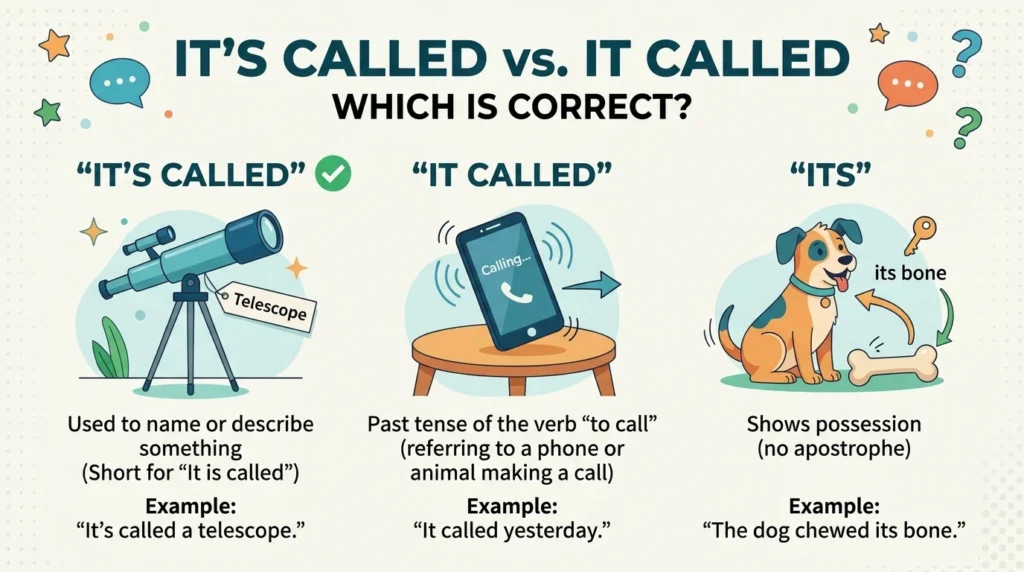

Use “it’s called” when identifying or naming something: “It’s called a solar panel.” Use “it called” when describing a past action, such as “It called my phone yesterday,” if it refers to something capable of making a call. Use “its” to show possession, as in “The dog wagged its tail.” The apostrophe in it’s matters because it marks a contraction of it is or it has.
What Is the Difference Between Its Called and It Called?
The main difference is grammatical: “it’s called” describes a name or label, while “it called” describes an action in the past. The expression “its called” usually results from confusing the possessive pronoun its with the contraction it’s.
Consider these three forms:
- It’s called: A shortened form of it is called. Example: “It’s called a password manager.”
- Its: A possessive word meaning that something belongs to or is associated with something. Example: “The company changed its logo.”
- It called: A past-tense construction describing an action performed by it. Example: “The automated system called me this morning.”
These forms may sound similar in everyday speech, but their grammatical functions differ.
Why It Matters
Choosing the correct form makes your writing clearer and helps readers understand whether you are naming something, showing possession, or describing a past event.
This distinction matters in several everyday situations:
- Emails: “It’s called the quarterly report” identifies a document, while “It called me yesterday” describes an action.
- School assignments: Correct apostrophe use demonstrates control of basic English grammar.
- Workplace communication: “The software updated its settings” is clearer and more professional than “The software updated it’s settings.”
- Social media: A small spelling mistake can change the intended meaning or make a sentence look careless.
- Academic writing: Correct contractions and possessive forms help maintain grammatical accuracy.
The problem is not simply about adding an apostrophe. It is about choosing the grammatical form that matches the meaning.
The Core Rule
Remember these three forms
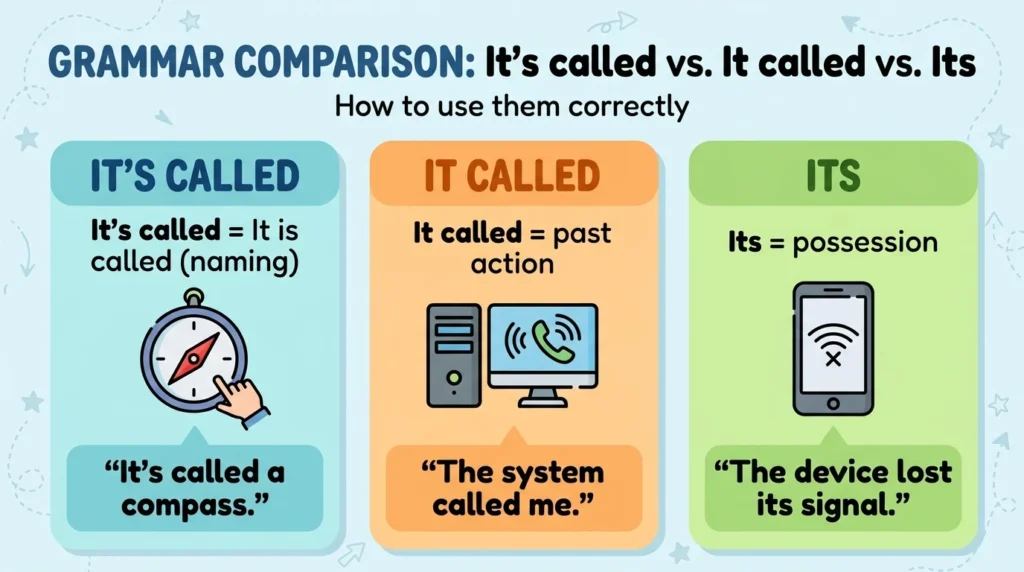
It’s called = It is called
Use it to give the name of something.
Example: It’s called a greenhouse.
It called = It performed a calling action
Use it for a past action when the subject actually made a call, called out, or summoned someone or something.
Example: The automated system called me.
Its called = Usually incorrect for naming something
Use its to show possession, not as a replacement for it is.
Incorrect: Its called a greenhouse.
Correct: It’s called a greenhouse.
The easiest test is to replace it’s with it is. If the sentence still makes sense, the apostrophe is appropriate.
- It’s called a chatbot. → It is called a chatbot. Correct.
- Its called a chatbot. → It is called a chatbot. The intended meaning reveals the missing apostrophe.
However, this test only works when you intend it’s to mean it is. In other sentences, it’s can also mean it has, as in “It’s been a long day.”
How to Use It’s Called and It Called
1. Use “It’s Called” to Name Something
Use it’s called when explaining what an object, concept, place, process, or other thing is named.
The complete grammatical structure is:
It + is + called + name or label.
Examples:
- This tool is called a wrench.
- It’s called renewable energy.
- The technique is called active listening.
- It’s called a receipt when you receive proof of payment.
In these examples, called is the past participle of the verb call. The phrase uses the passive voice, meaning the subject receives the action rather than performing it.
For example, “It’s called a telescope” means that someone calls or identifies the object as a telescope.
You can use the full form it is called instead of it’s called. Both are grammatically correct.
2. Use “It Called” for a Past Action
Use it called when it refers to something that actually performed the action of calling in the past.
Examples:
- The automated service called me twice.
- The alarm system called the emergency number.
- The bird called from the tree.
- The program called another function during execution.
Here, called is the simple past tense of the verb call. The sentence describes an action, not the name of something.
One important point: it called is not always the most natural wording. If it refers to a person, use an appropriate personal pronoun, such as he, she, or they. If it refers to a phone or computer system, the wording can be perfectly natural in context.
3. Use “Its” to Show Possession
Use its before a noun when you mean that something belongs to, or is associated with, an animal, object, organization, or other entity.
Examples:
- The company changed its policy.
- The cat licked its paw.
- The phone lost its connection.
- The website updated its homepage.
Notice that its does not need an apostrophe. This is different from many possessive nouns, such as the student’s book.
4. Know When “It’s” Means “It Has”
The contraction it’s can represent either it is or it has. The meaning depends on the sentence.
- It’s been a difficult week. = It has been a difficult week.
- It’s already finished. = It has already finished, if the context uses finished as a past participle describing a completed action.
- It’s a difficult question. = It is a difficult question.
This matters because not every correct use of it’s is followed by called. Always consider the complete sentence rather than judging a word in isolation.
Read More: Envolved vs. Involved: Which Spelling Is Correct?
Correct Examples of It’s Called and It Called
The following examples show how to use the forms in everyday conversation, schoolwork, emails, professional writing, and technical contexts.
| Situation | Correct example | Why it is correct |
|---|---|---|
| Conversation | “What is this dish?” “It’s called biryani.” | Identifies the dish’s name. |
| The document is called the Project Summary. | Names a document. | |
| School | It’s called photosynthesis. | Identifies a scientific process. |
| Workplace | It’s called a performance review. | Gives the name of a workplace process. |
| Social media | This trend is called quiet luxury. | Identifies a trend. |
| Academic writing | It is called a control variable in this experiment. | Uses the passive voice to name a concept. |
| Technology | The application called the server at midnight. | Describes a past technical action. |
| Customer service | The automated system called me back. | Describes an action performed by a system. |
| Nature | The bird called repeatedly before sunrise. | Describes a sound made in the past. |
| Everyday writing | The device is called a motion sensor. | Identifies a device. |
| Business report | The company updated its pricing policy. | Uses its to indicate possession or association. |
| Product description | The camera has its own storage compartment. | Uses its before a noun. |
More Examples in Complete Sentences
- Explaining a word: “It’s called an idiom because its meaning is not always literal.”
- Describing a place: “The small café is called The Corner Table.”
- Asking for clarification: “I know what the device does, but what’s it called?”
- Writing an email: “The attached file is called the Final Draft.”
- Discussing science: “It’s called evaporation when a liquid changes into a gas at its surface.”
- Explaining software: “The script called the backup routine after the first process ended.”
- Reporting a phone call: “The security system called the control center at 2 a.m.”
- Describing an animal: “The fox called from the edge of the forest.”
- Writing a report: “The organization revised its annual strategy.”
- Posting online: “I finally learned what it’s called!”
- Describing a machine: “The device stopped working because its battery was empty.”
- Helping a student: “The mathematical rule is called the distributive property.”
Each example uses the form that matches its intended meaning.
Incorrect vs. Correct: 12 Common Examples
| ❌ Incorrect | ✅ Correct | Why |
|---|---|---|
| Its called a keyboard. | It’s called a keyboard. | It’s means it is. |
| It called a keyboard. (when naming it) | It’s called a keyboard. | The naming expression requires a form of be. |
| Its called the final report. | It’s called the final report. | The apostrophe marks the contraction. |
| Its called photosynthesis. | It’s called photosynthesis. | Its indicates possession, not naming. |
| The app updated it’s settings. | The app updated its settings. | The settings belong to or are associated with the app. |
| The cat moved it’s tail. | The cat moved its tail. | Use possessive its before tail. |
| The phone it called me yesterday. | The phone called me yesterday. | The extra it creates an incorrect subject construction. |
| It called a bicycle. (when identifying an object) | It’s called a bicycle. | The intended meaning is that the object has that name. |
| The website changed it’s name. | The website changed its name. | The noun name needs the possessive form. |
| It’s tail was wet. | Its tail was wet. | It is tail does not make sense. |
| It’s called me yesterday. (when reporting a completed call) | It called me yesterday. | Use the simple past for the completed calling action. |
| The machine called the device is broken. (when intending to name it) | The machine is called the device. | The sentence needs the appropriate verb structure to identify the machine. |
Some incorrect examples are wrong only for the meaning shown. For instance, “It called a bicycle” could be grammatically possible in an unusual context where it actually called out the word “bicycle,” but it does not normally mean “Its name is a bicycle.”
Why People Make This Mistake
1. The Forms Sound Similar
In everyday speech, it’s and its are usually pronounced alike. The apostrophe is visible in writing but does not create a separate spoken syllable.
As a result, someone may hear “It’s called a camera” and write “Its called a camera.” The pronunciation alone cannot reliably tell you which spelling to choose.
2. The Word “Called” Has More Than One Use
The word called can appear in different grammatical constructions.
- Passive: It’s called a smartwatch.
- Active past tense: It called the technician.
- Adjective-like use: The so-called expert gave poor advice.
Learners may focus on the word called and overlook the grammatical structure around it.
3. English Possessives Do Not Follow One Simple Pattern
English uses apostrophes in possessive nouns, such as the student’s desk, but not in the possessive determiner its.
This makes its an important exception to a pattern that learners may otherwise find helpful.
4. Spellcheck Does Not Always Understand Meaning
A spellchecker may accept both its and it’s because both are valid English forms. It may not detect a mistake when the wrong form is used in an otherwise grammatical-looking sentence.
For example, “The dog wagged it’s tail” can slip past a basic spelling check even though the sentence requires its.
5. Translation Can Influence Word Choice
Some languages use one form for meanings that English expresses through different grammatical structures. A learner may translate a sentence directly and miss the difference between possession, naming, and past action.
The solution is to learn the English sentence patterns themselves rather than relying only on word-for-word translation.
Common Mistakes Checklist
Use this checklist when editing your writing.
- Using its instead of it’s: Ask whether you mean it is or it has. If so, use it’s.
- Using it’s before a possessive noun: In “The dog wagged its tail,” the tail belongs to the dog. Use its.
- Using it called to give something a name: Replace the phrase with it is called if that is your intended meaning.
- Confusing past actions with descriptions: “It called me” reports an action; “It’s called a phone” identifies an object.
- Trusting spellcheck alone: Read the entire sentence and check what each word means.
- Forgetting the apostrophe in contractions: Remember that the apostrophe represents omitted letters in it’s.
- Adding an unnecessary subject: Write “The phone called me,” not “The phone it called me,” when the phone is the subject.
- Ignoring the full sentence: Do not decide whether it’s or its is correct without checking what follows and what the sentence means.
A quick proofreading habit can prevent almost all these errors: expand contractions, check possessive nouns, and verify whether called expresses a name or an action.
It’s Called vs. It Called in Real English
Grammatically Correct
“It’s called a heat pump” is grammatically correct when you are identifying the name of a device. The full version, “It is called a heat pump,” has the same meaning. The construction uses the present tense of be with a past participle to form the passive voice. It is a standard way to introduce unfamiliar terminology, explain an object, or identify a concept in conversation and writing.
Grammatically Possible but Unnatural
“It called me” is grammatically possible when it refers to an entity that can make a call, such as an automated telephone system. However, using it to refer to a person may sound inappropriate when the person’s identity is known. Likewise, “It called a heat pump” does not naturally identify an object as a heat pump. The grammar and the intended meaning must work together.
Natural, Everyday English
In everyday English, people commonly say “It’s called a heat pump” when explaining a name and “It called me back” when reporting a past action by a device or service. They may also ask, “What’s it called?” when they cannot remember a name. The contracted form it’s often sounds more conversational than it is, although both forms are natural in many situations.
American vs. British English
There is no meaningful American-versus-British English difference in the spelling or core grammar of it’s called, it called, and its. Both varieties use it’s as a contraction of it is or it has, and both use its as a possessive determiner.
Examples in both varieties:
- American English: “It’s called a parking lot.”
- British English: “It’s called a car park.”
- Both varieties: “The company updated its website.”
- Both varieties: “The automated service called yesterday.”
The difference in parking lot and car park is vocabulary, not a difference in the grammar rule being discussed.
Formal vs. Informal Usage
Both it’s called and it called are grammatically acceptable in appropriate contexts. The choice between the contracted and full forms depends partly on the writing situation.
| Context | Recommended wording | Reason |
|---|---|---|
| Casual conversation | It’s called a password manager. | Natural and concise. |
| Informal message | I forgot what it’s called. | Common conversational wording. |
| Professional email | The process is called account verification. | Direct and professional. |
| Academic paper | This method is called stratified sampling. | Clear, formal, and precise. |
| Technical report | The application called the backup service at midnight. | Reports a completed action. |
| Formal explanation | It is called account verification. | Avoids a contraction when a more formal style is preferred. |
There is no universal rule requiring contractions to be avoided in every professional or academic document. Follow the publication’s style requirements and maintain consistency.
Comparison Table: It’s Called vs. It Called vs. Its Called
| Feature | It’s called | It called | Its called |
|---|---|---|---|
| Main function | Identifies a name or label | Describes a past action | Usually an error when naming something |
| Expansion | It is called | It called | Its cannot expand to it is |
| Verb tense or structure | Present-tense passive | Simple past, active | No correct naming structure |
| Example | It’s called a router. | The system called me. | Incorrect: Its called a router. |
| Apostrophe | Required in the contraction | Not needed | Not used in possessive its |
| Typical context | Definitions and descriptions | Phone calls, sounds, actions | Possession when followed by a noun |
| Correct alternative | It is called a router. | The system made a call. | It’s called a router. |
Remember that its called is not inherently impossible as a sequence of words in every imaginable sentence. For example, “Its called name appears on the form” could be interpreted as a possessive construction in a specialized context, although it is awkward and usually better rewritten. The key issue is whether its genuinely indicates possession.
Memory Trick: The “It Is” Test
Use this simple memory trick: If you can replace “it’s” with “it is,” keep the apostrophe.
- Write the sentence: “It’s called a compass.”
- Expand the contraction: “It is called a compass.”
- Check the meaning: The sentence still makes sense, so it’s is correct.
For possession, remember that its is like his or her:
- His name is Daniel.
- Her name is Sara.
- Its name is Rover.
For a past action, use the simple past:
- The system called yesterday.
- The bird called at dawn.
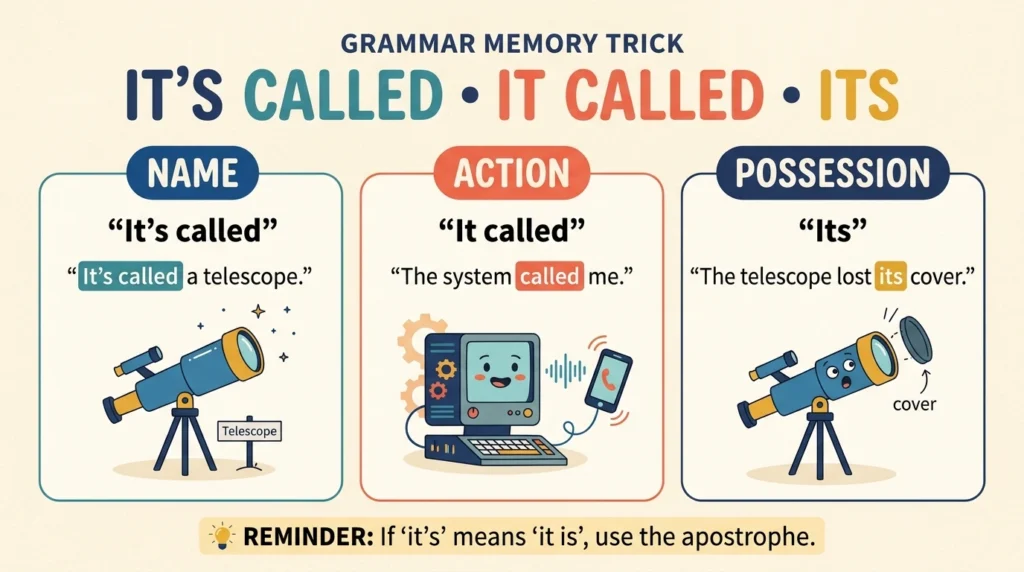
The three-word reminder is name, action, possession:
- Name: It’s called.
- Action: It called.
- Possession: Its name.
Read More: Tieing vs Tying: Which Spelling Is Correct?
Real-Life Situations
Situation 1: In a Job Interview
A candidate is describing a new software tool.
Interviewer: What is the software called?
Candidate: It’s called TaskFlow. It helps teams organize their projects.
The contraction is natural in spoken English. The candidate is identifying the software, not describing an action.
Situation 2: During a Meeting
A colleague asks why a system contacted the team overnight.
Colleague: Why did we receive an alert?
You: The monitoring system called the emergency number at midnight.
Here, called describes a past action performed by the system.
Situation 3: Writing an Email
You are explaining an unfamiliar attachment to a colleague.
Hello,
The attached document is called the Project Overview. It contains the main objectives, timeline, and responsibilities for the upcoming project.
Best regards
The wording clearly identifies the document. A contraction would also be acceptable in a less formal message.
Situation 4: Sending a Text Message
A friend asks you about a tool you mentioned earlier.
Friend: What’s that thing you use to save passwords?
You: I think it’s called a password manager.
This is a natural conversational use of it’s called.
Situation 5: Taking an English Exam
A student must correct the sentence “Its called a thermometer.”
Correct answer: “It’s called a thermometer.”
Explanation: It’s means it is. The sentence identifies an object, so the contraction is required for the intended meaning.
Situation 6: Reporting a Technical Problem
A technician writes an incident report.
“The application called the external service three times before the connection failed.”
Here, called is a past-tense verb describing an operation. Replacing it with it’s called would change the meaning.
Expert Tips
- Check the meaning before the spelling. Decide whether you are naming something, describing an action, or showing possession.
- Expand contractions when proofreading. Replacing it’s with it is is a quick way to catch errors.
- Look beyond the next word. “It’s called a name” and “its name” may appear similar, but their grammatical structures differ.
- Do not assume every sentence needs an apostrophe. The correct spelling depends on the word’s function, not on how important the word seems.
- Use the full form when it improves clarity. “It is called” can be helpful in a formal definition or when you want to emphasize the identification.
- Read the whole sentence aloud. Although its and it’s sound alike, reading the complete sentence may help you notice whether the meaning is logical.
- Remember that called has multiple grammatical uses. It can be a past-tense verb, a past participle in a passive construction, or part of an adjective-like expression.
- Proofread apostrophes separately. A dedicated check for contractions and possessives can catch mistakes that ordinary spellchecking misses.
Read More: Neighbour vs Neighbor: Which Spelling Is Correct?
Quick Summary
The difference between it’s called and it called depends on meaning and grammar. Use it’s called when you want to identify or name something; it means it is called. Use it called when describing a past calling action, such as an automated system calling a number. Use its without an apostrophe to show possession, as in “The device lost its connection.” The most reliable test is to expand it’s to it is and check whether the sentence still makes sense. Both American and British English follow the same basic rules. Once you understand the difference between naming, action, and possession, choosing the correct form becomes much easier.
Frequently Asked Questions
1. Is it “its called” or “it’s called”?
Use “it’s called” when you mean “it is called.” For example, “It’s called a microwave.” The spelling its without an apostrophe indicates possession, as in “The microwave has its own timer.”
2. Is “it called” ever grammatically correct?
Yes. “It called me yesterday” is correct when it refers to something that performed the action of calling. For example, an automated system, a phone application, or an animal may be described as calling in an appropriate context. It is not the usual construction for identifying a name.
3. Why does “its called” look correct to some people?
The words its and it’s generally sound identical in speech. Writers may therefore leave out the apostrophe when typing. Remember that it’s is a contraction, whereas its is possessive.
4. Can I write “it is called” instead of “it’s called”?
Yes. Both forms are grammatically correct and have the same meaning when it’s stands for it is. For example, “It is called a router” and “It’s called a router” are both correct. The full form may suit a more formal style.
5. Does “it’s called” mean the same as “its name is”?
They often communicate the same basic idea, but their structures differ. “It’s called a rose” means “It is called a rose.” “Its name is Rose” uses its to show possession or association before the noun name. Both can identify something, depending on context.
6. What is the difference between “it’s called” and “it has called”?
“It’s called” can mean “it is called” when naming something, while “it has called” describes a completed or past action with present relevance. For example, “It’s called a scanner” identifies an object, whereas “It has called three times” reports repeated calls.
7. Should I use “it’s called” in academic writing?
Yes, when it fits your sentence and the style requirements of your assignment or publication. For a more formal tone, you can write “it is called.” The important consideration is grammatical accuracy rather than avoiding every contraction.
8. Is “what’s it called?” correct English?
Yes. “What’s it called?” is a natural, grammatically correct question meaning “What is it called?” You can use it when you know what something is but cannot remember or do not know its name.
9. How can I remember when to use “its” without an apostrophe?
Remember that its works like his or her when showing possession. For example, “The bird spread its wings.” You would not write “The bird spread it’s wings” because “it is wings” does not make sense.
10. Is there a difference between American and British usage?
No meaningful grammatical difference exists for these three forms. American and British English both use it’s for it is or it has, its for possession, and it called for an appropriate past action.
Mini Quiz: Its Called vs. It Called
Test your understanding with these 10 questions. Each answer includes an explanation so you can learn from any mistakes.
Grammar practice
0 of 10 answered
Select one answer for each question, then check your results.
1. Choose the correct sentence: ___ called a solar panel.ItsIt’sIt
2. The company changed ___ website last week.it’sitits
3. The automated service ___ me yesterday.it’s calledits calledcalled
4. Correct this sentence: “Its called a thermometer.”Its call a thermometer.It’s called a thermometer.It called a thermometer.
5. Which sentence describes a past action?It’s called a router.It called the support number.Its name is Router.
6. Fill in the blank: The cat licked ___ paw.it’sitsit
7. Correct this sentence: “The app updated it’s settings.”The app updated its settings.The app updated it is settings.The app updated its’ settings.
8. Which sentence correctly asks for the name of an unfamiliar object?What its called?What it called?What’s it called?
9. Choose the correct expansion: “It’s been a long day.”It is been a long day.It has been a long day.Its been a long day.
10. Correct this sentence if the intended meaning is that an object has a particular name: “It called a barcode scanner.”Its called a barcode scanner.It’s called a barcode scanner.It called is a barcode scanner.