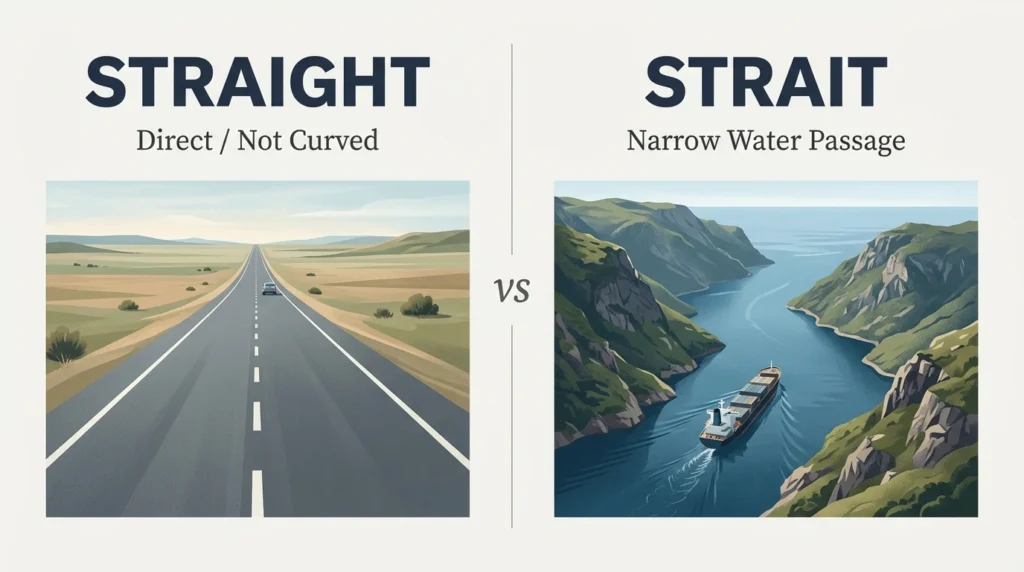

The difference between straight and strait is their meaning and usage, even though they sound exactly alike. Straight means not curved, direct, upright, or honest. Strait usually refers to a narrow passage of water connecting two larger bodies of water. It can also describe a difficult situation, as in the expression “in dire straits.” Use straight for direction and alignment, and strait for narrow passages and difficulties.
What Is the Difference Between Straight and Strait?
Straight and strait are homophones. This means they have different spellings and meanings but the same pronunciation.
Although they sound identical, they belong to different contexts.
- Straight: Describes something that is not curved, direct, level, honest, or uninterrupted.
- Strait: Refers to a narrow passage of water or a difficult situation. It can also describe something narrow or restrictive in less common, traditional usage.
Consider these examples:
- The road ahead is straight. (It does not curve.)
- The ship passed through the strait. (It travelled through a narrow water passage.)
- The company is in dire straits. (It is experiencing serious difficulties.)
The easiest way to understand the difference is to remember that straight is commonly associated with lines and directions, while strait is associated with narrow passages and difficult circumstances.
Why Does the Difference Between Straight and Strait Matter?
These words are easy to confuse because they have identical pronunciations. However, choosing the wrong spelling can change the meaning of a sentence or make your writing look careless.
For example:
- “Drive straight ahead” gives someone a direction.
- “Drive through the strait” describes travelling through a narrow water passage.
The difference becomes especially important in geographical writing, academic assignments, business communication, travel descriptions, and professional documents.
It also matters when using established expressions such as:
- In dire straits: Experiencing serious trouble.
- Straight to the point: Speaking directly without unnecessary details.
- Straight and narrow: Following an honest or morally acceptable way of life.
A spelling mistake in these expressions can make a sentence confusing or unintentionally humorous.
The Core Rule: Straight vs. Strait
STRAIGHT
Not curved, direct, level, honest, or uninterrupted.
Example: Walk straight to the entrance.
STRAIT
A narrow water passage, a difficult situation, or something narrow and restrictive.
Example: The ship entered the strait.
Remember: If you are talking about a straight line, direct movement, or an honest answer, use straight. If you are talking about a narrow waterway or serious difficulties, use strait.
How to Use Straight and Strait
Understanding the different grammatical roles of these words makes choosing the correct spelling much easier.
1. How to Use Straight
The word straight is much more common in everyday English. It can function as an adjective, an adverb, and a noun in certain expressions.
Straight as an adjective
An adjective describes a person, place, thing, or quality. Straight describes something without curves, something properly aligned, or something direct and honest.
Examples:
- Draw a straight line across the page.
- The new road is long and straight.
- Please keep your back straight during the exercise.
- She gave me a straight answer about the problem.
- His straight hair reaches his shoulders.
Straight as an adverb
An adverb describes how, where, or when an action happens. Straight can mean directly, immediately, or continuously.
Examples:
- Go straight home after school.
- The manager walked straight into the meeting.
- She looked straight at the camera.
- I went straight to bed after dinner.
- He worked for six hours straight without taking a break.
Straight in expressions
Straight also appears in several common English expressions.
| Expression | Meaning | Example |
|---|---|---|
| Straight ahead | Directly forward | Continue straight ahead. |
| Straight away | Immediately | Please call me straight away. |
| Straight to the point | Direct without unnecessary details | Let’s get straight to the point. |
| Straight answer | An honest, clear answer | I need a straight answer. |
| In a straight line | Without bending | The children stood in a straight line. |
| Five days straight | Five consecutive days | It rained for five days straight. |
| Set the record straight | Correct incorrect information | She wanted to set the record straight. |
2. How to Use Strait
The word strait is less common than straight. It mainly appears in geographical descriptions and expressions involving difficult circumstances.
Strait as a noun
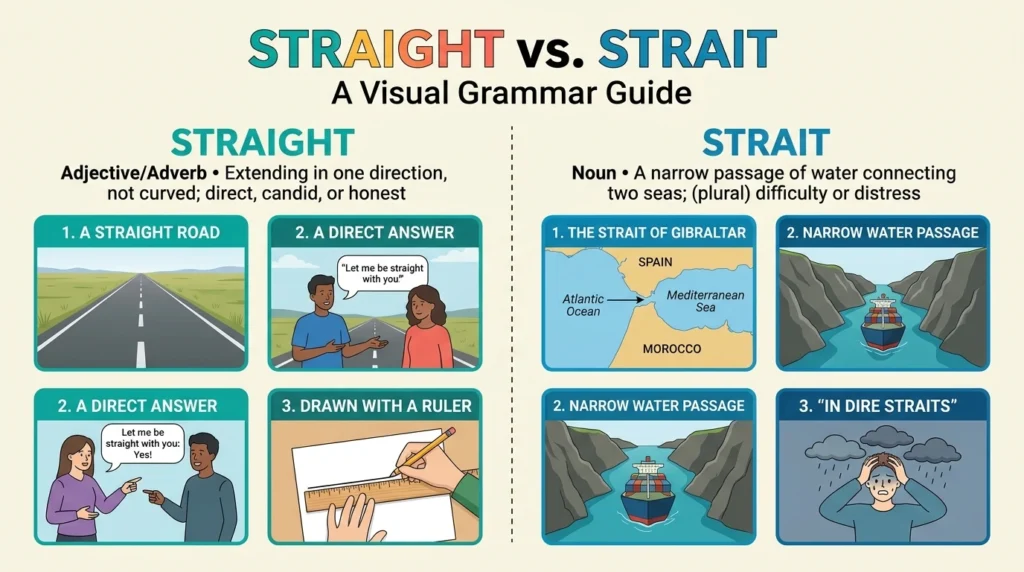
A strait is a narrow passage of water that connects two larger bodies of water.
Examples:
- The Strait of Gibraltar connects the Atlantic Ocean and the Mediterranean Sea.
- The sailors carefully navigated the narrow strait.
- The ship passed through the strait during its journey.
- The Strait of Malacca is an important international shipping route.
- The explorers studied the geographical features of the strait.
In geography, strait is an important term because these passages can provide essential routes for international trade, transportation, and maritime travel.
Strait meaning a difficult situation
Strait can also refer to a difficult or restricted situation. This meaning is particularly common in the plural expression in dire straits.
Examples:
- The business was in dire straits after losing its biggest customer.
- Many families found themselves in financial straits.
- The country was in serious straits following the economic crisis.
- Without additional funding, the organisation could be in desperate straits.
Notice that straits is generally plural when referring to difficult circumstances.
Strait as an adjective
Strait can also mean narrow, tight, restricted, or confining. This use is relatively old-fashioned or literary in modern English.
It survives in established expressions and compound words, including:
- Straitjacket: A restrictive garment historically designed to restrain someone’s movement.
- Strait-laced: Strict, conservative, or excessively concerned with proper behaviour.
These expressions are important because they show that strait is not limited to geographical passages.
Read More: Mobil vs Mobile: Which Spelling Is Correct?
Correct Examples of Straight and Strait
The following examples demonstrate how both words work in everyday communication, education, business, travel, and academic writing.
Straight Examples
1. Everyday conversation: Take the first street and continue straight until you reach the supermarket.
2. Email: Please send me a straight answer so I can make the final decision.
3. School: The mathematics teacher asked the students to draw a perfectly straight line.
4. Workplace: Our manager wants everyone to communicate openly and give straight answers during meetings.
5. Social media: Sometimes, a little straight talk is better than a thousand excuses.
6. Academic writing: The researcher followed a straight path from the laboratory entrance to the observation room.
7. Travel: We drove straight to the hotel after arriving at the airport.
8. Sports: The athlete maintained a straight posture throughout the competition.
9. Business: The company reported four straight quarters of revenue growth.
10. Daily life: I have been working for three hours straight, so I need a short break.
Strait Examples
1. Geography: The Strait of Gibraltar separates southern Spain from northern Morocco.
2. Travel: Our cruise ship passed through a narrow strait before reaching the open sea.
3. Education: The geography students studied the importance of the Strait of Malacca.
4. Business: The retailer found itself in dire straits after several unsuccessful financial decisions.
5. Academic writing: The passage examines the strategic importance of international shipping routes through major straits.
6. News reporting: The country was facing difficult economic straits following a prolonged financial crisis.
7. History: Ancient sailors used narrow straits as important routes between coastal settlements.
8. Workplace: The small organisation was in financial straits after losing two major contracts.
9. Environmental studies: Pollution in the strait threatened marine life and local fishing communities.
10. Maritime transport: The captain checked the navigation charts before entering the strait.
Read More: Copyright vs Copywrite: Which Is Correct?
Incorrect vs. Correct: Straight and Strait
The following table highlights common spelling mistakes and explains why each correction is necessary.
| ❌ Incorrect | ✅ Correct | Why |
|---|---|---|
| Draw a strait line. | Draw a straight line. | A line without curves is straight. |
| Go strait ahead. | Go straight ahead. | Straight means directly forward. |
| The road is strait. | The road is straight. | Straight describes a road without bends. |
| Give me a strait answer. | Give me a straight answer. | Straight means honest and direct. |
| She walked strait home. | She walked straight home. | Straight means directly home. |
| The ship crossed the Straight of Gibraltar. | The ship crossed the Strait of Gibraltar. | Strait is the geographical term. |
| The company is in dire straights. | The company is in dire straits. | The established expression uses straits. |
| The ship entered the straight. | The ship entered the strait. | A narrow water passage is a strait. |
| He worked for eight hours strait. | He worked for eight hours straight. | Straight means continuously. |
| The Strait of Malacca is a major shipping route, and the road is strait. | The Strait of Malacca is a major shipping route, and the road is straight. | The geographical passage is a strait; the road is straight. |
| Please walk in a strait line. | Please walk in a straight line. | The intended meaning is an unbent line. |
| We are facing difficult financial straights. | We are facing difficult financial straits. | Straits refers to difficult circumstances. |
Important: Not every sentence containing strait is incorrect when referring to narrowness or restriction. However, straight is the normal choice for ordinary descriptions of lines, directions, and alignment.
Why Do People Confuse Straight and Strait?
There are several reasons English learners and even experienced writers mix up these words.
1. They Have the Same Pronunciation
Straight and strait are homophones. Both are pronounced /streɪt/.
When people speak, listeners cannot identify which spelling the speaker intends simply by hearing the word. They must understand the surrounding sentence.
For example:
- “The road is straight.”
- “The ship entered the strait.”
Both sound identical, but their meanings are different.
2. Their Spellings Look Similar
Both words begin with the same four letters: S, T, R, and A.
The main difference is the additional letters in straight. Because the spellings look similar, writers sometimes choose the familiar form without considering the meaning.
3. Straight Is Much More Common
People encounter straight regularly in conversations, books, instructions, and professional communication.
By comparison, strait appears less frequently, mainly in geography, history, literature, and the expression “in dire straits.”
This difference in frequency can make writers automatically select straight, even when strait is correct.
4. Spellcheck Does Not Always Identify the Problem
Modern spellcheckers can recognise both words as correctly spelled English words.
If someone writes “the ship crossed the straight,” a basic spellchecker may not identify the error because straight is a valid word.
This is a contextual spelling mistake, not necessarily a spelling mistake that software can detect.
5. Translation Can Create Confusion
Some languages use one word or a closely related expression for ideas involving directness, narrowness, or passages.
When learners translate directly from their first language, they may not recognise the difference between these two English words.
The best solution is to learn each word through its meaning and example sentences rather than memorising its translation alone.
Common Mistakes Checklist
Use this checklist to avoid the most frequent mistakes involving straight and strait.
– Using strait for a straight line: A line without curves is always described as straight in ordinary modern English. Remember that a strait is usually a geographical passage.
– Writing “dire straights”: The correct established expression is “dire straits.” Associate it with serious financial or personal difficulties.
– Writing “Straight of Gibraltar”: The geographical name is the Strait of Gibraltar. Remember that a strait is a narrow water passage.
– Using straight when describing a waterway: A ship travels through a strait, not a straight, when referring to the geographical feature.
– Confusing spelling with pronunciation: Both words sound alike. Do not rely on pronunciation alone when writing.
– Assuming strait is always a noun: Strait can also function as an adjective meaning narrow or restrictive, although this use is less common.
– Trusting spellcheck without checking meaning: A grammatically correct spelling can still be the wrong word for your sentence.
– Forgetting the plural in “dire straits”: The conventional expression uses the plural form when describing difficult circumstances.
Straight vs. Strait in Real English
Understanding dictionary definitions is important, but knowing how these words are actually used in modern English makes your writing more accurate.
Grammatically Correct
Both straight and strait are grammatically correct English words. Use straight for things such as direct movement, alignment, honesty, and uninterrupted periods. Use strait for narrow geographical passages and difficult circumstances. For example, “The road is straight” and “The ship entered the strait” are both grammatically correct sentences.
Grammatically Possible but Unnatural
Using strait as an adjective to describe something narrow or restrictive is grammatically possible, but it often sounds old-fashioned or literary in modern everyday English. For example, “The narrow strait passage” is not a natural way to describe an ordinary narrow road. Modern writers would normally choose “narrow road” or “restricted passage.”
Natural, Everyday English
In everyday conversation, straight is far more common. People naturally say “go straight ahead,” “give me a straight answer,” and “I went straight home.” The word strait is more likely to appear in geographical discussions, historical writing, or expressions such as “in dire straits.” Choosing the word that fits the context makes your writing sound natural and precise.
American vs. British English
There is no significant American-versus-British spelling difference between straight and strait.
Both varieties of English use:
- Straight for directness, alignment, honesty, and uninterrupted action.
- Strait for a narrow water passage and difficult circumstances.
For example:
- American English: The ship passed through the strait.
- British English: The ship passed through the strait.
Both spellings are correct in both varieties. The geographical name Strait of Gibraltar is also written the same way.
Formal vs. Informal Usage
The distinction between these words is based on meaning rather than formality. However, their different uses can make them more suitable for particular writing situations.
Formal Usage
In academic, geographical, scientific, and professional writing, strait is appropriate when discussing narrow water passages or difficult circumstances.
Examples:
- The Strait of Hormuz is an important international shipping route.
- The organisation faced serious financial straits.
- The researchers examined the environmental impact of pollution in the strait.
Straight is equally appropriate in formal writing when describing alignment, direction, or direct communication.
Example: The report provides a straight comparison of the two proposed approaches.
Read More: Gray vs Grey: Which Spelling Is Correct?
Informal Usage
In everyday conversation, straight appears much more frequently.
Examples:
- Go straight home.
- Let me give you a straight answer.
- I have been studying for four hours straight.
Strait is less common in casual conversations, although people still use expressions such as “in dire straits” when describing serious difficulties.
Straight vs. Strait: Comparison Table
| Feature | Straight | Strait |
|---|---|---|
| Pronunciation | /streɪt/ | /streɪt/ |
| Spelling | Straight | Strait |
| Main meaning | Not curved or direct | Narrow water passage |
| Other meanings | Honest, level, continuous | Difficult or restrictive |
| Common part of speech | Adjective and adverb | Noun; sometimes adjective |
| Everyday frequency | Very common | Less common |
| Geographical use | Not normally used for waterways | Used for narrow waterways |
| Common expression | Straight ahead | In dire straits |
| Example | Walk straight ahead. | The ship entered the strait. |
| Common mistake | Using it for a water passage | Using it for an ordinary straight line |
Memory Trick: How to Remember Straight vs. Strait
Here is a simple way to remember the difference:
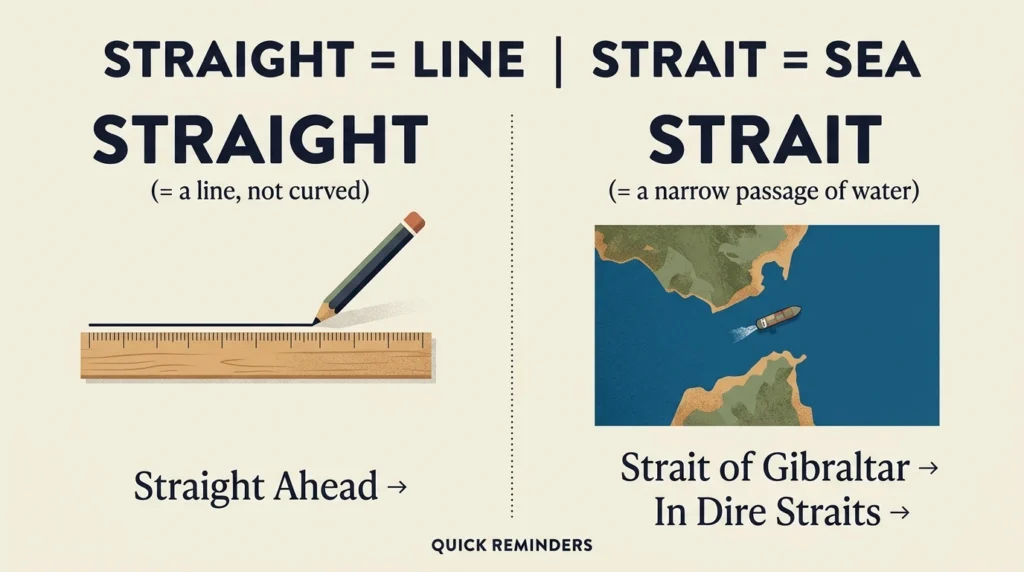
STRAIGHT has extra letters for a direct line. STRAIT is the shorter word for a narrow passage.
Think of these two associations:
- STRAIGHT = LINE: Imagine drawing a straight line with a ruler. The word has more letters, just as you can think of the longer spelling when picturing a straight line.
- STRAIT = SEA: Imagine a ship travelling through a narrow sea passage. Remember the word strait when you think about geography or difficult circumstances.
Also remember:
STRAIGHT AHEAD, STRAIT OF GIBRALTAR, DIRE STRAITS.
These three expressions cover some of the most common situations in which you need to distinguish the words.
Real-Life Situations: Straight and Strait in Context
Understanding the words in practical situations helps you remember their correct spelling.
1. During a Job Interview
Interviewer: Can you give me a straight answer about your previous experience?
Candidate: Yes. I worked in digital marketing for three years and managed several successful campaigns.
Here, straight means honest and direct.
2. During a Business Meeting
Manager: Our company is in dire straits. We need to reduce unnecessary expenses.
Employee: We should review our operating costs before making any major decisions.
Here, straits refers to serious difficulties.
3. While Giving Directions
Friend: How do I reach the railway station?
You: Go straight along this road, and you will see it on your left.
Here, straight means directly forward.
4. During a Geography Examination
Teacher: What is a strait?
Student: A strait is a narrow passage of water connecting two larger bodies of water.
Here, strait is a geographical term.
5. In an Email
Subject: Project Update
Please give me a straight assessment of the project’s current progress. I would appreciate an honest update so we can make the right decisions.
Here, straight means honest and clear.
Read More: Propose vs Purpose: Meaning, Differences & 20+ Examples.
Expert Tips: Mastering Straight and Strait
A few practical habits can help you avoid these mistakes permanently.
1. Check the meaning before the spelling. Ask yourself whether you are describing a line, direction, honest answer, water passage, or difficult situation.
2. Learn complete expressions. Memorise “straight ahead,” “straight to the point,” “Strait of Gibraltar,” and “in dire straits” as complete phrases.
3. Pay attention to geographical names. Names such as the Strait of Gibraltar and the Strait of Malacca use strait because they refer to geographical water passages.
4. Remember the plural expression. When discussing serious difficulties, “in dire straits” is the established expression.
5. Do not depend entirely on spellcheck. Both words are correctly spelled, so spelling software may not recognise that you selected the wrong one.
6. Practise with contrasting sentences. Write one sentence using straight and another using strait. This builds a stronger connection between spelling and meaning.
Quick Summary: Straight vs. Strait
Straight and strait are homophones, meaning they have the same pronunciation but different spellings and meanings. Straight is the more common word and describes something without curves, direct movement, proper alignment, honesty, or uninterrupted action. Strait usually refers to a narrow passage of water connecting two larger bodies of water. It also appears in expressions describing difficult circumstances, particularly “in dire straits.” Remember these three examples: a straight road, the Strait of Gibraltar, and a company in dire straits. Both words are used in American and British English without a significant spelling difference. Always choose the spelling according to the meaning you want to communicate.
Frequently Asked Questions (FAQ)
1. What is the main difference between straight and strait?
Straight means not curved, direct, level, or honest. Strait usually means a narrow water passage connecting two larger bodies of water. It can also refer to difficult circumstances, as in “in dire straits.”
2. Are straight and strait pronounced the same?
Yes. Both words are pronounced /streɪt/. They are homophones, which means they sound identical but have different spellings and meanings.
3. Is it Strait of Gibraltar or Straight of Gibraltar?
The correct geographical name is Strait of Gibraltar. It is a narrow water passage connecting the Atlantic Ocean and the Mediterranean Sea.
4. Is it in dire straits or in dire straights?
The correct expression is in dire straits. It describes a person, organisation, or country experiencing serious difficulties, particularly financial or personal problems.
5. Can strait be used as an adjective?
Yes. Strait can function as an adjective meaning narrow, tight, or restrictive. However, this usage is relatively old-fashioned or literary in modern English.
6. Is straight more common than strait?
Yes. Straight appears much more frequently in everyday English because it has several common meanings involving direction, shape, honesty, and continuity. Strait is more specialised and commonly appears in geography and established expressions.
7. Is straight a noun or an adjective?
Straight can function as an adjective and an adverb. It can also function as a noun in certain contexts, such as “a straight in poker.” Its grammatical role depends on how it is used in a sentence.
8. What does straits mean in financial writing?
In financial writing, straits refers to difficult financial circumstances. For example, “The company is in financial straits” means that the company is experiencing serious financial problems.
9. Is the spelling straight-laced or strait-laced?
Both spellings are found in modern English. Straight-laced commonly describes someone who is strict, conservative, or concerned with proper behaviour. Strait-laced is also an established spelling, historically associated with restriction or confinement. The two forms overlap in modern usage.
10. What is the easiest way to remember straight and strait?
Remember straight = line and strait = sea. Use straight when describing something direct or without curves. Use strait when describing a narrow water passage or difficult circumstances.
Mini Quiz: Straight vs. Strait
Test your understanding with these 10 questions. Each answer includes an explanation to help you recognise the difference.
| No. | Question | Answer | Explanation |
|---|---|---|---|
| 1 | The road ahead is perfectly _____. (A) strait (B) straight | B) Straight | Straight describes a road without curves or bends. |
| 2 | The ship passed through the ____ of Gibraltar. (A) straight (B) strait | B) Strait | Strait refers to a narrow passage of water. |
| 3 | The business is in dire _____. (A) straights (B) straits | B) Straits | The established expression is “in dire straits,” meaning serious difficulties. |
| 4 | Please walk _____ ahead until you reach the bridge. | Straight | Straight means directly forward. |
| 5 | Correct this sentence: “She gave me a strait answer.” | She gave me a straight answer. | Straight means honest, clear, and direct. |
| 6 | Which word describes a narrow water passage connecting two larger bodies of water? | Strait | A strait is a geographical water passage. |
| 7 | He worked for five hours _____ without stopping. (A) straight (B) strait | A) Straight | Straight means continuously or without interruption. |
| 8 | Correct this sentence: “The ship entered the straight.” | The ship entered the strait. | Strait is the correct geographical term. |
| 9 | Choose the correct expression: (A) Straight to the point (B) Strait to the point | A) Straight to the point | This expression means speaking directly without unnecessary details. |
| 10 | The country faced serious financial ____ after the crisis. (A) straits (B) straights | A) Straits | Straits refers to difficult circumstances. |


