
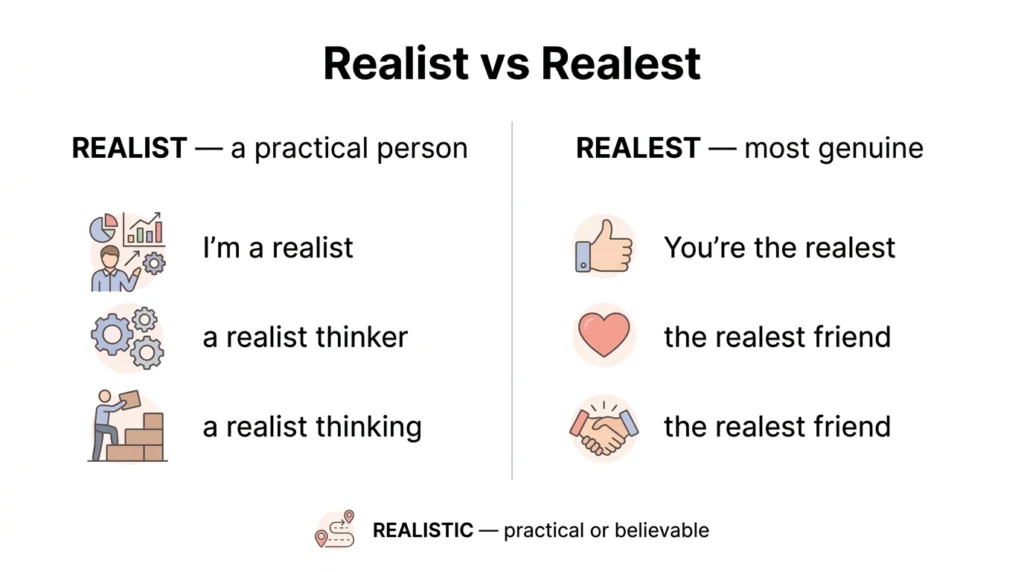
Realist usually means a person who accepts facts and deals with situations practically. Realest is the superlative form of real and means “most real,” “most genuine,” or “most authentic.” Use realist for a person’s outlook and realest mainly in informal praise: “I’m a realist” versus “You’re the realest friend I have.”
Compare these sentences:
The difference between realist and realest comes from their endings and grammatical functions.
- Amir is a realist. He accepts the facts and plans practically.
- Amir is the realest person in the group. He is considered the most honest or authentic person.
The words look and sound similar, but they answer different questions.
- Realist: What kind of person is someone?
- Realest: Who or what is the most genuine?
Why the Difference Matters
Choosing the wrong word can change your intended meaning.
Calling someone a realist describes the way that person thinks. Calling someone the realest praises that person’s honesty, authenticity, loyalty, or sincerity.
Consider this workplace sentence:
Our manager is a realist.
It suggests that the manager makes practical, fact-based decisions.
Now compare:
Our manager is the realest.
This sounds informal and suggests that the manager is extremely honest, genuine, or loyal.
Using the wrong word in an email, school assignment, job application, or business report can make your writing sound careless. It may also create a meaning you did not intend.
The Core Rule
Use realist for a person who thinks practically. Use realest for the person or thing considered most genuine or authentic.
The endings provide the clearest clue:
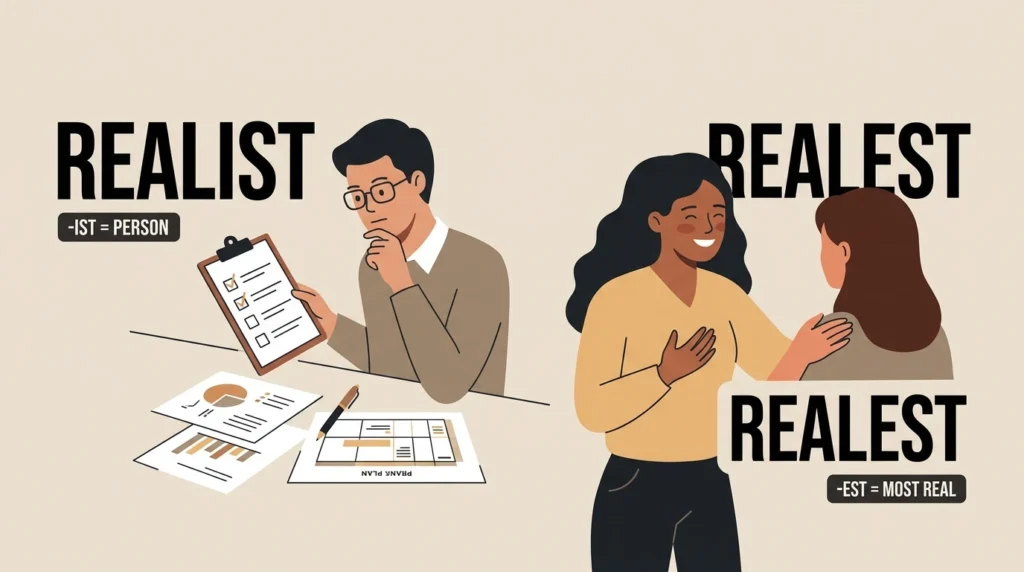
- -ist often identifies a person, follower, practitioner, or type of thinker.
- -est creates the highest degree of many adjectives.
A realist is a type of person. The realest is the most real or authentic.
Is Realest a Real Word?
Yes, realest is a real English word.
The ending -est is used to form superlative adjectives, which express the highest degree of a quality. Because real is a short adjective, realest follows the normal pattern used in words such as smallest, kindest, and fastest.
However, grammatical formation and natural usage are not exactly the same thing.
In its literal sense, real can describe something that exists rather than something imaginary or fake. That meaning may feel absolute: an object is either real or not real. As a result, phrases such as the realest building or the realest document can sound strange without a special context.
In informal English, real can also mean honest, authentic, sincere, relatable, or free from pretence. In that meaning, realest sounds much more natural:
She is the realest person on the team.
Here, the speaker is not measuring whether the person exists. The speaker is praising her authenticity.
What Does Realist Mean?
Realist as a Noun
As a noun, realist means someone who recognizes what is true, possible, or practical in a particular situation.
A realist does not necessarily expect the worst. Instead, a realist looks at the available facts before reaching a conclusion.
I’m a realist, so I know the project may take longer than planned.
In this sentence, the speaker accepts practical limitations.
A realist can still be hopeful. The word does not automatically mean pessimist.
Realist in Art and Literature
A realist may also be an artist or writer whose work represents life faithfully rather than idealizing it.
The novelist was a realist who wrote about ordinary working families.
In this context, realist describes the writer’s artistic tradition rather than the writer’s personality.
Realist in Philosophy
In philosophy, a realist supports a form of realism. The exact meaning depends on the branch of philosophy being discussed.
For example, philosophical realism may involve the view that certain things exist independently of whether people perceive or think about them.
This specialist meaning is common in academic writing but is less common in ordinary conversation.
Read More: Encorporate vs Incorporate: Which Spelling Is Correct?
Realist as an Adjective
Although realist is most commonly taught as a noun, it can also function as an adjective.
Correct adjective uses include:
- a realist painter
- realist fiction
- a realist theory
- a realist approach
- the realist tradition
Standard dictionary entries recognize adjective uses connected with realism, practical thinking, or a realist position. (merriam-webster.com)
However, realistic is usually more natural when you simply mean practical, believable, or achievable.
Compare:
We need a realistic deadline.
This is the normal everyday choice.
We need a realist approach to negotiations.
This is possible, but it sounds more specialized and describes an approach associated with realist principles.
What Does Realest Mean?
Realest means the most real, genuine, sincere, authentic, or honest among the people or things being compared.
It is the superlative form of real:
- real
- realer
- realest
In modern informal usage, the realest frequently praises someone who remains honest, loyal, grounded, or true to themselves.
You supported me when nobody else did. You’re the realest.
The noun after the adjective may be omitted when the listener already understands it. The complete idea might be:
You’re the realest friend I have.
Although realest can be formed normally, it often carries a casual, emotional, or slang-influenced tone when applied to people.
How to Choose the Correct Word
Use this three-step test:
- Are you naming a practical or reality-focused person?
Choose realist. - Are you describing a practical plan, prediction, image, or expectation?
Choose realistic, not usually realist or realest. - Are you praising someone or something as the most genuine or authentic?
Choose realest, especially in informal English.
Compare:
| Intended meaning | Correct word | Example |
|---|---|---|
| A practical person | Realist | Nadia is a realist about business. |
| A practical or achievable idea | Realistic | Nadia created a realistic budget. |
| The most authentic person | Realest | Nadia is the realest person in our group. |
Realist vs Realistic vs Realest
These three forms are closely related in spelling, but they perform different jobs.
| Word | Main grammatical role | Main meaning | Typical example |
|---|---|---|---|
| Realist | Noun; sometimes adjective | A practical person or something connected with realism | He is a realist. |
| Realistic | Adjective | Practical, believable, achievable, or true to life | The target is realistic. |
| Realest | Superlative adjective | Most genuine, authentic, or real | She is the realest friend here. |
The most common learner mistake is using realist where realistic is needed.
❌ The schedule is realist.
✅ The schedule is realistic.
A schedule is not a person or follower of realism. It is a plan that may be practical or achievable.
Correct Examples of Realist and Realest
Everyday Conversation
- I’m a realist, so I know we cannot solve everything in one day.
- My sister is a realist when it comes to money.
- You told me the truth when everyone else stayed quiet. You’re the realest.
- As a realist, I believe we should prepare for possible delays.
- Daniel is a realist who bases his recommendations on the available data.
- You have been the realest friend throughout this difficult period.
The third sentence is grammatically correct, but its casual tone makes it more suitable for a personal email than a formal business message.
School and University
- The main character begins as an idealist but gradually becomes a realist.
- The essay examines the work of a nineteenth-century realist.
- The researcher takes a realist position on the existence of social structures.
Workplace
- Our finance director is a realist about the company’s current resources.
- A realist would examine the risks before approving the expansion.
- Among my former supervisors, she was the realest because she always gave honest feedback.
The final sentence is natural in casual workplace conversation but may sound too informal in an official report.
Social Media and Text Messages
- Happy birthday to the realest friend a person could ask for.
- You stayed loyal from the beginning. Realest one here.
- She always speaks honestly, even when the truth is uncomfortable. She’s the realest.
Academic Writing
- The author presents a realist interpretation of international relations.
- Several realist thinkers rejected the idealized model.
- The novel combines realist observation with symbolic imagery.
Incorrect vs. Correct Usage
| ❌ Incorrect | ✅ Correct | Why |
|---|---|---|
| I am a realest. | I am a realist. | You are naming a type of person, so the noun realist is required. |
| She is the realist person I know. | She is the realest person I know. | The sentence compares authenticity and needs the superlative adjective realest. |
| Our target is realist. | Our target is realistic. | A target can be practical or achievable, so realistic is the natural adjective. |
| He is realist about the risks. | He is a realist about the risks. | Realist is a singular countable noun here and requires an article. |
| She gave the most realest answer. | She gave the realest answer. | Do not use both most and -est to create the same superlative. |
| The painter developed a realest style. | The painter developed a realist style. | A style associated with realism is realist, not realest. |
| We need to be realist about the deadline. | We need to be realistic about the deadline. | After be, everyday English normally uses realistic to mean practical. |
| He is one of the realest person I know. | He is one of the realest people I know. | One of the must be followed by a plural group noun. |
| This photograph looks realist. | This photograph looks realistic. | Realistic means that the image appears true to life. |
| A realest knows when to change plans. | A realist knows when to change plans. | A practical person is a realist. |
| Her report offers a realistic theory of art. | Her report offers a realist theory of art. | When referring to the philosophical or artistic school, realist is the precise term. |
| He is a realist friend because he never lies. | He is a real friend because he never lies. | Realist friend suggests a friend connected with realism, not simply an honest friend. |
Why People Confuse Realist and Realest
They Often Sound the Same
Realist and realest are commonly pronounced alike or almost alike. Both may sound approximately like “REE-uh-list.” The similarity makes it difficult to identify the intended spelling from speech alone.
You must use the sentence meaning to select the correct word.
Read More: Grately vs Greatly: Difference, Meaning & Correct Usage
Their Spellings Overlap
Both words begin with real and end with the same letters when spoken quickly.
The meaningful difference is hidden in the suffix:
- real + -ist
- real + -est
A reader who focuses only on the beginning of the word can easily overlook that difference.
Learners Overgeneralize One Familiar Form
Someone who knows that a practical person is a realist may use it in every sentence connected with reality.
That produces sentences such as:
❌ We need a realist goal.
In ordinary English, the better sentence is:
✅ We need a realistic goal.
Autocomplete Cannot Always Understand Meaning
A spelling checker may accept both words because both are legitimate spellings.
Software can identify an invented spelling more easily than a correctly spelled word used with the wrong meaning. Therefore, a document may contain realist when the writer meant realest without displaying a warning.
Translation Interference
Another language may use one related form for several English meanings.
A learner may translate the idea of “real,” “practical,” or “genuine” directly without distinguishing among realist, realistic, and realest. Learning each word’s grammatical role is more reliable than translating it alone.
Common Mistakes Checklist
- Using realest as a person-naming noun: Write a realist, not a realest, when identifying someone’s outlook.
- Using realist for an achievable plan: Write a realistic plan unless you specifically mean a plan based on a realist theory or tradition.
- Adding most before realest: Avoid most realest. The ending -est already expresses the superlative.
- Using realest in highly formal writing without considering tone: Choose most authentic, most genuine, or most faithful to reality when a neutral professional tone is needed.
- Assuming realist always means pessimist: A realist evaluates facts. A pessimist expects an unfavourable result.
- Forgetting the article before realist: In “She is a realist,” the noun normally needs a.
- Treating every adjective ending in -ist as wrong: Phrases such as realist fiction and a realist approach are valid.
- Calling a lifelike image realist in ordinary conversation: Realistic image is usually more natural unless discussing an artistic movement or style.
Realist vs Realest in Real English
Grammatically Correct English
Both realist and realest can be grammatically correct. Realist works as a noun in “She is a realist” and as an adjective in specialist phrases such as “realist fiction.” Realest works as a superlative adjective in “He is the realest person here.” Correct grammar, however, does not guarantee that every sentence will suit every setting.
Grammatically Possible but Unnatural English
A phrase such as “the realest building in the city” is structurally possible, but its meaning is unclear. Buildings normally either exist or do not exist, so comparing their degree of reality sounds unusual. A special context could make it meaningful, but ordinary writers would probably choose “the most authentic building” or “the most realistic model.”
Natural Everyday English
In everyday speech, people commonly say “I’m a realist” when they mean they are practical. They may say “You’re the realest” to praise an honest or loyal friend. For plans, expectations, images, and goals, realistic is usually the natural choice. That three-way distinction reflects how the words actually function in normal communication.
American vs. British English
There is no important American–British difference in the spelling or central meanings of realist and realest. The pronunciation of realist can differ slightly: British pronunciation commonly begins with a shorter vowel sound, while American pronunciation often begins with a longer “ree” sound. The grammatical distinction remains the same in both varieties.
Read More: Conex or Connex: What Is the Difference?
Formal vs. Informal Usage
Formal and Neutral Writing
Realist is acceptable in formal, academic, political, artistic, philosophical, and professional writing.
The committee included several economic realists.
The article offers a realist interpretation of the conflict.
In formal prose, replace informal uses of realest with a more precise expression:
- most authentic
- most genuine
- most honest
- most faithful to reality
- most accurate
- most true to life
Instead of:
She is the realest leader in the organization.
Write:
She is one of the organization’s most authentic leaders.
Informal Writing and Speech
Realest works naturally in friendly compliments, texts, captions, entertainment discussions, and conversational storytelling.
You remembered everyone who helped you. That’s why you’re the realest.
Its emotional force is part of its meaning. Replacing it with most authentic may sound more formal but less personal.
Realist vs Realest Comparison Table
| Feature | Realist | Realest |
|---|---|---|
| Main meaning | A person who accepts reality and thinks practically | Most real, genuine, sincere, or authentic |
| Main part of speech | Noun | Superlative adjective |
| Additional role | Adjective in phrases such as realist fiction | May appear without a following noun in You’re the realest |
| Word formation | real + -ist | real + -est |
| Common tone | Neutral, formal, academic, or conversational | Informal, emotional, or slang-influenced |
| Typical contexts | Business, philosophy, politics, art, literature, daily decisions | Friendship, social media, music, praise, casual conversation |
| Article needed? | Usually: a realist | Usually appears with the in a superlative phrase |
| Main question answered | What type of person or position? | Who or what is the most genuine? |
| Example | I’m a realist about our chances. | You’re the realest friend here. |
| Common alternative | Pragmatist, practical thinker | Most authentic, most genuine |
Memory Trick
Remember this sentence:
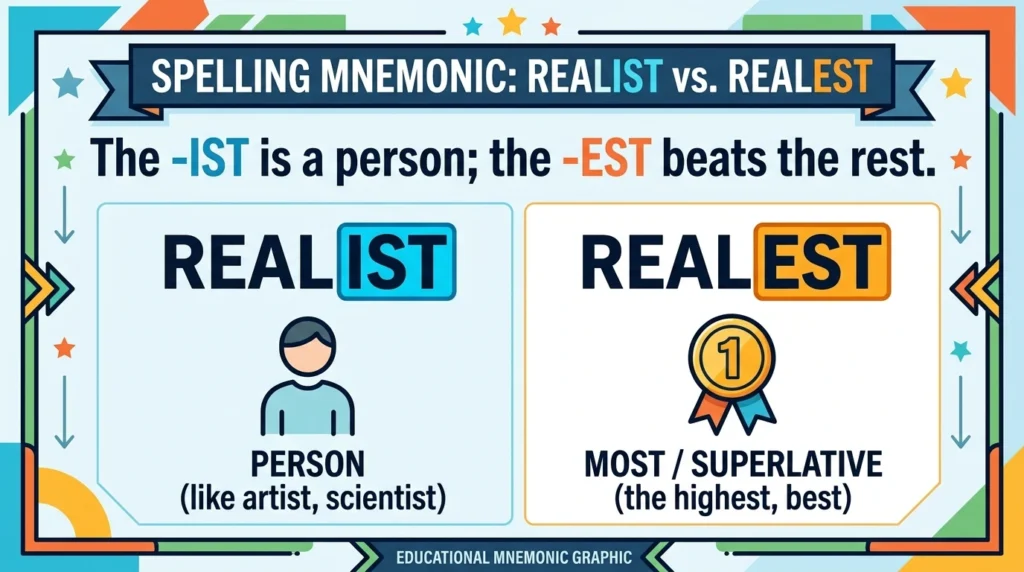
The IST is a person; the EST beats the rest.
- Realist names a person or position.
- Realest describes the highest degree of being real or authentic.
You can also cover the endings and ask:
- Does the sentence need a person? Choose -ist.
- Does the sentence compare someone with the rest? Choose -est.
Real-Life Situations
Job Interview
Question: How do you respond when a project becomes difficult?
Answer:
“I’m a realist. I stay positive, but I also review the risks and adjust the plan.”
Why it works:
The speaker is describing a practical mindset.
Business Meeting
Fatima is a realist about the launch schedule, so she has included extra time for testing.
Why it works:
Fatima accepts that delays are possible and plans accordingly.
Professional Email
As a realist, I recommend revising the deadline before we commit additional resources.
Why it works:
The noun identifies the writer’s practical perspective.
Personal Text Message
You stayed with me through the worst part. You’re honestly the realest.
Why it works:
The sentence informally praises loyalty and authenticity.
Social Media Caption
Celebrating ten years of friendship with the realest person I know.
Why it works:
The warm, casual setting suits realest.
School Examination
Sentence: The narrator accepts that the journey may fail, which reveals that he is a ______.
Correct answer: realist
Why:
The blank requires a noun naming a practical person.
Academic Essay
The article compares idealist and realist approaches to international cooperation.
Why it works:
Here, realist functions as an adjective describing an established theoretical approach.
Read More: Emaculate vs Immaculate: Correct Spelling & Meaning
Expert Tips
Look Beyond the Spelling
Both words are spelled correctly. Ask what the sentence is trying to communicate rather than depending only on a spelling checker.
Replace the Word as a Test
Replace realist with practical person.
She is a practical person about money.
The sentence is slightly awkward but preserves the intended idea, so realist is probably correct.
Replace realest with most authentic.
She is the most authentic person in the group.
If the meaning remains correct, realest may fit.
Use Realistic for Plans and Possibilities
When discussing deadlines, goals, expectations, budgets, chances, images, or predictions, realistic is often the word you need.
- realistic deadline
- realistic budget
- realistic expectation
- realistic portrait
- realistic chance
Do Not Confuse Informal With Incorrect
A word can be legitimate but unsuitable for a particular setting.
Realest may be correct in a caption yet too casual for a research report. That is a register issue, meaning a difference in language style, not necessarily a grammar error.
Check What Is Being Compared
A superlative normally identifies the highest member of a group.
She is the realest member of the cast.
The cast provides the comparison group.
In highly polished writing, make that group clear when the comparison might otherwise be vague.
Frequently Asked Questions
Can I Say “I Am the Realest”?
Yes. “I am the realest” is grammatically possible and common in informal or boastful language. It means that you consider yourself the most authentic, genuine, honest, or impressive person in a particular group or setting. It may sound confident, humorous, or self-promotional depending on the context.
Can I Say “I Am a Realist”?
Yes. “I am a realist” is the standard way to say that you accept facts, consider practical limitations, and base decisions on what appears possible.
The article a is needed because realist is a singular countable noun.
Is Realest Proper English?
Realest is a legitimate superlative form of real, but its suitability depends on meaning and context. It sounds natural when real means authentic or honest. In formal writing, most authentic or most genuine may communicate the same idea more neutrally.
Does Realest Mean Most Honest?
It can. Realest may describe someone as highly honest, sincere, loyal, authentic, or true to themselves.
Its exact meaning depends on the quality being praised.
Is a Realist a Negative Person?
Not necessarily. A realist evaluates the facts and recognizes practical limits. A negative person may expect bad results without sufficient evidence.
A realist can be hopeful while still preparing for difficulties.
What Is the Opposite of a Realist?
Idealist is a common contrast. An idealist focuses strongly on ideals or how things should be, while a realist concentrates on what currently exists or appears practically possible.
Depending on the sentence, dreamer or pessimist may also appear as a contrast, but they do not mean exactly the same thing.
Is Realist an Adjective?
Yes. Although it is often a noun, realist can be an adjective in phrases such as realist fiction, realist painter, realist philosophy, and realist approach.
For an ordinary plan or expectation, realistic is generally more natural.
Is Realest Always Slang?
Not in every possible use. It is regularly formed from real plus -est, but its popular meaning of “most authentic,” “most loyal,” or “most genuine” is strongly associated with informal speech and popular culture.
Should I Write Most Real or Realest?
Both forms can be possible, but the best choice depends on rhythm, meaning, and formality.
- Realest sounds direct and informal.
- Most real may emphasize a contrast.
- Most genuine or most authentic is often clearer in formal prose.
Can Realest Describe an Object?
Yes, when degrees of authenticity or realism make sense.
This is the realest-looking artificial plant in the collection.
However, most realistic would be more natural in that example. Use realest mainly when its informal emotional tone serves a clear purpose.
What Does “The Realest Person” Mean?
“The realest person” means the person considered most authentic, honest, sincere, loyal, or true to themselves.
It does not normally mean the person who exists more than everyone else.
Why Do Realist and Realest Sound Identical?
Their suffixes, -ist and -est, often receive an unstressed vowel sound in normal speech. This makes the words sound identical or nearly identical in many accents. Context usually reveals which word the speaker intends.
Mini Quiz
| No. | Question | Answer | Explanation |
|---|---|---|---|
| 1 | Fill in the blank: “I’m a ______, so I have prepared for possible delays.” | realist | The sentence names a person with a practical outlook. |
| 2 | Choose the correct word: “She is the realist/realest friend I have.” | realest | The speaker means the most genuine or loyal friend. |
| 3 | Correct the sentence: “Our sales forecast is realist.” | Our sales forecast is realistic. | A forecast can be practical or believable, so realistic is needed. |
| 4 | Which sentence is correct? A. He is a realest. B. He is a realist. | B. He is a realist. | Realist is the noun for a practical person. |
| 5 | Fill in the blank: “The course examines several ______ painters.” | realist | Realist functions as an adjective connected with realism in art. |
| 6 | Correct the sentence: “You are the most realest person here.” | You are the realest person here. | Do not combine most with an -est superlative. |
| 7 | Choose the more suitable formal wording: “She is the realest executive in the company” or “She is one of the company’s most authentic executives.” | She is one of the company’s most authentic executives. | The second option has a more neutral professional register. |
| 8 | Fill in the blank: “The character changes from an idealist into a ______.” | realist | The blank requires a noun contrasting with idealist. |
| 9 | Is this sentence natural in a friendly text? “Thanks for always telling me the truth. You’re the realest.” | Yes. | Realest naturally praises honesty or loyalty in informal communication. |
| 10 | Correct the sentence: “We need a realist deadline for the project.” | We need a realistic deadline for the project. | Realistic is the normal adjective for a practical deadline. |
Quick Summary
Realist and realest are both valid words, but they communicate different ideas. A realist is usually a person who accepts facts and approaches situations practically. The word can also function as an adjective in specialist phrases such as realist fiction or a realist theory. Realest is the superlative form of real and usually means the most genuine, authentic, sincere, or honest. It is especially natural in informal compliments, texts, captions, and conversation. For practical plans, believable images, achievable goals, or sensible expectations, use realistic. Remember the endings: -ist identifies a person or position, while -est compares someone or something with the rest.
Visual Strategy and Image Prompts
Featured Image Prompt
Create a clean editorial grammar-learning featured image for an article titled “Realist vs Realest.” Show the word REALIST on the left beside a thoughtful person examining facts, a checklist, and a practical plan. Show the word REALEST on the right beside a genuine friend offering honest support. Place “-IST = PERSON” and “-EST = MOST REAL” in small educational labels. Modern flat-vector style, strong typography, warm neutral background, high contrast, spacious composition, no logos, no copyrighted characters, 16:9 ratio.
Comparison Graphic Prompt
Design a professional vertical comparison infographic titled “Realist vs Realest.” Create two balanced columns. Left column: “REALIST — a practical person,” with examples “I’m a realist” and “a realist thinker.” Right column: “REALEST — most genuine,” with examples “You’re the realest” and “the realest friend.” Include a third small note at the bottom: “REALISTIC — practical or believable.” Minimal educational design, readable typography, soft icons, white background, mobile-friendly layout, no brand logos, 4:5 ratio.
Memory-Trick Graphic Prompt
Create an educational mnemonic graphic featuring the sentence “The IST is a person; the EST beats the rest.” Highlight IST inside REALIST and EST inside REALEST. Add a simple person icon below IST and a first-place comparison symbol below EST. Clean classroom-poster style, bold readable lettering, high contrast, uncluttered composition, original vector artwork, no copyrighted content, square format.