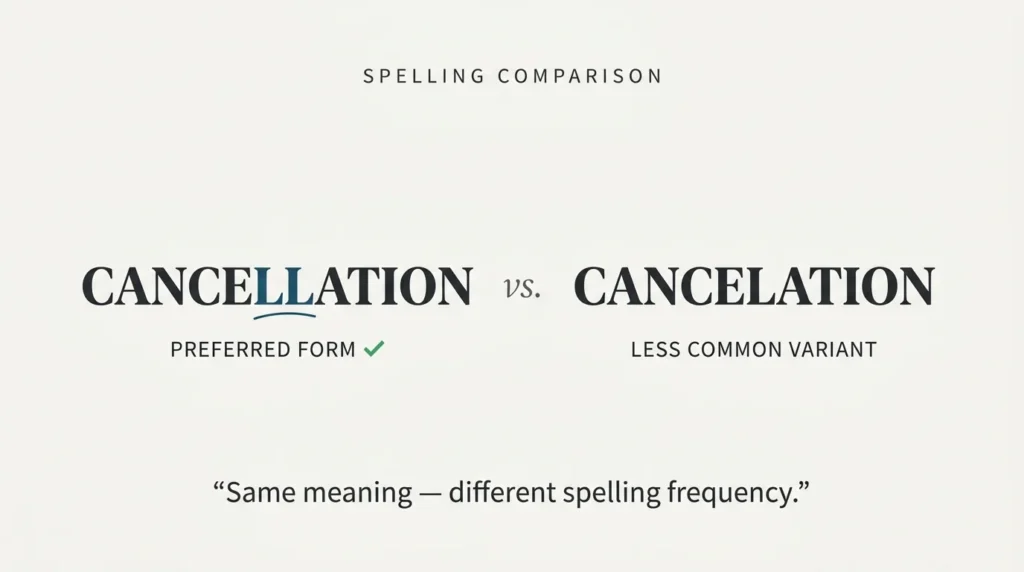

If you are wondering whether to write cancellation or cancelation, the answer is slightly more nuanced than simply calling one spelling wrong. Cancellation is the much more common spelling and is widely used in both American and British English. Cancelation is also a recognized variant, particularly associated with US usage in some dictionaries, but it is far less common. For general, professional, academic, and formal writing, cancellation is the safest choice.
What Is the Difference Between Cancellation and Cancelation?
The difference between cancellation and cancelation is primarily spelling, not meaning.
Both are nouns related to the verb cancel. They can describe the act of stopping something that was planned, arranged, scheduled, ordered, or previously agreed upon.
For example:
- The cancellation of the flight caused major delays.
- The cancelation of the flight caused major delays.
The two forms do not normally represent two different actions. The important difference is that cancellation is much more established and frequent in general English, while cancelation is a less common variant. Dictionaries such as Cambridge, Collins, and Dictionary.com recognize the relationship between the two forms.
Why It Matters
Choosing the more familiar spelling can make your writing clearer and more natural to readers.
You may encounter this word in:
- Business emails
- Hotel and airline policies
- Customer-service messages
- School assignments
- Academic writing
- Contracts and notices
- Website terms and conditions
- Social media posts
- News writing
- Appointment systems
Consider these two sentences:
Please confirm the cancellation of my reservation.
Please confirm the cancelation of my reservation.
The second spelling is not automatically meaningless or impossible. However, cancellation is the form most readers are likely to recognize immediately.
This matters particularly in professional writing, where familiar spelling reduces unnecessary distraction.
Read More: Spicey vs Spicy: Correct Spelling & Usage.
The Core Rule
Use “cancellation” as your default spelling.
“Cancelation” is a recognized variant, but it is much less common.
There is no difference in meaning that requires you to choose one form over the other.
The practical distinction is one of standard usage and frequency, not grammar.
How to Use Cancellation
Cancellation is a noun meaning the act of canceling something or, in some contexts, something that has been canceled.
It commonly appears after words such as:
- flight cancellation
- event cancellation
- order cancellation
- booking cancellation
- subscription cancellation
- appointment cancellation
- cancellation policy
- cancellation fee
- cancellation notice
- last-minute cancellation
Cancellation of an event
Use cancellation when an event will no longer take place.
The event’s cancellation was announced on Friday.
Cancellation of a booking
Use it when a reservation or booking is stopped.
We received your cancellation request this morning.
Cancellation of a service
It can describe ending a subscription or service.
Your subscription cancellation will take effect at the end of the billing period.
Cancellation in business
Businesses frequently use the word in policies, emails, and customer communications.
Please review our cancellation policy before placing your order.
Cancellation in academic writing
The word is also perfectly suitable for formal academic contexts.
The cancellation of the field study affected the research schedule.
Correct Examples
Here are examples showing how cancellation works in different kinds of writing.
| Situation | Example |
|---|---|
| Conversation | I heard about the cancellation of the concert. |
| We have received your cancellation request. | |
| Workplace | The meeting cancellation gave the team extra time. |
| Customer service | Your cancellation has been processed successfully. |
| Travel | The airline sent an alert about the flight cancellation. |
| School | The teacher announced the cancellation of today’s class. |
| Academic writing | The cancellation of the experiment changed the research timetable. |
| Social media | The cancellation of the event surprised many fans. |
| Business policy | A cancellation fee applies after the stated deadline. |
| Formal notice | Written confirmation of cancellation is required. |
| Appointment | I received a cancellation notice from the clinic. |
| Subscription | The cancellation of the membership was confirmed by email. |
Incorrect vs. Correct
The examples below focus on situations where writers may choose the less familiar spelling or confuse related forms.
| ❌ Incorrect / Less Suitable | ✅ Correct / Preferred | Why |
|---|---|---|
| Please confirm the cancelation of my order. | Please confirm the cancellation of my order. | Cancellation is the much more established spelling. |
| We received your cancelation request. | We received your cancellation request. | The double-L form is the usual choice in professional writing. |
| There is a cancelation fee. | There is a cancellation fee. | “Cancellation fee” is the familiar standard expression. |
| The flight cancelation caused delays. | The flight cancellation caused delays. | Cancellation is widely used in travel writing. |
| The event’s cancelation was announced yesterday. | The event’s cancellation was announced yesterday. | The meaning is unchanged, but cancellation is more familiar. |
| I received a cancelation email. | I received a cancellation email. | Cancellation is the safer general spelling. |
| The hotel has a strict cancelation policy. | The hotel has a strict cancellation policy. | “Cancellation policy” is the established form. |
| Your cancelation has been processed. | Your cancellation has been processed. | The double-L form is more conventional. |
| The class cancelation was unexpected. | The class cancellation was unexpected. | Cancellation is the normal choice for this noun. |
| We apologize for the cancelation of your appointment. | We apologize for the cancellation of your appointment. | Cancellation is more familiar in customer communication. |
Important: The left-hand forms above should not all be understood as impossible English. Cancelation is documented as a variant spelling. The table is showing the preferred practical choice, especially when you want broadly recognizable English.
Why People Make This Mistake
The confusion is understandable because cancel creates several spelling patterns that do not line up neatly.
The spelling of cancel
The base verb is:
cancel
When American English forms the past tense and -ing form, it commonly uses:
canceled
canceling
British English commonly uses:
cancelled
cancelling
That difference can lead writers to assume that the noun should also follow a strict one-L versus two-L regional rule.
But it does not.
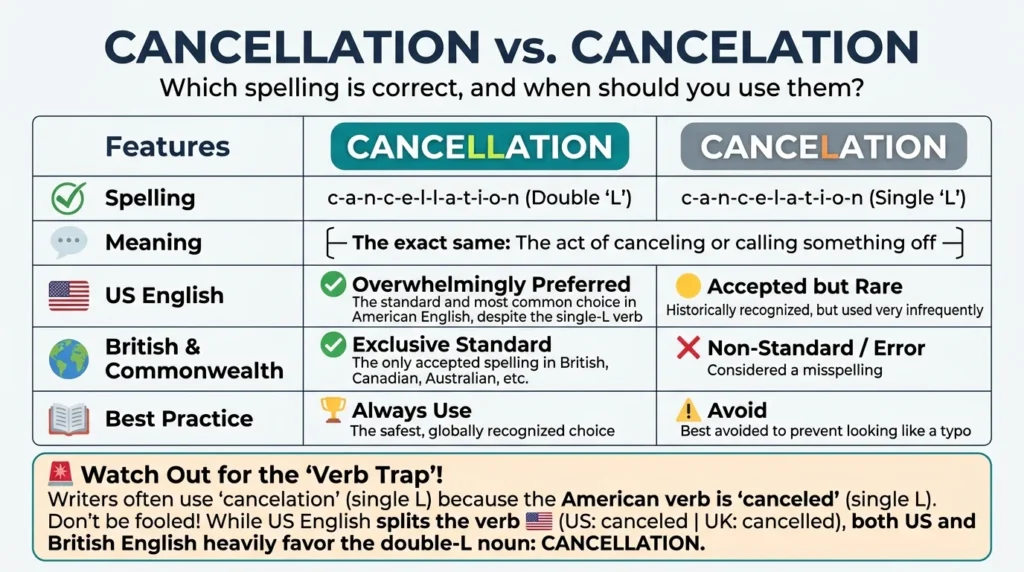
Cancellation remains very common in American English as well as British English. Dictionary.com specifically notes that cancellation is more frequent in American English than cancelation.
The spelling looks logical
A writer may naturally think:
cancel + ation = cancelation
That pattern looks straightforward.
However, English spelling is not always predictable simply by attaching a suffix to a base word. Established spellings can survive even when another spelling appears logically possible.
Spellcheck can add confusion
Modern spellcheckers may recognize more than one dictionary form. Therefore, seeing cancelation accepted by software does not necessarily mean it is the form you should prefer.
A dictionary can recognize a variant without making that variant equally common.
Translation interference
English learners may also transfer spelling patterns from another language. If their first language uses a single-letter equivalent or a different word-building pattern, cancelation can look more natural.
The safest solution is to learn the complete English word rather than trying to construct its spelling mechanically.
Common Mistakes Checklist
1. Assuming one L must mean American English
This is too simple.
American English often uses canceled and canceling, but cancellation remains the common noun spelling.
2. Treating cancelation as completely wrong
That goes too far.
Cancelation is documented as a variant. Collins explicitly lists it as another spelling of cancellation, while Cambridge identifies it as a US variant in its Business English entry.
3. Assuming both forms are equally common
They are not.
The fact that both forms exist does not mean that writers use them at the same rate.
4. Changing between spellings
If your document uses cancellation, do not switch randomly to cancelation later.
Consistency is especially important in policies, contracts, manuals, and other documents containing repeated terminology.
5. Applying the canceled/cancelled rule directly to cancellation
This is one of the most common traps.
American: canceled
British: cancelled
does not mean:
American: cancelation
British: cancellation
That simplified rule does not accurately describe actual usage.
Cancellation in Real English
Grammatically correct and natural
Cancellation is completely natural in ordinary English.
The flight cancellation caused a major problem.
We received your cancellation request.
What is your cancellation policy?
These are ordinary, clear constructions. The word appears naturally in travel, business, customer service, education, and everyday communication.
Grammatically possible but less familiar
Cancelation is possible because it is recognized as a variant spelling.
The cancelation of the order was unexpected.
A reader can understand this without difficulty. However, it is less familiar than cancellation, so choosing it may create a moment of uncertainty for some readers.
Natural everyday choice
For most writers, the easiest natural choice is:
cancellation
This works across American and British English and avoids unnecessary uncertainty.
You do not need to switch to cancelation simply because you are writing for an American audience. The noun cancellation is widely established in American English.
American vs. British English
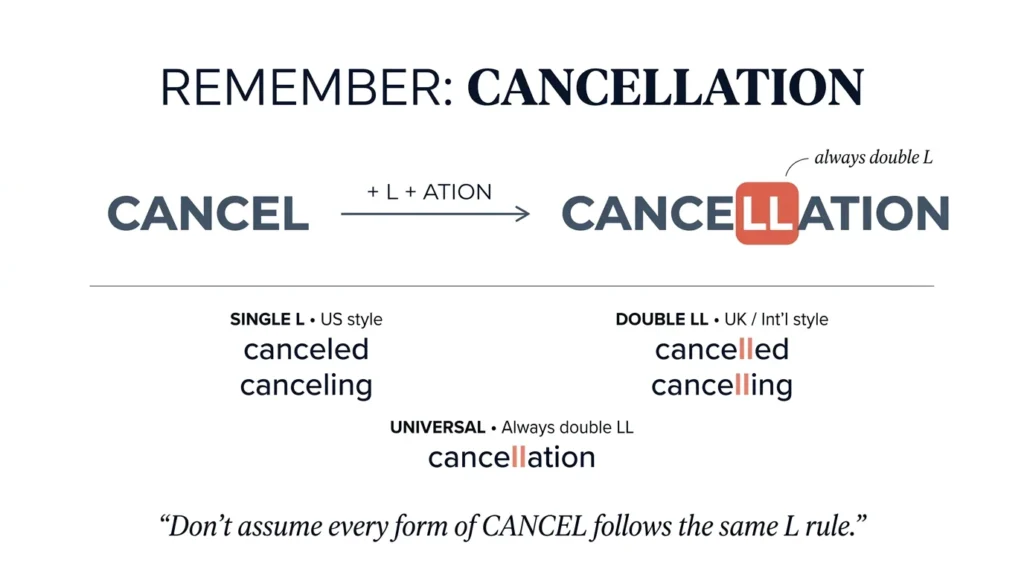
There is a genuine regional difference in related forms of cancel, but cancellation vs. cancelation should not be treated as a simple US-versus-UK spelling pair.
| Form | American English | British English |
|---|---|---|
| Base verb | cancel | cancel |
| Past tense | canceled | cancelled |
| -ing form | canceling | cancelling |
| Noun | cancellation | cancellation |
| Variant noun | cancelation occurs | cancelation exists as a variant |
American English commonly uses canceled and canceling, while British English commonly uses cancelled and cancelling. Yet cancellation remains the established noun in both varieties. Dictionary.com notes that cancellation is actually more frequent in American English than cancelation.
Cambridge also lists cancelation as a US alternative in its Business English entry, while its main entry is cancellation.
So this is not a case where you should automatically replace cancellation with cancelation when writing American English.
Formal vs. Informal Usage
There is no important formal-versus-informal grammar rule separating these two spellings.
However, if you are writing something where spelling consistency and broad reader recognition matter, cancellation is the sensible default.
Use cancellation in:
- Business documents
- Academic assignments
- Professional emails
- Customer policies
- Legal or administrative documents
- Websites
- Reports
- Formal notices
Cancelation can occur in published American English, but its lower frequency makes it less useful as a default spelling.
Comparison Table
| Feature | Cancellation | Cancelation |
|---|---|---|
| Part of speech | Noun | Noun |
| Basic meaning | Act of canceling | Act of canceling |
| Meaning difference | None normally | None normally |
| Spelling | Double l | Single l |
| Recognized in dictionaries | Yes | Yes, as a variant |
| American English | Widely used | Occurs as a variant |
| British English | Standard/common | Recognized as a variant |
| General writing | Preferred choice | Less common |
| Business writing | Strong default | Usually unnecessary |
| Academic writing | Strong default | Less familiar |
| Safest choice for most readers | Yes | No |
The dictionary evidence supports an important distinction: cancelation is not simply an invented misspelling, but its recognition does not make it equally common with cancellation.
Cancellation vs. Cancelation: Which Should You Use?
If you have to choose one spelling without any special house style to follow, use:
cancellation
This is particularly useful when writing for an international audience.
You do not need to worry that cancellation is somehow “British only.” It is widely used in American English too.
If an organization, publisher, or established document consistently uses cancelation, maintaining that spelling throughout the same document may be appropriate.
The key distinction is:
Recognized does not necessarily mean preferred.
Memory Trick
Remember:
Cancel → cancellation
Think of the phrase:
Cancellation policy
It is one of the most common combinations you are likely to encounter.
You can also remember the related forms separately:
- canceled — common American spelling
- cancelled — common British spelling
- canceling — common American spelling
- cancelling — common British spelling
- cancellation — widely used in both
Do not try to force every form of cancel into one simple one-L/two-L rule.
Real-Life Situations
Interview
Question: Why did the project change?
Answer: The cancellation of the original contract forced us to redesign the project.
Meeting
The meeting has been moved because of the cancellation of the manager’s flight.
We are writing to confirm the cancellation of your appointment.
Text message
Did you hear about the cancellation? The concert is not happening tonight.
Exam
The cancellation of the examination was announced early in the morning.
Business policy
Customers may request cancellation within 24 hours of purchase.
Travel
The airline offered compensation after the cancellation of the flight.
Expert Tips
Learn the noun as its own spelling
Do not assume that every derived form must follow the same spelling pattern.
Memorize:
cancellation
as a complete word.
Do not confuse frequency with correctness
A dictionary may list a variant because it exists in real usage. That does not mean you should use it as your first choice.
Follow your organization’s style
If you are writing for a company, publication, university, or legal organization with a house style, follow its established spelling consistently.
Remember that context can matter
The word cancellation is not limited to appointments and flights. It can describe ending events, services, agreements, orders, subscriptions, and other arrangements.
Do not overcorrect American English
Seeing canceled with one L does not mean the noun must be cancelation.
This is one of the most useful points to remember.
FAQ
Is cancellation or cancelation correct?
Cancellation is the standard and much more common spelling. Cancelation is also a recognized variant, so it should not automatically be treated as an impossible spelling. For general writing, cancellation is the safer choice.
Is cancelation an American spelling?
It can occur in American English and is identified as a US variant by some dictionary sources. However, American English also uses cancellation extensively, and it remains the more common choice.
Is cancellation British English only?
No. Cancellation is widely used in American English as well as British English. It should not be treated as an exclusively British spelling.
Why is cancellation spelled with two Ls?
Cancellation is an established spelling of the noun derived from cancel. English spelling does not always produce a predictable result simply by attaching a suffix, so the noun has to be learned in its established form.
Is cancelation a spelling mistake?
Not necessarily. Major dictionary sources recognize cancelation as a variant spelling. However, it is considerably less familiar than cancellation, so calling it simply “the correct American spelling” would be misleading.
Which spelling should I use in American English?
For most American English writing, use cancellation. It is widely established and avoids the unnecessary uncertainty that the less common cancelation may cause.
Which spelling should I use in British English?
Use cancellation. It is the standard and familiar form in British English.
Why do Americans write canceled but cancellation?
The spelling patterns for different forms of cancel developed differently. American English commonly simplifies the doubled L in canceled and canceling, while cancellation remains more frequent than the one-L variant cancelation.
Is “cancellation policy” correct?
Yes. Cancellation policy is a standard and widely used phrase for the rules governing when and how an arrangement, booking, service, or purchase can be canceled.
Is there a difference in pronunciation?
There is no meaningful pronunciation difference that distinguishes cancellation from cancelation in ordinary English. The issue is primarily spelling.
Should I use cancelation if my spellchecker accepts it?
Not necessarily. Spellcheck acceptance only tells you that the software recognizes the form. For general writing, cancellation remains the more familiar choice.
Can I use both spellings in the same document?
It is better not to switch between them without a reason. Choose one spelling and use it consistently, especially in professional or formal documents.
Read More: Muscle vs Mussel: Meaning, Difference & Examples.
Quick Summary
Cancellation and cancelation have the same basic meaning: the act of canceling something. The main difference is spelling and usage frequency. Cancellation, with two Ls, is the much more common and broadly familiar form in both American and British English. Cancelation, with one L, is a recognized variant, including in some American English usage, but it is considerably less common. Do not assume that American canceled automatically requires American cancelation; the noun has its own established usage pattern. For business emails, academic work, websites, formal documents, and general international English, cancellation is the safest default. If a particular organization has a house style, follow it consistently.
Mini Quiz
| # | Question | Answer | Explanation |
|---|---|---|---|
| 1 | Choose the usual spelling: “The flight ___ was announced at noon.” A) cancellation B) cancelation | A) cancellation | Cancellation is the more common and established spelling. |
| 2 | Fill in the blank: “Please review our cancellation ___.” | policy | “Cancellation policy” is a standard phrase. |
| 3 | Choose the preferred spelling: cancellation / cancelation | cancellation | Cancellation is the safer general choice. |
| 4 | True or false: “Cancelation is never a recognized English spelling.” | False | It is recognized as a variant by dictionary sources. |
| 5 | Complete the sentence: “The airline ___ the flight.” A) canceled B) cancellation | A) canceled | Here the sentence needs the past-tense verb, not the noun. |
| 6 | Which is the common British spelling? A) cancelled B) canceled | A) cancelled | British English commonly uses the double-L form. |
| 7 | Correct the sentence: “We received your cancelation request.” | We received your cancellation request. | Cancellation is the more familiar and preferred general spelling. |
| 8 | Is “cancellation” used in American English? | Yes | It is widely used in American English. |
| 9 | Fill in the blank: “The sudden ___ of the event surprised everyone.” | cancellation | The sentence requires the noun. |
| 10 | Which statement is accurate? A) Cancelation and cancellation always have different meanings. B) They normally have the same meaning, but cancellation is much more common. | B | The distinction is primarily spelling and usage frequency, not meaning. |