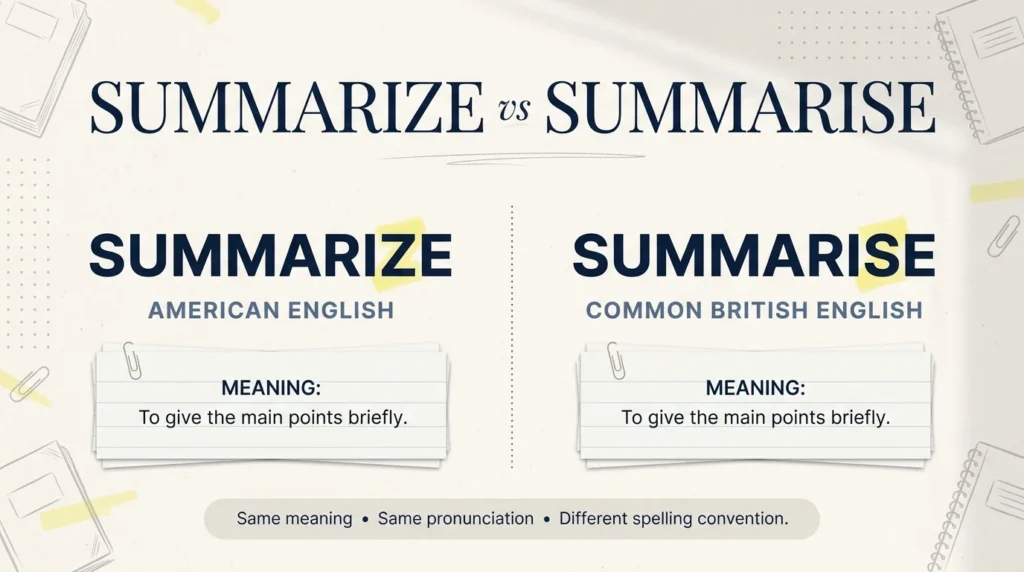

Summarize and summarise are both correct spellings of the same verb. They mean “to give the main points of something briefly.” Summarize is the standard spelling in American English, while summarise is the common spelling in many forms of British English. Some British style systems, including Oxford style, use -ize spellings. The important rule is to choose the spelling that matches your English variety or style guide and use it consistently.
What Is the Difference Between Summarize and Summarise?
Summarize and summarise are two spellings of the same verb.
Both mean to present the most important facts, ideas, or points of something in a shorter and clearer form. The difference is primarily spelling, not meaning.
For example:
- American English: Please summarize the report.
- Common British English: Please summarise the report.
Both sentences ask someone to give the main points of the report.
The pronunciation is also essentially the same. The spelling changes, but the meaning and grammatical function do not.
Dictionaries identify summarise as a British form of summarize, while summarize is used in American English and also occurs in British English.
Why It Matters
This spelling difference rarely causes misunderstanding, but it can matter when you are writing for a specific audience.
A student writing for a British school may normally be expected to use summarise. An American student would normally write summarize.
The same issue appears in:
- Academic papers
- Business reports
- Emails
- CVs and résumés
- Websites
- News articles
- Educational materials
- Company style guides
- International communications
The main problem is usually inconsistency, not comprehension.
For example, a document that repeatedly uses British spelling may look inconsistent if it suddenly changes from summarise to summarize without a reason.
That does not automatically make the sentence grammatically wrong. It simply means the writer may be mixing spelling conventions.
Read More: Cancellation vs Cancelation: Which Spelling Is Correct?
The Core Rule
Use “summarize” in standard American English and “summarise” in common British English. If your British style guide uses -ize spellings, “summarize” may also be appropriate. Most importantly, follow one style consistently.
There is no difference in meaning between the two forms.
| Form | Main use | Meaning |
|---|---|---|
| summarize | American English; also some British styles | Give the main points briefly |
| summarise | Common British English | Give the main points briefly |
The spelling -ise is common in British usage, while -ize is standard in American English. Oxford-style English is an important exception to the simple “British = -ise” rule because Oxford uses many -ize spellings.
How to Use Summarize
Use summarize when your chosen English variety or style calls for the -ize spelling.
In American English
Please summarize the article in three paragraphs.
The final section summarizes the study’s findings.
Can you summarize what happened during the meeting?
American English consistently uses summarize, summarizes, summarized, and summarizing.
In academic writing
The conclusion summarizes the main arguments presented in the paper.
Here, summarizes is the third-person singular form of summarize.
In professional writing
I will summarize the key decisions in an email.
The verb works naturally with objects such as:
- summarize a report
- summarize an article
- summarize a meeting
- summarize the findings
- summarize the evidence
- summarize an argument
- summarize the results
- summarize a discussion
How to Use Summarise
Use summarise when following a British English style that prefers -ise spellings.
In British English
Please summarise the article in three paragraphs.
The final section summarises the study’s findings.
Can you summarise what happened during the meeting?
The corresponding forms are:
- summarise
- summarises
- summarised
- summarising
The meaning remains exactly the same.
In British-style professional writing
I will summarise the key decisions in an email.
In education
Students should summarise the passage in their own words.
The spelling does not change the task. The student is still being asked to identify and express the main points.
Correct Examples
Here are original examples showing how the word works in different situations.
- Conversation:
“Can you summarize what the doctor explained?” - Email:
“I have summarized the main points below for everyone.” - School:
“Please summarise the chapter before tomorrow’s class.” - Workplace:
“Maria summarized the meeting before the team left.” - Academic writing:
“The final paragraph summarises the central argument.” - Social media:
“Can someone summarize the article in two sentences?” - Presentation:
“Let me summarize the three decisions we made today.” - Business report:
“This section summarizes the quarterly sales results.” - News writing:
“The final paragraph summarises the main developments.” - Text message:
“Can you summarise the movie for me?” - Research:
“The table summarizes the results of the experiment.” - Work email:
“To summarize, we need approval before Friday.”
The correct spelling depends on the style being followed. The underlying verb remains the same.
Incorrect vs. Correct
The important thing is to distinguish a genuine spelling or grammar error from a form that is simply associated with another English variety.
| ❌ Incorrect | ✅ Correct | Why |
|---|---|---|
| Please summary the report. | Please summarize the report. | Summary is normally a noun; summarize is the verb. |
| Please summarise the report. (in American style) | Please summarize the report. | American English uses the -ize spelling. |
| Please summarize the report. (in a British -ise house style) | Please summarise the report. | A consistent British -ise style would normally use summarise. |
| She summarize the findings. | She summarizes the findings. | A third-person singular present-tense verb takes -s. |
| They summarises the article. | They summarize the article. | “They” takes the base form summarize in American English. |
| He summarizing the report. | He is summarizing the report. | The present progressive needs the auxiliary verb is. |
| We have summarise the results. | We have summarized the results. | A perfect construction requires the past participle. |
| She summarised the report. (in American style) | She summarized the report. | American spelling uses -ized. |
| The student wrote a summarize. | The student wrote a summary. | The noun for the shortened account is summary. |
| Can you summary this chapter? | Can you summarize this chapter? | The action requires the verb summarize. |
| The report is summarise in one paragraph. | The report is summarised in one paragraph. | A passive construction requires a past participle. |
| The report is summarize in one paragraph. (British -ise style) | The report is summarised in one paragraph. | The participle should match the chosen spelling system. |
One important point: summarise is not inherently an incorrect spelling of summarize. Likewise, summarize is not automatically an American-only error when it appears in British writing. Style conventions differ.
Why People Make This Mistake
Phonetic similarity
The two words sound essentially the same. When people hear the word, they cannot normally tell whether it should be written with s or z.
That means pronunciation cannot solve the spelling problem.
Spelling overlap
English contains many pairs such as:
- organise / organize
- recognise / recognize
- realise / realize
- summarise / summarize
This creates a broader pattern that learners have to understand.
Overgeneralisation
A learner may remember:
“British English always uses -ise.”
That is too simple.
British English contains different spelling conventions, and Oxford-style English uses many -ize forms. Oxford’s own materials explain that both -ize and -ise can occur in British English for many verbs, while some words have fixed spellings.
Read More: Spicey vs Spicy: Correct Spelling & Usage.
Autocomplete and spellcheck
A word processor configured for American English may suggest summarize.
A British English setting may prefer summarise.
That does not necessarily mean one form is universally right and the other universally wrong. Your software is often following the language setting you selected.
Translation interference
Learners may encounter one spelling in textbooks and another on international websites.
Because both forms are valid, it can appear that different sources disagree. Often, they are simply following different regional conventions.
Common Mistakes Checklist
Mistake 1: Thinking summarise is misspelled
Why it happens: American English is often the variety learners encounter online.
How to avoid it: Remember that summarise is a standard spelling in common British English.
Mistake 2: Thinking summarize is always American and therefore wrong in Britain
Why it happens: Many simplified grammar explanations teach “American -ize, British -ise” without explaining British style variation.
How to avoid it: Check the style guide being followed. Oxford-style English uses many -ize spellings.
Mistake 3: Changing spelling halfway through a document
Why it happens: Writers copy material from different sources.
How to avoid it: Choose your regional or institutional style before editing the document.
Mistake 4: Confusing summary with summarize
Why it happens: The words are closely related.
How to avoid it: Remember:
- summary = noun
- summarize/summarise = verb
Mistake 5: Assuming the spelling changes the pronunciation
Why it happens: The visual difference is noticeable.
How to avoid it: Both spellings represent essentially the same pronunciation.
Summarize vs Summarise in Real English
Grammatically correct and natural
Both summarize and summarise are natural English when they match the spelling convention being used. An American reader will naturally encounter “summarize,” while readers accustomed to common British spelling will naturally encounter “summarise.” Neither form changes the meaning or grammatical role of the verb. The choice is primarily a matter of regional or house style.
Grammatically possible but potentially inconsistent
A British writer can encounter or use summarize, particularly when following an Oxford-style or another house style that permits or prefers -ize spellings. Likewise, summarise may appear in material intended for British readers. The issue is therefore not simple grammatical correctness. The potential problem is inconsistency within a document or conflict with a required style guide.
Natural everyday English
In everyday American English, summarize sounds completely ordinary: “Can you summarize this for me?” In common British English, summarise fills the same role: “Can you summarise this for me?” A speaker would not normally choose one because it has a different meaning. The spelling becomes visible mainly when the word is written, edited, published, or checked by software.
American vs. British English
There is a genuine regional spelling distinction, but it is more nuanced than simply saying “American English uses z and British English uses s.”
American English
Summarize is the normal spelling.
Examples:
- summarize
- summarizes
- summarized
- summarizing
- summarization
Common British English
Summarise is common in British English.
Examples:
- summarise
- summarises
- summarised
- summarising
- summarisation
The Oxford-style exception
Some British publishers and institutions use -ize spellings. Oxford’s spelling system is a well-known example.
That means a British publication may use:
summarize
rather than:
summarise
This is why saying “summarize is American and always wrong in British English” is too broad.
The University of Oxford’s own general style guide, however, uses -ise as its preferred institutional spelling, while Oxford University Press uses an -ize convention in its dictionaries and publications.
The practical rule
If you are writing for a specific organization, follow its style guide.
If there is no style guide:
- Use summarize for American English.
- Use summarise for common British English.
- Use summarize if your chosen British/Oxford-style convention calls for -ize.
- Do not switch between conventions without a reason.
Formal vs. Informal Usage
The difference between summarize and summarise is not primarily one of formality.
Both can be used in:
- Formal reports
- Academic writing
- Business emails
- Conversations
- Presentations
- Informal messages
- Educational writing
For example:
Formal:
“The final section summarizes the principal findings.”
Informal:
“Can you summarize the story for me?”
The same distinction applies to summarise in a British spelling system.
What matters more is the English variety and consistency, not whether the situation is formal or informal.
Comparison Table
| Feature | Summarize | Summarise |
|---|---|---|
| Word class | Verb | Verb |
| Meaning | Give the main points briefly | Give the main points briefly |
| Pronunciation | Essentially the same | Essentially the same |
| American English | Standard spelling | Not the usual spelling |
| Common British English | Used in some styles | Common spelling |
| Oxford-style English | Preferred/accepted | Alternative form |
| Past tense | summarized | summarised |
| Present participle | summarizing | summarising |
| Third-person singular | summarizes | summarises |
| Noun related to the process | summarization | summarisation |
| Meaning difference | None | None |
| Main issue | Style consistency | Style consistency |
Dictionary evidence confirms that summarise is a British form of summarize, while both forms represent the same verb.
Summarize vs Summarise vs Summary
These three forms are related but do different grammatical jobs.
Summarize
Verb in the common American spelling.
I need to summarize the article.
Summarise
Verb in the common British spelling.
I need to summarise the article.
Summary
Noun.
I need to write a summary of the article.
This distinction is much more important than the s/z difference because using summary as a verb creates an actual grammatical error.
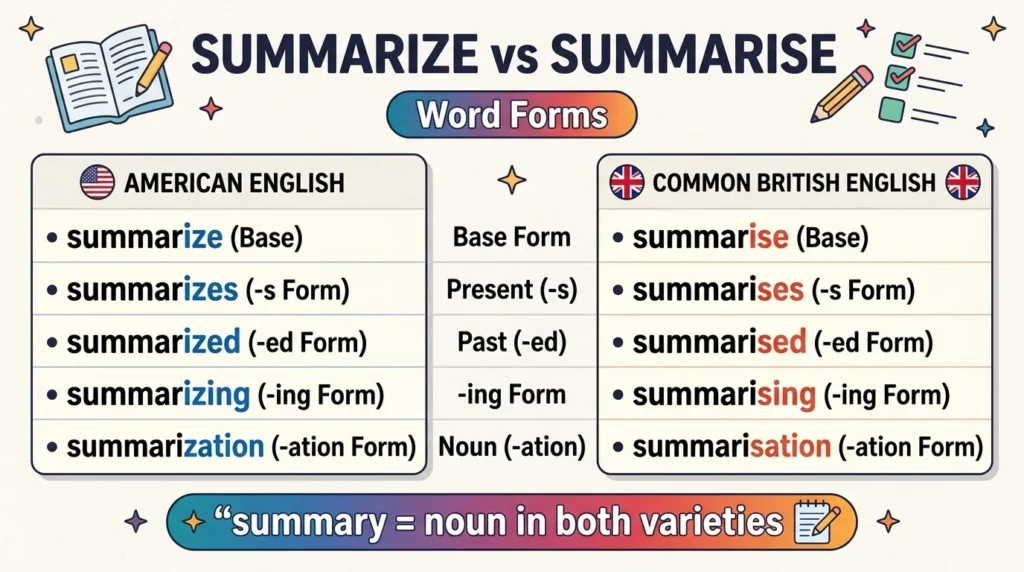
Word Forms You Should Know
| Function | American English | Common British English |
|---|---|---|
| Base verb | summarize | summarise |
| Third-person singular | summarizes | summarises |
| Past tense | summarized | summarised |
| Past participle | summarized | summarised |
| Present participle | summarizing | summarising |
| Noun: condensed account | summary | summary |
| Process noun | summarization | summarisation |
| Person noun | summarizer | summariser |
The underlying grammatical pattern stays the same. Only the regional spelling changes in the -ize/-ise forms.
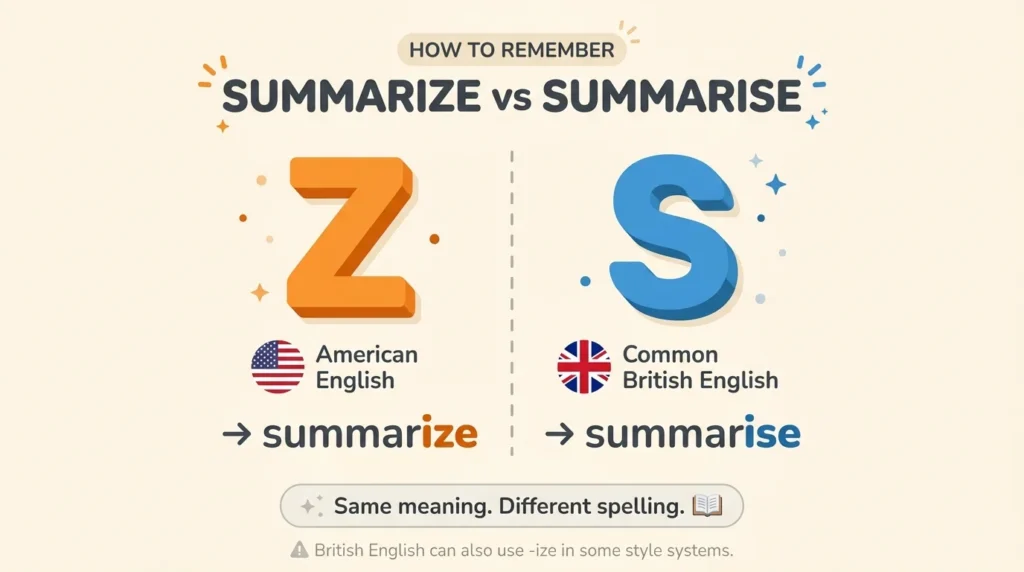
Memory Trick
Think:
Z = American “summarize”
S = common British “summarise”
A simple sentence can make the difference easier to remember:
US: Please summarize this report.
UK: Please summarise this report.
Then remember one more rule:
Same meaning. Different spelling convention.
Do not turn this memory trick into a universal rule that every British word must end in -ise. British spelling contains exceptions and different style systems.
Real-Life Situations
Job interview
An interviewer may ask:
“Can you summarize your previous experience?”
In American English, summarize is expected.
In common British English:
“Can you summarise your previous experience?”
Both mean the same thing.
Business meeting
A manager might say:
“Before we finish, I’ll summarize the decisions.”
A British-style document might write:
“Before we finish, I’ll summarise the decisions.”
Academic assignment
An American assignment might say:
“Summarize the author’s main argument.”
A British assignment might say:
“Summarise the author’s main argument.”
The task is identical.
American:
“To summarize, we have agreed on the new deadline.”
British:
“To summarise, we have agreed on the new deadline.”
Text message
American:
“Can you summarize the video?”
British:
“Can you summarise the video?”
The informal setting does not determine the spelling. The chosen English variety does.
Expert Tips
1. Choose the audience before choosing the spelling
Ask:
Who will read this?
If the document is for a US audience, summarize is the straightforward choice.
If it is for a British audience using conventional -ise spelling, summarise is usually the natural choice.
2. Follow the organization’s style guide
Large organizations may have their own spelling rules.
Do not change spelling simply because another dictionary uses a different convention.
3. Keep related forms consistent
If you write:
summarize
then check nearby forms such as:
summarizes
summarized
summarizing
summarization
A British -ise system would normally produce:
summarise
summarises
summarised
summarising
summarisation
4. Do not confuse spelling with grammar
A difference in s and z does not mean the sentence has a different grammatical meaning.
5. Do not rely blindly on spellcheck
If your spellchecker marks summarise as unusual, check the selected language.
You may have your software set to American English.
6. Watch for copied text
If you combine text from different writers, you may accidentally create a mixture of spelling systems.
An editorial pass can catch this.
7. Remember that British English is not one single spelling system
This is the point many short explanations miss.
Common British usage often prefers -ise, but Oxford-style English uses many -ize forms.
Quick Summary
Summarize and summarise are both correct spellings of the same verb. They mean to express the main points of something clearly and briefly. Summarize is the standard spelling in American English, while summarise is common in British English. Some British and international style systems, particularly Oxford-style systems, use -ize spellings. Neither form has a different meaning, pronunciation, or grammatical function. The main rule is to choose the spelling that fits your audience or style guide and use it consistently. Also remember that summary is a noun, while summarize and summarise are verbs. In short: same meaning, different spelling convention.
FAQ
Is summarize or summarise correct?
Both are correct. Summarize is the standard American English spelling, while summarise is common in British English. Some British style systems also use summarize.
Is summarize American or British English?
Summarize is the standard spelling in American English. It is also used in British English under some spelling conventions, including Oxford-style usage.
Is summarise British English?
Yes. Summarise is a common British English spelling of the verb. It has the same meaning as summarize.
Does summarize mean something different from summarise?
No. They have the same meaning: to give the main points of something briefly and clearly.
Do summarize and summarise sound different?
No meaningful pronunciation difference is intended. The distinction is mainly visible in writing.
Should I use summarize or summarise in academic writing?
Use the form required by your university, publisher, instructor, or style guide. If no specific style is required, match the English variety you are using and remain consistent.
Is summarise wrong in American English?
It is not the normal American spelling. American English generally uses summarize.
Is summarize wrong in British English?
No. Summarize can be used in British English, especially in style systems that prefer -ize spellings. Common British usage often prefers summarise.
What is the past tense of summarize?
The past tense is summarized.
She summarized the report.
The British -ise form is summarised.
She summarised the report.
What is the difference between summary and summarize?
Summary is a noun referring to a shortened account of something.
Summarize is a verb meaning to produce or give that shortened account.
I read the summary.
I will summarize the article.
Should I write summarization or summarisation?
Both forms exist. Summarization follows the -ize spelling, while summarisation follows the -ise spelling. Choose according to the spelling convention used in the rest of your writing.
Mini Quiz
| # | Question | Answer | Explanation |
|---|---|---|---|
| 1 | Choose the American spelling: “Please ___ the article.” A) summarise B) summarize | B) summarize | American English normally uses -ize. |
| 2 | Choose the common British spelling: “Please ___ the report.” A) summarize B) summarise | B) summarise | Summarise is common in British English. |
| 3 | Correct the sentence: “Can you summary the report?” | Can you summarize the report? | Summary is a noun; the action requires the verb summarize or summarise. |
| 4 | Fill in the blank: “She ___ the findings yesterday.” American English. | summarized | The American past-tense form is summarized. |
| 5 | Fill in the blank: “She ___ the findings yesterday.” British -ise style. | summarised | The corresponding British -ise form is summarised. |
| 6 | True or false: “Summarize and summarise have different meanings.” | False | They are spelling variants of the same verb. |
| 7 | Correct the sentence: “He summarize the results every Friday.” | He summarizes the results every Friday. | “He” requires the third-person singular form. |
| 8 | Which is the noun? A) summarize B) summary C) summarising | B) summary | Summary names the condensed account. |
| 9 | Which sentence is correct in American English? A) “They summarises the meeting.” B) “They summarize the meeting.” | B) They summarize the meeting. | “They” takes the base verb summarize. |
| 10 | Which sentence is correct in common British -ise spelling? A) “The report summarises the evidence.” B) “The report summariz the evidence.” | A) The report summarises the evidence. | The third-person singular form is summarises in this spelling system. |