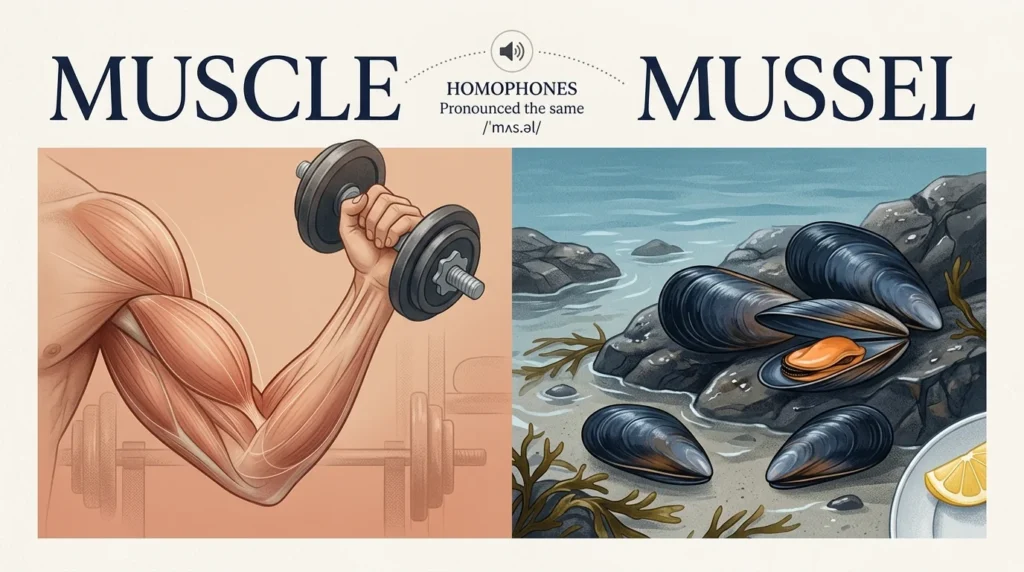

Muscle and mussel sound the same, but they have completely different meanings. Muscle usually refers to body tissue that helps produce movement, and it can also mean physical strength or power. Mussel refers to a type of bivalve shellfish that lives in freshwater or saltwater and is often eaten as seafood. Because the two words are homophones, you must use context to choose the correct spelling.
What Is the Difference Between Muscle and Mussel?
The simplest difference is this:
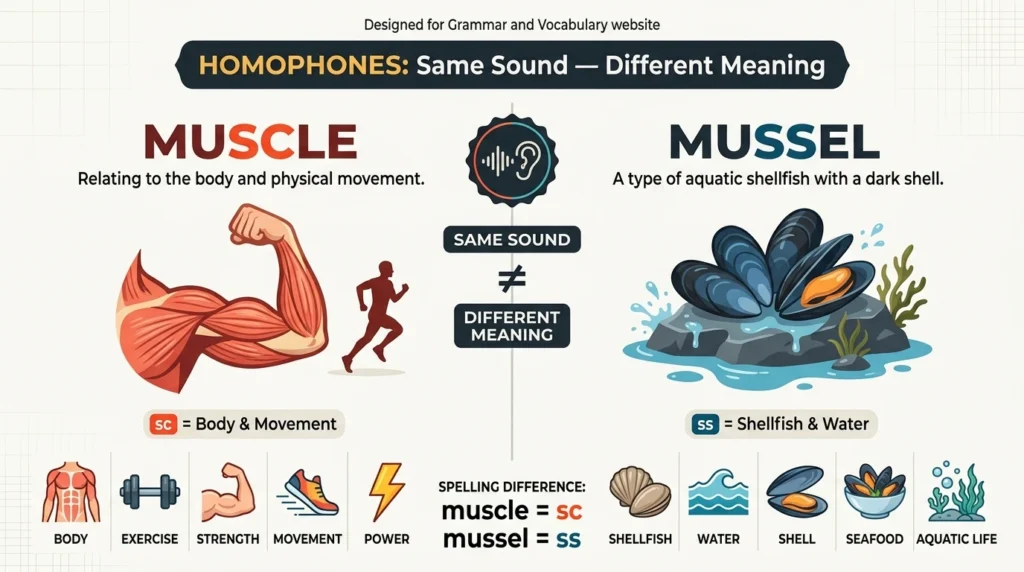
- Muscle = body tissue, strength, or power.
- Mussel = an aquatic shellfish.
- Muscle and mussel are pronounced the same in standard English.
- Muscle can be a noun or a verb.
- Mussel is normally a noun.
The confusion comes from pronunciation. When someone says muscle or mussel, you cannot normally tell which spelling they mean just by hearing the word.
For example:
She injured a muscle while exercising.
But:
We ordered steamed mussels for dinner.
The first sentence is about the human body. The second is about seafood.
The spelling therefore depends on meaning and context, not pronunciation.
What Does Muscle Mean?
Muscle is a noun referring to body tissue that can contract and relax to produce movement. Humans and other animals have muscles that help with movement, posture, stability, and other body functions.
For example:
- He pulled a muscle in his leg.
- Regular exercise can strengthen your muscles.
- The heart is made of cardiac muscle.
- Her shoulder muscles were sore after training.
The word also has broader meanings.
Muscle can describe physical strength:
The athlete has enough muscle to lift the heavy weight.
It can also mean power, influence, or force, especially in informal or figurative language:
The company used its financial muscle to expand into new markets.
In addition, muscle can be used as a verb. To muscle something means to move or force it using physical strength, while muscle in means to force your way into a situation or become involved where you are not wanted.
So muscle is not limited to anatomy.
What Does Mussel Mean?
A mussel is a type of bivalve mollusk. It is an aquatic animal with a two-part shell and can live in marine or freshwater environments.
Mussels are also commonly eaten as seafood.
For example:
- We ordered fresh mussels with garlic sauce.
- The rocks were covered with mussels.
- The researcher studied freshwater mussels.
- The restaurant serves steamed mussels.
The word mussel therefore belongs to contexts involving shellfish, aquatic life, seafood, marine environments, or freshwater ecosystems.
If you are talking about something with a shell that lives in water, mussel is usually the word you need.
The Core Rule
Use muscle for the body, strength, movement, or power. Use mussel for the shellfish.
A quick context test can make the choice easy:
- Is the sentence about your body, exercise, strength, or physical power? → muscle
- Is it about a shellfish, seafood, water, or an aquatic animal? → mussel
For example:
He strained a muscle while running.
The subject is an injury to the body, so muscle is correct.
The chef prepared fresh mussels.
The subject is seafood, so mussels is correct.
How to Use Muscle
Use muscle when the sentence refers to physical tissue, strength, movement, or power.
Muscle as a body part
This is the most common meaning.
She injured a muscle in her back.
His leg muscles became stronger after months of training.
The doctor examined the damaged muscle.
Muscle as physical strength
The word can also refer generally to muscular strength.
He has built a lot of muscle through weight training.
The boxer has impressive muscle and endurance.
Muscle as power or influence
In informal and figurative English, muscle can mean power or influence.
The company has enough financial muscle to compete internationally.
The organization used its political muscle to influence the negotiations.
This meaning has nothing to do with seafood. The spelling is still muscle.
Muscle as a verb
Muscle can also function as a verb.
He muscled the box through the narrow doorway.
The meaning is roughly “moved or forced something using physical strength.”
Another common expression is muscle in:
He tried to muscle in on their conversation.
This is an informal expression meaning to force yourself into a situation or activity.
How to Use Mussel
Use mussel when referring to the aquatic shellfish.
Singular
Use mussel when talking about one animal.
I found a mussel attached to the rock.
Plural
The plural is mussels.
The fisherman collected several mussels.
We ordered grilled mussels.
Do not write muscles when you mean shellfish.
Compare:
The athlete strengthened his muscles.
The restaurant served fresh mussels.
The difference between -cles and -sels changes the meaning completely.
Correct Examples of Muscle and Mussel
Here are examples from different real-life situations.
Conversation
I think I pulled a muscle while playing football.
This is about a sports injury.
I will be working from home today because I strained a muscle in my back.
The word refers to body tissue.
School
Skeletal muscles help the body move.
This is a biology context, so muscles is correct.
Workplace
The company has enough financial muscle to enter the international market.
Here, muscle means financial power.
Restaurant
We ordered steamed mussels with lemon and garlic.
The sentence is about seafood.
Social media
After six months at the gym, I’m finally building some muscle.
The meaning is physical strength and body tissue.
Academic writing
Skeletal muscles contract to produce movement.
This is a scientific use of muscles.
Travel
We saw thousands of mussels attached to the rocks along the coast.
The sentence describes aquatic animals.
Cooking
Add the cleaned mussels to the pan and cover it.
The word refers to shellfish.
Business
The company has considerable financial muscle in the region.
Here, muscle means power or influence.
Read More: Imbed vs Embed: Which Spelling Is Correct?
Incorrect vs. Correct
| ❌ Incorrect | ✅ Correct | Why |
|---|---|---|
| I pulled a mussel in my leg. | I pulled a muscle in my leg. | A leg contains muscles, not mussels. |
| He wants to build more mussel. | He wants to build more muscle. | The sentence refers to physical tissue. |
| We ordered grilled muscles. | We ordered grilled mussels. | The restaurant is serving shellfish. |
| The chef cleaned the muscles before cooking. | The chef cleaned the mussels before cooking. | Shellfish are mussels. |
| Exercise helps strengthen your mussels. | Exercise helps strengthen your muscles. | Exercise strengthens body muscles. |
| The rocks were covered with muscles. | The rocks were covered with mussels. | The sentence describes shellfish attached to rocks. |
| She strained a mussel during the workout. | She strained a muscle during the workout. | A muscle can be strained; a mussel cannot. |
| The restaurant specializes in fresh muscles. | The restaurant specializes in fresh mussels. | The context is seafood. |
| He showed his new mussels at the gym. | He showed his new muscles at the gym. | The sentence is about physical development. |
| The biologist studied marine muscles. | The biologist studied marine mussels. | The intended subject is aquatic shellfish. |
The important point is that these are not simply spelling variations. They identify different things.
Why Do People Confuse Muscle and Mussel?
There are several reasons these words cause problems.
They sound the same
Muscle and mussel are homophones. A homophone is a word that has the same pronunciation as another word but a different spelling and meaning.
Both are generally pronounced /ˈmʌsəl/ in standard English.
That means pronunciation gives you almost no help when you are writing.
The spellings are very similar
The words differ mainly in the middle:
- muscle
- mussel
The c in muscle is not pronounced as a separate /k/ sound. That makes the spelling particularly easy to forget.
Spellcheck may not catch the mistake
This is an important problem with homophones.
If you write:
I injured a mussel in my shoulder.
A basic spellchecker may not flag mussel because mussel is a correctly spelled English word.
The problem is not spelling validity. The problem is meaning.
That is why grammar and spelling tools cannot always replace careful proofreading.
People spell from sound
A learner may hear /ˈmʌsəl/ and try to reproduce the spelling from pronunciation.
That approach fails because English spelling often preserves historical forms that are not obvious from modern pronunciation.
Translation can interfere
Learners who translate directly from another language may choose the word associated with a familiar sound rather than checking the English meaning.
A better habit is to identify the concept first:
body → muscle
shellfish → mussel
Common Mistakes Checklist
Mistake 1: Writing “mussel” for an injury
❌ I pulled a mussel.
If you mean body tissue, use:
✅ I pulled a muscle.
Mistake 2: Writing “muscles” for seafood
❌ We had muscles for dinner.
If you mean shellfish, use:
✅ We had mussels for dinner.
Mistake 3: Assuming spellcheck will solve it
Both words are correctly spelled, so software may not know which one you intended.
Avoid it: Read the whole sentence and ask what the word means.
Mistake 4: Forgetting the plural difference
Muscle → muscles
Mussel → mussels
The extra s in the singular spelling of mussel remains part of the word when you make it plural.
Mistake 5: Treating “muscle” as only an anatomy word
Remember that muscle can also mean power or influence.
The company has considerable financial muscle.
The spelling does not change.
Muscle vs Mussel in Real English
Muscle
In everyday English, muscle is completely natural when people talk about the body, exercise, injuries, strength, or physical development. It also appears naturally in figurative expressions involving power or influence. Phrases such as build muscle, pull a muscle, muscle strength, and muscle power are ordinary English expressions.
Mussel
Mussel is natural when talking about shellfish, seafood, marine environments, freshwater habitats, or cooking. It commonly appears in phrases such as fresh mussels, mussel shell, steamed mussels, and freshwater mussels. The word is a normal noun rather than a grammatical alternative to muscle.
Grammatically possible but semantically wrong
A sentence can be grammatically structured correctly while still using the wrong word.
For example:
I injured a mussel.
The sentence follows normal English grammar, but if the intended meaning is a body injury, the vocabulary is wrong. The issue is therefore not grammar alone. It is word choice and meaning.
Similarly:
We ordered grilled muscles.
The sentence is grammatically fine, but if the restaurant is serving shellfish, mussels is the appropriate word.
This is why proofreading homophones requires more than checking whether every word is spelled correctly.
American vs. British English
There is no important American-versus-British spelling distinction between muscle and mussel for this issue.
Both varieties use:
- muscle for body tissue, strength, or power
- mussel for the shellfish
The words are also pronounced alike in standard English varieties. Dictionary sources identify them as homophones.
The main challenge is therefore not regional spelling. It is choosing the correct word according to meaning.
Formal vs. Informal Usage
Both muscle and mussel are standard English words and can appear in formal writing.
For example:
The study examined skeletal muscle function.
This is appropriate in academic or scientific writing.
The researchers examined freshwater mussels.
This is also appropriate in academic writing.
However, some figurative uses of muscle are more informal.
For example:
He tried to muscle in on the deal.
Muscle in is an informal expression meaning to force yourself into a situation.
In formal writing, you might instead say:
He tried to involve himself in the negotiations without being invited.
The noun muscle itself is not informal; the register depends on the particular expression.
Muscle vs Mussel: Comparison Table
| Feature | Muscle | Mussel |
|---|---|---|
| Main meaning | Body tissue or physical/political power | Aquatic bivalve shellfish |
| Part of speech | Noun and verb | Noun |
| Pronunciation | /ˈmʌsəl/ | /ˈmʌsəl/ |
| Homophone | Yes | Yes |
| Related to anatomy | Yes | No |
| Related to exercise | Yes | No |
| Related to seafood | No | Yes |
| Can refer to strength | Yes | No |
| Can refer to an aquatic animal | No | Yes |
| Singular | muscle | mussel |
| Plural | muscles | mussels |
| Example | She strained a muscle. | We cooked mussels. |
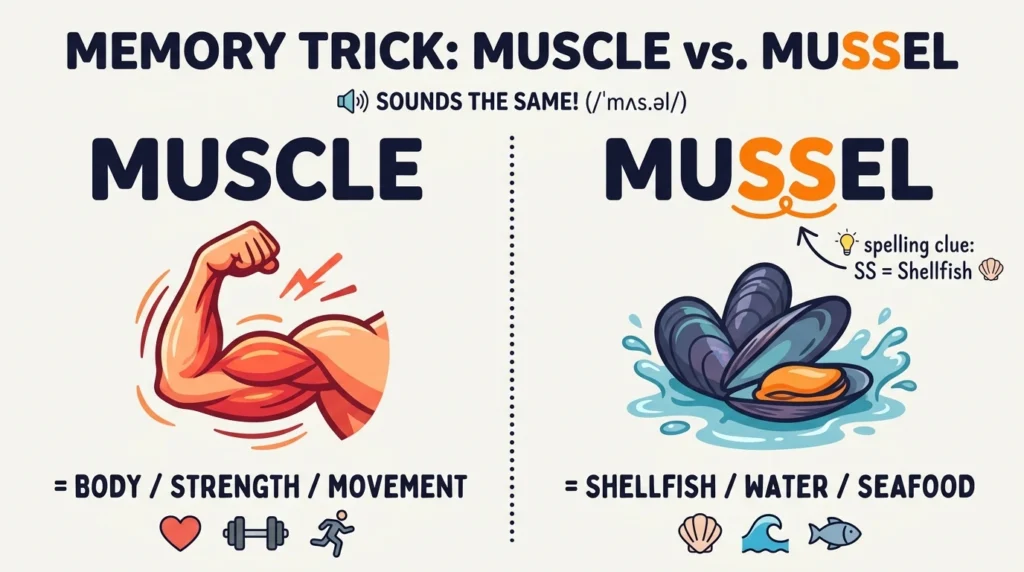
Muscle vs Mussel: The Easiest Memory Trick
Think:
Muscle = Movement
Both muscle and movement begin with the idea of the body moving.
For mussel, think:
Mussel = Marine meal
A mussel can be associated with water and seafood.
Another useful visual clue is the double s:
muSSel → Shellfish
The double s can remind you of a shellfish.
Do not depend on the mnemonic alone, though. The safest method is always to check the meaning of the sentence.
Real-Life Situations
At the gym
“My trainer said I need to build more muscle.”
The topic is physical development.
At a seafood restaurant
“Let’s order the garlic mussels.”
The topic is shellfish.
At a doctor’s office
“I think I strained a muscle in my shoulder.”
The topic is an injury.
In a business meeting
“The company has enough financial muscle to expand.”
The word means financial power or influence.
In a school exam
“Skeletal muscles are responsible for voluntary movement.”
The topic is anatomy.
In a cooking message
“Don’t forget to clean the mussels before cooking.”
The topic is seafood.
In an environmental report
“The researchers monitored freshwater mussels in the river.”
The topic is aquatic wildlife.
In casual conversation
“I can barely walk because my leg muscles are so sore.”
The topic is the body.
How to Decide Between Muscle and Mussel
When you are unsure, use this three-step method:
- Identify the subject. Is the sentence about the body or about shellfish?
- Ignore the pronunciation. Both words sound alike, so sound cannot reliably distinguish them.
- Check the meaning. Body, strength, or power = muscle. Shellfish or aquatic life = mussel.
For example:
She ordered ___ at the restaurant.
The restaurant context suggests food. If the food is shellfish, the answer is mussels.
Now consider:
She injured a ___ during the race.
The race and injury context point to body tissue, so the answer is muscle.
Context solves the problem.
Read More: Licence vs License: British and American English.
Expert Tips
Do not proofread homophones by spelling alone
A correctly spelled word can still be the wrong word.
That is exactly what happens with muscle and mussel.
Look for nearby context clues
Words such as gym, exercise, injury, strength, body, leg, arm, training strongly suggest muscle.
Words such as seafood, shell, restaurant, ocean, river, cooking, marine strongly suggest mussel.
Remember that muscle has figurative meanings
If the sentence discusses influence or power, do not switch to mussel simply because there is no literal body part.
The company has political muscle.
That is correct.
Watch the plural forms
The two plurals are:
- muscles = body tissue or physical/figurative strength
- mussels = shellfish
This is especially important in restaurant, biology, and fitness writing.
Read the sentence for meaning, not sound
When editing, ask:
“What thing am I actually talking about?”
That question is more reliable than asking:
“Which spelling sounds right?”
Frequently Asked Questions
Are muscle and mussel pronounced the same?
Yes. In standard English, muscle and mussel are homophones and are generally pronounced /ˈmʌsəl/.
Is “muscle” the correct spelling for the body?
Yes. Use muscle when referring to body tissue, muscular strength, or related physical functions.
He injured a muscle in his arm.
Is “mussel” the correct spelling for seafood?
Yes. Mussel refers to the aquatic shellfish. Its plural is mussels.
We ordered steamed mussels.
What is the plural of muscle?
The plural of muscle is muscles.
His leg muscles were tired after the race.
What is the plural of mussel?
The plural of mussel is mussels.
The restaurant serves fresh mussels.
Can muscle be used as a verb?
Yes. Muscle can be a verb meaning to move, force, or push something using physical strength. It also appears in the informal phrasal verb muscle in.
Can mussel be used as a verb?
In ordinary modern English, mussel is used primarily as a noun for the shellfish. It is not the normal verb counterpart of muscle.
Read More: Licence vs License: British and American English.
Why does muscle have a silent c?
English spelling preserves historical features that do not always match modern pronunciation. The c in muscle is not pronounced as a separate consonant sound.
Are muscle and mussel related words?
Interestingly, yes. Their histories are connected. Dictionary etymologies trace muscle and mussel through historical forms ultimately connected with Latin musculus, meaning “little mouse.” The words developed into their modern forms through different historical paths, but their similarity is not simply a modern coincidence.
Is “muscel” a correct spelling?
No. Muscel is not the standard spelling of either word. Use muscle for body tissue or strength and mussel for the shellfish.
Mini Quiz
| # | Question | Answer | Explanation |
|---|---|---|---|
| 1 | She injured a ___ while lifting weights. A) muscle B) mussel | A) muscle | Weightlifting involves the body’s muscles. |
| 2 | We ordered steamed ___ for dinner. A) muscles B) mussels | B) mussels | The sentence refers to seafood. |
| 3 | The athlete has developed strong leg ___. A) mussels B) muscles | B) muscles | Leg muscles are body tissue. |
| 4 | Correct the sentence: “I pulled a mussel in my back.” | I pulled a muscle in my back. | A back injury can involve a muscle, not a mussel. |
| 5 | The rocks were covered with ___. A) muscles B) mussels | B) mussels | Mussels are aquatic shellfish that can attach to surfaces. |
| 6 | The company has considerable financial ___. A) mussel B) muscle | B) muscle | Here, muscle means power or influence. |
| 7 | Choose the correct sentence: A) We cooked fresh muscles. B) We cooked fresh mussels. | B) We cooked fresh mussels. | Mussels are edible shellfish. |
| 8 | Correct the sentence: “Exercise can strengthen your mussels.” | Exercise can strengthen your muscles. | The sentence is about body tissue. |
| 9 | Which word can also be used as a verb? A) muscle B) mussel | A) muscle | Muscle can be used as a verb meaning to force or move using strength. |
| 10 | Complete the sentence: “The biologist studied freshwater ___.” | mussels | Freshwater mussels are aquatic bivalves. |
Quick Summary
Muscle and mussel are different words with different meanings, even though they sound the same. Muscle refers to body tissue involved in movement and can also mean physical strength, power, or influence. Mussel refers to an aquatic bivalve shellfish commonly found in freshwater or marine environments and often eaten as seafood. The easiest way to remember the difference is muscle = body, strength, or power and mussel = shellfish. Their pronunciation cannot help you choose the spelling, so always use the meaning and context of the sentence. Remember the plural forms too: muscles for body tissue and mussels for shellfish.