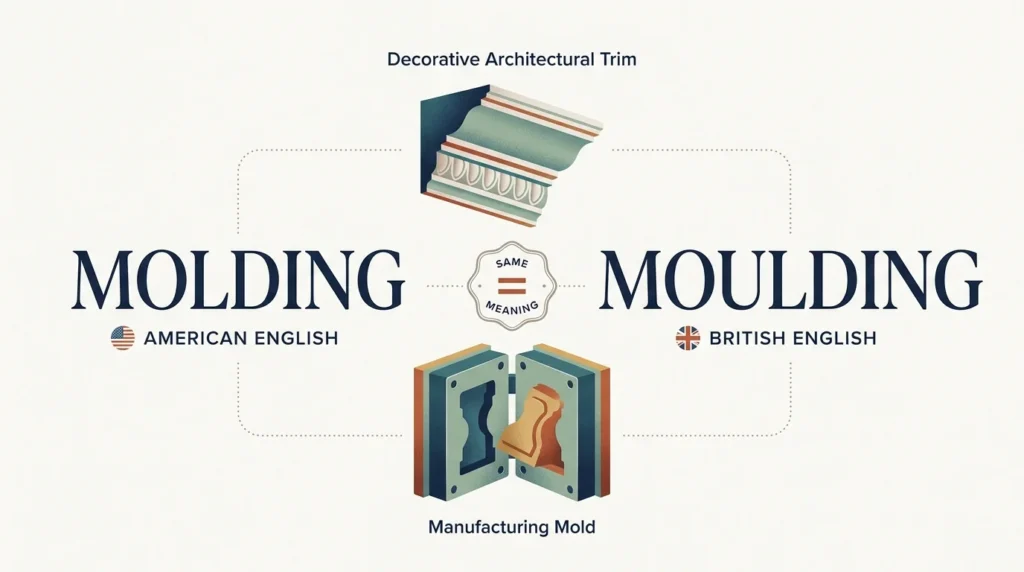

Molding is the standard spelling in American English, while moulding is the standard spelling in British English. Both words have the same basic meanings and grammatical uses. The difference comes from the spelling of the base word: American English uses mold, while British English uses mould. So you write injection molding in American English and injection moulding in British English.
What Is Molding or Moulding?
Molding and moulding are forms of the verb mold/mould and are also used as nouns.
The word can describe several related ideas:
- the process of shaping a material into a particular form
- something that has been shaped
- a decorative strip or feature used in buildings, furniture, doors, or windows
- the act of influencing how a person, idea, habit, or organization develops
For example:
The factory uses injection molding to make plastic components.
A British writer would normally write:
The factory uses injection moulding to make plastic components.
The manufacturing process being described is the same. Only the regional spelling changes. Dictionaries likewise treat molding as the American spelling of moulding.
The same pattern appears with the base words:
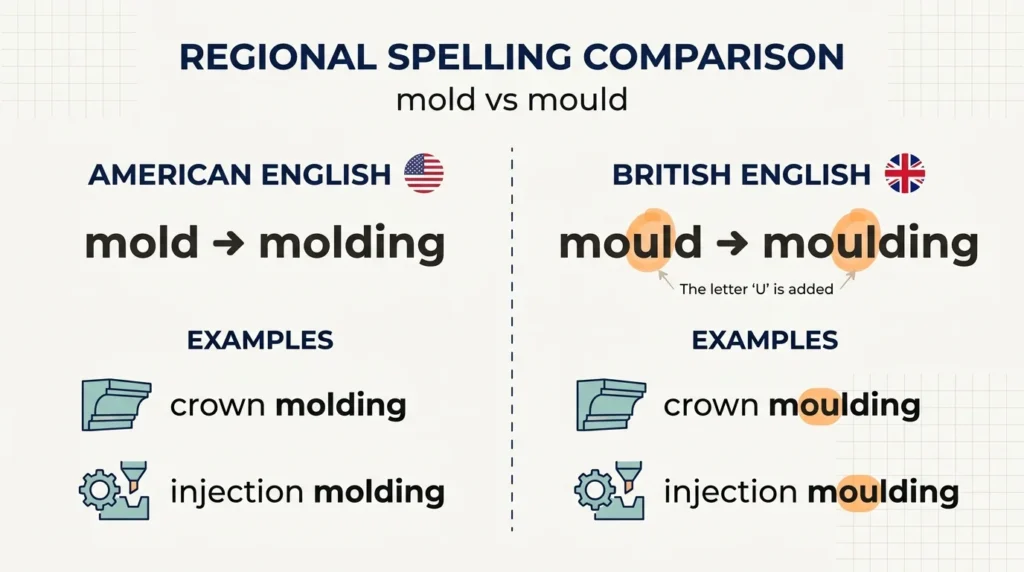
American English: mold → molding
British English: mould → moulding
So the easiest way to understand the difference is not to memorize two unrelated words. Instead, remember that they belong to two spelling systems.
Why It Matters
Choosing between molding and moulding usually does not change the meaning of your sentence. However, spelling can signal which variety of English you are following.
This matters when you are writing:
- a US-focused website
- a British publication
- technical or manufacturing documentation
- product descriptions
- construction or interior-design content
- academic or professional material
- marketing copy for a particular country
Imagine a US company consistently uses color, center, labor, and mold. Suddenly using moulding in the same document can look like an accidental spelling error.
Likewise, a British publication using colour, centre, labour, and mould would normally use moulding, not molding.
The important point is that neither spelling is inherently more correct. Consistency with the chosen English variety is what matters.
Read More: Muscle vs Mussel: Meaning, Difference & Examples.
The Core Rule
American English → molding
British English → moulding
The spelling follows the base word:
- mold → molding
- mould → moulding
This rule also carries through many related forms:
| American English | British English |
|---|---|
| mold | mould |
| molded | moulded |
| molding | moulding |
| moldable | mouldable |
| moldy | mouldy |
The exact spelling conventions can vary across English-speaking regions and individual style guides, so when writing for a specific organization, its house style should take priority.
How to Use It
Use “molding” in American English
If your document follows American English, use molding.
Examples include:
- crown molding
- decorative molding
- plastic molding
- injection molding
- molding process
- molding clay
- molding young minds
For example:
The designer chose white crown molding for the living room.
Use “moulding” in British English
If your document follows British English, use moulding.
Examples include:
- crown moulding
- decorative moulding
- plastic moulding
- injection moulding
- moulding process
- moulding clay
- moulding young minds
For example:
The designer chose white crown moulding for the living room.
Follow the spelling of the base word
If you are unsure, look at the related word mold/mould.
If your writing uses mold, use molding.
If your writing uses mould, use moulding.
This is much easier than trying to remember the two spellings independently.
Correct Examples
Here are examples from different types of writing.
Conversation
We are thinking about adding new molding around the doors.
American English:
The contractor said the molding needs to be replaced.
British English:
The contractor said the moulding needs to be replaced.
We have approved the design for the new crown molding.
British version:
We have approved the design for the new crown moulding.
Workplace
Our factory specializes in injection molding for automotive components.
British version:
Our factory specialises in injection moulding for automotive components.
School
The teacher explained how experiences can play a role in molding a person’s character.
British version:
The teacher explained how experiences can play a role in moulding a person’s character.
Academic writing
Early education can play a significant role in molding social behaviour.
A British publication may instead use:
Early education can play a significant role in moulding social behaviour.
Construction
The new molding around the windows gives the room a more finished appearance.
Interior design
The architect used decorative molding to create a traditional look.
Manufacturing
The company invested in new equipment for high-volume injection molding.
Social media
Sometimes small experiences end up molding the way we see the world.
Business communication
The company’s culture is molding the way employees approach customer service.
Incorrect vs. Correct
The following examples assume that the surrounding document follows the stated English variety.
| ❌ Incorrect or inconsistent | ✅ Correct | Why |
|---|---|---|
| The US company uses injection moulding. | The US company uses injection molding. | American English normally uses molding. |
| The British report discusses injection molding. | The British report discusses injection moulding. | British English normally uses moulding. |
| We installed crown moulding in our US-style report. | We installed crown molding in our US-style report. | Match the regional spelling throughout the document. |
| The British brochure features crown molding. | The British brochure features crown moulding. | British spelling uses mould and moulding. |
| The factory specialises in injection molding. | The factory specialises in injection moulding. | The spelling should fit the chosen variety. |
| The American article uses colour and moulding. | The American article uses color and molding. | Mixing regional spellings can make the style inconsistent. |
| The UK supplier offers plastic molding. | The UK supplier offers plastic moulding. | Use the British form in British-focused copy. |
| The US supplier offers plastic moulding. | The US supplier offers plastic molding. | Use the American form in American-focused copy. |
| The report changes from mold to moulding. | The report uses mold and molding. | Keep related forms within the same spelling convention. |
| The British text changes from mould to molding. | The British text uses mould and moulding. | Mould and moulding belong together in British spelling. |
These are not cases where one form suddenly becomes grammatically wrong. The problem is regional consistency.
Why People Make This Mistake
Phonetic similarity
Both words are generally pronounced the same within the corresponding varieties of English. The extra u in moulding is not something you can hear.
That makes pronunciation a poor way to decide which spelling to write.
Spelling overlap
English contains many American and British spelling differences, so readers regularly encounter both systems.
For example:
- color / colour
- labor / labour
- center / centre
- mold / mould
- molding / moulding
Seeing both forms online can make it difficult to remember which one belongs to which variety.
Overgeneralisation
A learner may learn that British English often uses -our where American English uses -or, then assume every regional spelling difference follows exactly the same pattern.
That is not how every spelling difference works.
For molding/moulding, the useful connection is the base word:
mold → molding
mould → moulding
Autocomplete and spellcheck
Modern writing tools may accept both forms. That does not mean they are interchangeable in every style guide or document.
A spellchecker may tell you that moulding is a valid English word while you are writing an American-English document. It may not flag the regional inconsistency because the spelling itself is legitimate.
Translation interference
Learners who work with more than one form of English may see one spelling repeatedly in textbooks, websites, software, or translated material and then encounter the other spelling elsewhere.
The solution is to identify the English variety required for the document rather than treating one form as universally correct.
Common Mistakes Checklist
Mistake 1: Thinking “moulding” is always wrong
It is not.
Moulding is a standard British English spelling.
How to avoid it: Check which English variety your document follows.
Mistake 2: Thinking “molding” is always American slang or simplified English
It is not.
Molding is the standard American spelling.
How to avoid it: Remember that mold → molding is the normal American pattern.
Mistake 3: Switching forms halfway through a document
For example, a writer may use mold in one paragraph and moulding in another.
How to avoid it: Choose your regional spelling before editing the document and apply it consistently.
Mistake 4: Assuming the meanings are different
They generally refer to the same concepts.
How to avoid it: Treat the difference as a regional spelling issue unless the context gives some separate technical reason.
Mistake 5: Using pronunciation to decide
The spelling difference cannot reliably be heard.
How to avoid it: Check the base form: mold or mould.
Mistake 6: Letting spellcheck choose your English variety
A writing tool can identify spelling errors, but it does not always understand your entire publication’s style.
How to avoid it: Follow your company’s, school’s, publisher’s, or client’s style guide.
Molding and Moulding in Real English
Both are natural in their own English varieties
In American English, molding is completely natural in phrases such as crown molding, injection molding, and molding young minds. In British English, moulding is the corresponding natural spelling. Neither form is an unnatural version of the other when used within its appropriate regional spelling system.
Mixing the forms is possible but usually undesirable
A sentence containing molding is still understandable to a British reader, and moulding is understandable to an American reader. The issue is not comprehension. The problem is consistency. If the rest of a document clearly follows one regional spelling system, suddenly switching to the other form can look like a typo or an editing oversight.
The most natural choice depends on the audience
There is no universal winner between the two spellings. A US home-improvement website would naturally use crown molding, while a British publication would naturally use crown moulding. The same applies to technical terminology such as injection molding/injection moulding. The audience and style convention determine the natural written form.
Read More: Imbed vs Embed: Which Spelling Is Correct?
American vs. British English
This is a genuine American-British spelling difference.
| Feature | American English | British English |
|---|---|---|
| Base word | mold | mould |
| -ing form | molding | moulding |
| Past form | molded | moulded |
| Decorative trim | molding | moulding |
| Manufacturing | injection molding | injection moulding |
| Figurative use | molding someone’s character | moulding someone’s character |
Cambridge identifies molding as the US spelling of moulding and gives the corresponding British form as moulding. The two forms also have corresponding pronunciation entries for US and UK English.
What about other English-speaking countries?
English spelling outside the US and UK is not always perfectly divided into two boxes. Countries and organizations may follow different conventions, and individual style guides can affect technical or commercial writing.
For that reason, avoid making a blanket rule such as “every country outside America must use moulding.” If you are writing for a specific country, publication, client, or organization, follow its established style.
Formal vs. Informal Usage
There is no important formal-versus-informal distinction between molding and moulding.
Both forms can appear in:
- professional reports
- academic writing
- technical documentation
- business communication
- websites
- product descriptions
- everyday conversation
The choice is mainly about regional spelling.
For example, an American engineering report can correctly use:
The component is produced through injection molding.
A British engineering report can correctly use:
The component is produced through injection moulding.
Both are professional. The difference is regional rather than a difference in formality.
Molding vs. Moulding: Comparison Table
| Feature | Molding | Moulding |
|---|---|---|
| Standard variety | American English | British English |
| Base word | mold | mould |
| Meaning | Same | Same |
| Grammatical use | Same | Same |
| Pronunciation | US pronunciation | UK pronunciation |
| Decorative trim | Yes | Yes |
| Manufacturing process | Yes | Yes |
| Figurative shaping | Yes | Yes |
| Formal writing | Yes | Yes |
| Informal writing | Yes | Yes |
| Main difference | Spelling | Spelling |
Cambridge and Collins both treat the forms as regional equivalents rather than separate words with different core meanings.
Memory Trick
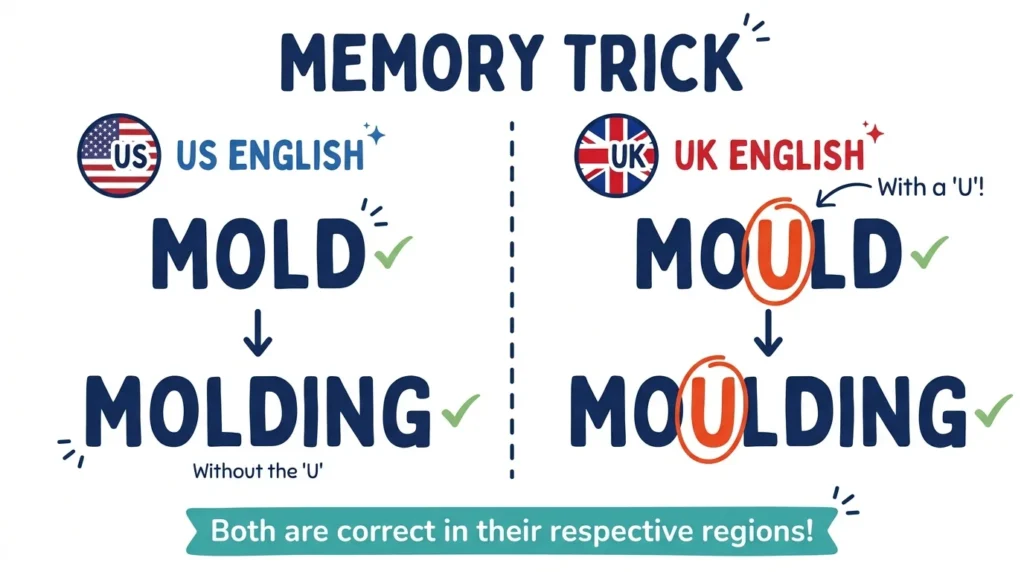
Remember the U.
UK → mould → moulding
US → mold → molding
Or remember the complete chain:
US: MOLD + ING = MOLDING
UK: MOULD + ING = MOULDING
If you can remember mold vs. mould, the answer to molding vs. moulding follows automatically.
Real-Life Situations
Job interview
If you are describing a US manufacturing company:
I worked with a team responsible for injection molding components.
For a British company:
I worked with a team responsible for injection moulding components.
Business meeting
American English:
We need to replace the molding around the entrance.
British English:
We need to replace the moulding around the entrance.
American:
Please confirm whether the new molding matches the approved design.
British:
Please confirm whether the new moulding matches the approved design.
Text message
American:
The new crown molding looks great.
British:
The new crown moulding looks great.
Exam
If the question asks for standard American English, choose molding.
If it asks for standard British English, choose moulding.
Product description
American:
Our decorative molding is made from durable polymer.
British:
Our decorative moulding is made from durable polymer.
Expert Tips
1. Check the base word first
Do not start by wondering whether the ending should contain a u.
Ask:
Am I writing mold or mould?
Then add -ing.
2. Do not change a quotation
If you are quoting an original document, preserve its spelling unless your publication’s editorial policy says otherwise.
A British quotation may contain moulding, while an American writer’s surrounding prose uses molding.
3. Be consistent in technical documents
Manufacturing documents often contain the word many times. A single spelling choice applied consistently is clearer than switching between regional forms.
4. Match your existing style
If the rest of your website uses American spelling, molding will usually fit better.
If the site uses British spelling, moulding will usually fit better.
5. Do not confuse spelling with grammar
Neither form is a separate grammar rule.
The central issue is regional spelling convention.
6. Remember the related forms
Once you choose one system, related words should normally follow it:
American: mold, molded, molding
British: mould, moulded, moulding
7. Let the audience decide
If you are writing for a US customer, use the US form.
If you are writing for a British customer, use the British form.
When the audience is international, choose a consistent house style rather than alternating between the two.
FAQ
Is molding or moulding correct?
Both are correct. Molding is the standard American English spelling, while moulding is the standard British English spelling. The two forms generally have the same meanings and grammatical uses.
Is moulding the British spelling?
Yes. Moulding is the standard British spelling corresponding to American molding. The base-word difference is mould versus mold.
Is molding the American spelling?
Yes. Molding is the standard American spelling corresponding to British moulding.
Is molding a noun or a verb?
It can be both, depending on the sentence. As a noun, it can refer to a decorative architectural feature or a process. It can also function as the -ing form of the verb mold, as in “The experience is molding his character.”
Is moulding a noun or a verb?
It can also function as both a noun and an -ing form of the verb mould. As a noun, it can refer to decorative trim or something shaped through a moulding process.
Is it crown molding or crown moulding?
Use crown molding in American English and crown moulding in British English. Both refer to decorative trim, commonly installed near the top of a wall.
Is it injection molding or injection moulding?
Use injection molding in American English and injection moulding in British English. Both refer to the same manufacturing process.
Do molding and moulding have different meanings?
Generally, no. The spelling difference reflects regional English conventions rather than a different basic meaning. Both can refer to shaping processes, shaped or decorative material, and figurative shaping or influence.
Is moulding wrong in American English?
It is not inherently an invalid English word. It is the British spelling. However, if you are writing consistently in American English, molding is normally the appropriate form.
Is molding wrong in British English?
It is not inherently an invalid English word. It is the American spelling. If you are writing consistently in British English, moulding is normally the appropriate form.
Which spelling should I use on a website?
Use the spelling that matches the English variety and style of your target audience. A US-focused website will normally use molding, while a British-focused website will normally use moulding. The most important principle is consistency.
How can I remember the difference?
Remember:
US = mold = molding
UK = mould = moulding
The base word gives you the spelling of the -ing form.
Mini Quiz
| # | Question | Answer | Explanation |
|---|---|---|---|
| 1 | Which spelling is standard in American English: molding or moulding? | Molding | American English normally uses mold, so the -ing form is molding. |
| 2 | Which spelling is standard in British English: molding or moulding? | Moulding | British English normally uses mould, giving moulding. |
| 3 | Fill in the blank: “The factory specializes in injection ______.” | molding | In American English, the standard phrase is injection molding. |
| 4 | Fill in the blank for British English: “The factory specializes in injection ______.” | moulding | British English uses injection moulding. |
| 5 | Correct the sentence for American English: “The room has beautiful crown moulding.” | The room has beautiful crown molding. | Molding is the American spelling. |
| 6 | Correct the sentence for British English: “The room has beautiful crown molding.” | The room has beautiful crown moulding. | Moulding is the British spelling. |
| 7 | True or false: Molding and moulding normally have different meanings. | False | The main difference is regional spelling, not meaning. |
| 8 | Which base word matches molding? | Mold | The American pair is mold → molding. |
| 9 | Which sentence is consistent American English? A) “The factory uses moulding.” B) “The factory uses molding.” | B | Molding matches the American spelling system. |
| 10 | Which is the best advice for an international website? | Choose a consistent English variety and follow it. | Switching between regional spellings can make the site’s editorial style inconsistent. |
Quick Summary
Molding and moulding are two regional spellings of the same word. Molding is the standard American English form, while moulding is the standard British English form. Both can describe a shaping process, a shaped or decorative feature, or the figurative act of shaping development. The easiest way to remember the difference is to start with the base word: mold → molding and mould → moulding. Neither spelling is inherently more professional or more correct. The important choice is to match your audience, publication style, or regional variety and then remain consistent throughout your writing. In technical phrases such as injection molding/injection moulding and crown molding/crown moulding, the same regional rule applies.