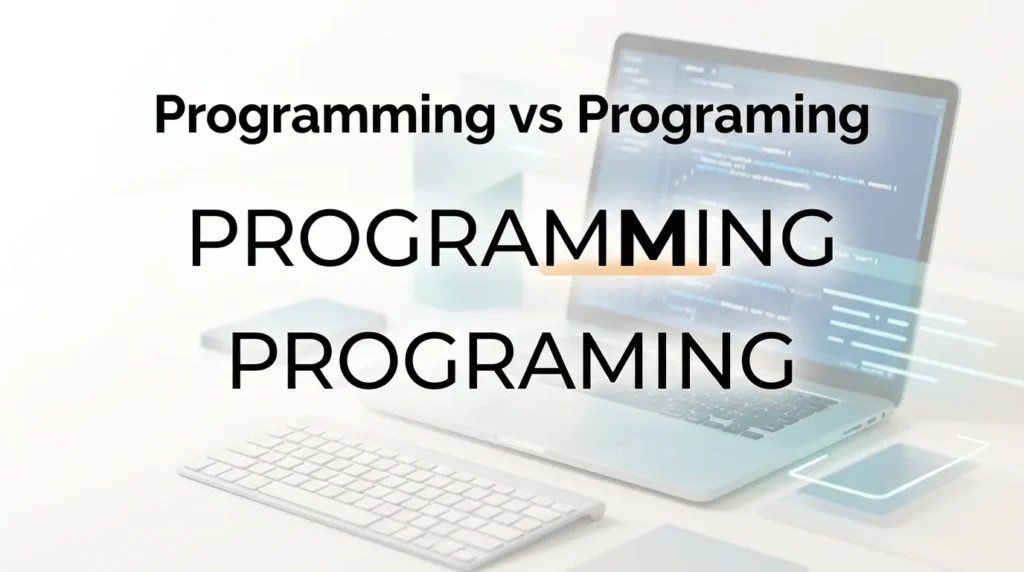

Programming is the spelling you should normally use for the activity of writing computer code, creating software, or planning programs. Programing is also recorded as a variant spelling in some major dictionaries, so it is not simply a meaningless typo. However, programming is far more familiar and is the standard-looking form in modern technical, academic, professional, and everyday writing.
What Is the Difference Between Programming and Programing?
Programming and programing refer to the same basic word: the activity or process of programming.
The important difference is spelling.
- Programming — the widely preferred spelling
- Programing — a recognized but much less common variant
When you are writing about computer science, software development, coding, or programming languages, programming is the form most readers expect.
For example:
She is learning programming.
He has three years of programming experience.
Programming languages help developers create software.
The one-letter difference can be easy to overlook, especially when typing quickly. But if you are writing a résumé, university assignment, technical article, documentation, or professional email, programming is the safest choice.
Dictionary evidence also shows why it is too simplistic to describe programing as a completely nonexistent word. Dictionary.com identifies programing as a variation of programming, while American Heritage lists both forms.
Why Does Programming Have Two Ms?
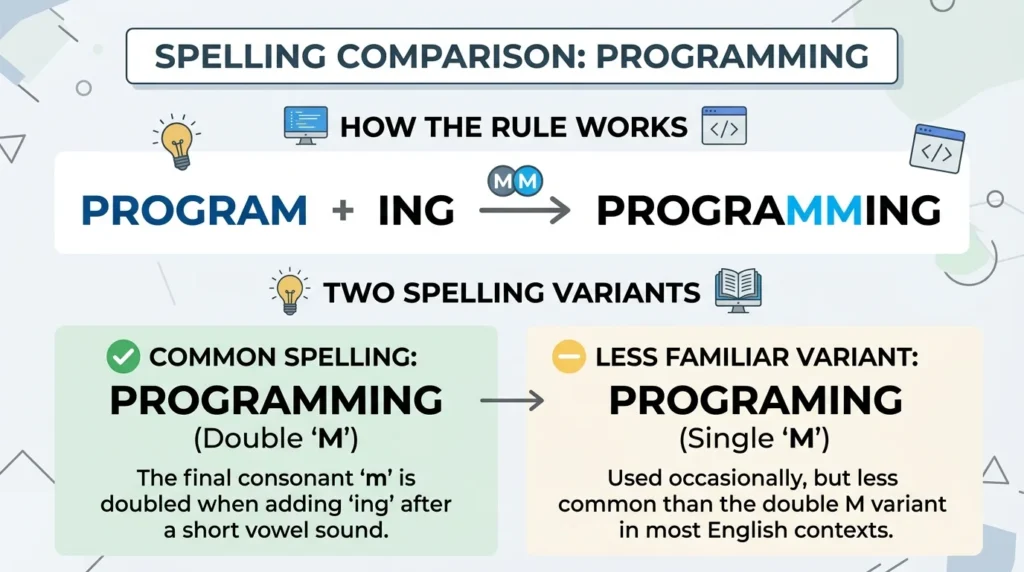
The word programming comes from the verb program plus the ending -ing.
The spelling is:
program + ing → programming
The final m is doubled.
This resembles a broader English spelling pattern in which a final consonant can be doubled when a suffix beginning with a vowel is added.
For example:
- run → running
- sit → sitting
- stop → stopping
- plan → planning
- begin → beginning
- program → programming
However, English spelling rules are not completely mechanical. Consonant doubling depends on factors such as syllable structure, stress, pronunciation, word history, and established spelling conventions.
So it is better not to memorize an oversimplified rule such as “every word ending in a consonant doubles it.”
For program, the established standard form is:
programming
The single-m form, programing, exists as a variant, but it is much less familiar to modern readers.
The Core Rule
For modern general, academic, and technical writing, use programming when you mean the activity of writing or developing programs.
A useful practical rule is:
program → programming
not:
program → programing
Although programing can be found in dictionaries and real-world published usage, choosing programming avoids unnecessary confusion and matches the form readers are most accustomed to seeing.
How to Use Programming
Programming can refer to several related activities.
Programming in Computer Science
This is the meaning most people think of today.
Programming is the process of writing instructions that computers can execute.
Examples:
- I am studying programming.
- She teaches programming at the university.
- Programming requires logical thinking.
- He wants to improve his programming skills.
- Python is a popular language for programming.
Programming as a General Activity
The word can also refer to planning or organizing a set of programs or activities.
For example:
The network changed its programming for the holiday season.
The festival’s programming includes films from several countries.
So programming is not limited to computer code.
Programming as a Job Skill
You will also see the word frequently in professional contexts:
- programming skills
- programming experience
- programming language
- programming course
- programming career
- programming education
- computer programming
- software programming
In these phrases, programming is the normal form readers expect.
Correct Examples
Here are examples from different areas of everyday writing.
Conversation
I’m learning programming because I want to build my own apps.
I have completed the programming course you recommended.
School
Our computer science teacher introduced us to programming this semester.
University
The assignment tests our understanding of object-oriented programming.
Workplace
We need someone with strong programming and problem-solving skills.
Résumé
Five years of professional programming experience.
Job Interview
My main programming experience is with Python and JavaScript.
Social Media
I’m spending this weekend learning programming instead of watching movies.
Academic Writing
Programming education can help students develop structured approaches to problem-solving.
Technical Writing
The application requires programming knowledge and basic database skills.
Everyday Technology
Programming allows developers to create instructions that computers can execute.
Incorrect vs. Correct
| ❌ Incorrect or less suitable | ✅ Preferred | Why |
|---|---|---|
| I am learning programing. | I am learning programming. | Programming is the familiar standard form. |
| She teaches programing. | She teaches programming. | The double-m spelling is the normal modern form. |
| He has strong programing skills. | He has strong programming skills. | Technical writing overwhelmingly favors programming. |
| I want a career in programing. | I want a career in programming. | Programming is the expected spelling in career contexts. |
| This programing course is difficult. | This programming course is difficult. | The established technical term is programming course. |
| We study computer programing. | We study computer programming. | Computer programming is the conventional phrase. |
| He enjoys programing in Python. | He enjoys programming in Python. | Programming is the familiar form in computing. |
| The company needs programming experience. | The company needs programming experience. | The double-m form is preferred for professional use. |
| She wrote about programing languages. | She wrote about programming languages. | Programming language is the established expression. |
| I am improving my programing skills. | I am improving my programming skills. | Programming skills is the conventional phrase. |
Important: The left-hand side should not always be understood as “a word that does not exist.” Programing is documented as a variant spelling. The practical distinction is that programming is the much more familiar and conventional choice.
Read More: Receive vs Recieve: Correct Spelling and Examples.
Why Do People Make This Mistake?
The spelling looks as though it should be straightforward, but several things can cause confusion.
Phonetic Similarity
When you pronounce programming, the two Ms are not heard as two separate sounds.
The word sounds roughly like:
program-ing
There is no obvious pronunciation clue telling you that the spelling needs two Ms.
This makes it easy to write the word with only one.
Spelling Overlap
Many English words add -ing without doubling the final consonant.
For example:
- open → opening
- visit → visiting
- develop → developing
- listen → listening
A learner may therefore assume:
program + ing = programing
The spelling looks logical, even though programming is the established preferred form.
Overgeneralising Spelling Rules
The opposite mistake can happen too.
Someone may learn a rule about doubling consonants and try to apply it mechanically to every word.
English spelling does not work that neatly. The doubling of consonants depends on the structure and history of individual words.
Autocomplete and Spellcheck
Digital tools can add another layer of confusion.
A spellchecker may recognize programing as a variant, fail to flag it in a particular dictionary configuration, or suggest programming depending on the language settings.
A tool’s response is useful, but it should not replace knowledge of standard usage.
Translation Interference
Learners who know another language may have encountered a spelling pattern in which suffixes are added without changing the final consonant.
When they transfer that pattern into English, programing can feel perfectly natural.
The solution is to learn the complete English form rather than trying to translate the spelling rule directly.
Common Mistakes Checklist
Mistake 1: Writing Programing in Professional Documents
Problem: The single-m spelling can look unfamiliar to readers.
Why it happens: The pronunciation does not make the doubled consonant obvious.
Avoid it: Use programming in résumés, reports, assignments, websites, and business communication.
Mistake 2: Assuming Programing Is a British Spelling
Problem: Writers sometimes believe American English uses programming while British English uses programing.
Why it happens: British and American English have many genuine spelling differences.
Avoid it: Do not treat programing as the British equivalent of programming. The double-m form is used in both varieties.
Mistake 3: Writing Programmeing
Problem: A writer may see programme in British English and attempt to create programmeing.
Why it happens: British English uses programme in several non-computing contexts.
Avoid it: In computing, the verb is program, giving programming.
Mistake 4: Calling Programing Completely Wrong
Problem: This statement is too absolute.
Why it happens: Programming is so much more common that the variant is easy to overlook.
Avoid it: Understand the distinction between recognized and preferred. Major dictionary sources record programing as a variant, but programming is the safer modern default.
Mistake 5: Mixing Spellings
Problem: A document may use programing in one place and programming elsewhere.
Why it happens: Different sources, editors, or software tools may use different spelling preferences.
Avoid it: Pick programming and use it consistently.
Programming in Real English
Grammatically correct and natural
Programming is completely natural when referring to writing computer code or developing software.
She is studying programming.
He works in programming.
Programming languages are used to create software.
These expressions fit normal educational, technical, and professional English.
Grammatically possible but less familiar
Programing can appear in real published material because it is recorded as a variant spelling.
That does not make it the best choice for every audience. A reader may understand it immediately, but the single-m spelling is considerably less familiar than programming. Dictionary sources explicitly record programing as a variant rather than treating it as a separate meaning.
Read More: Rumor vs Rumour: Which Spelling Is Correct?
Natural everyday choice
If you want your writing to look conventional to the widest audience, choose programming.
For example:
I am learning programming.
This is more immediately familiar than:
I am learning programing.
The difference is small, but spelling familiarity matters in professional and educational writing.
American vs. British English
There is no useful American-versus-British split in which American English uses programing and British English uses programming.
The more important regional distinction concerns program and programme.
| Meaning | American English | British English |
|---|---|---|
| Computer software | program | program |
| Writing computer code | programming | programming |
| Person who writes code | programmer | programmer |
| Television schedule | program | programme |
| Organized activity or initiative | program | programme is common |
For computer-related writing, programming is the form to use in both American and British English.
Do not change it to programing simply because you are writing for an American audience.
Likewise, do not write programmeing because you are writing for a British audience.
The computing forms are:
program → programming → programmer
Formal vs. Informal Usage
The spelling choice matters most in formal or professional writing.
Formal and professional writing
Use programming in:
- academic papers
- résumés
- cover letters
- job applications
- technical documentation
- business reports
- university assignments
- professional websites
- software documentation
Example:
I have extensive programming experience in Python and JavaScript.
Informal writing
In casual communication, people may encounter programing as a variant or typo.
For example, someone might write:
I’m learning programing right now.
The meaning is still clear.
However, informal communication does not make the spelling more useful. If you are choosing the form yourself, programming remains the better default.
Programming vs. Programing Comparison Table
| Feature | Programming | Programing |
|---|---|---|
| Number of Ms | Two | One |
| Meaning | Programming activity/process | Same basic meaning |
| Dictionary status | Established standard form | Recorded variant |
| Modern familiarity | Very high | Much lower |
| Technical writing | Preferred | Usually avoided |
| Academic writing | Preferred | Usually avoided |
| Professional writing | Preferred | Usually avoided |
| American English | Used | Variant recorded |
| British English | Used | Not a standard regional replacement |
| Best default for learners | Yes | No |
The key point is not that programing has no existence at all. It is that programming is the form most readers expect and the form you should normally choose.
Read More: Authorization vs Authorisation: Which Is Correct?
Program vs. Programme: A Related Spelling Trap
The word program creates another source of confusion because British English sometimes uses programme.
For example, British English commonly uses:
television programme
training programme
cultural programme
American English generally uses:
television program
training program
cultural program
But computing is different.
In both major varieties of English, the usual computing noun is:
computer program
And the activity is:
computer programming
So this is correct:
She is learning computer programming.
Not:
She is learning computer programmeing.
The existence of programme in British English does not mean that programing is the British version of programming.
Real-Life Situations
Job Interview
Interviewer: What technical skills do you have?
Candidate: I have three years of programming experience, mainly in Python.
The double-m spelling is appropriate in professional speech transcripts and written descriptions of the candidate’s experience.
University Assignment
This paper examines how programming education can improve computational thinking among students.
The spelling programming fits formal academic writing.
Workplace Email
I have completed the programming task and attached the updated file.
Again, programming is the natural professional choice.
Text Message
I’m learning programming this month.
Even in casual communication, there is no reason to prefer the less familiar variant.
Social Media
Six months of programming, dozens of bugs, and one very satisfying app launch.
The spelling remains programming regardless of the informal tone.
Résumé
Programming Languages: Python, JavaScript, Java, C++
This is the expected professional spelling.
Memory Trick
Use this simple mnemonic:
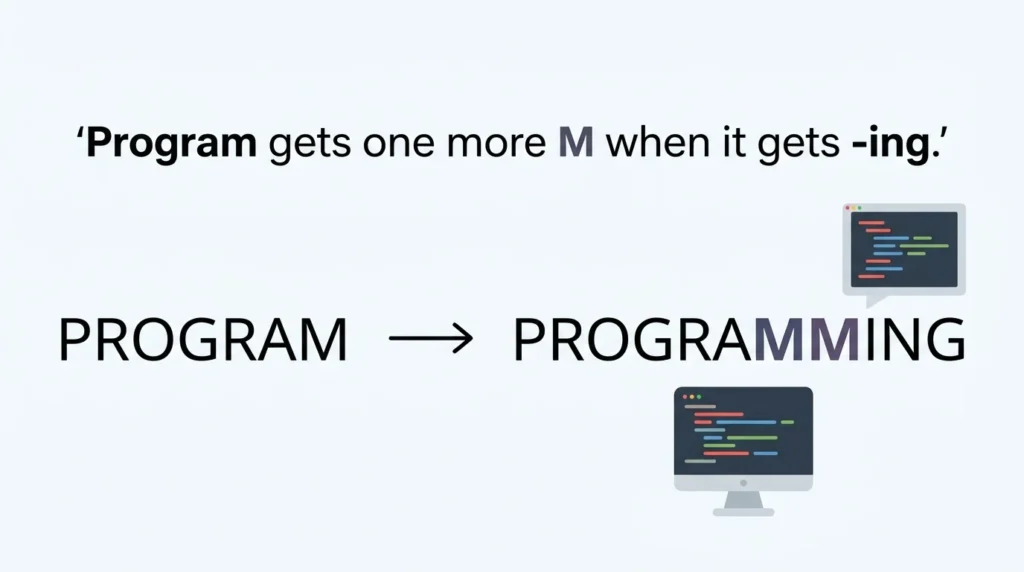
Program gets one more M when it gets -ing: program → programming.
Or remember:
One program, two Ms when programming.
Think of the extra m as the small addition that turns the base word into the familiar activity:
program → programming
Expert Tips
1. Learn the whole word, not just the rule
Instead of repeatedly asking whether the final m should double, memorize:
programming
You will see the word often enough that its visual pattern becomes familiar.
2. Remember the phrase “programming language”
If you work with technology, learn this phrase as a unit:
programming language
not:
programing language
This makes the spelling easier to recall.
3. Do not assume every dictionary-listed variant is equally useful
A dictionary can record more than one spelling without suggesting that both are equally common or equally appropriate for every situation.
That distinction is especially important for learners.
4. Check the audience, not just the dictionary
If you are writing for developers, students, employers, teachers, or international readers, the familiar form is usually the most practical.
That means:
programming
5. Be careful with absolute grammar claims
It is tempting to say:
“Programing is always wrong.”
That is not sufficiently precise because dictionary sources record it as a variant. A more accurate statement is:
Programming is the preferred and much more familiar spelling for modern general and technical writing.
Read More: Heros vs Heroes: Which Spelling Is Correct?
FAQ
Is programming or programing correct?
Programming is the preferred spelling for modern general, academic, professional, and technical writing. Programing is also recorded as a variant spelling in some dictionaries, but it is much less common.
Is programing a misspelling?
Not necessarily. Some dictionaries recognize programing as a variant of programming. However, because programming is much more familiar, using programing can look like a spelling mistake to many readers.
Why does programming have two Ms?
The established spelling doubles the final m when the suffix -ing is added to program:
program + ing = programming
The spelling follows established English word-formation conventions.
Is programing used in American English?
Yes. Some American dictionary sources recognize programing as a variant. However, programming is the much more familiar form and is the better default for American English writing.
Is programing British English?
No. It should not be treated as the British equivalent of programming. British English also uses programming for computer programming.
Is programming the correct spelling for computer science?
Yes. Programming is the normal spelling in computer science, software development, education, and technical communication.
Should I write programming on my résumé?
Yes. Programming is the clearest and most familiar choice for a résumé, CV, portfolio, or job application.
Is programmeing correct?
No. Programmeing is not the normal spelling for computer programming. In computing, the base word is program, giving programming.
What is the difference between program and programming?
Program can be a noun referring to software or a plan, while programming can refer to the activity or process of writing programs. For example: “I installed a program” and “I am learning programming.”
Does programming mean only computer coding?
No. Programming can also refer to planning or selecting programs, such as television programming, event programming, or other organized activities.
Which spelling should ESL learners memorize?
Memorize programming with two Ms. It is the most familiar and practical form for modern English writing.
Quick Summary
Programming is the preferred spelling when you mean the activity of writing computer code, developing software, or creating programs. It is written with two Ms: program + ing = programming. Programing, with one m, is not simply a meaningless typo; some dictionaries record it as a variant spelling. However, it is much less familiar, so programming is the safer choice for academic, professional, technical, and everyday writing. There is also no useful American-versus-British distinction in which one variety requires programing. For computer-related writing, both use programming. If you are unsure, remember the simplest rule: program → programming.
Mini Quiz
| # | Question | Answer | Explanation |
|---|---|---|---|
| 1 | Which spelling is the preferred modern form? A) programing B) programming | B) programming | Programming is the much more familiar and preferred form. |
| 2 | Complete the sentence: “She is learning ______.” | programming | The standard preferred form is programming. |
| 3 | Which is better for a résumé? A) programing experience B) programming experience | B) programming experience | Programming experience is the conventional professional phrase. |
| 4 | Correct the sentence: “He has five years of programing experience.” | He has five years of programming experience. | Programming is the preferred modern spelling. |
| 5 | Is programing completely nonexistent in English? | No. | Some dictionaries record it as a variant spelling. |
| 6 | Complete: “Python is a popular ______ language.” | programming | The established phrase is programming language. |
| 7 | Which spelling is normally used in British English for computer coding? A) programing B) programming C) programmeing | B) programming | British English uses programming for this computing meaning. |
| 8 | Correct the sentence: “I am taking a programmeing course.” | I am taking a programming course. | The computing verb is program, producing programming. |
| 9 | True or false: “Programing is simply the British spelling of programming.” | False | It is not a British-American spelling distinction. |
| 10 | Which is the best spelling to memorize? A) programing B) programming | B) programming | It is the more familiar and practical default for modern writing. |
Final Takeaway
If you are deciding between programming and programing, use:
Programming
It is the form readers are most accustomed to seeing, especially in computer science, education, professional writing, and technical communication.
The useful spelling is:
program → programming
The single-m form does exist as a dictionary-recorded variant, so calling it universally nonexistent would be inaccurate. But when you are writing for a modern audience and want the familiar standard form, programming is the clear practical choice.