

Enable is the correct modern English verb when you mean “make something possible,” “give someone the means to do something,” or “activate a feature.” Inable should not be used in normal modern English. Although historical records show obsolete and nonstandard uses of inable, modern writers should choose enable for “make possible” or unable for “not able.”
What Is Enable vs Inable?
Enable is a transitive verb. In plain English, that means it normally acts on a person, thing, feature, or situation.
It can mean to give someone the ability or opportunity to do something, make an action possible, or cause a feature or system to operate.
For example:
Better software can enable employees to work remotely.
Here, the software makes remote work possible.
Inable looks as though it should belong to the same word family, but it is not the form normally used in present-day standard English. Historical sources record inable as an obsolete or later nonstandard form that could mean either “unable” or “enable.” For ordinary writing today, using it will usually look like a spelling error.
If your intended meaning is not able, write unable:
I am unable to attend the meeting.
If your intended meaning is make possible, write enable:
This update will enable faster payments.
Why It Matters
Confusing enable, inable, and unable can change your meaning rather than merely create a small spelling mistake.
Compare these ideas:
The training enabled her to lead the project.
This means the training gave her the ability, knowledge, or opportunity to lead it.
She was unable to lead the project.
This means she could not lead it.
Writing inable in either sentence may force the reader to guess which meaning you intended.
That matters in emails, reports, academic assignments, instructions, job applications, customer support messages, and technical documentation. A small spelling choice can make otherwise professional writing look uncertain.
The Core Rule
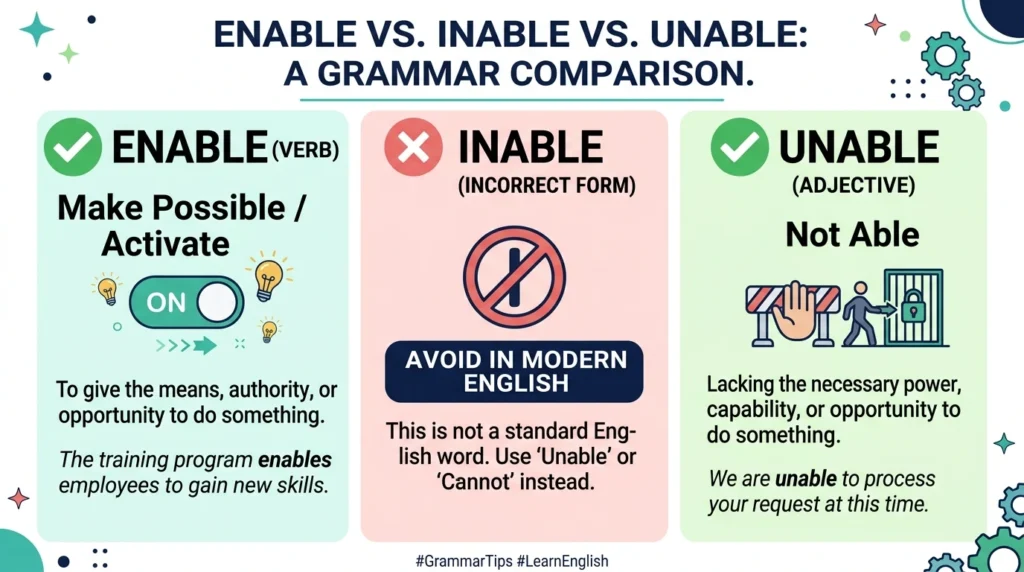
Rule: Use enable when something makes an action possible. Use unable when someone or something cannot do an action. Avoid inable in modern standard English.
Remember the grammatical difference too:
Enable = verb
Unable = adjective
Inable = obsolete/nonstandard form that you should normally avoid
Read More: Vinal vs Vinyl: Which Spelling Is Correct?
How to Use Enable, Unable, and Inable
Use Enable When Something Makes an Action Possible
The common structure is:
enable + person/thing + to + verb
Examples:
The scholarship enabled Maya to continue her studies.
This option enables users to control notifications.
New equipment will enable the factory to increase production.
Because enable is a transitive verb, it commonly takes an object such as users, students, employees, or the system.
A reliable pattern is:
Something + enables + someone/something + to do something
Use Enable for Technology and Features
In technology, enable frequently means to activate or make a function operational.
Examples:
Enable Bluetooth before connecting the headphones.
You must enable location access to use this feature.
The administrator enabled two-factor authentication.
This meaning is closely related to the broader idea of “making possible.”
Use Unable When Someone Cannot Do Something
Unable is an adjective meaning “not able” or “incapable of doing something.”
A common structure is:
be + unable + to + verb
Examples:
I am unable to open the file.
They were unable to reach an agreement.
The system is unable to process the request.
Notice that unable normally appears with a form of be:
- am unable
- is unable
- are unable
- was unable
- were unable
- has been unable
Avoid Inable in Modern Writing
You may occasionally find inable in historical texts, old dictionaries, informal writing, or spelling mistakes.
That does not make it a good choice for modern business, academic, educational, or everyday writing.
Use:
enable = make possible
unable = not able
Do not normally use:
inable
Four Steps for Choosing the Right Word
- Ask whether you mean make possible or not able.
- Choose enable for “make possible.”
- Choose unable for “not able.”
- Treat inable as a form to avoid in present-day standard English.
Correct Examples
The following examples show how enable and unable work across different situations.
- Conversation: A quieter room would enable me to concentrate better.
- Email: Please enable editing access before sending the document again.
- School: The extra tutoring enabled Carlos to understand the algebra lesson.
- Workplace: The new dashboard enables managers to monitor sales in real time.
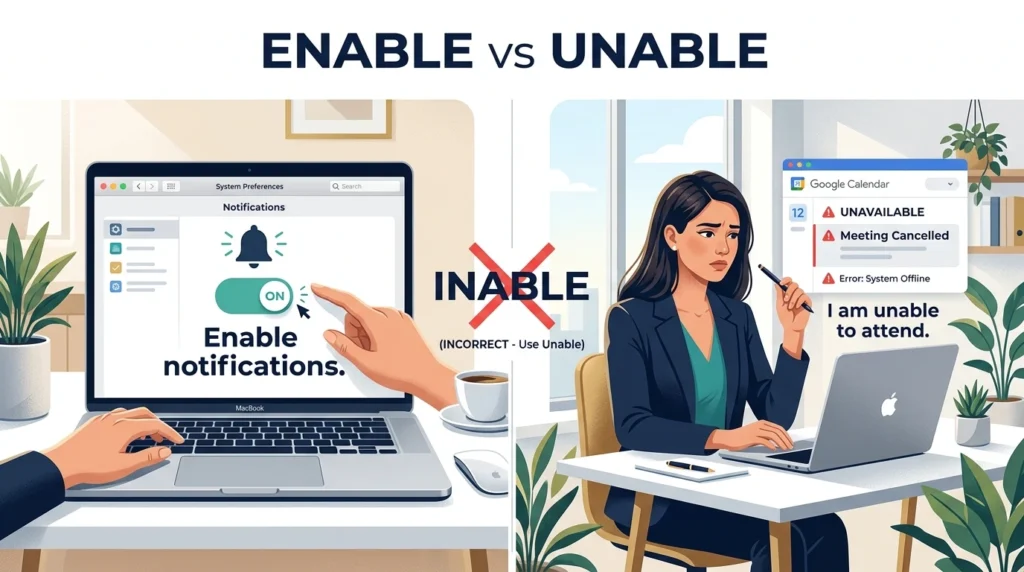
- Technology: Enable notifications if you want to receive security alerts.
- Social media: This privacy setting enables you to limit who can comment.
- Academic writing: The new methodology enables researchers to compare larger datasets.
- Customer service: We are currently unable to process international payments.
- Meeting: I will be unable to join the call before 3 p.m.
- Job application: My previous experience enabled me to develop strong project-management skills.
- Everyday English: The ramp enables wheelchair users to enter the building more easily.
- Technical writing: Administrators can enable or disable the feature from the control panel.
Incorrect vs. Correct
| ❌ Incorrect | ✅ Correct | Why |
|---|---|---|
| The software will inable remote access. | The software will enable remote access. | The meaning is “make remote access possible,” so the verb enable is required. |
| I am inable to attend today. | I am unable to attend today. | The sentence means “I am not able,” which requires the adjective unable. |
| This tool enable users to edit files. | This tool enables users to edit files. | The singular subject tool requires the third-person singular form enables. |
| The update enables to save files automatically. | The update enables users to save files automatically. | Enable commonly needs an object before the to-infinitive. |
| She was enable to finish the test. | She was able to finish the test. | After was, use the adjective able, not the verb enable. |
| We are enable to access the account. | We are able to access the account. | Are able to describes capability. Enable is a verb with a different structure. |
| The grant unable them to continue the research. | The grant enabled them to continue the research. | The grant made continued research possible, so enabled is the correct verb. |
| Please inable the camera permission. | Please enable the camera permission. | Activating a setting requires enable. |
| The server is enable to connect. | The server is able to connect. | After is, able describes the server’s capability. |
| The server is inable to connect. | The server is unable to connect. | The intended meaning is “not able to connect.” |
Why People Make This Mistake
Phonetic Similarity
Enable is pronounced roughly like ih-NAY-buhl.
Because the first vowel is unstressed, some learners may hear the beginning as in- rather than en-.
That makes inable look like a reasonable spelling based on sound alone.
English Uses the Prefix In- for Many Negative Words
- incomplete
- inaccurate
- incapable
- indirect
- inactive
English contains words such as:
A learner may therefore reason:
able → inable
The logic seems reasonable, but English vocabulary does not always form opposites with the same prefix.
The standard adjective is:
able → unable
The Word Inability Makes Inable Look Logical
This is one of the strongest causes of the confusion.
English uses:
able → unable
but:
ability → inability
Inability is a standard noun meaning lack of ability or capacity. Its history comes through a different word-formation path, which is one reason the modern forms do not create a perfectly regular pair.
So these are correct:
Her inability to sleep affected her concentration.
She was unable to sleep.
But this is not normal modern English:
She was inable to sleep.
Spelling Overlap
All three forms contain the visible sequence able:
enable
unable
inable
Because only the beginning changes, writers typing quickly may select the wrong prefix.
Overgeneralisation
English learners naturally try to apply familiar rules to unfamiliar words.
If in- means “not” in inactive, incorrect, and incomplete, it is reasonable to predict inable.
The problem is that vocabulary develops historically rather than according to one perfectly consistent modern formula.
Autocomplete and Spellcheck Have Limits
Typing tools can catch many errors, but they should not replace knowledge of meaning.
A rare, historical, brand-specific, proper-name, or user-added form may escape correction. A suggestion may also fail to tell you whether you actually meant enable, able, or unable.
Translation Interference
Some languages form negatives more predictably than English.
A learner may translate the idea of “not able” by attaching a familiar negative prefix to able. English instead uses the established adjective unable.
Common Mistakes Checklist
Before using enable, check for these common problems:
- Writing “inable” when you mean “unable.” If the meaning is “cannot,” use unable.
- Writing “inable” when you mean “enable.” If something makes an action possible or activates a function, use enable.
- Using “enable” after a form of “be” to describe ability. Write I am able, not I am enable.
- Dropping the object from the usual enable pattern. Prefer The feature enables users to download files rather than The feature enables to download files.
- Forgetting subject-verb agreement. Write This feature enables users, but These features enable users.
- Confusing unable with disable. Unable describes a lack of ability. Disable is a verb meaning to make something inactive or incapable of operating.
- Assuming every negative English word takes in-. Prefix choice depends on the established word, not a single universal formula.
- Assuming inability proves that inable must be standard. English uses inability as the noun but unable as the ordinary negative adjective.
Enable vs Inable in Real English
Grammatically Correct English
In current standard English, sentences such as “The software enables users to collaborate” and “I am unable to attend” are grammatically correct and natural. Enable functions as a verb while unable functions as an adjective. When enable introduces another action performed by a person or thing, the pattern enable + object + to + verb is especially common and clear.
Grammatically Possible but Unnatural English
A sentence can sometimes be technically understandable without sounding like the wording most people would choose. For example, “The button enables the opening of the menu” is possible, but “The button enables users to open the menu” or simply “The button opens the menu” is clearer. Good English is not only about avoiding grammatical errors; it is also about choosing structures that fit the situation naturally.
Natural Everyday English
In casual conversation, people often use can, can’t, let, or allow where formal writing might use able, unable, or enable. Someone may say “I can’t come tonight” instead of “I am unable to attend tonight.” Likewise, “This app lets you share files” often sounds more conversational than “This app enables you to share files.” Both can be correct; the difference is usually register and emphasis.
Formal vs. Informal Usage
Enable is common in professional, academic, business, technical, and instructional writing because it precisely expresses the idea of providing the means or conditions for something to happen.
The funding will enable the organization to expand its services.
In everyday speech, let, allow, help, or make it possible may sound more relaxed.
This app lets me work from home.
Unable is also slightly more formal than can’t in many situations.
Formal:
We are unable to approve the request.
Conversational:
We can’t approve the request.
Neither version is automatically better. Choose the one that matches the situation.
Read More: Descision vs Decision: Which Spelling Is Correct?
Enable vs Inable vs Unable Comparison Table
| Feature | Enable | Inable | Unable |
| Modern status | Standard English | Obsolete/nonstandard | Standard English |
| Main part of speech | Verb | Historical adjective/verb uses | Adjective |
| Basic meaning | Make possible, activate, give means | Historically “unable” or “enable” | Not able |
| Example | The tool enables sharing. | Avoid in modern writing. | I am unable to log in. |
| Common in technology | Yes | No | Yes, when describing failure/capability |
| Used after “am/is/are” for personal ability | No | No | Yes |
| Can mean activate a setting | Yes | No in standard usage | No |
| Opposite relationship | Often contrasts with disable | — | Contrasts with able |
| Recommended today | Yes | No | Yes |
An important distinction is that disable, rather than unable, is often the direct verb opposite of enable, especially when discussing systems or features.
Enable Bluetooth.
Disable Bluetooth.
By contrast:
Bluetooth is unable to connect.
Here, unable describes a condition rather than the action of switching something off.
Memory Trick
Use this simple mnemonic:
ENable = ENters into action. UNable = UNsuccessful at doing it.
Think of EN in enable as helping something enter action.
Think of UN in unable as meaning not able.
Then remember:
INable stays IN the history books, not in normal modern writing.
Real-Life Situations
Interview
Correct: My previous role enabled me to develop strong leadership skills.
Here, your previous role provided the experience that made skill development possible.
Meeting
Correct: Priya is unable to join the meeting this morning.
The sentence describes Priya’s lack of availability or ability to join.
Correct: Could you enable access to the shared folder?
You are asking someone to activate or grant access.
Text Message
Natural: I can’t come tonight.
More formal: I am unable to come tonight.
Both communicate the same basic idea, but the first is more conversational.
Exam
Question:
The new laboratory will ___ students to conduct advanced experiments.
Correct answer:
enable
The laboratory makes the experiments possible.
Expert Tips
Do Not Treat Enable and Able as Interchangeable
Compare:
I am able to drive.
The lessons enabled me to drive confidently.
Able describes capability.
Enable describes what creates or supports that capability.
Learn the Whole Pattern
Instead of memorizing only the word enable, remember:
enable someone to do something
That makes errors such as enable someone do something easier to notice.
Use Unable for States, Not Actions
Unable describes a state:
The printer is unable to connect.
It does not mean that someone actively switched the printer off.
If someone turns a function off, disable may be the better verb:
The administrator disabled printing.
Do Not Build Vocabulary Only from Prefix Rules
Prefixes are useful clues, not perfect equations.
English has:
unable
inability
disable
enable
Learning each established word as part of a word family is safer than assuming one prefix works everywhere.
Check Meaning Before Correcting Spelling
When you see inable, first determine what the writer meant.
If the intended meaning is not able, replace it with unable.
If the intended meaning is make possible, replace it with enable.
That prevents a spelling correction from accidentally changing the meaning.
Read More:
FAQ
Is Inable a Word?
Inable has historical and nonstandard uses, so saying that it has never existed is too absolute. However, it is not the form you should normally use in modern standard English. Historical references record it as an obsolete form meaning either unable or enable. In current writing, choose enable or unable according to your intended meaning.
Is It Inable or Unable?
Use unable when you mean “not able.”
Correct:
I am unable to attend.
Avoid:
I am inable to attend.
Is It Inable or Enable?
Use enable when you mean “make possible,” “give the means to,” or “activate.”
Correct:
The setting will enable automatic updates.
Avoid inable in ordinary modern writing.
Why Is It Unable but Inability?
The two words developed through different historical word-formation patterns. Modern English settled on unable as the adjective while inability became the standard noun. Inability entered English through forms connected with Latin in- plus ability. English therefore does not produce a perfectly symmetrical able/inable pair.
What Is the Difference Between Enable and Able?
Able is an adjective describing capability:
She is able to swim.
Enable is a verb describing what gives or creates capability:
The lessons enabled her to improve her swimming.
What Is the Opposite of Enable?
In many contexts, especially technology, disable is the direct verb opposite of enable.
Enable notifications.
Disable notifications.
Unable is different because it is an adjective describing a lack of ability.
Does Enable Mean Allow?
Sometimes their meanings overlap, but they are not identical in every situation.
Allow often focuses on permission:
The teacher allowed us to leave early.
Enable often focuses on providing the means, conditions, or capability:
The new equipment enabled us to finish faster.
Can Enable Mean Turn On?
Yes, especially in technology.
You can:
enable Wi-Fi
enable notifications
enable permissions
enable two-factor authentication
In these contexts, enable means to activate or make a function operational.
Is “Enable Me to” Correct?
Yes.
Enable + object + to + verb is a standard structure.
The scholarship enabled me to attend university.
Here, me is the object and to attend describes what became possible.
Can I Say “I Am Enable to Do It”?
No.
Use:
I am able to do it.
If you mean the opposite:
I am unable to do it.
Enable is a verb, so it does not replace the adjective able in this structure.
What Is the Noun Form Related to Unable?
The standard noun is inability.
His inability to concentrate affected his work.
Do not assume that because inability is correct, inable must also be the standard adjective. The standard adjective is unable.
Should I Ever Use Inable in Professional Writing?
Normally, no. Use inable only if you are deliberately discussing historical language, quoting an older source, studying obsolete vocabulary, or explaining the spelling itself.
For modern professional, academic, business, or everyday communication, choose enable or unable.
Mini Quiz
| # | Question | Answer | Explanation |
| 1 | Fill in the blank: This feature will ___ users to save time. | enable | The feature makes saving time possible. |
| 2 | Fill in the blank: I am ___ to access my account. | unable | The meaning is “not able.” |
| 3 | Which is correct: inable or enable for activating Bluetooth? | enable | Enable can mean activate a function. |
| 4 | Correct the sentence: “She was enable to finish early.” | She was able to finish early. | After was, use the adjective able. |
| 5 | Choose the correct sentence: A) The grant enabled us to expand. B) The grant inabled us to expand. | A | Enabled is the standard past-tense verb. |
| 6 | Fill in the blank: The technicians were ___ to identify the problem. | unable | The technicians could not identify it. |
| 7 | Correct the sentence: “This software enables to edit photos.” | This software enables users to edit photos. | The usual structure is enable + object + to + verb. |
| 8 | Which word is the standard noun: unability or inability? | inability | Inability is the established modern noun meaning lack of ability. |
| 9 | Which is the better opposite of enable in “___ notifications”: unable or disable? | disable | Enable and disable are contrasting verbs in this technical context. |
| 10 | Correct the sentence: “I am inable to reply today.” | I am unable to reply today. | Unable is the standard adjective meaning “not able.” |
Quick Summary
Enable and inable are not interchangeable in modern English. Enable is a standard verb meaning to make something possible, provide the means or opportunity to act, or activate a function. Unable is the standard adjective meaning “not able.” Although inable has appeared historically as an obsolete or nonstandard form, it should normally be avoided in present-day writing. Use the pattern enable + object + to + verb, as in “The software enables users to work remotely.” Use be unable to + verb when someone or something cannot perform an action. Remember that English uses unable but inability, so prefix patterns are not always perfectly regular. When in doubt, choose enable for possibility and unable for inability.